



Community hub
Recent from talks
Knowledge base stats:
Talk channels stats:
Members stats:
Rediscovery of Sargon II
Sargon II ruled the Neo-Assyrian Empire from 722 to 705 BC as one of its most successful kings. In his final military campaign, Sargon was killed in battle in the south-eastern Anatolian region Tabal and the Assyrian army was unable to retrieve his body, which meant that he could not undergo the traditional royal Assyrian burial. In ancient Mesopotamia, not being buried was believed to condemn the dead to becoming a hungry and restless ghost for eternity. As a result, the Assyrians believed that Sargon must have committed some grave sin in order to suffer this fate. His son and successor Sennacherib (r. 705–681), convinced of Sargon's sin, consequently spent much effort to distance himself from his father and to rid the empire from his work and imagery. Sennacherib's efforts led to Sargon only rarely being mentioned in later texts. When modern Assyriology took form in Western Europe in the 18th century, historians mainly followed the writings of classical Greco-Roman authors and the descriptions of Assyria in the Hebrew Bible for information. Given that Sargon is barely mentioned in either, he was consequently forgotten, the then prevalent historical reconstructions placing Sennacherib as the direct successor of Sargon's predecessor Shalmaneser V and identifying Sargon as an alternate name for one of the more well-known kings.
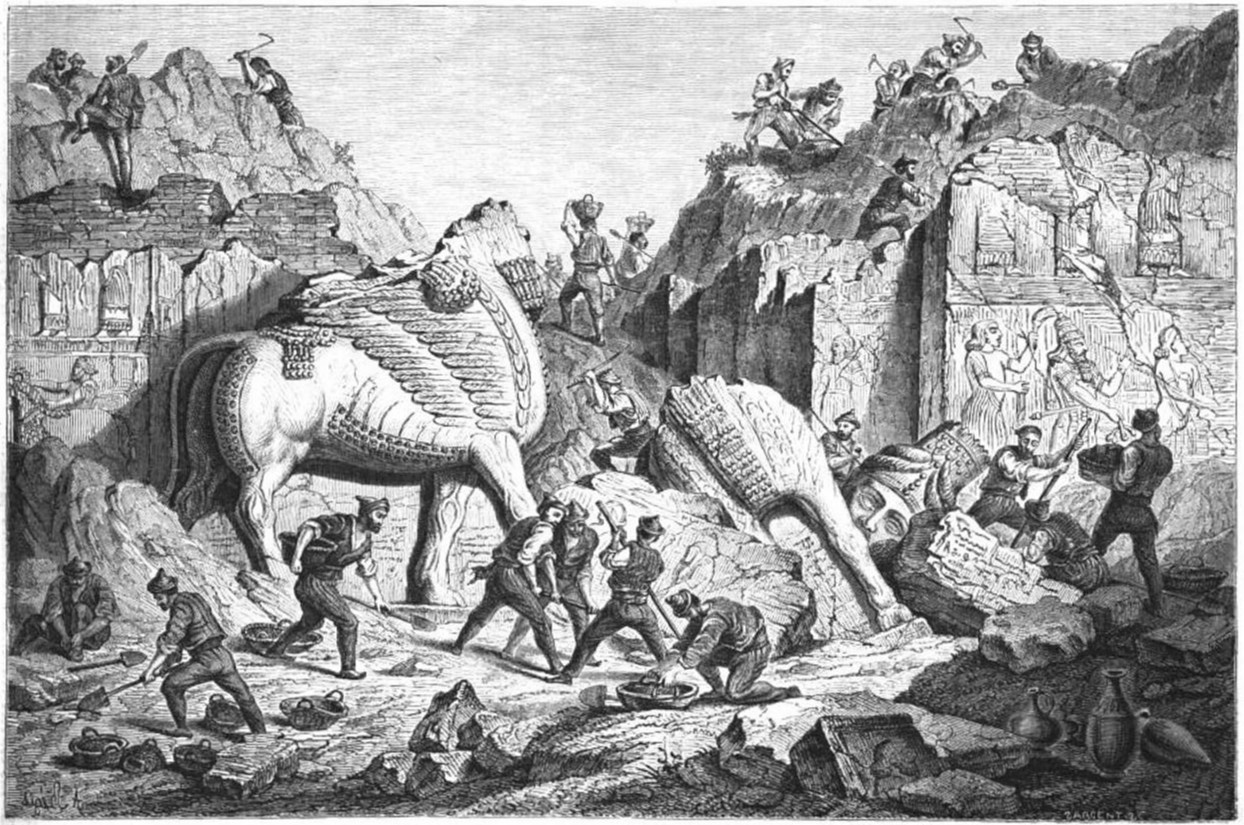
After centuries of Sargon being forgotten, there were important developments in Assyriology in the 19th century and the traditional reconstruction of Assyrian history became increasingly challenged in the scholarly community. In 1825, Ernst Friedrich Karl Rosenmüller was the first to recognize Sargon, based solely on the name's single appearance in the Bible, as a distinct king. Though there was some further scholarly support during the years that followed, the most significant developments came after the ruins of Sargon's ancient capital city, Dur-Sharrukin, were discovered by Paul-Émile Botta in 1843. Before the cuneiform inscriptions were deciphered in 1847 it was impossible to identify the builder of the city. In 1845, Isidore Löwenstern was the first to suggest Sargon as the builder; though Löwenstern's analysis had little scientific basis, his conclusion was by coincidence correct. Sargon was securely identified as the builder of Dur-Sharrukin by Adrien Prévost de Longpérier in 1847, after the inscriptions had been deciphered. Sargon was despite this not immediately recognized as a distinct king, with some still preferring to view him as the same person as one of the more well-established kings. Works published in the 1850s and 1860s, most prominently publications by Edward Hincks, Austen Henry Layard and George Smith, slowly turned Sargon into a textbook entity. In 1886, he received his own entry in the Ninth edition of the Encyclopædia Britannica and by the beginning of the 20th century he was as well-accepted and recognized as any of the other great Neo-Assyrian kings.
Sargon II acceded to the throne of the Neo-Assyrian Empire in 722 BC. By the time of his death in 705, he had ruled the empire with remarkable success for 17 years. Sargon significantly expanded the empire's borders, defeated its most prominent enemies and founded a new capital city named after himself, Dur-Sharrukin. His final military campaign, directed to the notoriously difficult to control region of Tabal in southeastern Anatolia, ended in disaster as the Assyrian camp was attacked by Gurdî of Kulumma and Sargon was killed in the fighting, with the soldiers unable to retrieve his body.
Sargon's legacy in ancient Assyria was severely damaged by the manner of his death; his battlefield death and the inability to recover his body was a major psychological blow for the empire. The ancient Assyrians believed that unburied dead became ghosts (eṭemmu) that could come back and haunt the living; these ghosts were further believed to have a miserable existence, being constantly hungry and restless. Sargon's son and successor, Sennacherib (r. 705–681) was horrified by Sargon's death and believed that he must have committed some unforgivable sin which made the gods abandon him, perhaps that he had offended Babylon's god upon his capture of that city in 710. As a consequence of the theological implications of Sargon's death, Sennacherib did everything he could to distance himself from his father and never wrote or built anything in his memory; he transferred the capital to Nineveh and worked to rid the empire of Sargon's imagery and works. Images Sargon had created at the temple in Assur were for instance made invisible through raising the level of the courtyard.
Due to Sennacherib's efforts, Sargon is scarcely mentioned in ancient sources. He was mentioned as an ancestor in the inscriptions of some later Assyrian kings, such as his grandson Esarhaddon (r. 681–669 BC), his great-grandson Shamash-shum-ukin (r. 668–648 BC in Babylonia) and his great-great-grandson Sinsharishkun (r. 627–612 BC). Ancient Assyria fell in the late 7th century BC, a little less than a century after Sargon's death. Because cuneiform was not decoded by modern researchers until the middle of the 19th century, these references confirming Sargon's existence could not be read by authors and scholars for many centuries following Assyria's fall.
The local population of northern Mesopotamia never forgot ancient Assyria or its most prominent rulers. That Sargon was remembered in some capacity in Mesopotamia comes from scant later Aramaic-language sources. According to the 6th-century AD History of Karka, twelve of the then contemporary noble families of Karka (ancient Arrapha) were descendants of ancient Assyrian nobility, explicitly noted as living there in the "time of Sargon". The personal name Sargon also survived, with there for instance being records of a priest at Mardin in the 8th century AD called Sarguno. These scant sources had little impact on later scholarship in Western Europe, where knowledge of Assyria was mainly derived from the writings of classical Greek and Latin authors as well as the accounts of the Assyrian Empire in the Bible.
Though some Assyrian kings, such as Sennacherib and Esarhaddon, are mentioned in multiple places in the Bible, Sargon's name appears only once (Isaiah 20.1) and he is unmentioned in Classical sources. Early Assyriologists were puzzled by the appearance of the name Sargon in the Bible and tended to identify it as a second name of one of the better known kings, typically Shalmaneser V, Sennacherib or Esarhaddon. Sargon is recorded in Ptolemy's 2nd century AD Canon of Kings as one of the rulers of Babylon, though under the Greek name Arkeanos. Though scholars found it difficult to identify Arkeanos, it was not the only name in the Canon of Kings at the time unsupported by other known sources. Various explanations were proposed for the identity of Arkeanos; as late as 1857, Maximilian Wolfgang Duncker suggested identifying Arkeanos as a brother of Sennacherib and a vassal ruler of Babylonia.
Mesopotamia was long ignored by western archaeologists. Unlike other ancient civilizations, Assyria and other Mesopotamian civilizations left no magnificent ruins above ground; all that remained to see were huge grass-covered mounds in the plains which travellers at times believed to simply be natural features of the landscape. Such scant remains did not fit well with the European idea of ancient great cities, with stone columns and great sculptures like those of Greece and Persia. In the early 19th century, European explorers and archaeologists first began to investigate the ancient mounds, though early archaeologists were chiefly interested in confirming Biblical truth through their excavations rather than spending time on new interpretations of the evidence they discovered. The early excavations were in large part inspired by archaeological finds of the British business agent Claudius Rich at the site of Nineveh in 1820. After Rich's findings, Julius von Mohl, secretary of the French Société Asiatique, persuaded the French authorities to create the position of a French consul in Mosul, and to start excavations at Nineveh. The first consul to be appointed was Paul-Émile Botta in 1841.
Hub AI
Rediscovery of Sargon II AI simulator
(@Rediscovery of Sargon II_simulator)
Rediscovery of Sargon II
Sargon II ruled the Neo-Assyrian Empire from 722 to 705 BC as one of its most successful kings. In his final military campaign, Sargon was killed in battle in the south-eastern Anatolian region Tabal and the Assyrian army was unable to retrieve his body, which meant that he could not undergo the traditional royal Assyrian burial. In ancient Mesopotamia, not being buried was believed to condemn the dead to becoming a hungry and restless ghost for eternity. As a result, the Assyrians believed that Sargon must have committed some grave sin in order to suffer this fate. His son and successor Sennacherib (r. 705–681), convinced of Sargon's sin, consequently spent much effort to distance himself from his father and to rid the empire from his work and imagery. Sennacherib's efforts led to Sargon only rarely being mentioned in later texts. When modern Assyriology took form in Western Europe in the 18th century, historians mainly followed the writings of classical Greco-Roman authors and the descriptions of Assyria in the Hebrew Bible for information. Given that Sargon is barely mentioned in either, he was consequently forgotten, the then prevalent historical reconstructions placing Sennacherib as the direct successor of Sargon's predecessor Shalmaneser V and identifying Sargon as an alternate name for one of the more well-known kings.
After centuries of Sargon being forgotten, there were important developments in Assyriology in the 19th century and the traditional reconstruction of Assyrian history became increasingly challenged in the scholarly community. In 1825, Ernst Friedrich Karl Rosenmüller was the first to recognize Sargon, based solely on the name's single appearance in the Bible, as a distinct king. Though there was some further scholarly support during the years that followed, the most significant developments came after the ruins of Sargon's ancient capital city, Dur-Sharrukin, were discovered by Paul-Émile Botta in 1843. Before the cuneiform inscriptions were deciphered in 1847 it was impossible to identify the builder of the city. In 1845, Isidore Löwenstern was the first to suggest Sargon as the builder; though Löwenstern's analysis had little scientific basis, his conclusion was by coincidence correct. Sargon was securely identified as the builder of Dur-Sharrukin by Adrien Prévost de Longpérier in 1847, after the inscriptions had been deciphered. Sargon was despite this not immediately recognized as a distinct king, with some still preferring to view him as the same person as one of the more well-established kings. Works published in the 1850s and 1860s, most prominently publications by Edward Hincks, Austen Henry Layard and George Smith, slowly turned Sargon into a textbook entity. In 1886, he received his own entry in the Ninth edition of the Encyclopædia Britannica and by the beginning of the 20th century he was as well-accepted and recognized as any of the other great Neo-Assyrian kings.
Sargon II acceded to the throne of the Neo-Assyrian Empire in 722 BC. By the time of his death in 705, he had ruled the empire with remarkable success for 17 years. Sargon significantly expanded the empire's borders, defeated its most prominent enemies and founded a new capital city named after himself, Dur-Sharrukin. His final military campaign, directed to the notoriously difficult to control region of Tabal in southeastern Anatolia, ended in disaster as the Assyrian camp was attacked by Gurdî of Kulumma and Sargon was killed in the fighting, with the soldiers unable to retrieve his body.
Sargon's legacy in ancient Assyria was severely damaged by the manner of his death; his battlefield death and the inability to recover his body was a major psychological blow for the empire. The ancient Assyrians believed that unburied dead became ghosts (eṭemmu) that could come back and haunt the living; these ghosts were further believed to have a miserable existence, being constantly hungry and restless. Sargon's son and successor, Sennacherib (r. 705–681) was horrified by Sargon's death and believed that he must have committed some unforgivable sin which made the gods abandon him, perhaps that he had offended Babylon's god upon his capture of that city in 710. As a consequence of the theological implications of Sargon's death, Sennacherib did everything he could to distance himself from his father and never wrote or built anything in his memory; he transferred the capital to Nineveh and worked to rid the empire of Sargon's imagery and works. Images Sargon had created at the temple in Assur were for instance made invisible through raising the level of the courtyard.
Due to Sennacherib's efforts, Sargon is scarcely mentioned in ancient sources. He was mentioned as an ancestor in the inscriptions of some later Assyrian kings, such as his grandson Esarhaddon (r. 681–669 BC), his great-grandson Shamash-shum-ukin (r. 668–648 BC in Babylonia) and his great-great-grandson Sinsharishkun (r. 627–612 BC). Ancient Assyria fell in the late 7th century BC, a little less than a century after Sargon's death. Because cuneiform was not decoded by modern researchers until the middle of the 19th century, these references confirming Sargon's existence could not be read by authors and scholars for many centuries following Assyria's fall.
The local population of northern Mesopotamia never forgot ancient Assyria or its most prominent rulers. That Sargon was remembered in some capacity in Mesopotamia comes from scant later Aramaic-language sources. According to the 6th-century AD History of Karka, twelve of the then contemporary noble families of Karka (ancient Arrapha) were descendants of ancient Assyrian nobility, explicitly noted as living there in the "time of Sargon". The personal name Sargon also survived, with there for instance being records of a priest at Mardin in the 8th century AD called Sarguno. These scant sources had little impact on later scholarship in Western Europe, where knowledge of Assyria was mainly derived from the writings of classical Greek and Latin authors as well as the accounts of the Assyrian Empire in the Bible.
Though some Assyrian kings, such as Sennacherib and Esarhaddon, are mentioned in multiple places in the Bible, Sargon's name appears only once (Isaiah 20.1) and he is unmentioned in Classical sources. Early Assyriologists were puzzled by the appearance of the name Sargon in the Bible and tended to identify it as a second name of one of the better known kings, typically Shalmaneser V, Sennacherib or Esarhaddon. Sargon is recorded in Ptolemy's 2nd century AD Canon of Kings as one of the rulers of Babylon, though under the Greek name Arkeanos. Though scholars found it difficult to identify Arkeanos, it was not the only name in the Canon of Kings at the time unsupported by other known sources. Various explanations were proposed for the identity of Arkeanos; as late as 1857, Maximilian Wolfgang Duncker suggested identifying Arkeanos as a brother of Sennacherib and a vassal ruler of Babylonia.
Mesopotamia was long ignored by western archaeologists. Unlike other ancient civilizations, Assyria and other Mesopotamian civilizations left no magnificent ruins above ground; all that remained to see were huge grass-covered mounds in the plains which travellers at times believed to simply be natural features of the landscape. Such scant remains did not fit well with the European idea of ancient great cities, with stone columns and great sculptures like those of Greece and Persia. In the early 19th century, European explorers and archaeologists first began to investigate the ancient mounds, though early archaeologists were chiefly interested in confirming Biblical truth through their excavations rather than spending time on new interpretations of the evidence they discovered. The early excavations were in large part inspired by archaeological finds of the British business agent Claudius Rich at the site of Nineveh in 1820. After Rich's findings, Julius von Mohl, secretary of the French Société Asiatique, persuaded the French authorities to create the position of a French consul in Mosul, and to start excavations at Nineveh. The first consul to be appointed was Paul-Émile Botta in 1841.