



Community hub
Recent from talks
Knowledge base stats:
Talk channels stats:
Members stats:
Reef aquarium
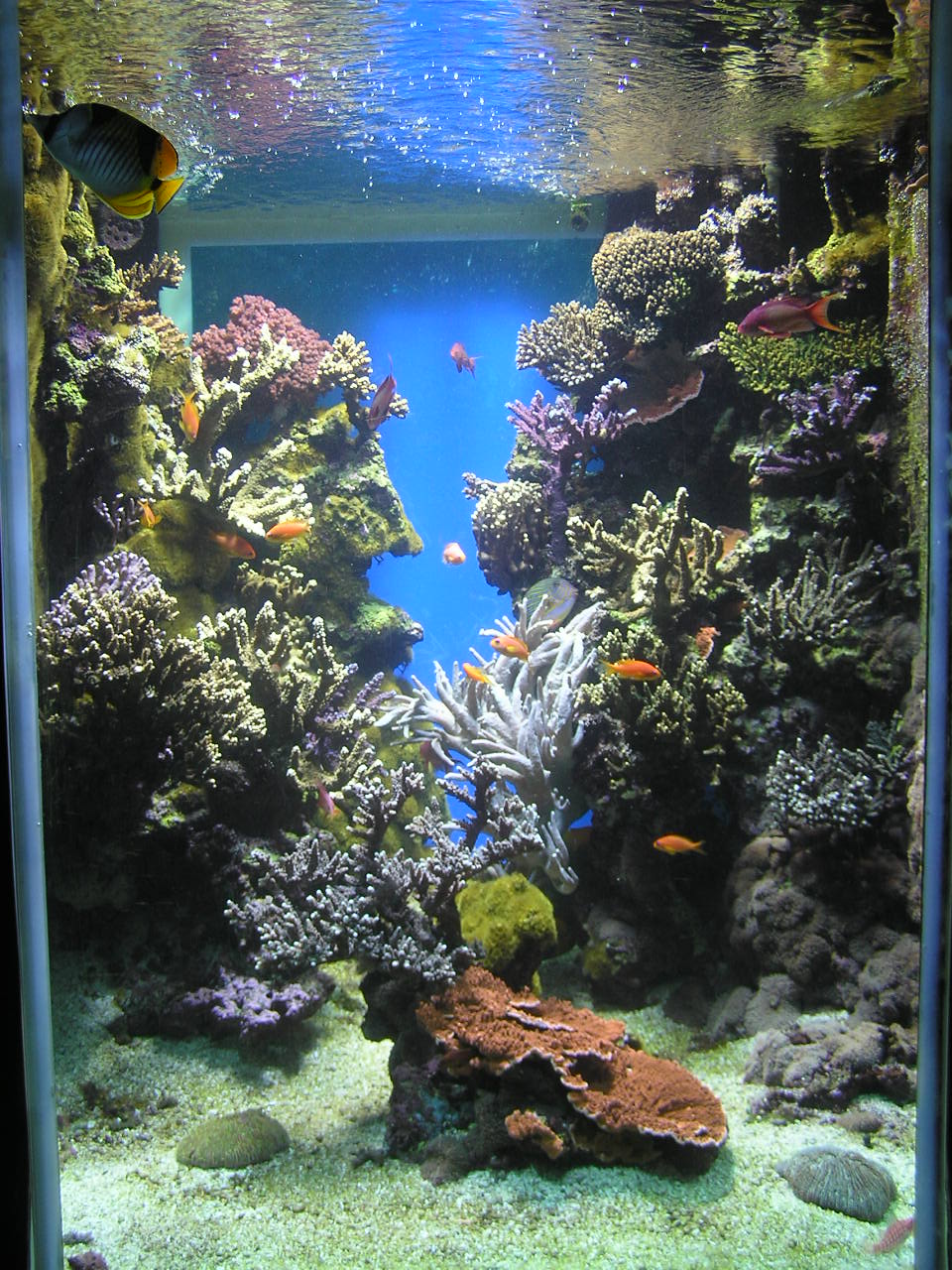
A reef aquarium or reef tank is a marine aquarium that prominently displays live corals and other marine invertebrates as well as fish that play a role in maintaining the tropical coral reef environment. A reef aquarium requires appropriately intense lighting, turbulent water movement, and more stable water chemistry than fish-only marine aquaria, and careful consideration is given to which reef animals are appropriate and compatible with each other.
Reef aquariums consist of a number of components, in addition to the livestock, including:
A "reef ready" or simply "drilled" tank is often used. This style of tank has holes drilled into the rear pane allowing water to drain into the sump or refugium.
These drains are usually housed in an internal overflow apparatus made of plastic or glass which encloses a drain standpipe and a water return line. The surface water pours over the overflow, down the standpipe, through PVC piping, into the sump. After transiting the sump, water is pushed by a return water pump through the second hole and into the aquarium.
Alternatively, standard non-drilled aquariums employ an external "hang-on" overflow that feeds water via continuous siphon to the sump as shown in fig 1.
The tanks are usually constructed from either glass or acrylic. Acrylic has the advantage of optical clarity, lightness, and ease of drilling. Drawbacks include a tendency to scratch easily, bowing, and often limited access from above due to top bracing. Glass aquariums are heavier but harder to scratch. Other materials such as epoxy-coated plywood have been used by industrious DIYers, but these materials are typically reserved for the construction of larger tanks.
The primary biological filtration for reef aquariums usually comes from the use of live rock which come from various tropical zones around existing reefs, or more recently aquacultured rock from Florida. Some reefkeepers also use what is called deep sand beds (DSB). These are often employed to augment the biological filtration by aiding in the reduction of nitrate, a waste product in an incomplete nitrogen cycle. Deep sand bed opponents may prefer a "bare bottom" or "suspended reef" which allows for easier removal of nitrate-generating accumulated detritus. This biological filtration is usually supplemented by protein skimmers. Protein skimmers use the foam fractionation process wherein air is introduced into a water stream creating microbubbles. Organic waste adheres to the surface of these microbubbles and is removed as it overflows at the reactor surface into a removable cup. This group of elements used in conjunction is characteristic of the Berlin Method, named for the city in which it was first devised.
In recent years, the Berlin Method is often supplemented with a refugium. A refugium provides many benefits, which include nitrate reduction, as well as providing a natural food source. It typically houses two main species of macroalgae, including Caulerpa prolifera or chaetomorphae or both (because these two strains are known not to spore but grow by rooting to propagate). Macroalgae is used for two reasons: to remove excess nutrients from the water such as nitrate, phosphate, and iron, and to support beneficial microflora and fauna (zooplankton). Small invertebrates (copepods and amphipods) are provided a space free of predation to grow and, when returned to the display tank, serve as food for corals and fish. Conventional combined mechanical/biological filtration used in fish only systems is avoided because those filters trap detritus and produce nitrates which may stunt or even kill many delicate corals. Chemical filtration in the form of activated carbon is used when needed to remove discoloration of the water, or to remove dissolved matter (organic or otherwise) to help purify the water in the reef system.
Hub AI
Reef aquarium AI simulator
(@Reef aquarium_simulator)
Reef aquarium
A reef aquarium or reef tank is a marine aquarium that prominently displays live corals and other marine invertebrates as well as fish that play a role in maintaining the tropical coral reef environment. A reef aquarium requires appropriately intense lighting, turbulent water movement, and more stable water chemistry than fish-only marine aquaria, and careful consideration is given to which reef animals are appropriate and compatible with each other.
Reef aquariums consist of a number of components, in addition to the livestock, including:
A "reef ready" or simply "drilled" tank is often used. This style of tank has holes drilled into the rear pane allowing water to drain into the sump or refugium.
These drains are usually housed in an internal overflow apparatus made of plastic or glass which encloses a drain standpipe and a water return line. The surface water pours over the overflow, down the standpipe, through PVC piping, into the sump. After transiting the sump, water is pushed by a return water pump through the second hole and into the aquarium.
Alternatively, standard non-drilled aquariums employ an external "hang-on" overflow that feeds water via continuous siphon to the sump as shown in fig 1.
The tanks are usually constructed from either glass or acrylic. Acrylic has the advantage of optical clarity, lightness, and ease of drilling. Drawbacks include a tendency to scratch easily, bowing, and often limited access from above due to top bracing. Glass aquariums are heavier but harder to scratch. Other materials such as epoxy-coated plywood have been used by industrious DIYers, but these materials are typically reserved for the construction of larger tanks.
The primary biological filtration for reef aquariums usually comes from the use of live rock which come from various tropical zones around existing reefs, or more recently aquacultured rock from Florida. Some reefkeepers also use what is called deep sand beds (DSB). These are often employed to augment the biological filtration by aiding in the reduction of nitrate, a waste product in an incomplete nitrogen cycle. Deep sand bed opponents may prefer a "bare bottom" or "suspended reef" which allows for easier removal of nitrate-generating accumulated detritus. This biological filtration is usually supplemented by protein skimmers. Protein skimmers use the foam fractionation process wherein air is introduced into a water stream creating microbubbles. Organic waste adheres to the surface of these microbubbles and is removed as it overflows at the reactor surface into a removable cup. This group of elements used in conjunction is characteristic of the Berlin Method, named for the city in which it was first devised.
In recent years, the Berlin Method is often supplemented with a refugium. A refugium provides many benefits, which include nitrate reduction, as well as providing a natural food source. It typically houses two main species of macroalgae, including Caulerpa prolifera or chaetomorphae or both (because these two strains are known not to spore but grow by rooting to propagate). Macroalgae is used for two reasons: to remove excess nutrients from the water such as nitrate, phosphate, and iron, and to support beneficial microflora and fauna (zooplankton). Small invertebrates (copepods and amphipods) are provided a space free of predation to grow and, when returned to the display tank, serve as food for corals and fish. Conventional combined mechanical/biological filtration used in fish only systems is avoided because those filters trap detritus and produce nitrates which may stunt or even kill many delicate corals. Chemical filtration in the form of activated carbon is used when needed to remove discoloration of the water, or to remove dissolved matter (organic or otherwise) to help purify the water in the reef system.