



Community hub
Recent from talks
Contribute something to knowledge base
Content stats: 0 posts, 0 articles, 0 media, 0 notes
Members stats: 0 subscribers, 0 contributors, 0 moderators, 0 supporters
Subscribers
Supporters
Contributors
Moderators
Hub AI
Reference materials for stable isotope analysis AI simulator
(@Reference materials for stable isotope analysis_simulator)
Hub AI
Reference materials for stable isotope analysis AI simulator
(@Reference materials for stable isotope analysis_simulator)
Reference materials for stable isotope analysis
Isotopic reference materials are compounds (solids, liquids, gasses) with well-defined isotopic compositions and are the ultimate sources of accuracy in mass spectrometric measurements of isotope ratios. Isotopic references are used because mass spectrometers are highly fractionating. As a result, the isotopic ratio that the instrument measures can be very different from that in the sample's measurement. Moreover, the degree of instrument fractionation changes during measurement, often on a timescale shorter than the measurement's duration, and can depend on the characteristics of the sample itself. By measuring a material of known isotopic composition, fractionation within the mass spectrometer can be removed during post-measurement data processing. Without isotope references, measurements by mass spectrometry would be much less accurate and could not be used in comparisons across different analytical facilities. Due to their critical role in measuring isotope ratios, and in part, due to historical legacy, isotopic reference materials define the scales on which isotope ratios are reported in the peer-reviewed scientific literature.
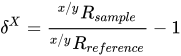
Isotope reference materials are generated, maintained, and sold by the International Atomic Energy Agency (IAEA), the National Institute of Standards and Technology (NIST), the United States Geologic Survey (USGS), the Institute for Reference Materials and Measurements (IRMM), and a variety of universities and scientific supply companies. Each of the major stable isotope systems (hydrogen, carbon, oxygen, nitrogen, and sulfur) has a wide variety of references encompassing distinct molecular structures. For example, nitrogen isotope reference materials include N-bearing molecules such ammonia (NH3), atmospheric dinitrogen (N2), and nitrate (NO3−). Isotopic abundances are commonly reported using the δ notation, which is the ratio of two isotopes (R) in a sample relative to the same ratio in a reference material, often reported in per mille (‰) (equation below). Reference material span a wide range of isotopic compositions, including enrichments (positive δ) and depletions (negative δ). While the δ values of references are widely available, estimates of the absolute isotope ratios (R) in these materials are seldom reported. This article aggregates the δ and R values of common and non-traditional stable isotope reference materials.
The δ values and absolute isotope ratios of common reference materials are summarized in Table 1 and described in more detail below. Alternative values for the absolute isotopic ratios of reference materials, differing only modestly from those in Table 1, are presented in Table 2.5 of Sharp (2007) (a text freely available online), as well as Table 1 of the 1993 IAEA report on isotopic reference materials. For an exhaustive list of reference material, refer to Appendix I of Sharp (2007), Table 40.1 of Gröning (2004), or the website of the International Atomic Energy Agency. Note that the 13C/12C ratio of Vienna Pee Dee Belemnite (VPDB) and 34S/32S ratio of Vienna Canyon Diablo Troilite (VCDT) are purely mathematical constructs; neither material existed as a physical sample that could be measured.
In Table 1, "Name" refers to the common name of the reference, "Material" gives its chemical formula and phase, "Type of ratio" is the isotopic ratio reported in "Isotopic ratio", "δ" is the δ value of the material with indicated reference frame, "Type" is the category of the material using the notation of Gröening (2004) (discussed below), "Citation" gives the article(s) reporting the isotopic abundances on which the isotope ratio is based, and "Notes" are notes. The reported isotopic ratios reflect the results from individual analyses of absolute mass fraction, aggregated in Meija et al. (2016) and manipulated to reach the given ratios. Error was calculated as the square root of the sum of the squares of fractional reported errors, consistent with standard error propagation, but is not propagated for ratios reached through secondary calculation.
The terminology of isotopic reference materials is not applied consistently across subfields of isotope geochemistry or even between individual laboratories. The terminology defined below comes from Gröening et al. (1999) and Gröening (2004). Reference materials are the basis for accuracy across many different types of measurement, not only the mass spectrometry, and there is a large body of literature concerned with the certification and testing of reference materials.
Primary reference materials define the scales on which isotopic ratios are reported. This can mean a material that historically defined an isotopic scale, such as Vienna Standard Mean Ocean Water (VSMOW) for hydrogen isotopes, even if that material is not currently in use. Alternatively, it can mean a material that only ever existed theoretically but is used to define an isotopic scale, such as VCDT for sulfur isotope ratios.
Calibration materials are compounds whose isotopic composition is known extremely well relative to the primary reference materials or which define the isotopic composition of the primary reference materials but are not the isotopic ratios to which data are reported in the scientific literature. For example, the calibration material IAEA-S-1 defines the isotopic scale for sulfur but measurements are reported relative to VCDT, not relative to IAEA-S-1. The calibration material serves the function of the primary reference material when the primary reference is exhausted, unavailable, or never existed in physical form.
Reference materials for stable isotope analysis
Isotopic reference materials are compounds (solids, liquids, gasses) with well-defined isotopic compositions and are the ultimate sources of accuracy in mass spectrometric measurements of isotope ratios. Isotopic references are used because mass spectrometers are highly fractionating. As a result, the isotopic ratio that the instrument measures can be very different from that in the sample's measurement. Moreover, the degree of instrument fractionation changes during measurement, often on a timescale shorter than the measurement's duration, and can depend on the characteristics of the sample itself. By measuring a material of known isotopic composition, fractionation within the mass spectrometer can be removed during post-measurement data processing. Without isotope references, measurements by mass spectrometry would be much less accurate and could not be used in comparisons across different analytical facilities. Due to their critical role in measuring isotope ratios, and in part, due to historical legacy, isotopic reference materials define the scales on which isotope ratios are reported in the peer-reviewed scientific literature.
Isotope reference materials are generated, maintained, and sold by the International Atomic Energy Agency (IAEA), the National Institute of Standards and Technology (NIST), the United States Geologic Survey (USGS), the Institute for Reference Materials and Measurements (IRMM), and a variety of universities and scientific supply companies. Each of the major stable isotope systems (hydrogen, carbon, oxygen, nitrogen, and sulfur) has a wide variety of references encompassing distinct molecular structures. For example, nitrogen isotope reference materials include N-bearing molecules such ammonia (NH3), atmospheric dinitrogen (N2), and nitrate (NO3−). Isotopic abundances are commonly reported using the δ notation, which is the ratio of two isotopes (R) in a sample relative to the same ratio in a reference material, often reported in per mille (‰) (equation below). Reference material span a wide range of isotopic compositions, including enrichments (positive δ) and depletions (negative δ). While the δ values of references are widely available, estimates of the absolute isotope ratios (R) in these materials are seldom reported. This article aggregates the δ and R values of common and non-traditional stable isotope reference materials.
The δ values and absolute isotope ratios of common reference materials are summarized in Table 1 and described in more detail below. Alternative values for the absolute isotopic ratios of reference materials, differing only modestly from those in Table 1, are presented in Table 2.5 of Sharp (2007) (a text freely available online), as well as Table 1 of the 1993 IAEA report on isotopic reference materials. For an exhaustive list of reference material, refer to Appendix I of Sharp (2007), Table 40.1 of Gröning (2004), or the website of the International Atomic Energy Agency. Note that the 13C/12C ratio of Vienna Pee Dee Belemnite (VPDB) and 34S/32S ratio of Vienna Canyon Diablo Troilite (VCDT) are purely mathematical constructs; neither material existed as a physical sample that could be measured.
In Table 1, "Name" refers to the common name of the reference, "Material" gives its chemical formula and phase, "Type of ratio" is the isotopic ratio reported in "Isotopic ratio", "δ" is the δ value of the material with indicated reference frame, "Type" is the category of the material using the notation of Gröening (2004) (discussed below), "Citation" gives the article(s) reporting the isotopic abundances on which the isotope ratio is based, and "Notes" are notes. The reported isotopic ratios reflect the results from individual analyses of absolute mass fraction, aggregated in Meija et al. (2016) and manipulated to reach the given ratios. Error was calculated as the square root of the sum of the squares of fractional reported errors, consistent with standard error propagation, but is not propagated for ratios reached through secondary calculation.
The terminology of isotopic reference materials is not applied consistently across subfields of isotope geochemistry or even between individual laboratories. The terminology defined below comes from Gröening et al. (1999) and Gröening (2004). Reference materials are the basis for accuracy across many different types of measurement, not only the mass spectrometry, and there is a large body of literature concerned with the certification and testing of reference materials.
Primary reference materials define the scales on which isotopic ratios are reported. This can mean a material that historically defined an isotopic scale, such as Vienna Standard Mean Ocean Water (VSMOW) for hydrogen isotopes, even if that material is not currently in use. Alternatively, it can mean a material that only ever existed theoretically but is used to define an isotopic scale, such as VCDT for sulfur isotope ratios.
Calibration materials are compounds whose isotopic composition is known extremely well relative to the primary reference materials or which define the isotopic composition of the primary reference materials but are not the isotopic ratios to which data are reported in the scientific literature. For example, the calibration material IAEA-S-1 defines the isotopic scale for sulfur but measurements are reported relative to VCDT, not relative to IAEA-S-1. The calibration material serves the function of the primary reference material when the primary reference is exhausted, unavailable, or never existed in physical form.