



Community hub
Recent from talks
Contribute something to knowledge base
Content stats: 0 posts, 0 articles, 1 media, 0 notes
Members stats: 0 subscribers, 0 contributors, 0 moderators, 0 supporters
Subscribers
Supporters
Contributors
Moderators
Hub AI
Regio Patalis AI simulator
(@Regio Patalis_simulator)
Hub AI
Regio Patalis AI simulator
(@Regio Patalis_simulator)
Regio Patalis
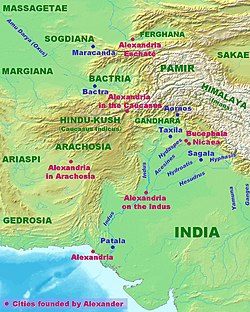
Regio Patalis is Latin for “the region of Patala”, that is the region around the ancient city of Patala at the mouth of the Indus River in Sindh, Pakistan. The historians of Alexander the Great state that the Indus parted into two branches at the city of Patala before reaching the sea, and the island thus formed was called Patalene, the district of Patala. Alexander constructed a harbour at Patala.
While the Patala was well known to mariners and traders of the Ancient Mediterranean, by the European Middle Ages, mapmakers no longer knew its location. Regio Patalis appeared on late 15th and early 16th century maps and globes in a variety of increasingly erroneous locations, further and further east and south of India. It even appeared on some maps as a promontory of Terra Australis.
Pliny the Elder (Gaius Plinius Secundus, 23-79 AD) referring to “the island of Patale, at the mouth of the Indus”, wrote in Historia Naturalis: “Also in India [as well as at Aswan in Egypt] at the well-known port of Patale the sun rises on the right and shadows fall southward”.
The geographer Strabo (c.64 BC–c.24 AD) had said: “The Indus falls into the southern sea by two mouths, encompassing the country of Patalênê, which resembles the Delta in Egypt”. He noted: “All these [nations] were conquered by Alexander, and last of all he reduced Patalênê, which the Indus forms by splitting into two branches… Patalênê contains a considerable city, Patala, which gives its name to the island”.
The 1507 Martin Waldseemüller map shows Patala in this location.
In the late 2nd century BC, Agatharchides of Cnidus recorded merchants from Patala, or as he called it, Potana, coming to the island of Socotra to trade with Alexandrian merchants. The 2nd century AD author Dionysios Periegetes said in his Orbis Descriptio: “This river [the Indus] has two mouths, and dashes against the island enclosed between them, called in the tongue of the natives, Patalênê”. Or, as Priscian put it in his popular rendition of Periegetes: “the River Indus... Patalene is girt by its divided waters.”
Some scholars identify Patala with Thatta, a one-time capital of Sindh. But the identity of Patala is much debated among scholars. However, as 'Regio' is Latin for 'region', one might expect that 'Patalis' may also be of Latin origin. This indeed appears to be the case, as in ancient Latin 'patalis' meant 'broad-horned', usually used in conjunction with 'bos', meaning an ox or a bull or all sorts of oxen [Thomas Morell, An Abridgement of Ainsworth's Dictionary, English and Latin, Camden Town, London: A. Wilson, 1817], rendering 'region of the broad-horns (bulls)'.
Siltation has caused the Indus to change its course many times since the days of Alexander the Great, and the site of ancient Patala has been subject to much conjecture. Ahmad Hasan Dani, director of the Taxila Institute of Asian Civilisations, Islamabad, concluded: “There has been a vain attempt to identify the city of Patala. If ‘Patala’ is not taken as a proper name but only refers to a city, it can be corrected to ‘Pattana’, that is, [Sanskrit for] a city or port city par excellence, a term applied in a later period to Thatta [onetime capital of Sindh], which is ideally situated in the way the Greek historians describe”. However, the Dravidian Etymological Dictionary clearly indicates that this word is derived from South and South Central Dravidian languages, and the variety of Sanskrit used for official purposes in Sindh would not have used the term to describe a city.
Regio Patalis
Regio Patalis is Latin for “the region of Patala”, that is the region around the ancient city of Patala at the mouth of the Indus River in Sindh, Pakistan. The historians of Alexander the Great state that the Indus parted into two branches at the city of Patala before reaching the sea, and the island thus formed was called Patalene, the district of Patala. Alexander constructed a harbour at Patala.
While the Patala was well known to mariners and traders of the Ancient Mediterranean, by the European Middle Ages, mapmakers no longer knew its location. Regio Patalis appeared on late 15th and early 16th century maps and globes in a variety of increasingly erroneous locations, further and further east and south of India. It even appeared on some maps as a promontory of Terra Australis.
Pliny the Elder (Gaius Plinius Secundus, 23-79 AD) referring to “the island of Patale, at the mouth of the Indus”, wrote in Historia Naturalis: “Also in India [as well as at Aswan in Egypt] at the well-known port of Patale the sun rises on the right and shadows fall southward”.
The geographer Strabo (c.64 BC–c.24 AD) had said: “The Indus falls into the southern sea by two mouths, encompassing the country of Patalênê, which resembles the Delta in Egypt”. He noted: “All these [nations] were conquered by Alexander, and last of all he reduced Patalênê, which the Indus forms by splitting into two branches… Patalênê contains a considerable city, Patala, which gives its name to the island”.
The 1507 Martin Waldseemüller map shows Patala in this location.
In the late 2nd century BC, Agatharchides of Cnidus recorded merchants from Patala, or as he called it, Potana, coming to the island of Socotra to trade with Alexandrian merchants. The 2nd century AD author Dionysios Periegetes said in his Orbis Descriptio: “This river [the Indus] has two mouths, and dashes against the island enclosed between them, called in the tongue of the natives, Patalênê”. Or, as Priscian put it in his popular rendition of Periegetes: “the River Indus... Patalene is girt by its divided waters.”
Some scholars identify Patala with Thatta, a one-time capital of Sindh. But the identity of Patala is much debated among scholars. However, as 'Regio' is Latin for 'region', one might expect that 'Patalis' may also be of Latin origin. This indeed appears to be the case, as in ancient Latin 'patalis' meant 'broad-horned', usually used in conjunction with 'bos', meaning an ox or a bull or all sorts of oxen [Thomas Morell, An Abridgement of Ainsworth's Dictionary, English and Latin, Camden Town, London: A. Wilson, 1817], rendering 'region of the broad-horns (bulls)'.
Siltation has caused the Indus to change its course many times since the days of Alexander the Great, and the site of ancient Patala has been subject to much conjecture. Ahmad Hasan Dani, director of the Taxila Institute of Asian Civilisations, Islamabad, concluded: “There has been a vain attempt to identify the city of Patala. If ‘Patala’ is not taken as a proper name but only refers to a city, it can be corrected to ‘Pattana’, that is, [Sanskrit for] a city or port city par excellence, a term applied in a later period to Thatta [onetime capital of Sindh], which is ideally situated in the way the Greek historians describe”. However, the Dravidian Etymological Dictionary clearly indicates that this word is derived from South and South Central Dravidian languages, and the variety of Sanskrit used for official purposes in Sindh would not have used the term to describe a city.
Recent media
Recent media