


Community hub
Recent from talks
Contribute something
Nothing was collected or created yet.
Regla Torres
View on Wikipedia
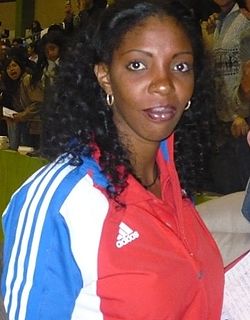
Regla Torres Herrera (born 12 February 1975) is a Cuban former volleyball player who won three Olympic gold medals with the Cuban women's national volleyball team. Torres began playing on the international circuit at the age of 14.[1] As a middle blocker, she was a key player in the dominance of the Cuban national team of the 1990s.[1][2]
Key Information


In 2001, Torres was the recipient of the "Best Player of the 20th Century" award by the FIVB[3] and was inducted into the International Volleyball Hall of Fame.[1]
Early life
[edit]Torres was born in Havana, Cuba on 12 February 1975.[4] Since she was a young girl, Torres was encouraged by teachers to play sports due to her height.[2] Though her parents separated while she was in primary school, both were involved in her upbringing.[2] While Torres was more interested in the high jump than volleyball, her mother insisted that she focus on the latter.[2] In the fourth grade, Torres was sent to a sports school to develop her athletic talent.[2] At the age of 14, she was sent to the Cerro Pelado school, where she quickly developed her volleyball skills.[2] She then joined the national team in 1989.[2]
Career
[edit]Olympic Games
[edit]Torres won her first Olympic gold medal in 1992 in Barcelona at the age of 17.[1][5] She helped her team to additional gold medals at the 1996 Olympics in Atlanta and the 2000 Olympics in Sydney,[6] achieving the extraordinary feat of winning three Olympics in a row.[1][5] She was selected as the best spiker at the Sydney Olympics.[3]
Pan American Games
[edit]Torres helped the Cuban team to the gold medal at the 1991 Pan American Games in Havana, at the age of 16.[4] She won another gold medal with the national team at the 1995 Pan American Games in Mar del Plata.[4]
World Cups and World Championships
[edit]Torres helped Cuba win gold medals at the 1991 and 1995 FIVB World Cup in Japan.[1] She also helped Cuba win the 1994 FIVB World Championship in Brazil and the 1998 FIVB World Championship in Japan, and was selected as the MVP in both tournaments.[7]
World Grands Prix
[edit]Torres won additional gold medals with the Cuban team at the 1993 and 2000 FIVB World Grand Prix in Japan.[1][2]
Awards
[edit]- Three-time Olympic gold medal — 1992, 1996, 2000
- Two-time FIVB World Cup gold medal — 1991, 1995
- Two-time Pan American Games gold medal — 1991, 1995
- Two-time FIVB World Grand Prix gold medal — 1993, 2000
- Two-time FIVB World Championship gold medal — 1994, 1998
- Two-time FIVB World Championship MVP — 1994, 1998
- Olympic best spiker, MVP — Sydney 2000
- FIVB Best Player of the 20th Century — 2001
- International Volleyball Hall of Fame — 2001
References
[edit]- ^ a b c d e f g "Regla Torres Herrera". International Volleyball Hall of Fame. Archived from the original on 22 August 2010. Retrieved 11 March 2010.
- ^ a b c d e f g h Coll Untoria, Jorge Luis (27 November 2023). "La armadura de Regla Torres". Oncubanews.com (in Spanish). Archived from the original on 27 November 2023. Retrieved 21 January 2024.
- ^ a b "Best Volleyball Player Of The 20th Century - Female". FIVB. Archived from the original on 21 December 2001. Retrieved 11 March 2010.
- ^ a b c "Regla Torres". Olympedia. Archived from the original on 16 May 2023. Retrieved 8 September 2023.
- ^ a b "'The Spectacular Caribbean Girls': Cuba's three volleyball golds in a row". Olympics.com. 19 January 2021. Archived from the original on 19 August 2023. Retrieved 19 August 2023.
- ^ Roberts, Selena (1 October 2000). "Sydney 2000: Volleyball; Cuba Cruises to Third Straight Gold". The New York Times. sec. 8 p. 13. Retrieved 6 September 2024. (subscription required)
- ^ Gunston, Jo (22 September 2022). "Volleyball: The most asked questions about women's indoor volleyball". Olympics.com. Archived from the original on 3 November 2022. Retrieved 19 August 2023.
External links
[edit]- Regla Torres at the International Volleyball Hall of Fame
- Regla Torres at FIVB.org World Championships Women 2002
- Regla Torres at Volleybox.net
- Regla Torres at Olympics.com
- Regla Torres at Olympedia

|  | |
| | |
| | |
| | |
| | |
| | |
Regla Torres
View on GrokipediaEarly life
Childhood and family background
Regla Torres was born on February 12, 1975, in Havana, Cuba.[1] As the only child of her parents, she grew up in the El Palenque neighborhood of La Lisa in Havana, where her family faced economic challenges that influenced her early path.[3] Her parents separated when she was 10 years old in 1985, an event that marked her childhood but did not hinder her overall happiness; both parents remained involved in her upbringing despite the split.[3] From a young age, Torres displayed physical attributes suited for sports, including exceptional height and long limbs that made her stand out among peers.[3] She enjoyed outdoor activities such as running and climbing during visits to her grandmother's house in Matanzas, though her initial interests leaned toward athletics like the high jump rather than team sports.[3] At around age 10, her mother enrolled her in a pre-EIDE semi-boarding school in Havana, driven by necessity and a preference for volleyball as a structured outlet, marking the beginning of her athletic journey under coach Bárbara Palmer.[3] Torres later reflected on this transition, stating, “My career began because of a problem of necessity.”[3] Torres progressed quickly through Cuba's youth sports system, attending the Mártires de Barbados EIDE for grades 6 through 8 and later the national ESPA school.[3] By age 14 in 1989, she caught the attention of legendary coach Eugenio George, who promoted her to the national youth team despite her self-assessed lack of technical polish, recognizing her innate physical conditions.[3][1] She noted of this early inclusion, “I didn’t have the level, but I had the conditions.”[3] This foundation in Havana's sports schools solidified her dedication to volleyball, setting the stage for her rapid ascent in the sport.[3]Introduction to volleyball and youth development
Regla Torres Herrera grew up in an environment that fostered early athletic development through the country's robust sports education system.[1] From a young age, her physical attributes—standing at 1.91 meters tall—drew attention to her potential in sports, leading her to focus exclusively on volleyball starting around age 10.[1][3] She began training in a Havana sports school, a key institution in Cuba's youth talent identification program, which emphasized disciplined skill-building and technical proficiency from the grassroots level.[3] This early immersion allowed Torres to develop her agility, power, and blocking technique as a middle blocker, setting the foundation for her rapid ascent in the sport.[1] By age 14, Torres's talent had earned her a spot on Cuba's national youth team, where she immediately began competing in international tournaments, showcasing her ability to perform under pressure. At age 14, she was transferred to the Cerro Pelado school by coach Chela González, further advancing her skills before joining the national youth team.[3] Her youth career progressed swiftly within Cuba's structured development pathway, which integrated junior competitions with senior exposure to accelerate growth. At 16, she made the transition to the senior national team, blending seamlessly with established players while continuing to refine her hitting and defensive skills.[1] This dual-level involvement highlighted the Cuban system's emphasis on progressive talent nurturing, enabling young athletes like Torres to gain competitive experience without overwhelming specialization.[3] Torres's youth phase yielded early international success that underscored her development. In 1991, at just 16, she contributed to Cuba's gold medal win at the Pan American Games in Havana, marking her debut major title.[1] Two years later, in 1993, she led the junior team to gold at the FIVB Women's Junior World Championship in Brazil for her dominant attacks.[1] That same year, already integrating into senior play, she helped secure another gold at the FIVB World Grand Champions Cup in Tokyo, demonstrating how her youth training translated to high-stakes elite competition.[1] These accomplishments not only validated Cuba's youth development model but also propelled Torres toward her historic Olympic breakthrough at age 17.[1]Playing career
Club career
Torres began her club career in Cuba, developing through youth and provincial teams in Havana before establishing herself with Ciudad de La Habana in the domestic league during the early 1990s.[2] In 1995–96, she ventured abroad for the first time, joining Daiei Orange Attackers in Japan's V.League, where she contributed to the team's competitive performance in the professional circuit.[4] Torres then moved to Italy's Serie A1, starting with Omnitel Volley Modena in the 1997–98 season, marking her entry into one of Europe's top leagues as a middle blocker.[5] The following two seasons, 1998–99 and 1999–2000, saw her play for Despar Perugia; however, during the 1998–99 campaign, a knee injury sidelined her and forced her to miss the 1999 Pan American Games.[5][3] Her time in Italy culminated in winning the Coppa Italia A1, highlighting her impact on club-level success in the competitive environment.[5] Returning to Cuba, Torres rejoined Ciudad de La Habana from 2000–01 to 2004–05, anchoring the team's front line and helping secure victories such as the Salonpas Cup in 2004–05.[4][6] She concluded her playing career with a final stint abroad in 2005–06, signing with Megius Volley Padova in Italy's Serie A1, where she provided veteran leadership before retiring.[5]Olympic Games
Regla Torres, a prominent middle blocker for the Cuban national women's volleyball team, achieved remarkable success in the Olympic Games, securing gold medals in three consecutive editions from 1992 to 2000.[1][2] This feat made her one of only a handful of athletes to win three Olympic golds in volleyball, highlighting Cuba's dominance in the sport during that era.[1] Her contributions as a powerful hitter and blocker were instrumental in Cuba's victories, earning her recognition as a key figure in the team's strategy.[7] At the 1992 Summer Olympics in Barcelona, Torres, then just 17 years old, debuted for Cuba and helped the team defeat the Unified Team 3-1 in the final to claim gold.[1] This victory marked her as the youngest Olympic gold medalist in volleyball history at the time, showcasing her early prowess despite her youth.[1] Cuba's campaign was characterized by strong offensive plays, with Torres contributing significantly to the team's undefeated run to the final.[2] In the 1996 Summer Olympics in Atlanta, Torres played a pivotal role in Cuba's title defense, leading them to another gold medal after overcoming early group-stage losses to Brazil and Russia.[1] The team advanced through the knockout stages and defeated China 3-1 in the final, with Torres' blocking and attacking skills proving crucial in high-pressure matches.[1] Her performance solidified her status as a core member of the squad, contributing to Cuba's second consecutive Olympic triumph.[2] Torres capped her Olympic career at the 2000 Summer Olympics in Sydney, where Cuba secured a third straight gold by beating Russia in a thrilling five-set final, winning the tiebreaker 15-7.[1] She was named the tournament's Best Spiker for her outstanding attacking efficiency, despite battling injuries throughout the competition.[7][8] This achievement remains a highlight of her career, underscoring her resilience and impact on Cuba's unprecedented three-peat.[1]| Olympic Games | Location | Medal | Notable Achievement |
|---|---|---|---|
| 1992 | Barcelona | Gold | Youngest gold medalist at age 17 |
| 1996 | Atlanta | Gold | Overcame group losses to win final vs. China |
| 2000 | Sydney | Gold | Best Spiker award; three-peat completed |
World Championships and World Cups
Regla Torres made her international debut with the Cuban senior national team at the remarkably young age of 14 during the 1989 FIVB Volleyball Women's World Cup in Japan, where Cuba secured the gold medal by defeating the Soviet Union in the final. As a promising middle blocker, Torres contributed to the team's defensive strength and quick attacks, helping establish Cuba's emerging dominance in global women's volleyball.[9] Torres continued her ascent in the 1991 FIVB World Cup, also held in Japan, where Cuba defended their title with another gold medal victory over the Soviet Union. Her growing presence in the front row bolstered Cuba's impenetrable block and versatile offense, solidifying the team's reputation for explosive, coordinated play that overwhelmed opponents. By this point, Torres had become an integral part of the squad under coach Eugenio George, whose tactical innovations amplified her natural athleticism and timing.[10] The pinnacle of Torres' World Cup career came in 1995 in Japan, where Cuba claimed a third consecutive gold, defeating China in the final match. At 20 years old, Torres exemplified the physical prowess and mental resilience that defined Cuba's golden era, recording key blocks and points in crucial sets that showcased her evolution into one of the world's elite middle blockers. This triumph marked Cuba's fourth World Cup title overall and underscored Torres' role in maintaining the nation's unbeaten streak in the competition during the 1990s.[10] Shifting to the FIVB Volleyball Women's World Championships, Torres led Cuba to gold at the 1994 edition in Brazil, where the team triumphed over the unified CIS squad in a hard-fought final. Named both the Most Valuable Player (MVP) and Best Blocker of the tournament, Torres anchored the defense and delivered clutch attacks, her 1.91-meter (6 ft 3 in) height and leaping ability proving decisive in high-stakes rallies. This victory propelled Cuba to the forefront of international volleyball, with Torres' performance symbolizing the blend of power and precision that characterized the team's style.[7] In 1998, at the World Championship in Japan, Torres again steered Cuba to gold, defeating China in the final to secure back-to-back titles. Once more honored as MVP and Best Blocker, she earned widespread acclaim for her leadership on the court, mentoring younger players while maintaining her elite-level impact. Her contributions extended beyond statistics, fostering the unbreakable team chemistry that made Cuba unbeatable during this period.[7]| Competition | Year | Medal | Individual Award |
|---|---|---|---|
| FIVB World Cup | 1989 | Gold | - |
| FIVB World Cup | 1991 | Gold | - |
| FIVB World Cup | 1995 | Gold | - |
| FIVB World Championship | 1994 | Gold | MVP, Best Blocker |
| FIVB World Championship | 1998 | Gold | MVP, Best Blocker |