


Community hub
Recent from talks
Contribute something
Nothing was collected or created yet.
Reliability block diagram
View on WikipediaA reliability block diagram (RBD) is a diagrammatic method for showing how component reliability contributes to the success or failure of a redundant system. RBD is also known as a dependence diagram (DD).

An RBD is drawn as a series of blocks connected in parallel or series configuration. Parallel blocks indicate redundant subsystems or components that contribute to a lower failure rate. Each block represents a component of the system with a failure rate. RBDs will indicate the type of redundancy in the parallel path.[1] For example, a group of parallel blocks could require two out of three components to succeed for the system to succeed. By contrast, any failure along a series path causes the entire series path to fail.[2][3]
An RBD may be drawn using switches in place of blocks, where a closed switch represents a working component and an open switch represents a failed component. If a path may be found through the network of switches from beginning to end, the system still works.
An RBD may be converted to a success tree or a fault tree depending on how the RBD is defined. A success tree may then be converted to a fault tree or vice versa by applying de Morgan's theorem.
To evaluate an RBD, closed form solutions are available when blocks or components have statistical independence.
When statistical independence is not satisfied, specific formalisms and solution tools such as dynamic RBD have to be considered.[4]
Calculating an RBD
[edit]The first thing one must determine when calculating an RBD is whether to use probability or rate. Failure rates are often used in RBDs to determine system failure rates. Use probabilities or rates in an RBD but not both.
Series probabilities are calculated by multiplying the reliability (a probability) of the series components:

Parallel probabilities are calculated by multiplying the unreliability (Q) of the series components where Q = 1 – R if only one unit needs to function for system success:

For constant failure rates, series rates are calculated by superimposing the Poisson point processes of the series components:

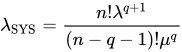
Parallel rates can be evaluated using a number of formulas including this formula[5] for all units active with equal component failure rates. n − q out of n redundant units are required for success. μ >> λ
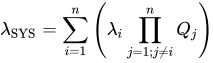
If the components in a parallel system have n different failure rates a more general formula can be used as follows. For the repairable model Q = λ/μ as long as .

See also
[edit]References
[edit]- ^ Electronic Design Handbook, MIL-HDBK-338B, October 1, 1998
- ^ Mohammad Modarres; Mark Kaminskiy; Vasiliy Krivtsov (1999). "4" (pdf). Reliability Engineering and Risk Analysis: A Practical Guide. Ney York, NY: Marcel Decker, Inc. p. 198. ISBN 978-0-8247-2000-1. Retrieved 2010-03-16.
- ^ "6.4 Reliability Modeling and Prediction". Electronic Reliability Design Handbook. B. U.S. Department of Defense. 1998. MIL–HDBK–338B. Archived from the original (pdf) on 2011-07-22. Retrieved 2010-03-16.
- ^ Salvatore Distefano, Antonio Puliafito. "Dependability Evaluation with Dynamic Reliability Block Diagrams and Dynamic Fault Trees." IEEE Trans Dependable Sec. Comput. 6(1): 4–17 (2009)
- ^ Electronic Design Handbook, MIL-HDBK-338B, October 1, 1998
External links
[edit]- Reliability Block Diagram (RBD) (commercial website) Archived 2012-03-03 at the Wayback Machine
- Institut pour la Maîtrise des Risques, method sheets, english version[permanent dead link]
Reliability block diagram
View on GrokipediaFundamentals
Definition
A reliability block diagram (RBD) is a graphical method used in reliability engineering to represent the structure of a system in terms of its components and their interdependencies for successful operation. Each block in the diagram symbolizes a component, subsystem, or assembly, with connections illustrating how the success or failure of one element affects the overall system reliability. This visualization aids in identifying critical paths and potential failure points without delving into detailed internal component behaviors.[5] RBDs originated in the 1960s amid advancements in aerospace and military engineering, where they were employed to model the reliability of complex, redundant systems in electronic equipment. These diagrams emerged as part of early efforts to quantify and predict system performance under stress, driven by the need for robust designs in high-stakes applications like missiles and aircraft.[6] In contrast to fault tree analysis (FTA), which employs Boolean logic to trace causal paths leading to system failure from a top-level undesired event, or success tree analysis, which similarly maps success logic, RBDs specifically focus on reliability paths that ensure functional success rather than exhaustive event sequences. A key underlying assumption in RBD modeling is that component failures occur independently unless dependencies are explicitly modeled otherwise, simplifying the analysis while allowing for extensions in more complex scenarios.[7][8] Fundamental configurations in RBDs, such as series and parallel arrangements, serve as building blocks to represent how component reliabilities aggregate into system-level metrics.[9]Basic Components and Symbols
In a reliability block diagram (RBD), the fundamental building blocks represent individual components, subsystems, or assemblies within a system, each characterized by its operational states and associated reliability metrics. These blocks symbolize the success or failure paths necessary for overall system functionality, without implying physical wiring or structural details.[10][11] Each block is assigned reliability parameters, such as the failure rate denoted by λ (failures per unit time) or the time-dependent reliability function R(t), which quantifies the probability that the element performs its required function over a specified interval under stated conditions. For instance, under the exponential failure assumption common in basic RBD modeling, R(t) = e^{-λt}.[10][11] Standard symbols in RBDs employ simple, universal graphical elements to ensure clarity and portability across analyses. The primary symbol is a rectangular block, which encapsulates a single component or function, often labeled with an identifier for traceability. Connection lines, depicted as straight or curved lines linking the blocks, indicate logical success dependencies rather than electrical, mechanical, or physical connections; they delineate the paths through which the system's functioning is achieved. Arrows may be added to these lines to denote directionality in flow-based systems, such as sequential processes, but this is optional and context-dependent. These conventions follow established standards, promoting consistency in reliability engineering documentation.[1][10] RBD representation distinguishes between non-repairable and repairable systems through the interpretation of block parameters and states. For non-repairable systems, where failed elements cannot be restored, blocks focus on one-time mission reliability using metrics like mean time to failure (MTTF = 1/λ) and assume a single transition from functioning (up state) to failed (down state). In contrast, repairable systems model blocks with cyclic up and down states, incorporating repair rates (μ) alongside failure rates to assess steady-state availability, often using mean time between failures (MTBF = 1/λ) as a key parameter. Composite blocks may aggregate multiple elements to simplify diagrams while preserving these distinctions.[10][1][11] Such blocks and connections facilitate modeling redundancy in series or parallel setups, where the logical paths determine overall system success.[10]System Configurations
Series Systems
In a series system within a reliability block diagram (RBD), the entire system fails if any single component fails, as there is no redundancy to compensate for individual breakdowns.[12] This configuration models systems where success requires the uninterrupted operation of all elements in the chain.[13] The blocks in a series RBD are arranged sequentially from input to output, connected by lines that indicate the flow of reliability-wise dependencies, forming a linear path without branching.[12] This straightforward structure visually represents how the failure of one block propagates to the whole system. The reliability of such a setup degrades multiplicatively with each added component, amplifying the impact of lower-reliability parts.[14] A representative example is a power supply circuit in an electronic device, where components like the transformer, rectifier, and regulator are connected in series; if the rectifier fails, the entire circuit ceases to function.[15] Series configurations are commonly applied in non-critical linear processes, such as assembly lines in manufacturing, where sequential stations must all operate for the production flow to continue without interruption.[16] Unlike parallel systems that incorporate redundancy for fault tolerance, series setups prioritize simplicity in modeling straightforward dependencies.[12]Parallel Systems
In a parallel configuration within a reliability block diagram (RBD), the system is deemed successful if at least one of the redundant components or paths functions successfully, thereby providing fault tolerance against individual failures.[15][2] This setup contrasts with non-redundant structures by distributing risk across multiple independent elements, enhancing overall system reliability.[17] The blocks in a parallel RBD are arranged as multiple branches connecting the system's input to its output, representing either active redundancy—where all components operate simultaneously—or standby redundancy, where backups activate upon primary failure via switching mechanisms.[2][15] This parallel layout visually emphasizes the system's dependence on the "or" logic for success, with each branch modeled as a separate reliability block.[17] To compute the reliability of a parallel system, the unreliability approach is commonly used, where the system fails only if all components fail independently; thus, the overall unreliability is the product of the individual component unreliabilities : The system reliability is then .[15] This method assumes statistical independence among components and constant failure rates for exponential distributions.[2] A practical example of a parallel RBD is in dual-engine aircraft propulsion, where the system remains operational if at least one engine functions, ensuring continued flight despite a single failure.[15][2] Similarly, backup power generators in parallel configuration provide uninterrupted electricity if at least one unit operates during a primary source outage.[17][15] Parallel RBDs have limitations, including the assumption of perfect switching in standby setups, which may fail in practice, and the neglect of common-cause failures that could affect all redundant elements simultaneously.[2][17] These models can be extended to k-out-of-n systems for scenarios requiring partial redundancy beyond full parallelism.[15]k-out-of-n Systems
A k-out-of-n system represents a partial redundancy model in reliability engineering, where the overall system functions successfully if at least k out of n components operate correctly, with 1 ≤ k ≤ n. This configuration bridges the extremes of series systems, where k = n and all components must function (no redundancy), and parallel systems, where k = 1 and at least one component suffices for success. Such systems provide a flexible framework for balancing redundancy against cost and complexity in fault-tolerant designs.[18] In reliability block diagrams (RBDs), k-out-of-n systems are typically depicted using specialized node blocks that aggregate n input paths, succeeding only if at least k of those paths are operational. This arrangement simulates grouped parallel blocks integrated with threshold or voting logic, allowing the model to capture the required minimum functionality without explicit series-parallel decomposition for every scenario. For instance, software tools like BlockSim implement these nodes by specifying the value of k in the block properties, enabling straightforward incorporation into larger RBD structures.[19] The combinatorial nature of k-out-of-n systems arises from the need to enumerate viable states based on the number of functioning components, often employing binomial coefficients to count the combinations where at least k components succeed. Under the assumption of independent and identically distributed (i.i.d.) components with reliability p, the system's reliability involves summing over these combinations from i = k to n, reflecting the probabilistic state space. This approach highlights the inherent counting problem in reliability assessment, scaling with system size.[18] Practical examples include RAID storage arrays, where configurations like RAID 5 operate as (n-1)-out-of-n systems, tolerating a single disk failure (k = n-1) while reconstructing data from parity information across the remaining drives. Similarly, multi-processor voting systems in avionics, such as triple modular redundancy (2-out-of-3), ensure fault tolerance by requiring at least two processors to agree on outputs, critical for phased-mission reliability in aerospace applications. These implementations underscore the model's utility in high-stakes environments demanding precise redundancy thresholds.[20][21] One key challenge in modeling k-out-of-n systems lies in handling shared resources among components, which introduces dependencies that violate the i.i.d. assumption and complicate RBD representations. Shared elements, such as common power supplies or overlapping subsystems in linear or circular arrangements, require advanced techniques like decomposition into disjoint cases or Markov chain imbedding to accurately compute failure probabilities in overlapping areas. This increased complexity can demand hybrid analytical-simulation methods to maintain tractable evaluations.[22]Analysis Methods
Reliability Calculation
Reliability block diagrams (RBDs) enable the computation of overall system reliability through a top-down evaluation process, where the reliability of each block is first determined and then combined based on the system's configuration. For non-repairable components, the reliability of the -th block at time is commonly modeled using the exponential distribution as , where is the constant failure rate of the component.[23] This assumption simplifies calculations for systems with constant failure rates, allowing the system's reliability to be derived by propagating individual block reliabilities through the diagram's structure.[24] In a series configuration, the system fails if any single block fails, so the overall reliability is the product of the individual block reliabilities: This formula reflects the multiplicative nature of independent failure events in series-connected blocks.[25] For a parallel configuration, the system functions as long as at least one block operates, yielding the reliability as one minus the product of the unreliabilities: This approach accounts for redundancy, where multiple paths can sustain system operation.[25] In a k-out-of-n system, reliability requires at least k out of n identical components to function, often analyzed using the binomial expansion for the probability of exactly j successes: where is the reliability of each identical component. This summation captures the threshold for system success in redundant setups.[18] For complex RBDs that cannot be easily decomposed into basic series, parallel, or k-out-of-n structures, numerical methods are employed. Analytical reduction involves recursively simplifying the diagram by evaluating subnetworks to equivalent blocks, while Monte Carlo simulation generates random failure times for each component to estimate system reliability through repeated trials. These techniques handle intricate dependencies and non-series-parallel configurations effectively.[24][26]Availability and Maintainability Analysis
Availability analysis in reliability block diagrams (RBDs) extends beyond pure reliability by incorporating repair and restoration processes to evaluate the steady-state probability that a system is operational. This approach accounts for both failure rates and repair capabilities, providing a measure of long-term system readiness essential for mission-critical applications. Maintainability aspects are integrated by modeling downtime and recovery times, allowing engineers to assess how design choices impact overall operability.[10] Steady-state availability for a repairable system is defined as the ratio of mean time between failures (MTBF) to the sum of MTBF and mean time to repair (MTTR), expressed as where MTBF represents the average operating time before failure, typically with as the constant failure rate, and MTTR is the average restoration time.[10] This intrinsic availability metric assumes exponential failure and repair distributions and excludes external delays like logistics.[27] In series configurations within an RBD, where the system fails if any component fails, the overall availability is the product of individual component availabilities: assuming independent operation and repair.[10] For parallel configurations, which provide redundancy, the system availability is calculated as one minus the product of individual unavailabilities: under the assumption of independent repairs and no shared resources that could introduce dependencies.[10] These formulas enable straightforward computation for simple RBDs but require validation of independence for accurate results.[28] Maintainability metrics in RBDs incorporate repair rates directly into block parameters, allowing assessment of how restoration efficiency affects system downtime. Each block can be assigned a repair rate alongside its failure rate, facilitating sensitivity analyses to identify critical repair bottlenecks. For instance, in a series-parallel RBD, varying values helps optimize maintenance policies to maximize availability.[10][27] For complex RBDs involving dynamic repair scenarios, such as shared spares or load-dependent failures, Markov chain modeling supplements static combinatorial methods. The system is represented as a set of states (e.g., fully operational, degraded, failed) with transitions governed by failure rates and repair rates . Steady-state availability is derived from the balance equations, yielding for a single-unit model, solved via the state transition matrix for multi-state systems. This approach captures time-dependent behaviors and dependencies not amenable to simple series-parallel approximations.[10][29]Applications and Extensions
Engineering Applications
Reliability block diagrams (RBDs) have been extensively applied in aerospace engineering to model redundant flight control systems, particularly following the Apollo program's evolution toward enhanced redundancy in the post-Apollo era. NASA's Block II guidance and control systems incorporated hermetically sealed devices and redundancy in critical areas to achieve high reliability without onboard maintenance, using RBDs to visualize success paths for components like valves and processors. In the Space Shuttle program, RBDs facilitated the analysis of auxiliary power units and main engines by representing parallel redundancies and quantifying failure probabilities, aligning with NASA's probabilistic risk assessment standards. These applications enabled engineers to evaluate system success under mission phases, such as ascent and entry, by diagramming interdependent blocks for redundant elements. In the automotive industry, RBDs support reliability assessments of braking systems, including brake-by-wire architectures that must meet stringent safety requirements. For instance, RBDs model fail-operational systems with triple modular redundancy in brake pedal interfaces and dual fail-silent units in electronic control modules, calculating system unreliability levels to ensure no total loss of braking. Similarly, for electric vehicle (EV) battery packs, RBDs represent series-parallel configurations of cells and management systems to predict power supply reliability, identifying failure modes like cell imbalances that could degrade overall pack performance. These models help pinpoint weak components, such as control units, where redundancy can significantly reduce fault rates. RBDs are also vital in power systems for evaluating grid reliability with backup generators and distributed energy resources. They diagram standby configurations, such as emergency diesel generators (with availability of 99.5%) in parallel with solar photovoltaics or battery storage, to assess survival probabilities during outages lasting from one hour to two weeks. By modeling failure-to-start events and mean time to failure (e.g., 1,100 hours for generators), RBDs reveal single points of failure in hybrid setups, guiding the integration of redundancies to maintain grid stability.[30] The practical benefits of RBDs across these domains include identifying weak links in complex systems, supporting design trade-offs between redundancy and cost, and facilitating regulatory certification; for example, in automotive applications, they aid compliance with ISO 26262 by validating automotive safety integrity levels through failure rate quantification below 10⁻⁸ per hour. A notable case study from the 1970s-1980s involves the Space Shuttle Main Engine (SSME) redundancy analysis, where RBDs modeled series configurations of failure modes like gas containment loss, demonstrating equivalence to fault tree methods while simplifying visualization of engine cluster redundancies. RBDs can be integrated with fault tree analysis to form hybrid models for more comprehensive risk assessment in these engineering contexts.Software Tools and Standards
Several commercial software tools facilitate the creation, analysis, and simulation of reliability block diagrams (RBDs). ReliaSoft BlockSim, developed by HBM Prenscia, enables users to build graphical RBDs through drag-and-drop interfaces and supports advanced simulations for reliability, availability, and maintainability assessments, including complex configurations like k-out-of-n systems.[31] Similarly, Isograph's Reliability Workbench provides a dedicated RBD module for parametric reliability analysis, allowing integrated modeling of system dependencies and automated calculation of metrics such as mean time between failures (MTBF).[32] Key standards guide the application of RBDs in reliability engineering. MIL-HDBK-217F (1991), a U.S. Department of Defense handbook, offers models for predicting electronic component failure rates based on parts stress and environmental factors, serving as a foundational reference for populating RBDs despite its age and the development of successors like 217Plus for more contemporary data integration. IEC 61508 (2010), an international standard for functional safety of electrical/electronic/programmable electronic safety-related systems, incorporates RBD modeling to verify safety integrity levels (SIL) by calculating probabilistic failure metrics like average probability of failure on demand (PFDavg) for safety instrumented systems.[33] Emerging trends in RBD practices include the integration of artificial intelligence (AI) for predictive optimization, where machine learning algorithms enhance maintenance decisions by analyzing RBD structures alongside real-time data to minimize downtime in complex systems, including recent applications in digital twins for renewable energy systems as of 2025.[34] Open-source tools are also gaining traction; for instance, PyRBD, a Python-based library, supports efficient evaluation of RBDs for large-scale networks, including bidirectional links and Monte Carlo simulations, making advanced analysis accessible without proprietary software. Older standards like MIL-HDBK-217 exhibit gaps in addressing cyber-physical systems (CPS), particularly vulnerabilities from interconnected digital and physical components that traditional failure rate models overlook. These limitations are being addressed in post-2020 standards, such as ISO/SAE 21434 (2021), which extends reliability frameworks to include cybersecurity risk management throughout the lifecycle of road vehicle E/E systems, ensuring RBDs incorporate threat modeling for CPS resilience.[35]References
- https://sebokwiki.org/wiki/System_Reliability%2C_Availability%2C_and_Maintainability