Hubbry Logo
Restriction site associated DNA markersRestriction site associated DNA markersMain
Open search
Restriction site associated DNA markers
Community hub
Restriction site associated DNA markers
logo
8 pages, 0 posts
0 subscribers
Be the first to start a discussion here.
Restriction site associated DNA markers
from Wikipedia
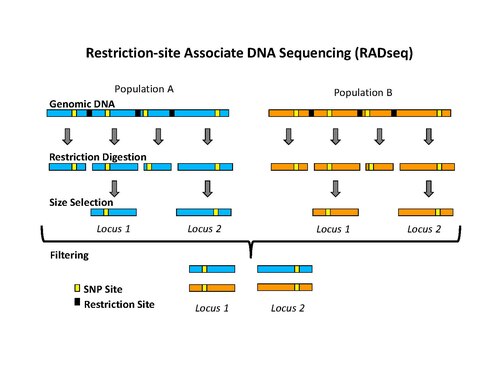
Genomic DNA is first digested with a specific restriction enzyme(s) to fragment the DNA. For restriction fragment length polymorphism (RFLP) analysis, these fragments are then visualized by gel electrophoresis. For RADseq, restriction fragments are ligated to an adapter that makes them readable by sequencing machines (not pictured), then fragments of a selected size range are sequenced using next-generation sequencing methods, aligned, and compared.

Restriction site associated DNA (RAD) markers are a type of genetic marker which are useful for association mapping, QTL-mapping, population genetics, ecological genetics and evolutionary genetics. The use of RAD markers for genetic mapping is often called RAD mapping. An important aspect of RAD markers and mapping is the process of isolating RAD tags, which are the DNA sequences that immediately flank each instance of a particular restriction site of a restriction enzyme throughout the genome.[1] Once RAD tags have been isolated, they can be used to identify and genotype DNA sequence polymorphisms mainly in form of single nucleotide polymorphisms (SNPs).[1] Polymorphisms that are identified and genotyped by isolating and analyzing RAD tags are referred to as RAD markers. Although genotyping by sequencing presents an approach similar to the RAD-seq method, they differ in some substantial ways.[2][3][4]

Isolation of RAD tags

[edit]

The use of the flanking DNA sequences around each restriction site is an important aspect of RAD tags.[1] The density of RAD tags in a genome depends on the restriction enzyme used during the isolation process.[5] There are other restriction site marker techniques, like RFLP or amplified fragment length polymorphism (AFLP), which use fragment length polymorphism caused by different restriction sites, for the distinction of genetic polymorphism. The use of the flanking DNA-sequences in RAD tag techniques is referred as reduced-representation method.[2]

The initial procedure to isolate RAD tags involved digesting DNA with a particular restriction enzyme, ligating biotinylated adapters to the overhangs, randomly shearing the DNA into fragments much smaller than the average distance between restriction sites, and isolating the biotinylated fragments using streptavidin beads.[1] This procedure was used initially to isolate RAD tags for microarray analysis.[1][6][7] More recently, the RAD tag isolation procedure has been modified for use with high-throughput sequencing on the Illumina platform, which has the benefit of greatly reduced raw error rates and high throughput.[5] The new procedure involves digesting DNA with a particular restriction enzyme (for example: SbfI, NsiI,…), ligating the first adapter, called P1, to the overhangs, randomly shearing the DNA into fragments much smaller than the average distance between restriction sites, preparing the sheared ends into blunt ends and ligating the second adapter (P2), and using PCR to specifically amplify fragments that contain both adapters. Importantly, the first adapter contains a short DNA sequence barcode, called MID (molecular identifier) that is used as a marker to identify different DNA samples that are pooled together and sequenced in the same reaction.[5][8] The use of high-throughput sequencing to analyze RAD tags can be classified as reduced-representation sequencing, which includes, among other things, RADSeq (RAD-Sequencing).[2]

Detection and genotyping of RAD markers

[edit]

Once RAD tags have been isolated, they can be used to identify and genotype DNA sequence polymorphisms such as single nucleotide polymorphisms (SNPs).[1][5] These polymorphic sites are referred to as RAD markers. The most efficient way to find RAD tags is by high-throughput DNA sequencing,[5][8] called RAD tag sequencing, RAD sequencing, RAD-Seq, or RADSeq.

Prior to the development of high-throughput sequencing technologies, RAD markers were identified by hybridizing RAD tags to microarrays.[1][6][7] Due to the low sensitivity of microarrays, this approach can only detect either DNA sequence polymorphisms that disrupt restriction sites and lead to the absence of RAD tags or substantial DNA sequence polymorphisms that disrupt RAD tag hybridization. Therefore, the genetic marker density that can be achieved with microarrays is much lower than what is possible with high-throughput DNA-sequencing.[9]

History

[edit]

RAD markers were first implemented using microarrays and later adapted for NGS (Next-Generation-Sequencing).[9] It was developed jointly by Eric Johnson and William Cresko's laboratories at the University of Oregon around 2006. They confirmed the utility of RAD markers by identifying recombination breakpoints in D. melanogaster and by detecting QTLs in threespine sticklebacks.[1]

ddRADseq

[edit]

In 2012 a modified RAD tagging method called double digest RADseq (ddRADseq) was suggested.[10][11] By adding a second restriction enzyme, replacing the random shearing, and a tight DNA size selection step it is possible to perform low-cost population genotyping. This can be an especially powerful tool for whole-genome scans for selection and population differentiation or population adaptation.[11]

hyRAD

[edit]

A study in 2016 presented a novel method called hybridization RAD (hyRAD),[12] where biotinylated RAD fragments, covering a random fraction of the genome, are used as baits for capturing homologous fragments from genomic shotgun sequencing libraries. DNA fragments are first generated using ddRADseq protocol applied to fresh samples, and used as hybridization-capture probes to enrich shotgun libraries in the fragments of interest. This simple and cost-effective approach allows sequencing of orthologous loci even from highly degraded DNA samples, opening new avenues of research in the field of museomics. Another advantage of the method is not relying on the restriction site presence, improving among-sample loci coverage. The technique was first tested on museum and fresh samples of Oedaleus decorus, a Palearctic grasshopper species, and later implemented in regent honeyeater,[13] arthropods,[14] among other species. A lab protocol was developed to implement hyRAD in birds.[15]

See also

[edit]

References

[edit]
Revisions and contributorsEdit on WikipediaRead on Wikipedia
from Grokipedia
Restriction site associated DNA (RAD) markers are short DNA fragments adjacent to the recognition sites of specific restriction enzymes, utilized as genetic markers to detect polymorphisms, particularly single nucleotide polymorphisms (SNPs), across the genome. These markers are generated by digesting genomic DNA with a restriction enzyme, ligating adapters to the resulting fragments, and selectively amplifying or sequencing the regions near the cut sites, providing a reduced representation of the genome that focuses on variable loci. This approach enables cost-effective, high-throughput genotyping without requiring a reference genome, making it particularly valuable for studying non-model organisms. The development of RAD markers began in the mid-2000s as a response to the need for efficient polymorphism discovery and mapping tools in diverse species. Initially described using microarray-based detection in 2007, the method was formalized and named "restriction site associated DNA" in a 2008 study that demonstrated its utility for bulk-segregant analysis and fine-scale genetic mapping in organisms like the threespine stickleback fish. The integration of next-generation sequencing technologies, such as Illumina platforms, rapidly advanced RAD into RAD-seq (RAD sequencing), allowing for the simultaneous discovery of thousands of SNPs in a single run and multiplexing of multiple samples via barcoded adapters. This evolution addressed limitations of earlier genotyping methods by reducing costs and increasing resolution, with early applications including trait mapping in fish and fungi. RAD markers and their sequencing variants have become staples in , (QTL) analysis, phylogenomics, and genomic selection across a wide range of taxa, from and animals to microbes. For instance, they facilitate the construction of high-density genetic maps, identification of adaptive loci under selection, and parentage analysis in wild populations where whole-genome sequencing is impractical. In , RAD-seq supports breeding programs by enabling rapid for traits like disease resistance in crops and . Despite their advantages in accessibility and scalability, challenges include potential biases from choice, which can unevenly sample the , and the need for bioinformatics pipelines to handle and alignment errors. Ongoing refinements, such as double-digest RAD-seq (ddRAD-seq), mitigate these issues by using paired enzymes for more uniform fragment size selection and improved coverage.

Fundamentals

Definition and Principles

Restriction site-associated DNA (RAD) markers are polymorphic DNA fragments adjacent to specific recognition sites within the , serving as a foundation for high-throughput single nucleotide polymorphism (SNP) discovery and without requiring full sequencing. This technique generates short, sequenceable DNA tags that capture near cut sites, enabling the identification of SNPs, insertions, deletions, and other polymorphisms. The underlying principles of RAD markers revolve around reduced-representation sequencing, a that samples only a modest fraction of the —typically 0.1-1%—by focusing on regions flanking restriction sites to prioritize areas rich in . Restriction enzymes, such as or SbfI, digest genomic DNA at predictable sequences, producing fragments that are selectively amplified and sequenced, thereby avoiding the sequencing of repetitive or low-variation genomic portions. This targeted approach enhances efficiency by concentrating resources on polymorphic loci, which are often clustered near restriction sites in diverse populations. RAD markers facilitate cost-effective genetic studies, especially in non-model organisms without reference genomes, by integrating with next-generation sequencing (NGS) platforms like Illumina for multiplexed sample processing via barcoded adapters. The resulting RAD tags—short sequences of 36-100 base pairs immediately downstream of the cut sites—allow for SNP detection through alignment to a or de novo assembly of reads, supporting applications in , linkage mapping, and evolutionary studies.

Biological and Technical Basis

Restriction site associated DNA (RAD) markers are generated through the targeted digestion of genomic DNA using type II restriction endonucleases, which recognize specific palindromic nucleotide sequences and cleave the DNA at or near these sites, producing overhangs known as sticky ends. These enzymes, such as EcoRI (which recognizes GAATTC) and SbfI (which recognizes CCTGCAGG), create consistent cut sites distributed across the genome, with SbfI typically cutting every approximately 65 kilobases in vertebrate genomes. The sticky ends generated by these cuts are essential for the subsequent ligation of adapters, which contain complementary overhangs to ensure specific attachment. Biologically, the efficacy of RAD markers arises from the conservation of restriction recognition sites within a or , contrasted with natural polymorphism in the adjacent flanking sequences. These sites remain largely invariant, but variations such as single polymorphisms (SNPs), insertions, deletions, or even disruptions at the cut site itself (observed in about 39% of cases in some analyses) enable the detection of genome-wide . This approach captures such variation without necessitating a , as the polymorphic regions—typically 200–300 base pairs flanking each site—yield informative markers, with roughly 20–30% of sites expected to be polymorphic in diverse populations at a diversity of 0.1%. From a technical standpoint, successful RAD marker production demands high-quality DNA extraction, often using kits like the DNeasy Tissue Kit, to provide 0.1–1 micrograms of intact genomic DNA per sample for efficient enzymatic digestion. Adapter ligation incorporates barcoded sequences (molecular identifiers) to the sticky ends of restriction fragments, facilitating multiplexing of up to 96 or more samples in a single sequencing run. Post-ligation, the DNA is sheared (e.g., via nebulization) and subjected to size selection, typically enriching for 200–500 base pair fragments via gel purification, to optimize compatibility with next-generation sequencing platforms such as Illumina. Unlike random shearing methods employed in whole-genome , which fragment DNA non-specifically and lead to variable coverage across samples, the RAD protocol combines precise enzymatic with controlled shearing to generate fragments that consistently originate from restriction sites. This targeted strategy ensures high reproducibility, as the same loci are sampled across individuals, with studies demonstrating consistent recovery of 50,000–150,000 tags per sample in over 68% of cases.

Methodology

Isolation of RAD Tags

The isolation of RAD tags is the foundational laboratory step in restriction site associated DNA (RAD) sequencing workflows, generating a reduced representation library of short DNA fragments flanking specific restriction sites to facilitate high-throughput . The process starts with high-quality genomic DNA (typically 100–1000 ng per sample), which is digested using a rare-cutting such as SbfI (recognizing CCTGCAGG, an 8-bp site occurring approximately every 65 kb in random DNA). This initial cut produces large fragments with 3' overhangs of TGCA, selectively sampling the genome at to control overall complexity. Immediately following or simultaneously, a frequent-cutting like MseI (recognizing TTAA, a 4-bp site occurring every 256 ) is applied to trim these fragments into shorter tags (usually 200–700 bp), creating 5' overhangs of TAA and defining the tag length as the genomic distance between the rare and frequent cut sites. To prepare the ends for adapter ligation, the overhangs are partially filled in using (3'→5' exo⁻) in the presence of selected dNTPs (dGTP and dCTP for SbfI overhangs, dATP for MseI), converting the sticky ends to blunt or semi-compatible configurations while preserving the restriction site for potential downstream verification. Barcoded adapters are then ligated to these ends using T4 under dilute conditions to minimize self-ligation. The barcoded (often compatible with the rare cutter end) incorporates a unique 5–8 bp inline for sample identification, along with Illumina-compatible P1 and P2 sequences for paired-end sequencing and flow cell binding; the P2 is typically Y-shaped to prevent dimer formation. This enables of up to 96 samples per Illumina sequencing by pooling libraries post-ligation, reducing costs and allowing parallel processing of large cohorts. Complexity is further managed through size-selective purification to isolate fragments of optimal length (e.g., 300–500 bp including adapters), using either agarose gel electrophoresis followed by excision and extraction or magnetic bead-based cleanup (e.g., AMPure XP beads at 0.5–1.8× ratios) to remove unincorporated adapters, small off-target fragments, and multimers. These steps ensure >90% of sequenced reads map to intended RAD loci, minimizing mitochondrial or repetitive DNA contamination. Protocol optimization accounts for genome size, with the expected number of RAD tags approximated by (genome size × combined restriction site frequency) / average fragment length; for instance, a 500 Mb genome with SbfI-MseI digestion and 400 bp tags yields roughly 10,000–20,000 unique loci, adjustable by enzyme choice or adapter concentration to balance coverage and cost.

Detection and Genotyping of RAD Markers

Following the preparation of RAD libraries through adapter ligation, the detection of restriction site associated DNA (RAD) markers involves short-read next-generation sequencing (NGS), typically using platforms like Illumina to generate millions of reads per sample. These reads, often 50–150 base pairs in length and produced in paired-end mode (e.g., 100 bp paired-end), capture fragments adjacent to restriction sites, with unique barcodes in the adapters enabling demultiplexing of multiplexed samples post-sequencing. This process yields high-throughput data, where each sample receives sufficient reads to cover thousands of loci, facilitating the identification of single nucleotide polymorphisms (SNPs) across the genome. The bioinformatics pipeline for processing RAD sequencing data begins with quality filtering to remove low-quality reads and adapter contaminants, followed by either de novo assembly of loci or mapping to a reference genome. Widely adopted software such as STACKS performs these steps by clustering reads into putative loci based on shared restriction sites and sequence similarity, then calling SNPs at read depths typically ranging from 20–50× per locus to ensure reliable variant detection. For de novo approaches, parameters like minimum read depth and mismatch allowances are optimized to account for biological variation, while reference-based mapping uses tools integrated with STACKS to align reads and identify polymorphisms. Genotyping of RAD markers assigns diploid genotypes (homozygous reference, heterozygous, or homozygous alternate) using methods that handle uneven coverage and potential inherent to reduced-representation sequencing. Fixed-threshold approaches score alleles based on the presence or absence of reads supporting each , often requiring a minimum proportion (e.g., one-third) of the peak read depth for calling. Alternatively, probabilistic models, such as maximum likelihood or Bayesian frameworks in STACKS, estimate genotype likelihoods by modeling read depth distributions and allele frequencies, improving accuracy for low-coverage loci. , arising from sampling or restriction site absence, is managed by filtering loci with excessive gaps or imputing based on population-level patterns. Error rates in RAD genotyping are minimized through replicate sequencing at each locus, which provides redundancy to detect and correct sequencing or PCR-induced artifacts, often achieving per-locus error rates below 1% with adequate coverage. The pipeline culminates in output files, such as (VCF), containing thousands to tens of thousands of SNPs per dataset, ready for downstream genetic analyses.

Variants

ddRAD-seq

Double-digest restriction site-associated DNA sequencing (ddRAD-seq) is a cost-effective variant of restriction site-associated DNA (RAD) sequencing designed for de novo single nucleotide polymorphism (SNP) discovery and in model and non-model species. Introduced by Peterson et al. in 2012, ddRAD-seq streamlines library preparation by simultaneously digesting genomic DNA with two restriction enzymes—one rare-cutting, such as (recognizing GAATTC), and one frequent-cutting, such as NlaIII (recognizing CATG) or MspI (recognizing CCGG)—to generate a predictable set of DNA fragments with compatible overhangs. This approach avoids the partial digestion and random shearing steps of original RAD methods, resulting in reduced representation libraries that capture hundreds to thousands of loci with high uniformity. The core protocol begins with the double enzymatic digestion of approximately 100–1000 ng of high-quality genomic DNA, followed by the ligation of two types of Y-shaped adapters: one specific to the rare cutter (e.g., P1 adapter for EcoRI) and a universal adapter for the frequent cutter (e.g., P2 adapter for NlaIII). These adapters incorporate sample-specific barcodes and Illumina sequencing primer sites, enabling multiplexing of up to 48 samples per library through combinatorial indexing. The ligated fragments are then purified and subjected to size selection, typically excising a narrow range such as 300–500 bp from an agarose gel or using automated systems, to isolate the desired fragments while excluding uncut DNA and very short or long products. Subsequent steps include PCR amplification (8–12 cycles) with indexed primers to add multiplexing indices, followed by normalization, pooling, and sequencing on Illumina platforms, yielding 200,000–500,000 reads per individual to cover 10,000–30,000 loci depending on genome size and enzyme choice. Key advantages of ddRAD-seq include minimized genomic complexity through predictable fragment sizes, which enhances reproducibility across samples and laboratories, and eliminates biases associated with random fragmentation. The method requires no prior genomic reference, has a hands-on preparation time of about 8 hours, and achieves per-sample costs as low as $5 for library construction, making it accessible for studies involving small genomes or limited funding. It is particularly well-suited for applications, where it sequences approximately 0.1% of the to generate sufficient polymorphic markers for robust analysis. proceeds via standard RAD pipelines, such as de novo assembly and variant calling using tools like Stacks or custom scripts for barcode demultiplexing and locus clustering.

hyRAD

hyRAD, or hybridization RAD, is a targeted capture method that extends restriction site associated DNA (RAD) sequencing to low-input or degraded samples, such as those from museum specimens or ancient DNA, by using probes derived from RAD libraries to enrich orthologous genomic fragments. Developed by Suchan et al. in 2016, the technique addresses limitations in direct RAD application to fragmented DNA by decoupling probe generation from target library preparation, allowing the use of high-quality reference DNA for probes while capturing homologous loci from poor-quality targets. The protocol begins with the creation of a RAD library from fresh DNA of a reference species, typically using double-digest restriction enzymes like MseI and SbfI to generate short fragments around 270 bp, which are then size-selected and amplified. These RAD amplicons serve as templates for probe synthesis: biotinylated DNA probes via nick translation labeling. The probes are hybridized to a shotgun library prepared from the target degraded DNA, and bound fragments are captured using streptavidin-coated magnetic beads, followed by washing to remove off-target material and subsequent PCR amplification for sequencing. This approach enables cross-species application without requiring a full reference genome, as the RAD-derived probes target conserved restriction sites and flanking sequences likely to have orthologs. hyRAD demonstrates high efficacy on degraded samples, recovering thousands of single nucleotide polymorphisms (SNPs) from specimens up to 100 years old, with matrix completeness around 63% across datasets from non-model organisms like and sedges. It achieves substantial on-target enrichment, yielding datasets with reduced off-target sequencing compared to unbiased methods, and supports phylogenetic analyses across broad evolutionary distances by prioritizing orthologous loci. A variant, HyRAD-X, introduced in 2017 by Schmid et al., integrates hyRAD with capture by generating RNA probes from cDNA-derived RAD libraries of expressed genes via in vitro transcription using T7 with incorporation, further enhancing locus recovery and SNP accuracy in contexts, such as subfossil plant material over 5,000 years old, producing hundreds of exome-targeted SNPs.

Other Variants

Other notable variants of RAD markers include 2b-RAD, which uses type IIB restriction enzymes to produce uniform-length tags without size selection, and genotyping-by-sequencing (GBS), a streamlined multiplexing approach for high-throughput primarily in . These methods offer alternatives for specific applications like reduced bias in fragment length or large-scale population studies.

History

Origins and Early Development

Restriction site associated DNA (RAD) markers emerged in 2007–2008 during the early adoption of next-generation sequencing (NGS) technologies, which promised to democratize but remained costly for whole-genome sequencing of non-model organisms such as . With sequencing costs of approximately $150 million per human-sized genome in 2007—far higher than today's levels—the focus shifted to reduced-representation approaches that sampled specific genomic regions to generate thousands of markers for genetic studies without requiring a . This innovation was particularly motivated by the need for efficient SNP discovery in species like the threespine stickleback (Gasterosteus aculeatus), where traditional methods were labor-intensive and limited in scale. The method was first formalized by Miller et al. in 2007, who developed RAD markers through digestion followed by ligation of biotinylated adapters and hybridization for polymorphism detection. Applied to for bulk-segregant of lateral plate armor traits and to for mapping recombination breakpoints, this approach enabled the cost-effective identification of thousands of genetic markers, bypassing the need for extensive prior sequencing. The technique relied on enzymes like to target thousands of sites in the stickleback genome, producing approximately 2,000 polymorphic markers for high-throughput analysis. Building on this foundation, Baird et al. in 2008 introduced sequenced RAD markers by adapting the protocol for NGS, using the Illumina Genome Analyzer to directly sequence restriction fragments after digestion and ligation with sample-specific barcodes. In , this yielded over 13,000 SNPs for high-density genetic mapping of traits like pelvic girdle reduction; a parallel application in confirmed its versatility for induced mutation mapping. The integration of reduced per-sample costs, making genome-wide feasible at scale. The primary aim of early RAD development was to support QTL mapping and linkage analysis in organisms without assembled genomes, providing a scalable tool for evolutionary and . Initial challenges included achieving even sequencing depth across restriction sites to avoid bias and handling the bioinformatics for short-read alignment, though Illumina's low substitution error rate (~0.1%) offered advantages over prior platforms like 454 , which suffered higher indel errors. These advancements laid the groundwork for broader adoption in non-model systems.

Key Advancements and Adoption

Following the initial development of restriction site-associated DNA (RAD) sequencing, significant advancements emerged in analytical software, enabling more efficient processing of the resulting data for de novo assembly and without a . A pivotal contribution was the introduction of the STACKS pipeline in 2011, which standardized workflows for identifying single nucleotide polymorphisms (SNPs) and computing population genetic statistics from RAD-seq datasets. This open-source toolset facilitated the analysis of thousands of markers across populations, becoming a cornerstone for subsequent RAD-based studies in non-model organisms. Parallel to software improvements, methodological variants were developed to address limitations in cost, sample quality, and enzymatic specificity, expanding RAD's applicability from 2012 onward. Double-digest RAD sequencing (ddRAD-seq), introduced in 2012, employed a second restriction enzyme to generate more uniform fragment sizes, reducing sequencing costs and PCR duplication biases compared to the original protocol. That same year, 2b-RAD was proposed, utilizing type IIB restriction enzymes like BsaXI to produce fixed-length tags directly adjacent to cut sites, simplifying library preparation and enabling high-density genotyping at lower depths. By 2016, hybridization RAD (hyRAD) was developed to handle degraded DNA from preserved specimens, such as museum samples, by using RAD probes for targeted capture of orthologous loci, thus broadening access to historical genetic data. Subsequent updates to analysis pipelines, such as enhanced versions of STACKS in the late 2010s, and hybrid approaches combining RAD with long-read technologies, further solidified RAD-seq's role in genomics as of 2025. These innovations drove widespread adoption of RAD markers in , particularly as next-generation sequencing platforms like Illumina became dominant, slashing per-base costs by over 100-fold between 2008 and 2015 and making large-scale experiments feasible for ecological and evolutionary . By 2016, hundreds of publications had utilized RAD-seq approaches, reflecting its integration into mainstream reduced-representation sequencing strategies. A 2011 review by Davey et al. further established RAD as a foundational technique for marker discovery and , emphasizing its efficiency in generating -wide data from limited resources.

Applications

Population Genetics and Phylogenetics

Restriction site associated DNA (RAD) markers play a pivotal role in by providing thousands of single nucleotide polymorphisms (SNPs) for high-resolution analysis of , structure, and . This genome-wide sampling enables precise calculations of differentiation metrics such as FST and detection of admixture events, particularly in non-model where traditional markers like microsatellites fall short in power. For example, a 2019 study on European scallops (Pecten maximus) utilized RAD sequencing to identify 82,439 high-quality SNPs across 240 individuals from 14 sites, revealing fine-scale population structure with pairwise FST values of 0.02–0.05 between Atlantic and Norwegian lineages, and evidence of admixture in aquaculture-influenced populations. Such applications demonstrate RAD's capacity to uncover subtle genetic signals, including estimates and signatures of local , as seen in associations with environmental variables like . In phylogenetics, RAD markers facilitate de novo phylogenomics by generating datasets from thousands of orthologous loci, excelling at resolving recent divergences and mitigating issues like incomplete lineage sorting that plague multi-locus Sanger sequencing. A landmark 2015 study on octocorals in the genus Paragorgia applied RAD sequencing to 44 specimens, yielding 5,997 loci with at least 75% taxon coverage, which unambiguously resolved phylogenetic relationships among taxa diverged over 80 million years ago and delimited nine species—including cryptic ones tied to depth and geography—rejecting prior morphology-based classifications. This approach outperforms few-locus markers by reducing stochastic error through dense genomic coverage, producing well-supported trees via methods like maximum likelihood with bootstrap values often exceeding 90%. The high number of loci (often 10,000+) obtainable with RAD sequencing minimizes ascertainment bias inherent in targeted markers, enhancing resolution for shallow evolutionary timescales in non-model taxa. RAD has been utilized in numerous studies for and , underscoring its transformative role in evolutionary inference across diverse ecosystems, from to .

Genetic Mapping and QTL Analysis

Restriction site associated DNA (RAD) markers, primarily in the form of single nucleotide polymorphisms (SNPs), serve as effective anchors for constructing high-density linkage maps in various organisms, enabling resolutions typically ranging from 1 to 5 cM. In plants, RAD sequencing has been instrumental in generating maps with thousands to tens of thousands of markers, facilitating precise localization of genes and quantitative trait loci (QTLs) for (MAS). For instance, in , RAD-seq identified 966 SNPs to map a stem rust resistance locus on 7AL, producing a genetic spanning 13.4 cM with markers suitable for breeding Ug99-resistant varieties. These high-density maps enhance breeding efficiency by allowing the selection of favorable alleles in early generations, thereby shortening breeding cycles compared to traditional methods. In QTL analysis, RAD-derived SNPs enable association mapping to pinpoint loci controlling quantitative traits, often integrating with genome-wide association studies (GWAS) through software like , which handles large SNP datasets for analysis. This approach has been applied to identify growth-related QTLs in species, such as in the red-spotted , where a RAD-seq map with 3,435 SNPs across 24 linkage groups (total length 2,300.12 cM, average 0.67 cM interval) detected 17 significant QTLs for body length, , and full length, each explaining 10.7–12.9% of phenotypic variation. Such mappings support by linking genetic variants to economically important traits, aiding programs. A key innovation in RAD-based mapping is bin mapping, which collapses closely linked RAD loci into recombination bins to manage high marker density while preserving accuracy. In soybean, RAD-seq yielded 47,472 SNPs that were grouped into 2,639 bins (average 1.00 cM spacing, total map 2,638.24 cM), reducing computational demands for construction and QTL detection without losing resolution for identifying 60 yield- and quality-related QTLs. Since the introduction of RAD-seq in , this technology has enabled ultrahigh-density maps in , exemplified by studies incorporating over 10,000 markers to accelerate trait dissection and breeding applications.

References

Add your contribution
Related Hubs
User Avatar
No comments yet.