Hubbry Logo
Rex HarrisonRex HarrisonMain
Open search
Rex Harrison
Community hub
Rex Harrison
logo
8 pages, 0 posts
0 subscribers
Be the first to start a discussion here.
Contribute something
Rex Harrison
Rex Harrison
from Wikipedia

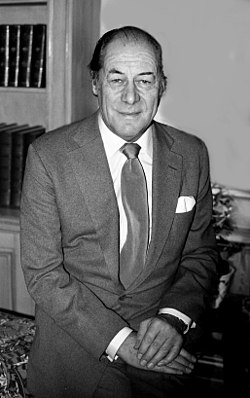
Sir Reginald Carey Harrison (5 March 1908 – 2 June 1990) was an English actor. Harrison began his career on the stage at the Liverpool Playhouse in 1924. He made his West End debut in 1936 appearing in the Terence Rattigan play French Without Tears, in what was his breakthrough role. He won his first Tony Award for Best Actor in a Play for his performance as Henry VIII in the Broadway play Anne of the Thousand Days in 1949. He returned to Broadway portraying Professor Henry Higgins in My Fair Lady (1956) where he won the Tony Award for Best Actor in a Musical.

Key Information

In addition to his stage career, Harrison also appeared in numerous films. His first starring role opposite Vivien Leigh was in the romantic comedy Storm in a Teacup (1937). Receiving critical acclaim for his performance in Major Barbara (1941), which was shot in London during the Blitz, his roles since then included Blithe Spirit (1945), Anna and the King of Siam (1946), The Ghost and Mrs. Muir (1947), Cleopatra (1963), My Fair Lady (1964), reprising his stage role as Henry Higgins which won him an Academy Award for Best Actor, and the titular character in Doctor Dolittle (1967).

In 1975, Harrison released his first autobiography. In June 1989, he was knighted by Queen Elizabeth II. He was married six times and had two sons: Noel and Carey Harrison. He continued working in stage productions until shortly before his death from pancreatic cancer in June 1990 at the age of 82. His second autobiography, A Damned Serious Business: My Life in Comedy, was published posthumously in 1991.

Early life

[edit]

Reginald Carey Harrison was born on 5 March 1908 at Derry House in Huyton, Lancashire,[1] the son of Edith Mary (née Carey) and William Reginald Harrison, a cotton broker.[2] From the age of 10 he went by the name “Rex”, which he adopted for himself.[3] He was the youngest of three children and had two older sisters, Edith Marjorie Harrison (1900-1976) and Sylvia Sackville, Countess De La Warr, DBE (1903-1992).[4][5] He was educated at Birkdale preparatory school and Liverpool College.[3] After a bout of childhood measles, Harrison lost most of the sight in his left eye.[3] He showed an early desire to become an actor, with regular appearances in school plays, and visits to the Liverpool Playhouse.[3]

Stage career

[edit]
Playhouse Theatre, Liverpool where Harrison made his stage debut in 1924

Harrison first appeared on stage in 1924 in Thirty Minutes in a Street at the Liverpool Playhouse, when he was 16 years old. He remained there, playing small parts, until 1927 when he joined a touring production of Charley's Aunt. Six years of touring and repertory followed. He achieved critical acclaim for Heroes Don't Care in 1936. His West End debut in the same year was in Terence Rattigan's French Without Tears which proved to be his breakthrough stage role as a leading light comedian.[3] His acting career was interrupted by World War II, during which he served in the Royal Air Force (1942–1944), reaching the rank of Flight Lieutenant.[6]

Harrison as Professor Henry Higgins alongside Julie Andrews as Eliza Doolittle in the musical My Fair Lady

He alternated appearances in London and New York in such plays as Bell, Book and Candle (1950), Venus Observed, The Cocktail Party, The Kingfisher and The Love of Four Colonels, which he also directed.[7] He won his first Tony Award for his appearance at the Shubert Theatre as Henry VIII in Maxwell Anderson's play Anne of the Thousand Days and international superstardom (and a second Tony) for his portrayal of Henry Higgins in the 1956 stage musical My Fair Lady, where he appeared opposite Julie Andrews.

Later appearances included a 1984 appearance at the Haymarket Theatre with Claudette Colbert in Frederick Lonsdale's Aren't We All?, and one on Broadway at the Brooks Atkinson Theatre presented by Douglas Urbanski, at the Haymarket in J. M. Barrie's The Admirable Crichton with Edward Fox. He returned as Henry Higgins in the revival of My Fair Lady directed by Patrick Garland in 1981.

Having retired from films after A Time to Die in 1983, Harrison continued to act on Broadway and the West End until the end of his life, despite suffering from glaucoma, painful teeth, and a failing memory.[8] Later roles included Julius Caesar in Caesar and Cleopatra, and General Burgoyne in a Los Angeles production of The Devil's Disciple. He was nominated for a third Tony Award in 1984 for his performance as Captain Shotover in the revival of George Bernard Shaw's Heartbreak House. He followed with two successful pairings with Claudette Colbert, The Kingfisher in 1985 and Aren't We All? in 1986. In 1989, he appeared with Edward Fox in The Admirable Crichton in London. In 1989/90, he appeared on Broadway in The Circle by W. Somerset Maugham, opposite Glynis Johns, Stewart Granger, and Roma Downey.[9] The production opened at Duke University for a three-week run followed by performances in Baltimore and Boston before opening 14 November 1989 on Broadway.[10][11]

Film career

[edit]

Harrison's film debut was in The Great Game (1930) and he had a bit part in The School for Scandal (1930).

He had support roles in Get Your Man (1934), Leave It to Blanche (1934), and All at Sea (1935), and a better part in Men Are Not Gods (1936) as a reporter in love with Miriam Hopkins; this was the first time Harrison worked for Alexander Korda.

Leading man

[edit]

Harrison's first starring role was in the romantic comedy Storm in a Teacup (1937), opposite Vivien Leigh, for Korda.[12][13] He starred in School for Husbands (1937) then reteamed with Leigh in St. Martin's Lane (1938).

Harrison had a key support role in The Citadel (1938) for MGM and starred in a comedy for Korda, Over the Moon (1939) alongside Merle Oberon. He starred in some thrillers: The Silent Battle (1939), Ten Days in Paris (1940) and Night Train to Munich (1940), the latter directed by Carol Reed and co starring Margaret Lockwood.

Harrison played Adolphus in Major Barbara (1941)—filmed in London during The Blitz of 1940, a role for which he received critical acclaim, and a success at the British box office. He was then absent from screens due to war service (1942–1944).[6]

Harrison returned to films as the lead in Blithe Spirit (1945), from the play by Noël Coward, directed by David Lean. Coward described him as "The best light comedy actor in the world—except for me."[14]

Harrison appeared opposite Anna Neagle in I Live in Grosvenor Square (1945) which was another big hit. Also popular was The Rake's Progress (1946), directed by Sidney Gilliat.

20th Century Fox

[edit]

Harrison received an offer from 20th Century Fox to star in Anna and the King of Siam (1946) in Hollywood. Harrison signed a long-term contract with Fox.

Anna was popular, as was The Ghost and Mrs. Muir (1947) with Gene Tierney and The Foxes of Harrow (1947) with Maureen O'Hara. Escape (1949) reunited Harrison with Joseph L. Mankiewicz who had made Ghost and Mrs Muir.

Return to England

[edit]

Back in England, he appeared in The Long Dark Hall (1951) opposite his then wife Lilli Palmer. They co-starred in an adaptation of The Four Poster (1952).

In Hollywood, he made his first action film, the medieval epic King Richard and the Crusaders (1954) playing Saladin.

In England, Harrison was in The Constant Husband (1955) for Sidney Gilliat and British Lion. It was a hit at the box office.

America

[edit]

Harrison was offered top billing in MGM's The Reluctant Debutante (1958) alongside his wife Kay Kendall.

He co-starred opposite Doris Day in Midnight Lace (1960) and Rita Hayworth in The Happy Thieves (1961).

Harrison as Julius Caesar in Cleopatra (1963) for which he was nominated for an Academy Award

Harrison received an offer from Joseph L. Mankiewicz to play Julius Caesar in the 20th Century Fox epic Cleopatra (1963).

In 1964 Harrison reprised his 1956 stage performance as Henry Higgins in My Fair Lady, for which he won an Oscar for Best Actor.

He was one of several stars in the popular The Yellow Rolls-Royce (1964), and played the Pope opposite Charlton Heston in Fox's The Agony and the Ecstasy (1965), for Carol Reed.

Harrison starred in 1967's Doctor Dolittle. At the height of his box office fame after the success of My Fair Lady, Harrison proved a temperamental force during production, demanding auditions for prospective composers after musical playwright Leslie Bricusse was contracted[15] and demanding to have his singing recorded live during shooting, only to agree to have it rerecorded in post-production.[16] He also disrupted production by engaging in incidents with his then wife, Rachel Roberts, and through other deliberate misbehaviour, such as intentionally moving his yacht in front of cameras during shooting in St Lucia and refusing to move it out of sight, all prompted by contract disputes.[17] Harrison was at one point temporarily replaced by Christopher Plummer, until he agreed to be more cooperative.[18] Harrison was not by any objective standards a singer and the talking on pitch style he used in My Fair Lady was adopted by many other classically trained actors with limited vocal ranges; the music was written to allow for long periods of recitative, or "speaking to the music". Nevertheless "Talk to the Animals", which Harrison performed in Doctor Dolittle, won the Academy Award for Best Original Song in 1967. In a rare coincidence the very next year his son Noel Harrison sang the song that won the Academy Award for Best Original Song, "The Windmills of Your Mind."

Harrison reunited with Mankiewicz in The Honey Pot (1967), a modern adaptation of Ben Jonson's play Volpone. Two of his co-stars, Maggie Smith and Cliff Robertson, were to become lifelong friends. Both spoke at his New York City memorial at the Little Church Around the Corner when he died in 1990.

Harrison made two more films for 20th Century Fox, both expensive play adaptations that failed at the box office: A Flea in Her Ear (1968), and Staircase (1969).[19]

Later film career

[edit]

After a break from screen acting, Harrison appeared in The Prince and The Pauper (1977) and a Hindi film, Shalimar, alongside Indian Bollywood stars Dharmendra and Zeenat Aman. He had small roles in Ashanti (1979), The Fifth Musketeer (1979) and A Time to Die (shot 1979), his last film.

Personal life

[edit]

Alexander Walker wrote: "in looks and temperament, Rex went back to the Elizabethans. They would have called him 'a man of passionate parts'. His physique and looks were far more striking once middle age had literally stretched too smooth and callow a youthful face into a long, saturnine physiognomy, whose hooded eyes and wide mouth had satyr-like associations for some people."[20]

Harrison was married six times. In 1942, he divorced his first wife, Noel Margery Colette Thomas, and married actress Lilli Palmer the next year; they later appeared together in numerous plays and films, including The Four Poster.[21] Whilst married to Palmer, he built a villa at Portofino, San Genesio, where over the years he hosted showbiz royalty including Laurence Olivier, Vivien Leigh and John Gielgud and royalty, the Duke of Windsor and his wife the Duchess.

In 1947, while married to Palmer, Harrison began an affair with actress Carole Landis. Landis took her own life in 1948 after spending the evening with Harrison.[22] Harrison's involvement in the scandal by waiting several hours before calling a doctor and police[23] briefly damaged his career and his contract with Fox was ended by mutual consent.[24]

In 1955, Harrison starred opposite Kay Kendall in The Constant Husband, and they had an affair.[25] When he learned that Kendall had been diagnosed with myeloid leukaemia, he and Palmer agreed to divorce so that he could marry Kendall and provide for her care.[26] Harrison and Palmer divorced in 1957 and he married Kendall the same year. Kendall died of myeloid leukaemia in 1959.[27] Terence Rattigan's 1973 play In Praise of Love was written about the end of this marriage, and Harrison appeared in the New York production playing the character based on himself. Rattigan was said to be "intensely disappointed and frustrated" by Harrison's performance, as "Harrison refused to play the outwardly boorish parts of the character and instead played him as charming throughout, signalling to the audience from the start that he knew the truth about [the] illness."[28] Critics, however, were quite pleased with the performance and although it did not have a long run it was yet another of Harrison's well-plotted naturalistic performances.

He was subsequently married to Welsh actress Rachel Roberts from 1962 to 1971. Harrison then married Elizabeth Rees-Williams, divorcing in 1975; finally, in 1978, he married Mercia Tinker, his sixth and final wife.[29] In 1980, despite his having married twice since their divorce, Roberts made a final attempt to win Harrison back, which proved to be futile; she took her own life that same year.[30]

Harrison's elder son, Noel Harrison, became an Olympic skier, singer and occasional actor; he toured in several productions including My Fair Lady in his father's award-winning role; Noel died suddenly of a heart attack on 19 October 2013 at age 79. Rex's younger son, Carey Harrison, was a playwright and social activist. He died of a heart attack on 22 January 2025,[3] at age 80.

Harrison's sister Sylvia was married to the 1st Earl of Kilmuir (better known to history as Sir David Maxwell Fyfe), a lawyer, Conservative politician and judge who was successively the lead British prosecutor at Nuremberg, Home Secretary and Lord Chancellor (head of the English judiciary); after his death she married another Cabinet minister, the 9th Earl De La Warr.

Chronology of Harrison's six marriages:

  • Noel M Colette-Thomas, 1934–1942 (divorced); one son, the actor/singer Noel Harrison, (29 January 1934 – 19 October 2013)
  • Lilli Palmer, 1943–1957 (divorced); one son, the novelist/playwright Carey Harrison (19 February 1944 – 22 January 2025).
  • Kay Kendall, 1957–1959 (her death)
  • Rachel Roberts, 1962–1971 (divorced)
  • Elizabeth Rees-Williams, 1971–1975 (divorced)
  • Mercia Tinker, 1978–1990 (his death)

Grandchildren:

  • Granddaughters: Cathryn, Harriott, Chloe, Chiara, Rosie, Faith
  • Grandsons: Will, Simon, Sam

Harrison owned properties in London, New York City and Portofino, Italy. His villa in Portofino was named San Genesio after the patron saint of actors.[31]

Death

[edit]

Harrison died from the effects of pancreatic cancer at his home in Manhattan, New York City, on 2 June 1990 at the age of 82. He had been diagnosed with the disease only a short time before. The stage production in which he was appearing at the time, The Circle, came to an end upon his death.[32] His body was cremated and his ashes were scattered in Portofino.

Harrison's second autobiography, A Damned Serious Business: My Life in Comedy, was published posthumously in 1991.

Filmography

[edit]

Film

[edit]
Year Title Role Notes
1930 The Great Game George
The School for Scandal Bit Part Uncredited
1934 Get Your Man Tom Jakes
Leave It to Blanche Ronnie
1935 All at Sea Aubrey Bellingham
1936 Men Are Not Gods Tommy Stapleton
1937 Storm in a Teacup Frank Burdon
School for Husbands Leonard Drummond
1938 Sidewalks of London, Harley Prentiss aka St. Martin's Lane
The Citadel Dr. Frederick Lawford
1939 Over the Moon Dr. Freddie Jarvis
The Silent Battle Jacques Sauvin
1940 Ten Days in Paris Bob Stevens
Night Train to Munich Gus Bennett / "Dickie Randall"
1941 Major Barbara Adolphus Cusins
1945 Blithe Spirit Charles Condomine
I Live in Grosvenor Square Major David Bruce
Journey Together Guest Uncredited
The Rake's Progress Vivian Kenway
1946 Anna and the King of Siam King Mongkut
1947 The Ghost and Mrs. Muir Captain Daniel Gregg
The Foxes of Harrow Stephen Fox
1948 Escape Matt Denant
Unfaithfully Yours Sir Alfred De Carter
1951 The Long Dark Hall Arthur Groome
1952 The Four Poster John Edwards
1953 Main Street to Broadway Himself
1954 King Richard and the Crusaders Emir Hderim Sultan Saladin
1955 The Constant Husband William Egerton
1958 The Reluctant Debutante Jimmy Broadbent
1960 Midnight Lace Anthony "Tony" Preston
1961 The Happy Thieves Jimmy Bourne
1963 Cleopatra Julius Caesar
1964 My Fair Lady Professor Henry Higgins
The Yellow Rolls-Royce Lord Charles Frinton – The Marquess of Frinton
1965 The Agony and the Ecstasy Pope Julius II
1967 The Honey Pot Cecil Sheridan Fox
Doctor Dolittle Dr. John Dolittle
1968 A Flea in Her Ear Victor Chandebisse / Poche
1969 Staircase Charles Dyer
1977 Crossed Swords The Duke of Norfolk
1978 Shalimar Sir John Locksley
1979 Ashanti Brian Walker
The Fifth Musketeer Colbert
1982 A Time to Die Van Osten

Television

[edit]
Year Title Role Notes
1952 Omnibus Henry VIII Episode: The Trial of Anne Boleyn
1953 The United States Steel Hour Raymond Dabney Episode: The Man in Possession
1957 DuPont Show of the Month Mr. Sir Episode: Crescendo
1960 Dow Hour of Great Mysteries Cyril Paxton Episode: The Dachet Diamonds
1971–1973 Play of the Month Mikhail Platonov, schoolmaster
Don Quixote
2 episodes
1974 Rex Harrison Presents Stories of Love Host, himself Pilot-Television film
1983 The Kingfisher Cecil Television film
1985 Heartbreak House Captain Shotover Television film
1986 Anastasia: The Mystery of Anna Grand Duke Cyril Romanov Television film, (final film role)

Theatre

[edit]
Date[33] Production Role Venue
4–25 March 1936 Sweet Aloes Tubbs Barrow
6 November 1936 French Without Tears Alan Howard
8 December 1948 – 8 October 1949 Anne of the Thousand Days Henry
14 November 1950 – 2 June 1951 Bell, Book and Candle Shepherd Henderson
13 February – 26 April 1952 Venus Observed Hereward
15 January – 16 May 1953 The Love of Four Colonels The Man
15 March 1956 – 29 September 1962 My Fair Lady Henry Higgins
8 December 1959 – 20 February 1960 The Fighting Cock The General
28 March – 28 April 1973 The Living Mask Henry IV
10 December 1974 – 31 May 1975 In Praise of Love Sebastian Cruttwell
1976 Monsieur Perichon's Travels Eugène Labiche & Edouard Martin
24 February – 5 March 1977 Caesar and Cleopatra Julius Caesar
6 December 1978 – 13 May 1979 The Kingfisher Cecil
16 September 1980 – 29 November 1981 My Fair Lady Henry Higgins
7 December 1983 – 5 February 1984 Heartbreak House Captain Shotover
29 April – 21 July 1985 Aren't We All? Lord Grenham
20 November 1989 – 20 May 1990 The Circle Lord Porteous

Radio

[edit]
Year Title Role Notes
1951 The Private Files of Rex Saunders Main Role
1952 Philip Morris Playhouse Episode: The Gioconda Smile[34]
1952 Theatre Guild on the Air Episode: An Ideal Husband[35]
1953 Star Playhouse No Time for Comedy[36]
1953 Star Playhouse Twentieth Century[37]

Honours and legacy

[edit]
Year Award Category Nominated work Result Ref.
1963 Academy Awards Best Actor Cleopatra Nominated [38]
1964 My Fair Lady Won [39]
1965 British Academy Film Awards Best British Actor Nominated [40]
1965 David di Donatello Awards Best Foreign Actor Won [41]
1984 Drama Desk Awards Outstanding Actor in a Play Heartbreak House Nominated [42]
1985 Special Award Won [43]
1963 Golden Globe Awards Best Actor in a Motion Picture – Drama Cleopatra Nominated [44]
1964 Best Actor in a Motion Picture – Musical or Comedy My Fair Lady Won
1966 World Film Favorite – Male Won
Best Actor in a Motion Picture – Drama The Agony and the Ecstasy Nominated
1968 Best Actor in a Motion Picture – Musical or Comedy Doctor Dolittle Nominated
1983 Laurence Olivier Awards Actor of the Year Heartbreak House Nominated [45]
1963 National Board of Review Awards Best Actor Cleopatra Won [46]
1946 New York Film Critics Circle Awards Best Actor Anna and the King of Siam Nominated [47]
1964 My Fair Lady Won
1949 Tony Awards Best Actor in a Play Anne of a Thousand Days Won [48]
1957 Best Leading Actor in a Musical My Fair Lady Won [49]
1969 Special Tony Award Won [50]
1984 Best Leading Actor in a Play Heartbreak House Nominated [51]

Recognition

[edit]

Seth MacFarlane, creator of the American animated series Family Guy, modelled the voice of the character Stewie Griffin after Harrison, after seeing him in the film adaptation of My Fair Lady.[54][55]

Ex-CIA chief of disguise Jonna Mendez stated in 2019 that a mask of Harrison was used by multiple CIA agents for covert work. The moulds of his face were larger and so could fit over a smaller agent's face. The moulds were made from aluminium and bought from Hollywood film facilities. She mentioned that his likeness was "taking part in a lot of operations".[56] According to Mendez, Rex Harrison's aluminium facial props mould was used as a baseline for over-the-head masks that the agency would create and use operationally. The masks came in small, medium and large sizes, with Rex's mould becoming the agency's standard "large" size. Subsequently, many undercover operatives' real identities were disguised by masks bearing Rex's facial features.[56]

References

[edit]

Sources

[edit]

Further reading

[edit]
[edit]
Revisions and contributorsEdit on WikipediaRead on Wikipedia
from Grokipedia
Sir Rex Harrison (5 March 1908 – 2 June 1990), born Reginald Carey Harrison, was an English actor celebrated for his sophisticated portrayals of witty, urbane, and often predatory characters in theatre and film, achieving global fame as Professor Henry Higgins in both the stage and screen versions of , earning him a Tony Award in 1957 and an Academy Award in 1965. Born in , , to Edith Mary Carey, a homemaker, and William Reginald Harrison, a broker, he was educated at but left school early after losing much of his vision in one eye due to childhood , prompting his entry into as a teenager. Harrison began his professional stage career in 1924 with the Liverpool Repertory Company and made his West End debut in 1930, gaining breakthrough recognition in 1936 with Noël Coward's French Without Tears on the West End and his Broadway debut in Sweet Aloes. His film career started in 1930 with minor British roles, evolving into leading parts in the 1930s and 1940s, including (1940) as a spy, and (1941) based on George Bernard Shaw's play. His career was interrupted by service in the Royal Air Force. Postwar, he starred in Hollywood productions such as Anna and the King of Siam (1946) and (1947), but his signature style—marked by a distinctive spoken-singing technique and dry wit—shone brightest on stage. Harrison's theatre triumphs included his first Tony Award for in a Play as in (1948–1950), followed by his iconic turn as Henry Higgins in the original Broadway production of (1956–1958), which ran for 2,717 performances and revolutionized by blending drama with his unique vocal delivery. Later notable roles encompassed The Fighting Cock (1959–1960), (1983), and his final Broadway appearance in The Circle (1989), interrupted by illness. On screen, he reprised Higgins in the 1964 film adaptation of , alongside , and appeared in high-profile epics like (1963) as opposite and . Beyond professional accolades—including two Tony Awards, an Academy Award, a Golden Globe, and two stars on the (1960)—Harrison was knighted by Queen Elizabeth II in 1989 for services to drama. His was tumultuous, marked by six marriages to prominent actresses such as (1943–1957), (1957–1959, who died of ), and Rachel Roberts (1962–1971), alongside publicized affairs that earned him the tabloid nickname "Sexy Rexy." Harrison died of in at age 82, leaving a legacy as one of the 20th century's most versatile and charismatic performers in Anglo-American entertainment.

Early years

Birth and family background

Reginald Carey Harrison, known professionally as Rex Harrison, was born on 5 March 1908 in , , , to middle-class parents William Reginald Harrison, a cotton broker, and Edith Mary Carey. The family resided in the Huyton area near , where Harrison grew up in a modest suburban environment typical of the region's mercantile class. Harrison was the youngest of three children, with two older sisters, Edith Marjorie and Sylvia Margaret, experiencing a close-knit family dynamic. During his childhood, around the age of 12, Harrison contracted , resulting in the permanent loss of sight in his left eye; this health setback shaped his self-perception, fostering a resilient personality amid childhood challenges.

Education and early influences

Harrison attended Liverpool College starting at the age of eight, where he struggled academically but distinguished himself in drama and elocution classes. His involvement in school productions introduced him to Shakespearean works, including a notable performance in A Midsummer Night's Dream during his early teens, fostering his appreciation for classical theatre. Teachers played a key role in nurturing his talents, encouraging him to practice mimicry and develop various accents, which honed his distinctive speaking style. At age ten, Harrison joined the dramatic society, marking his entry into amateur theatre and deepening his passion for the stage amid family financial strains that limited formal educational pursuits. Broader influences included his admiration for actors such as Beerbohm , whose performances inspired Harrison's theatrical ambitions. Despite his father's initial reservations about a career in , his mother's encouragement supported his early endeavors in local repertory groups. Influenced by both economic pressures and his growing enthusiasm for performance, Harrison left at age 16 without formal qualifications to focus on , participating in amateur productions around before turning professional. This period solidified his commitment to , blending self-taught skills with the foundational experiences from his school years.

Stage career

Debut and early roles

Harrison's professional stage career commenced in 1924 at the age of 16, when he joined the Liverpool Repertory Theatre (later renamed the Liverpool Playhouse) as an apprentice following his departure from school. His debut performance occurred in Katherine Mayo's Thirty Minutes in a Street, where he portrayed a minor role as a husband after being hired hastily to replace an absent actor. This initial foray marked the beginning of his immersion in repertory theatre, providing a rigorous training ground for the aspiring performer. From 1924 to 1927, Harrison remained with the company, where he performed in a wide array of productions under the guidance of director William Armstrong, accumulating essential experience in diverse roles that sharpened his versatility as an . The repertory system allowed him to tackle everything from classical pieces to contemporary works, fostering his natural affinity for character-driven performances. By the end of this period, he had developed a solid foundation in , though his early efforts included a notable mishap during his debut when he forgot his lines and fled , prompting Armstrong to initially suggest he abandon . Undeterred, Harrison persisted, crediting the Playhouse as "a wonderful place to learn one’s job." In 1927, Harrison transitioned to touring repertory companies across the provinces, appearing in popular plays such as The Constant Nymph by and Basil Dean, as well as Charley’s Aunt by Brandon Thomas. This itinerant phase, lasting several years, exposed him to the rigors of regional theatre and helped refine his timing and presence. By late 1929 or early 1930, he relocated to , securing his first West End engagements in 1931 with roles in comedies like Getting George Married by Cyril Campion and George Arthurs at the Everyman Theatre, The Ninth Man by John Hastings Turner at the Prince of Wales Theatre, and Autumn Crocus by C.L. Anthony at the Lyric Theatre. These appearances showcased his emerging talent for light comedy, characterized by witty, urbane characterizations that would become his signature. Throughout the early 1930s, Harrison grappled with professional hurdles, including in juvenile and sophisticated comedic parts that limited his range, as well as the broader economic pressures of the , which brought financial instability to many actors reliant on inconsistent work. Despite these obstacles, his persistence in minor and supporting roles during this formative era laid the groundwork for his later prominence, emphasizing his growth from a provincial novice to a recognized West End presence.

Major Broadway and West End productions

Harrison's breakthrough came with his West End debut in Terence Rattigan's French Without Tears at the in 1936, where he portrayed the charming and opportunistic Alan Howard, a role that captivated audiences and established him as a rising star of the British stage. The production enjoyed extraordinary success, running for over 1,000 performances and marking Rattigan's first major hit. Building on this momentum, Harrison starred in Noël Coward's at the Theatre Royal, Haymarket in 1939, taking on the sophisticated role of Leo in a cast that included Diana Wynyard and ; the play transferred to the and ran for 203 performances. This production further honed his reputation for urbane, witty characterizations in drawing-room comedies. Harrison made his Broadway debut in Maxwell Anderson's historical drama at the Shubert Theatre in 1948, embodying King opposite Joyce as in a verse play that explored the monarch's tumultuous pursuit of a male heir. The production ran for 288 performances, earning Harrison the 1949 Tony Award for in a Play for his commanding and authoritative portrayal. His most iconic stage role arrived in 1956 with the original Broadway production of My Fair Lady at the Mark Hellinger Theatre, where Harrison originated the part of the irascible phonetics professor Henry Higgins in Lerner and Loewe's musical adaptation of George Bernard Shaw's Pygmalion. Paired with Julie Andrews as Eliza Doolittle, the show premiered on March 15, 1956, and became a landmark of American musical theatre, running for 2,717 performances through 1962. Harrison, known more for his dramatic prowess than vocal training, employed a distinctive "talk-sing" or spoken-song technique to deliver Higgins's numbers, such as "Why Can't the English?" and "I've Grown Accustomed to Her Face," infusing them with rhythmic speech and dry wit that perfectly suited the character's intellectual arrogance and became a hallmark of the production. He reprised the role in the 1958 West End transfer at the Drury Lane Theatre and subsequent revivals, performing it over 2,000 times across his career and solidifying his status as a sophisticated leading man. In 1959, Harrison starred in the Broadway premiere of Jean Anouilh's The Fighting Cock, earning his second Tony Award for Best Actor in a Play. Among his other significant stage appearances in this period, Harrison took on the enigmatic Reilly in T.S. Eliot's during its 1950 West End run at the New Theatre, bringing nuanced intensity to the mysterious "uninvited guest" who guides the protagonists through existential dilemmas. These roles underscored Harrison's versatility in handling both contemporary verse drama and classical wit, contributing to his enduring appeal on both sides of the Atlantic.

Later stage work

In February 1977, Harrison starred as in a Broadway revival of George Bernard Shaw's Caesar and Cleopatra opposite , though the production closed after 40 performances. In the 1970s, Harrison revitalized his stage presence with elegant comedy roles, beginning with the West End premiere of William Douglas-Home's The Kingfisher in 1977 at the Lyric Theatre, where he portrayed the suave bachelor Cecil opposite . The production transferred to Broadway's Biltmore Theatre in 1978, co-starring as Evelyn, and ran for 157 performances, showcasing Harrison's signature urbane charm in intimate drawing-room settings. Harrison's enduring affinity for My Fair Lady led him to reprise Henry Higgins in a national U.S. tour starting in 1980, which transitioned into a Broadway revival at the Uris Theatre in 1981, earning acclaim for his commanding yet weary interpretation of the professor— a nod to the original 1956 triumph that had defined his career. He continued with George Bernard Shaw's on Broadway in 1983, playing Captain Shotover and receiving a Tony Award nomination for in a Play, highlighting his versatility in classical revivals amid a selective schedule. The 1984 West End revival of Frederick Lonsdale's Aren't We All? at the Haymarket Theatre marked another London success for Harrison as Lord Grenham, with the production moving to Broadway's Theatre in 1985 alongside Colbert and , where it played 80 performances. This role extended to an international tour, including a 1986 Australian run produced by the Elizabethan Theatre Trust, performing in major cities like and , where Harrison's sophisticated delivery captivated audiences in smaller, focused venues. As Harrison entered his 80s, health challenges from longstanding vision impairment and advancing age limited his engagements to less physically demanding plays, favoring character-driven works over expansive musicals. His final Broadway appearance came in the 1989 revival of W. Somerset Maugham's The Circle at the Ambassador Theatre, portraying Lord Porteous as a poignant farewell role opposite ; the production ran until May 1990, with Harrison's last performance on May 11, just weeks before his death.

Film career

British films and debut

Harrison made his film debut in the British sports comedy The Great Game (1930), directed by Jack Raymond, where he appeared in a small credited role as George Urry, marking his initial transition from stage work to cinema. This early appearance was followed by a bit part in the historical comedy The School for Scandal (1930), an adaptation of Richard Brinsley Sheridan's play directed by Maurice Elvey, though uncredited. These initial roles were modest, reflecting his burgeoning screen presence amid a busy stage schedule. Throughout the early 1930s, Harrison secured supporting and emerging lead roles in British productions, often under contracts with studios like British International Pictures. Notable examples include his performance as Tom Jakes in the crime comedy Get Your Man (1934), directed by George King, and as Ronnie in the comedy Leave It to Blanche (1934). By mid-decade, he took on more prominent parts, such as Aubrey Bellingham in the nautical comedy All at Sea (1935) and Tommy Stapleton in the drama Men Are Not Gods (1936), both British films that showcased his growing versatility in lighter fare and dramatic tension. These roles helped solidify his reputation in the British film industry during a period of expanding sound cinema. Harrison's breakthrough came with the Storm in a Teacup (1937), co-directed by Ian Dalrymple and Victor Saville, where he starred as the idealistic journalist Frank Burdon opposite Vivien Leigh's spirited role as a Scottish noblewoman's daughter. Adapted from James Bridie's play A Sleeping Clergyman, the film highlighted Harrison's ability to adapt his sophisticated stage charm to screen comedy, blending verbal sparring with subtle romantic tension in a satirical take on small-town politics. This performance earned critical praise for his urbane wit and established him as a leading man in British cinema. His acting style during this era emphasized eloquent dialogue and intellectual charisma over or action, a approach partly shaped by partial vision loss in his left eye resulting from a childhood bout of . This limitation steered him toward roles relying on vocal delivery and expressive facial nuances, enhancing his signature dry humor and aristocratic poise that defined his early screen persona.

Hollywood leading roles

Harrison relocated to Hollywood in 1945 alongside his wife , prompted by an offer from 20th Century executive for a seven-year contract at $4,500 per week, following his performances in British productions that caught the studio's attention. This marked his transition to leading roles in American cinema, where he quickly established himself as a charismatic presence in major studio films during the mid-1940s. His Hollywood debut came with the role of King Mongkut in Anna and the King of Siam (1946), directed by John Cromwell, where he portrayed the monarch as a complex romantic lead opposite Irene Dunne's , earning praise for his authoritative yet nuanced performance in this adaptation of the novel. The film was a critical and commercial success, nominated for five , solidifying his status as a at . Prior to this, Harrison had gained prominence in British films with Hollywood crossover appeal, such as Major Barbara (1941), where he played the intellectual Adolphus Cusins in Gabriel Pascal's adaptation of George Bernard Shaw's play, a production influenced by international financing and distribution that highlighted his sophisticated demeanor. Throughout the 1940s, Harrison frequently embodied the archetype of the suave Englishman, a rooted in his urbane charm and precise , evident in roles that blended and worldliness to appeal to American audiences. This persona shone in wartime thrillers like (1940), directed by , where he starred as the resourceful British spy Gus Bennett, delivering a performance noted for its humor and brilliance in a tense narrative involving Nazi pursuits. He continued this vein in post-war comedies, including Blithe Spirit (1945), a David Lean-directed adaptation of Noël Coward's play in which Harrison portrayed the bemused novelist Charles Condomine, haunted by his ghostly first wife, showcasing his comedic timing in a film that blended fantasy and . Their collaboration on Blithe Spirit marked an early highlight of Lean's career, with Harrison's lead role contributing to the film's enduring reputation for sprightly supernatural humor. Harrison also starred in (1945), known as Notorious Gentleman in the U.S., directed by , where he played the charming but wayward Vivian Kenway, a role that explored moral ambiguity and further exemplified his ability to infuse rakish characters with elegant charisma. His focus on these films during stemmed from an exemption from full active duty due to vision impairment in his left eye, caused by childhood , which limited him to non-combat RAF roles like flight instruction before his 1944 discharge, allowing uninterrupted work in cinema.

Post-war and later films

Following , Rex Harrison solidified his Hollywood presence during his tenure with 20th Century Fox, where he starred in the The Ghost and Mrs. Muir (1947), directed by , portraying the spirit of a deceased who romances a widowed author played by ; the film was praised for its whimsical charm and Harrison's suave, ethereal performance. He followed this with the Unfaithfully Yours (1948), also directed by Mankiewicz, in which he played a jealous conductor fantasizing elaborate revenge on his suspected cheating wife, earning acclaim for blending humor with darker tones. After a period of stage work, Harrison returned to the for The Long Dark Hall (1951), a co-directed by and , where he depicted a family man wrongly accused of murdering his mistress, showcasing his ability to convey moral ambiguity in a taut thriller. In the , Harrison took on grand epic roles that highlighted his commanding presence, notably as the shrewd and manipulative in (1963), directed by , a lavish co-starring and ; his portrayal earned him an Academy Award nomination for . This success paved the way for his iconic turn as the irascible phonetics professor Henry Higgins in the musical adaptation (1964), directed by , where he reprised his stage role with a distinctive spoken-singing style that captured the character's elitist wit; the performance won him the . Harrison's foray into musicals brought mixed results, exemplified by (1967), directed by , in which he starred as the animal-communing physician in a costly production plagued by on-set issues and over 1,700 animals; despite a Golden win for in a Musical or , the film was a critical and commercial flop that nearly bankrupted 20th Century Fox. He continued with lighter fare in (1967), directed by Mankiewicz, playing a scheming Venetian millionaire who fakes his death to test his ex-lovers, a sophisticated that drew positive reviews for Harrison's urbane mischief. The decade closed with the farce A Flea in Her Ear (1968), directed by Jacques Charon, where Harrison embodied a suspicious husband entangled in mistaken identities at a , though critics noted his overly mannered approach in the chaotic comedy. Harrison's later film appearances were sporadic and often in supporting or character roles, reflecting a shift toward smaller-scale projects. In The Fifth Musketeer (1979), directed by , he appeared as the scheming Colbert in this swashbuckling adaptation of ' novel, contributing to the film's blend of historical intrigue and adventure. One of his final screen roles came in Anastasia: The Mystery of Anna (1986), a television directed by with a cinematic scope, where he played Vladimir, examining the real-life claim of a woman purporting to be the lost Romanov princess; it marked a poignant close to his film career.

Personal life

Marriages and relationships

Harrison's personal life was defined by six marriages, often overlapping with his professional collaborations and punctuated by high-profile scandals that affected his public image and led to career interruptions. His first marriage to Noel Marjorie Collette Thomas ended in amid rumors of affairs. He then married German-born actress in 1943; the couple co-starred in several films and stage productions, including (1950), but their union was strained by Harrison's infidelity. A particularly notorious affair occurred during this marriage with American actress , beginning in 1947 while Harrison and Palmer were in Hollywood. The relationship became in the industry, with Landis leaving her husband in hopes Harrison would do the same. However, he remained with Palmer, leading to intense emotional turmoil for Landis. On July 5, 1948, Landis died by from a at her Pacific Palisades home; Harrison discovered the body and faced intense media scrutiny, with the dominating headlines and briefly halting his film work. Palmer stood by him publicly, but the incident highlighted Harrison's pattern of extramarital involvements. Harrison and Palmer owned a villa in , , which served as a glamorous retreat and social hub where they hosted celebrity guests like and , blending their professional and personal worlds. The marriage ended in divorce in 1957. That same year, Harrison married British actress shortly after her diagnosis, which he and her doctor kept secret from her to avoid distress; their union lasted until Kendall's death in 1959 at age 33. Harrison's subsequent marriages continued this pattern of intense but short-lived partnerships with actresses. He wed Welsh actress Rachel Roberts in 1962; their volatile relationship, marked by mutual affairs and public arguments, ended in a contentious in 1971. Later that year, he married Elizabeth Rees-Williams, the former wife of actor , but they divorced in 1975. His final marriage was to Mercia Tinker in 1978, a more stable union that lasted until Harrison's death in 1990 and included shared residences in New York and . These relationships often overlapped, with Harrison maintaining friendships with ex-wives like Palmer and Roberts, though they contributed to his reputation as a charismatic yet unreliable partner in both love and Hollywood circles.

Children and family

Rex Harrison had two sons from his first two marriages. His elder son, Noel Harrison, was born on January 29, 1934, to his first wife, Marjorie Noel Collette Thomas. Noel pursued a multifaceted career as an actor, singer, and Olympic skier, representing Great Britain in the 1952 and 1956 Winter Olympics; he gained prominence for recording the Academy Award-winning song "The Windmills of Your Mind" from the 1968 film The Thomas Crown Affair and for his role as Mark Slate in the television series The Girl from U.N.C.L.E. (1966–1967). He died on October 19, 2013, at age 79. Harrison's relationship with Noel was strained, largely due to his absence as a father following the couple's in 1942, when Noel was eight years old; Noel was raised primarily by his maternal grandparents in , , and saw his father only occasionally thereafter. This distance contributed to Noel's initial reluctance to enter , as he sought to forge an independent path away from his father's towering legacy in theater and . His younger son, Carey Harrison, born on February 19, 1944, to his second wife, Lilli Palmer, became a prolific playwright, novelist, and social activist, authoring over 200 plays and 16 novels, including the award-winning Richard's Feet (1990). Carey was involved in anti-apartheid efforts, supporting the African National Congress through underground networks in the 1970s and 1980s. He died on January 22, 2025, at age 80. Carey shared a closer, though complex, bond with Harrison, exploring their family dynamics in his writings, such as a 1991 essay reviewing a biography of his father, where he depicted Harrison as a charismatic yet self-absorbed figure whose personal flaws deeply affected his loved ones. Unlike Noel, Carey grappled publicly with his parents' legacies, incorporating elements of their lives into works like the play Rex & Rex (2013), which examined Harrison's inner life. Among Harrison's grandchildren, Noel's daughter (1959–2018) followed the family tradition as an actress, appearing in films such as The Pied Piper (1972) and (1975). Noel had four other children from his three marriages, including daughters Harriet and Chloe, and sons Simon and Will. Carey fathered four children—daughters Rosie, Faith, and Chiara, and son Sam—across his three marriages, along with stepdaughter Zoe; some, like Chiara, have pursued creative paths, while others carry forward activist commitments inspired by Carey's work. No other direct descendants are prominently documented. The Harrison family legacy reflects the sons' determination to carve independent artistic careers, often in contrast to their father's dominant influence; both Noel and Carey achieved recognition on their own merits, with Carey particularly honoring and critiquing the family through post-1990 writings and tributes, including reflections after Harrison's death in 1990 that highlighted his enduring impact on their lives. Carey's 2025 passing prompted renewed acknowledgments from literary and activist circles of the Harrisons' intergenerational contributions to the arts and social causes.

Later years and death

Health issues

Harrison experienced lifelong partial blindness in his left eye, stemming from a severe bout of he contracted in childhood, which nearly blinded him in that eye. The condition progressed over time, exacerbated by that damaged his and resulted in the loss of in his right eye by his 80s. To manage daily life and performances, he used prescription but avoided wearing onstage, where bright lighting and the drops further impaired his sight, sometimes causing him to grope toward doorways or furniture. Despite these visual challenges, Harrison adapted effectively to his stage work by memorizing precise blocking and movements in advance, pacing out the theater space before shows to internalize spatial cues. He maintained through daily walking and exercises to support his demanding eight-performance weekly schedule well into his later years. These adaptations allowed him to continue delivering acclaimed performances, such as in the 1989 Broadway revival of The Circle, without apparent disruption to audiences. Harrison's history as a heavy smoker earlier in life led to chronic vascular issues, including leg cramps from narrowed arteries that affected his mobility and stamina. This smoking-related decline contributed to reduced endurance, limiting his acceptance of physically demanding roles after the and prompting thoughts of as early as 1989 after over 65 years in theater. Ultimately, accumulating health problems forced him to withdraw from The Circle after his final performance on May 11, 1990, near the end of its run, marking an effective end to his stage career.

Death and memorials

In 1990, Rex Harrison was diagnosed with pancreatic cancer and received private treatment in New York while continuing limited professional commitments. He made his final stage appearance on May 11, 1990, as Lord Porteous in a Broadway revival of W. Somerset Maugham's The Circle, before withdrawing due to his illness. Harrison died peacefully in his sleep from the disease on June 2, 1990, at his Manhattan apartment, aged 82. Harrison's funeral was a private family affair, with no public attendance permitted. Following , his ashes were divided: a portion scattered in Bay, , a favored location from his life, and the remainder over the grave of his second wife, , at Forest Lawn Memorial Park in . Public memorials honored his legacy soon after; a service was held on June 18, 1990, at the Little Church Around the Corner in , attended by theatrical peers including and featuring tributes to his career highlights. Another took place on September 12, 1990, at in . Contemporary obituaries extensively praised Harrison's portrayal of Henry Higgins in My Fair Lady, crediting it as the defining role that elevated his international stature. These tributes, published in major outlets like The New York Times and Los Angeles Times, emphasized his urbane wit and enduring contributions to stage and screen. Harrison's estate, handled without notable disputes, included bequests to family members and support for charitable causes, such as a scholarship fund at established through a 1990 auction of his personal effects by William Doyle Galleries.

Awards and honors

Stage awards

Rex Harrison's stage career was marked by several prestigious accolades, particularly from the , which recognized his commanding performances in both plays and musicals. His first Tony Award came in 1949 for in a Play, earned for portraying King in Maxwell Anderson's on Broadway, a role that showcased his ability to embody historical figures with intellectual depth and charismatic authority. This win established Harrison as a leading dramatic actor in New York theatre, highlighting his transition from British stages to American acclaim. In 1957, Harrison secured his second Tony, this time for Best Actor in a Musical, for his iconic interpretation of Professor Henry Higgins in Lerner and Loewe's My Fair Lady. His portrayal, blending acerbic wit with underlying vulnerability, not only propelled the production to unprecedented success but also solidified his reputation as a versatile performer capable of elevating through spoken-song techniques. The award underscored the cultural impact of the show, which ran for over six years on Broadway. Twelve years later, in 1969, Harrison received a for lifetime achievement, honoring his enduring contributions to the American stage amid a career spanning decades of innovative character work. Harrison also garnered nominations that reflected his continued relevance in later revivals. In 1984, he was nominated for a Tony Award for Best Actor in a Play for his role as Captain Shotover in George Bernard Shaw's , a performance that captured the character's eccentric philosophy and world-weary cynicism in a production noted for its ensemble strength. This nomination, along with a Drama Desk Award nomination for Outstanding Actor in a Play for the same role, affirmed his enduring appeal in classical repertoire. The following year, 1985, he was honored with a Special Drama Desk Award "for the continuing pleasure of his company," a testament to his irreplaceable presence in theatre. Across the Atlantic, Harrison's work in UK productions earned Olivier Award recognition, further cementing his transatlantic legacy. In 1983, he received a Laurence Olivier Award nomination for Actor of the Year in a Revival for Heartbreak House at the Theatre Royal Haymarket, where his nuanced depiction of the aging naval captain contributed to the play's exploration of pre-war disillusionment. These honors collectively illustrate Harrison's profound influence on stage acting, emphasizing his skill in portraying complex, intellectually demanding characters that bridged dramatic and musical genres.
AwardYearCategoryProductionResult
Tony Award1949Best Actor in a PlayAnne of the Thousand DaysWinner
Tony Award1957Best Actor in a MusicalMy Fair LadyWinner
Tony Award1969Special Tony AwardLifetime AchievementWinner
Tony Award1984Best Actor in a PlayHeartbreak HouseNominee
Drama Desk Award1984Outstanding Actor in a PlayHeartbreak HouseNominee
Drama Desk Award1985Special AwardContinuing Pleasure of His CompanyWinner
Laurence Olivier Award1983Actor of the Year in a RevivalHeartbreak HouseNominee

Film and other awards

Rex Harrison received significant recognition for his contributions to film, most notably through . He won the for his portrayal of Professor Henry Higgins in the 1964 musical , presented at the ceremony in 1965. He was also nominated for for his role as Julius Caesar in the 1963 epic , at the in 1964. Harrison earned a Golden Globe Award for Best Actor in a Motion Picture – Musical or Comedy for in 1965. He received a nomination in the same category for his performance as Doctor John Dolittle in the 1967 family musical , at the 1968 Golden Globes. In addition to these, Harrison was nominated for the BAFTA Award for Best British Actor for in 1966, recognizing his leading role in the film adaptation. Harrison received two stars on the in 1960, one for motion pictures and one for television. Beyond competitive film awards, Harrison was honored with a lifetime achievement accolade through his knighthood. In 1989, he was made a by Queen Elizabeth II at for services to drama, acknowledging his extensive career in stage and screen.

Legacy

Cultural impact

Rex Harrison's portrayal of Henry Higgins in the stage and film versions of introduced an innovative "talking-singing" or technique to , allowing non-singers to perform lead roles by rhythmically speaking lyrics over the melody rather than sustaining traditional notes. This approach, necessitated by Harrison's own vocal limitations, became a benchmark for integrating naturalistic speech into song, influencing subsequent productions where actors prioritized dramatic delivery over operatic singing. Harrison epitomized the of the urbane, eccentric Englishman in sophisticated comedies and social satires, shaping portrayals of polished yet acerbic British gentlemen across and screen. His performances, marked by ironic enunciation, detached , and authoritative charm, set a standard for depicting brittle aristocratic characters, as seen in roles like the whimsical Dr. John Dolittle in the 1967 film adaptation. This style influenced perceptions of British sophistication in global entertainment, drawing comparisons to contemporaries like and contributing to a template for urbane in acting. Through his Hollywood successes, including an Oscar-nominated performance in (1963) and an Oscar-winning performance in (1964), Harrison helped elevate the prominence of British performers in American cinema during the mid-20th century. His suave authority in international productions bridged stage traditions with film stardom, paving the way for other British actors to gain footing in Hollywood's prestige projects.

Posthumous recognition

Following his death in 1990, Rex Harrison's legacy was honored through several posthumous publications and tributes that celebrated his contributions to stage and screen. His second autobiography, A Damned Serious Business: My Life in Comedy, was published in 1991, offering insights into his career and personal reflections compiled from his notes and interviews. Additionally, the 1992 biography Fatal Charm: The Life of Rex Harrison by Alexander Walker provided a detailed account of his life, drawing on extensive research and personal accounts to highlight his theatrical achievements. In 2008, to mark the centenary of his birth, the Museum of Modern Art in New York presented "Rex Harrison: A Centenary Tribute," a film series screening key works like My Fair Lady (1964) and Major Barbara (1941), underscoring his enduring cinematic impact. Harrison's performances received formal recognition in the American Film Institute's (AFI) prestigious lists. His portrayal of Henry Higgins in was featured in AFI's "100 Years...100 Passions" (2002) at number 12, celebrating it as one of America's greatest love stories. These inclusions affirmed the lasting influence of his work in musical theater and film long after his passing. In popular culture, Harrison's distinctive voice and demeanor continued to inspire references. Creator modeled the voice of in the animated series (1999–present) after Harrison's sophisticated British accent as Henry Higgins, blending his urbane wit with the character's mischievous persona. A more unexpected tribute emerged in 2019 when former CIA Chief of Disguise revealed that masks modeled on Harrison's face, sourced from Hollywood molds, had been used by agents for covert operations during the , praising their versatility due to the actor's prominent features. Memorials to Harrison include his two stars on the —one for motion pictures awarded in 1960 at 6901 and another for television in 1981 at 6384 —which remain prominent tributes visited by fans. In his hometown region, the Playhouse, where he began his career in 1924, continues to honor him as a foundational alumnus through its historical exhibits and programming, though no venue has been formally renamed in his honor. More recently, the death of Harrison's son , a noted and novelist, on January 22, 2025, at age 80 prompted obituaries that reflected on his life within the artistic family of his parents, Rex Harrison and , amid complex familial dynamics. While no major new events marked 2025 specifically for Harrison, ongoing revivals of —such as the San Francisco Playhouse production running July to September 2025—routinely acknowledge his original Tony- and Oscar-winning performance as a benchmark for the role of Henry Higgins.

Works

Film roles

Harrison began his film career in British cinema during the early sound era, debuting in the sports-themed drama The Great Game (1930) in a minor role. Over the next decade, he appeared in more than a dozen films, transitioning from supporting parts in silents and early talkies like The School for Scandal (1930) in a to leading roles in comedies and dramas, including All at Sea (1935) as Aubrey Bellingham and Men Are Not Gods (1936) as Tommy Stapledon, a troubled . His breakthrough came with romantic leads such as Frank Burdon, a reporter, in the satirical Storm in a Teacup (1937) opposite , and the idealistic physician Dr. Andrew Manson in the socially conscious The Citadel (1938), adapted from A.J. Cronin's . During the 1940s, amid , Harrison contributed to British wartime efforts with roles like the undercover agent Gus Bennett in the espionage thriller (1940) and the intellectual suitor Adolphus Cusins in George Bernard Shaw's (1941). Postwar, he made several adaptations of stage successes, including Blithe Spirit (1945) as the skeptical author Charles Condomine and I Live in (1945) as an American officer. Transitioning to Hollywood, he earned praise for portraying the authoritative yet charming King Mongkut in Anna and the King of Siam (1946), followed by his memorable turn as the spectral sea captain Daniel Gregg in the romantic fantasy (1947), directed by . These early roles highlighted his suave, urbane persona and command of both light comedy and dramatic nuance. Harrison's Hollywood peak in the and solidified his status as a versatile leading man, with standout performances in over 20 films that spanned genres from to historical epics. In Unfaithfully Yours (1948), he played a jealous conductor imagining elaborate revenge scenarios under ' direction, showcasing his flair for verbal wit. He brought authority to historical figures like in King Richard and the Crusaders (1954) and Lord James Broadbent in The Reluctant Debutante (1958). The decade's pinnacle arrived with Cleopatra (1963), where he embodied the ambitious Roman dictator amid the production's notorious extravagance and off-screen drama with co-stars and . His Academy Award-winning portrayal of the irascible phonetics professor Henry Higgins in the musical (1964), adapted from the stage hit, exemplified his unique "talk-singing" style and cemented his legacy in musical cinema. Other key entries included the Renaissance-era pontiff in The Agony and the Ecstasy (1965) opposite and the whimsical animal-communing physician Dr. John Dolittle in the family musical (1967), despite its critical and commercial underperformance. In his later career from the 1970s onward, Harrison shifted toward character supporting roles in approximately 10 films, leveraging his gravitas in ensemble pieces while maintaining his distinctive patrician charm. Notable appearances included the protective husband Anthony Preston in the thriller Midnight Lace (1960), the art thief in The Happy Thieves (1961), and the Duke of Norfolk in the swashbuckling adventure The Prince and the Pauper (1977). He lent prestige to international productions like the action-drama Ashanti (1979) and the period swashbuckler The Fifth Musketeer (1979), before concluding his feature film work with the role of the enigmatic Van Osten in the spy thriller A Time to Die (1982). Across his roughly 50 films, Harrison demonstrated remarkable range, evolving from youthful romantic leads to authoritative elders, often infusing roles with intellectual sharpness and wry humor.

Television and radio appearances

Harrison's radio work spanned several decades, beginning with guest appearances on anthology programs and extending to a starring role in a short-lived detective series. In 1947, he starred as the King of Siam opposite Irene Dunne in a Lux Radio Theatre adaptation of Anna and the King of Siam, broadcast on CBS, which highlighted his distinctive voice and dramatic delivery in recreating his film role from 1946. His most substantial radio commitment came in 1951 with The Private Files of Rex Saunders, an NBC series sponsored by RCA Victor, where he portrayed the suave private detective Rex Saunders across 14 episodes from May to August, solving cases of intrigue and adventure with his assistant Alec; the show emphasized Harrison's sophisticated narration and influenced his later voice work in audio formats. Later, he guested on programs like Lux Radio Theatre for remakes of his films, though specific post-1950s appearances were sporadic as his focus shifted to stage and screen. On television, Harrison made selective appearances, preferring dramatic specials and adaptations over serialized roles, resulting in approximately 20 guest spots and productions from the to the 1980s that showcased his stage-honed monologues adapted for the small screen. His U.S. television debut occurred in the early with anthology series such as Omnibus (1952), where he performed in historical dramas. Notable later roles included the tyrannical King in on The Show of the Month (1957), a Hallmark Hall of Fame-style emphasizing his authoritative presence. In Britain, he starred as Platonov in a 1971 BBC production of Chekhov's comedy, marking a rare small-screen venture into . Harrison's final major TV role was as the eccentric Captain Shotover in the 1985 of George Bernard Shaw's , earning him an Emmy nomination for Outstanding in a Limited Series or Special; this performance underscored his reluctance for ongoing series, favoring one-off dramatic readings that echoed his theatrical style.

Theatre credits

Harrison began his professional acting career in repertory theatre at the Liverpool Repertory Company (Liverpool Playhouse) in 1924, at the age of 16, making his stage debut in September of that year in the play Thirty Minutes in a Street. He remained with the company for several years, performing in a wide variety of roles across numerous productions that helped develop his versatility as an actor. His West End debut came in 1936 with Terence Rattigan's French Without Tears at the in , where he played Alan Howard in a production that became a major success, running for 1,039 performances and marking his breakthrough as a . Harrison's subsequent theatre work spanned the West End, Broadway, and international tours, encompassing over 50 major productions noted for their longevity and critical acclaim, including revivals and original runs of classic and contemporary plays. Key examples include long-running hits like , in which he originated the role of Henry Higgins on both Broadway (1956–1957 and 1981) and the West End (1958), contributing to the musical's total of 2,717 Broadway performances and 2,281 in . Other significant credits featured historical dramas such as (1948, Broadway, as , 288 performances) and romantic comedies like (1950, Broadway, as Shepherd Henderson, 233 performances). In the post-war period, Harrison balanced Broadway and West End engagements with tours, such as his 1980 U.S. tour as Henry Higgins in My Fair Lady. Later revivals highlighted his enduring stage presence, including The Fighting Cock (1959, Broadway, as The General, 189 performances), In Praise of Love (1974, Broadway, as Sebastian Cruttwell, 200 performances), The Kingfisher (1978, Broadway, as Cecil, 187 performances), Heartbreak House (1983, London at Theatre Royal Haymarket followed by Broadway transfer, as Captain Shotover, 65 Broadway performances), Aren't We All? (1985, Broadway revival, as Lord Grenham, 80 performances), and his final Broadway appearance in The Circle (1989–1990, as Lord Porteous, 182 performances). These roles often showcased his signature blend of wit, charm, and authority in works by playwrights like Terence Rattigan, Noël Coward, and George Bernard Shaw.
YearProductionRoleVenuePerformances
1936French Without TearsAlan HowardCriterion Theatre, London1,039
1948–1949Anne of the Thousand DaysHenry VIIIShubert Theatre, Broadway288
1950–1951Bell, Book and CandleShepherd HendersonEthel Barrymore Theatre, Broadway233
1956–1957My Fair Lady (original)Henry HigginsMark Hellinger Theatre, Broadway2,717 (total run)
1958My Fair LadyHenry HigginsDrury Lane Theatre, London2,281 (total run)
1959–1960The Fighting CockThe GeneralANTA Playhouse, Broadway189
1974–1975In Praise of LoveSebastian CruttwellHelen Hayes Theatre, Broadway200
1978–1979The KingfisherCecilEthel Barrymore Theatre, Broadway187
1983Heartbreak HouseCaptain ShotoverTheatre Royal Haymarket, London / Circle in the Square Theatre, Broadway65 (Broadway)
1985Aren't We All? (revival)Lord GrenhamBrooks Atkinson Theatre, Broadway80
1989–1990The Circle (revival)Lord PorteousAmbassador Theatre, Broadway182

References

Add your contribution
Related Hubs
Contribute something
User Avatar
No comments yet.