
Recent from talks
Rickettsia rickettsii
Knowledge base stats:
Talk channels stats:
Members stats:
Rickettsia rickettsii
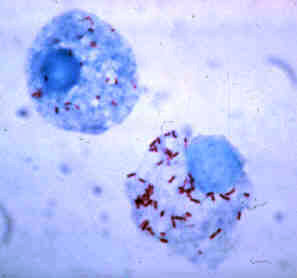
Rickettsia rickettsii is a Gram-negative, intracellular, cocco-bacillus bacterium that was first discovered in 1896. Having a reduced genome, the bacterium harvests nutrients from its host cell to carry out respiration, making it an organo-heterotroph. Maintenance of its genome is carried out through vertical gene transfer where specialization of the bacterium allows it to shuttle host sugars directly into its TCA cycle.
Other characteristics of the bacteria include membrane proteins that are useful in the identification of R. rickettsii strains and useful in targeting from antibiotics. A capsule encircling the bacterium allows for attachment to host cells and additionally acts as a defense mechanism for resisting phagocytosis. Varying strains of R. rickettsii have different genotypes and phenotypes that alter the pathogenicity, virulence, and the appearance of the bacteria.
R. rickettsii is the causative agent of Rocky Mountain Spotted Fever and is transferred to its host via a tick bite. It is one of the most pathogenic Rickettsia species and affects a large majority of the Western Hemisphere, most commonly the Americas. The pathogenic agent has been found on every continent, except Antarctica; however, Rocky Mountain Spotted Fever occurs mostly in North, Central, and South America. This prevalence is due to R. rickettsii ability to thrive in warm, damp environments. These environments provide sufficient conditions for the amplification of the bacteria within a vertebrate host, such as a horse or dog. The bacteria are transmitted through a vector, such as a tick, to a vertebrate host where it can then be amplified and passed on to a person, resulting in the zoonotic disease.
Headache, high fever, and spotted rash are some effects of the disease with more severe cases resulting in organ damage and coma. Antibiotics, such as doxycycline, target the ribosome of R. rickettsii in order to inhibit protein synthesis of the bacteria, providing a form of treatment for the disease.
R. rickettsii are obligate intracellular bacteria, meaning they need a host cell in order to replicate and survive. In fact, no glycolytic enzymes for the breakdown of intact glucose remain in R. rickettsii's genome. It is theorized that while R. rickettsii once possessed complete, complex metabolic pathways that allowed it to survive outside a host, evolutionary pressures caused progressive genomic reduction that now limits metabolism to the tricarboxylic acid cycle (TCA). Energy is primarily obtained through a combination of oxidative phosphorylation of imported host carbon sources and direct harvesting of ATP via a ATP/ADP transmembrane pump. Remnants of these lost metabolic pathways can be seen in analysis of R. rickettsii's genome, which contain some identified remnant enzymes of pathways that remain unfunctional in vivo. This decrease in available metabolic pathways has left R. rickettsii largely dependent on a range of transport systems to harvest essential amino acids, nucleic acids, and other metabolites from its host.
The primary carbon source of R. rickettsii is pyruvate, though many other amino acids and TCA cycle intermediates such as glutamine, glutamate, and malate can be used. For lipid metabolism, a complete map of fatty acid synthesis enzymes have been found, allowing R. rickettsii to construct a viable cell membrane made up of lipopolysaccharides (LPS). Regarding synthesis of a peptidoglycan layer, there is speculation as to whether key components are synthesized internally or imported and modified for use. Pathways for producing critical small molecules such as riboflavin (B2), nicotinamide (B3), pantothenate (B5), pyridoxine (B6), and biotin (B7) are all missing key enzymes, forcing R. rickettsii to rely solely on transmembrane transport proteins.
Overall, R. rickettsii has a genome that does not encode many of the enzymes and proteins that are required for several pathways besides the TCA cycle. These bacteria import many of the intermediates, cofactors, and byproducts from the host cells' metabolic pathways to use for their own synthesis of necessary structures and energy for survival.
R. rickettsii has many vital proteins within its cellular membranes. One of these proteins is YbgF, which maintains the structure of the cellular membrane. YbgF is found within both the inner and outer membranes along with another protein called TolC. TolC is a transport protein that connects to other transport proteins within the periplasmic space and inner membrane. These two proteins are believed to be associated with pathogenicity of this microbe and serve as specific points that antibodies can bind to in order to prevent the bacteria from interacting with host cells.
Hub AI
Rickettsia rickettsii AI simulator
(@Rickettsia rickettsii_simulator)
Rickettsia rickettsii
Rickettsia rickettsii is a Gram-negative, intracellular, cocco-bacillus bacterium that was first discovered in 1896. Having a reduced genome, the bacterium harvests nutrients from its host cell to carry out respiration, making it an organo-heterotroph. Maintenance of its genome is carried out through vertical gene transfer where specialization of the bacterium allows it to shuttle host sugars directly into its TCA cycle.
Other characteristics of the bacteria include membrane proteins that are useful in the identification of R. rickettsii strains and useful in targeting from antibiotics. A capsule encircling the bacterium allows for attachment to host cells and additionally acts as a defense mechanism for resisting phagocytosis. Varying strains of R. rickettsii have different genotypes and phenotypes that alter the pathogenicity, virulence, and the appearance of the bacteria.
R. rickettsii is the causative agent of Rocky Mountain Spotted Fever and is transferred to its host via a tick bite. It is one of the most pathogenic Rickettsia species and affects a large majority of the Western Hemisphere, most commonly the Americas. The pathogenic agent has been found on every continent, except Antarctica; however, Rocky Mountain Spotted Fever occurs mostly in North, Central, and South America. This prevalence is due to R. rickettsii ability to thrive in warm, damp environments. These environments provide sufficient conditions for the amplification of the bacteria within a vertebrate host, such as a horse or dog. The bacteria are transmitted through a vector, such as a tick, to a vertebrate host where it can then be amplified and passed on to a person, resulting in the zoonotic disease.
Headache, high fever, and spotted rash are some effects of the disease with more severe cases resulting in organ damage and coma. Antibiotics, such as doxycycline, target the ribosome of R. rickettsii in order to inhibit protein synthesis of the bacteria, providing a form of treatment for the disease.
R. rickettsii are obligate intracellular bacteria, meaning they need a host cell in order to replicate and survive. In fact, no glycolytic enzymes for the breakdown of intact glucose remain in R. rickettsii's genome. It is theorized that while R. rickettsii once possessed complete, complex metabolic pathways that allowed it to survive outside a host, evolutionary pressures caused progressive genomic reduction that now limits metabolism to the tricarboxylic acid cycle (TCA). Energy is primarily obtained through a combination of oxidative phosphorylation of imported host carbon sources and direct harvesting of ATP via a ATP/ADP transmembrane pump. Remnants of these lost metabolic pathways can be seen in analysis of R. rickettsii's genome, which contain some identified remnant enzymes of pathways that remain unfunctional in vivo. This decrease in available metabolic pathways has left R. rickettsii largely dependent on a range of transport systems to harvest essential amino acids, nucleic acids, and other metabolites from its host.
The primary carbon source of R. rickettsii is pyruvate, though many other amino acids and TCA cycle intermediates such as glutamine, glutamate, and malate can be used. For lipid metabolism, a complete map of fatty acid synthesis enzymes have been found, allowing R. rickettsii to construct a viable cell membrane made up of lipopolysaccharides (LPS). Regarding synthesis of a peptidoglycan layer, there is speculation as to whether key components are synthesized internally or imported and modified for use. Pathways for producing critical small molecules such as riboflavin (B2), nicotinamide (B3), pantothenate (B5), pyridoxine (B6), and biotin (B7) are all missing key enzymes, forcing R. rickettsii to rely solely on transmembrane transport proteins.
Overall, R. rickettsii has a genome that does not encode many of the enzymes and proteins that are required for several pathways besides the TCA cycle. These bacteria import many of the intermediates, cofactors, and byproducts from the host cells' metabolic pathways to use for their own synthesis of necessary structures and energy for survival.
R. rickettsii has many vital proteins within its cellular membranes. One of these proteins is YbgF, which maintains the structure of the cellular membrane. YbgF is found within both the inner and outer membranes along with another protein called TolC. TolC is a transport protein that connects to other transport proteins within the periplasmic space and inner membrane. These two proteins are believed to be associated with pathogenicity of this microbe and serve as specific points that antibodies can bind to in order to prevent the bacteria from interacting with host cells.
Recent media