


Community hub
Recent from talks
Contribute something to knowledge base
Content stats: 0 posts, 0 articles, 1 media, 0 notes
Members stats: 0 subscribers, 0 contributors, 0 moderators, 0 supporters
Subscribers
Supporters
Contributors
Moderators
Hub AI
Rickettsia AI simulator
(@Rickettsia_simulator)
Hub AI
Rickettsia AI simulator
(@Rickettsia_simulator)
Rickettsia
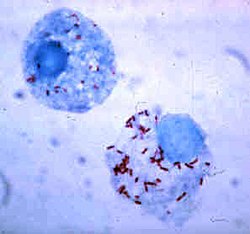
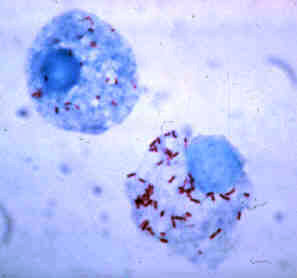
Rickettsia is a genus of nonmotile, gram-negative, nonspore-forming, highly pleomorphic bacteria that may occur in the forms of cocci (0.1 μm in diameter), bacilli (1–4 μm long), or threads (up to about 10 μm long). The genus was named after Howard Taylor Ricketts in honor of his pioneering work on tick-borne spotted fever.
Properly, Rickettsia is the name of a single genus, but the informal term "rickettsia", plural "rickettsias," usually not capitalised, commonly applies to any members of the order Rickettsiales. Being obligate intracellular bacteria, rickettsias depend on entry, growth, and replication within the cytoplasm of living eukaryotic host cells (typically endothelial cells). Accordingly, Rickettsia species cannot grow in artificial nutrient culture; they must be grown either in tissue or embryo cultures. Mostly chicken embryos are used, following a method developed by Ernest William Goodpasture and his colleagues at Vanderbilt University in the early 1930s. Many new strains or species of Rickettsia are described each year. Some Rickettsia species are pathogens of medical and veterinary interest, but many Rickettsia are non-pathogenic to vertebrates, including humans, and infect only arthropods, often non-hematophagous, such as aphids or whiteflies. Many Rickettsia species are thus arthropod-specific symbionts, but are often confused with pathogenic Rickettsia (especially in medical literature), showing that the current view in rickettsiology has a strong anthropocentric bias.
Pathogenic Rickettsia species are transmitted by numerous types of arthropods, including chiggers, ticks, fleas, and lice, and are associated with both human and plant diseases. Most notably, Rickettsia species are the pathogens responsible for typhus, rickettsialpox, boutonneuse fever, African tick-bite fever, Rocky Mountain spotted fever, Flinders Island spotted fever, and Queensland tick typhus (Australian tick typhus). The majority of pathogenic Rickettsia bacteria are susceptible to antibiotics of the tetracycline group.
The classification of Rickettsia into three groups (spotted fever, typhus, and scrub typhus) was initially based on serology. This grouping has since been confirmed by DNA sequencing. All three of these groups include human pathogens. The scrub typhus group has been reclassified as a related new genus, Orientia, but they still are in the order Rickettsiales and accordingly still are grouped with the rest of the rickettsial diseases.[citation needed]
Rickettsias are more widespread than previously believed and are known to be associated with arthropods, leeches, and protists. Divisions have also been identified in the spotted fever group and this group should probably be divided into two clades. Arthropod-inhabiting rickettsiae are generally associated with reproductive manipulation (such as parthenogenesis) to persist in host lineage.
In March 2010, Swedish researchers reported a case of bacterial meningitis in a woman caused by Rickettsia helvetica previously thought to be harmless.
Plant diseases have been associated with these Rickettsia-like organisms (RLOs):
Infection occurs in nonhuman mammals; for example, species of Rickettsia have been found to afflict the South American guanaco, Lama guanacoe potentially marsupials and reptiles.
Rickettsia
Rickettsia is a genus of nonmotile, gram-negative, nonspore-forming, highly pleomorphic bacteria that may occur in the forms of cocci (0.1 μm in diameter), bacilli (1–4 μm long), or threads (up to about 10 μm long). The genus was named after Howard Taylor Ricketts in honor of his pioneering work on tick-borne spotted fever.
Properly, Rickettsia is the name of a single genus, but the informal term "rickettsia", plural "rickettsias," usually not capitalised, commonly applies to any members of the order Rickettsiales. Being obligate intracellular bacteria, rickettsias depend on entry, growth, and replication within the cytoplasm of living eukaryotic host cells (typically endothelial cells). Accordingly, Rickettsia species cannot grow in artificial nutrient culture; they must be grown either in tissue or embryo cultures. Mostly chicken embryos are used, following a method developed by Ernest William Goodpasture and his colleagues at Vanderbilt University in the early 1930s. Many new strains or species of Rickettsia are described each year. Some Rickettsia species are pathogens of medical and veterinary interest, but many Rickettsia are non-pathogenic to vertebrates, including humans, and infect only arthropods, often non-hematophagous, such as aphids or whiteflies. Many Rickettsia species are thus arthropod-specific symbionts, but are often confused with pathogenic Rickettsia (especially in medical literature), showing that the current view in rickettsiology has a strong anthropocentric bias.
Pathogenic Rickettsia species are transmitted by numerous types of arthropods, including chiggers, ticks, fleas, and lice, and are associated with both human and plant diseases. Most notably, Rickettsia species are the pathogens responsible for typhus, rickettsialpox, boutonneuse fever, African tick-bite fever, Rocky Mountain spotted fever, Flinders Island spotted fever, and Queensland tick typhus (Australian tick typhus). The majority of pathogenic Rickettsia bacteria are susceptible to antibiotics of the tetracycline group.
The classification of Rickettsia into three groups (spotted fever, typhus, and scrub typhus) was initially based on serology. This grouping has since been confirmed by DNA sequencing. All three of these groups include human pathogens. The scrub typhus group has been reclassified as a related new genus, Orientia, but they still are in the order Rickettsiales and accordingly still are grouped with the rest of the rickettsial diseases.[citation needed]
Rickettsias are more widespread than previously believed and are known to be associated with arthropods, leeches, and protists. Divisions have also been identified in the spotted fever group and this group should probably be divided into two clades. Arthropod-inhabiting rickettsiae are generally associated with reproductive manipulation (such as parthenogenesis) to persist in host lineage.
In March 2010, Swedish researchers reported a case of bacterial meningitis in a woman caused by Rickettsia helvetica previously thought to be harmless.
Plant diseases have been associated with these Rickettsia-like organisms (RLOs):
Infection occurs in nonhuman mammals; for example, species of Rickettsia have been found to afflict the South American guanaco, Lama guanacoe potentially marsupials and reptiles.
Recent media
Recent media