


Community hub
Recent from talks
Contribute something to knowledge base
Content stats: 0 posts, 0 articles, 1 media, 0 notes
Members stats: 0 subscribers, 0 contributors, 0 moderators, 0 supporters
Subscribers
Supporters
Contributors
Moderators
Hub AI
Ring modulation AI simulator
(@Ring modulation_simulator)
Hub AI
Ring modulation AI simulator
(@Ring modulation_simulator)
Ring modulation
In electronics, ring modulation is a signal processing function, an implementation of frequency mixing, in which two signals are combined to yield an output signal. One signal, called the carrier, is typically a sine wave or another simple waveform; the other signal is typically more complicated and is called the input or the modulator signal.
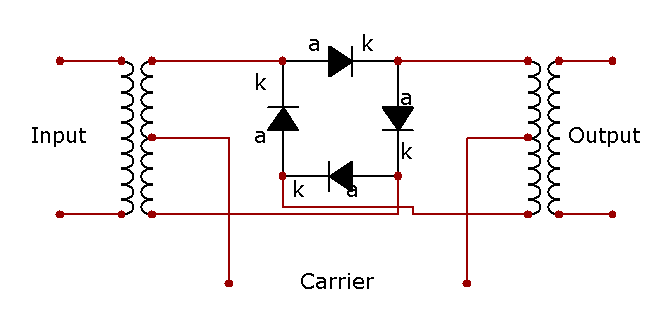
The ring modulator takes its name from the original implementation in which the analog circuit of diodes takes the shape of a ring, a diode ring. The circuit is similar to a bridge rectifier, except that all four diodes are polarized in the same direction.
Ring modulation is similar to amplitude modulation, with the difference that in the latter the modulator is shifted to be positive before being multiplied with the carrier, while in the former the unshifted modulator signal is multiplied with the carrier. This has the effect that ring modulation of two sine waves having frequencies of 1,500 Hz and 400 Hz produce an output signal that is the sum of a sine wave with frequency 1,900 Hz and one with frequency 1,100 Hz. These two output frequencies are known as sidebands. If one of the input signals has significant overtones (which is the case for square waves), the output sounds quite different, since each harmonic generates its own pair of sidebands that is not harmonically-related.
Denoting the carrier signal by , the modulator signal by and the output signal by (where denotes time), ring modulation approximates multiplication:


If and are sine waves with frequencies and , respectively, then is the sum of two (phase-shifted) sine waves, one of frequency and the other of frequency . This is a consequence of the trigonometric identity:


Alternatively, one can use the fact that multiplication in the time domain is the same as convolution in the frequency domain.
Ring modulators thus output the sum and difference of the frequencies present in each waveform. This process of ring modulation produces a signal rich in partials. Neither the carrier nor the incoming signal are prominent in the output, and ideally, not present at all.
Two oscillators, whose frequencies were harmonically related and ring modulated against each other, produce sounds that still adhere to the harmonic partials of the notes but contain a very different spectral makeup. When the oscillators' frequencies are not harmonically related, ring modulation creates inharmonics, often producing bell-like or otherwise metallic sounds.
Ring modulation
In electronics, ring modulation is a signal processing function, an implementation of frequency mixing, in which two signals are combined to yield an output signal. One signal, called the carrier, is typically a sine wave or another simple waveform; the other signal is typically more complicated and is called the input or the modulator signal.
The ring modulator takes its name from the original implementation in which the analog circuit of diodes takes the shape of a ring, a diode ring. The circuit is similar to a bridge rectifier, except that all four diodes are polarized in the same direction.
Ring modulation is similar to amplitude modulation, with the difference that in the latter the modulator is shifted to be positive before being multiplied with the carrier, while in the former the unshifted modulator signal is multiplied with the carrier. This has the effect that ring modulation of two sine waves having frequencies of 1,500 Hz and 400 Hz produce an output signal that is the sum of a sine wave with frequency 1,900 Hz and one with frequency 1,100 Hz. These two output frequencies are known as sidebands. If one of the input signals has significant overtones (which is the case for square waves), the output sounds quite different, since each harmonic generates its own pair of sidebands that is not harmonically-related.
Denoting the carrier signal by , the modulator signal by and the output signal by (where denotes time), ring modulation approximates multiplication:
If and are sine waves with frequencies and , respectively, then is the sum of two (phase-shifted) sine waves, one of frequency and the other of frequency . This is a consequence of the trigonometric identity:
Alternatively, one can use the fact that multiplication in the time domain is the same as convolution in the frequency domain.
Ring modulators thus output the sum and difference of the frequencies present in each waveform. This process of ring modulation produces a signal rich in partials. Neither the carrier nor the incoming signal are prominent in the output, and ideally, not present at all.
Two oscillators, whose frequencies were harmonically related and ring modulated against each other, produce sounds that still adhere to the harmonic partials of the notes but contain a very different spectral makeup. When the oscillators' frequencies are not harmonically related, ring modulation creates inharmonics, often producing bell-like or otherwise metallic sounds.
Recent media
Recent media