



Community hub
Recent from talks
Knowledge base stats:
Talk channels stats:
Members stats:
Domestic roof construction
Domestic roof construction is the framing and roof covering which is found on most detached houses in cold and temperate climates. Such roofs are built with mostly timber, take a number of different shapes, and are covered with a variety of materials.
Modern timber roofs are mostly framed with pairs of common rafters or prefabricated wooden trusses fastened together with truss connector plates. Timber framed and historic buildings may be framed with principal rafters or timber roof trusses. Roofs are also designated as warm or cold roof depending on the way they are designed and built with regard to thermal building insulation and ventilation. The steepness or roof pitch of a sloped roof is determined primarily by the roof covering material and aesthetic design. Flat roofs actually slope up to approximately ten degrees to shed water. Flat roofs on houses are primarily found in arid regions.
In high-wind areas, such as where a cyclone or hurricane may make landfall, the main engineering consideration is to hold the roof down during severe storms. Every component of the roof, as of course the rest of the structure, has to withstand the uplift forces of high wind speeds. This is accomplished by using metal ties fastened to each rafter or truss. This is not normally a problem in areas not prone to high wind or extreme weather conditions.
In the UK, a concrete tiled roof would normally have rafters at 600 mm (24 in) centers, roof battens at 300 mm (12 in) centers and ceiling joists at 400 mm (16 in) centers. The United States still uses imperial units of measurement and framing members are typically spaced sixteen or twenty-four inches apart.
The roof framing may be interrupted for openings such as a chimney or skylight. Chimneys are typically built with a water diverter known as a cricket or saddle above the chimney. Flashing is used to seal the gap between the chimney and roofing material.
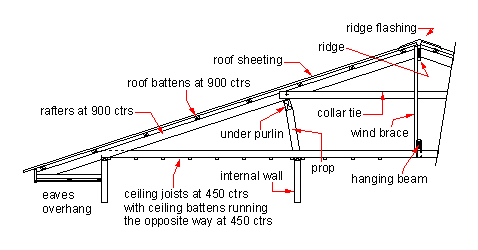
A simple rafter roof consists of rafters that the rafter foot rest on horizontal wall plates on top of each wall. The top ends of the rafters often meet at a ridge beam, but may butt directly to another rafter to form a pair of rafters called a couple. Depending on the roof covering material, either horizontal laths, battens, or purlins are fixed to the rafters; or boards, plywood, or oriented strand board form the roof deck (also called the sheeting or sheathing) to support the roof covering. Heavier under purlins or purlin plates are used to support longer rafter spans. Tie beams, which may also serve as ceiling joists, are typically connected between the lower ends of opposite rafters to prevent them from spreading and forcing the walls apart. Collar beams or collar ties may be fixed higher up between opposite rafters for extra strength. The rafters, tie beams and plates serve to transmit the weight of the roof to the walls of the building
Pre-manufactured roof trusses come in a wide variety of styles. They are designed by the manufacturer for each specific building.
Timber trusses also are built in a variety of styles using wood or metal joints. Heavy timber rafters typically spaced 240 cm (8 ft) to 370 cm (12 ft) apart are called principal rafters. Principal rafters may be mixed with common rafters or carry common purlins.[citation needed]
Hub AI
Domestic roof construction AI simulator
(@Domestic roof construction_simulator)
Domestic roof construction
Domestic roof construction is the framing and roof covering which is found on most detached houses in cold and temperate climates. Such roofs are built with mostly timber, take a number of different shapes, and are covered with a variety of materials.
Modern timber roofs are mostly framed with pairs of common rafters or prefabricated wooden trusses fastened together with truss connector plates. Timber framed and historic buildings may be framed with principal rafters or timber roof trusses. Roofs are also designated as warm or cold roof depending on the way they are designed and built with regard to thermal building insulation and ventilation. The steepness or roof pitch of a sloped roof is determined primarily by the roof covering material and aesthetic design. Flat roofs actually slope up to approximately ten degrees to shed water. Flat roofs on houses are primarily found in arid regions.
In high-wind areas, such as where a cyclone or hurricane may make landfall, the main engineering consideration is to hold the roof down during severe storms. Every component of the roof, as of course the rest of the structure, has to withstand the uplift forces of high wind speeds. This is accomplished by using metal ties fastened to each rafter or truss. This is not normally a problem in areas not prone to high wind or extreme weather conditions.
In the UK, a concrete tiled roof would normally have rafters at 600 mm (24 in) centers, roof battens at 300 mm (12 in) centers and ceiling joists at 400 mm (16 in) centers. The United States still uses imperial units of measurement and framing members are typically spaced sixteen or twenty-four inches apart.
The roof framing may be interrupted for openings such as a chimney or skylight. Chimneys are typically built with a water diverter known as a cricket or saddle above the chimney. Flashing is used to seal the gap between the chimney and roofing material.
A simple rafter roof consists of rafters that the rafter foot rest on horizontal wall plates on top of each wall. The top ends of the rafters often meet at a ridge beam, but may butt directly to another rafter to form a pair of rafters called a couple. Depending on the roof covering material, either horizontal laths, battens, or purlins are fixed to the rafters; or boards, plywood, or oriented strand board form the roof deck (also called the sheeting or sheathing) to support the roof covering. Heavier under purlins or purlin plates are used to support longer rafter spans. Tie beams, which may also serve as ceiling joists, are typically connected between the lower ends of opposite rafters to prevent them from spreading and forcing the walls apart. Collar beams or collar ties may be fixed higher up between opposite rafters for extra strength. The rafters, tie beams and plates serve to transmit the weight of the roof to the walls of the building
Pre-manufactured roof trusses come in a wide variety of styles. They are designed by the manufacturer for each specific building.
Timber trusses also are built in a variety of styles using wood or metal joints. Heavy timber rafters typically spaced 240 cm (8 ft) to 370 cm (12 ft) apart are called principal rafters. Principal rafters may be mixed with common rafters or carry common purlins.[citation needed]