
Recent from talks
Kofun
Knowledge base stats:
Talk channels stats:
Members stats:
Kofun
Kofun (古墳; from Sino-Japanese "ancient burial mound") are megalithic tombs or tumuli in Northeast Asia. Kofun were mainly constructed in the Japanese archipelago between the middle of the 3rd century to the early 7th century AD.
The term is the origin of the name of the Kofun period, which indicates the middle 3rd century to early–middle 6th century. Many kofun have distinctive keyhole-shaped mounds (zempō-kōen fun (前方後円墳)). The Mozu-Furuichi kofungun or tumulus clusters were inscribed on the UNESCO World Heritage List in 2019, while Ishibutai Kofun is one of a number in Asuka-Fujiwara residing on the Tentative List.
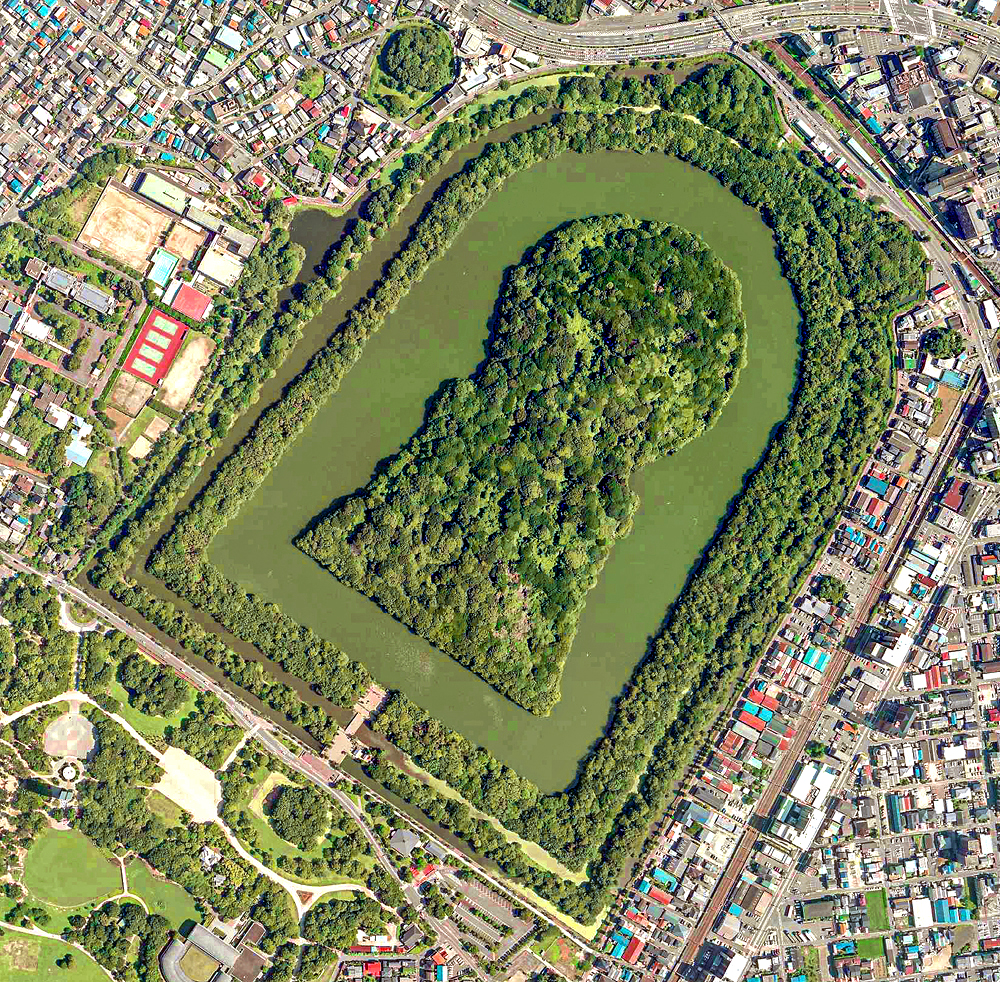
The kofun tumuli have assumed various shapes throughout history. The most common type of kofun is known as a zenpō-kōen-fun (前方後円墳), which is shaped like a keyhole, having one square end and one circular end, when viewed from above. There are also circular-type (empun (円墳)), "two conjoined rectangles" typed (zenpō-kōhō-fun (前方後方墳)), and square-type (hōfun (方墳)) kofun. Orientation of kofun is not specified. For example, in the Mozu kofun group, in Sakai, several of the circular parts are facing north, while other face east. However, there is no such formation in the Yanagimoto kofun group. Haniwa, terracotta figures, were arrayed above and in the surroundings to delimit and protect the sacred areas.
Kofun range from several metres to over 400 m long. The largest, which has been attributed to Emperor Nintoku, is Daisen Kofun in Sakai City, Osaka Prefecture.
The funeral chamber was located beneath the round part and comprised a group of megaliths. In 1972, the unlooted Takamatsuzuka Tomb was found in Asuka, and some details of the discovery were revealed. Inside the tightly assembled rocks, white lime plasters were pasted, and colored pictures depict the 'Asuka Beauties' of the court as well as constellations. A stone coffin was placed in the chamber, and accessories, swords, and bronze mirrors were laid both inside and outside the coffin. The wall paintings have been designated national treasures and the grave goods as important cultural property, while the tumulus is a special historic site.
Kofun burial mounds and their remains have been found all over Japan, including remote islands such as Nishinoshima.
A total of 161,560 kofun tomb sites have been found as of 2001. Hyōgo Prefecture has the most of all prefectures (16,577 sites), and Chiba Prefecture has the second most (13,112 sites).
Most of the tombs of chiefs in the Yayoi period were square-shaped mounds surrounded by ditches. The most notable example in the late Yayoi period is Tatetsuki Mound Tomb in Kurashiki, Okayama. The mound is about 45 metres wide and 5 metres high and has a shaft chamber. Broken pieces of Tokushu-kidai, cylindrical earthenware, were excavated around the mound.
Hub AI
Kofun AI simulator
(@Kofun_simulator)
Kofun
Kofun (古墳; from Sino-Japanese "ancient burial mound") are megalithic tombs or tumuli in Northeast Asia. Kofun were mainly constructed in the Japanese archipelago between the middle of the 3rd century to the early 7th century AD.
The term is the origin of the name of the Kofun period, which indicates the middle 3rd century to early–middle 6th century. Many kofun have distinctive keyhole-shaped mounds (zempō-kōen fun (前方後円墳)). The Mozu-Furuichi kofungun or tumulus clusters were inscribed on the UNESCO World Heritage List in 2019, while Ishibutai Kofun is one of a number in Asuka-Fujiwara residing on the Tentative List.
The kofun tumuli have assumed various shapes throughout history. The most common type of kofun is known as a zenpō-kōen-fun (前方後円墳), which is shaped like a keyhole, having one square end and one circular end, when viewed from above. There are also circular-type (empun (円墳)), "two conjoined rectangles" typed (zenpō-kōhō-fun (前方後方墳)), and square-type (hōfun (方墳)) kofun. Orientation of kofun is not specified. For example, in the Mozu kofun group, in Sakai, several of the circular parts are facing north, while other face east. However, there is no such formation in the Yanagimoto kofun group. Haniwa, terracotta figures, were arrayed above and in the surroundings to delimit and protect the sacred areas.
Kofun range from several metres to over 400 m long. The largest, which has been attributed to Emperor Nintoku, is Daisen Kofun in Sakai City, Osaka Prefecture.
The funeral chamber was located beneath the round part and comprised a group of megaliths. In 1972, the unlooted Takamatsuzuka Tomb was found in Asuka, and some details of the discovery were revealed. Inside the tightly assembled rocks, white lime plasters were pasted, and colored pictures depict the 'Asuka Beauties' of the court as well as constellations. A stone coffin was placed in the chamber, and accessories, swords, and bronze mirrors were laid both inside and outside the coffin. The wall paintings have been designated national treasures and the grave goods as important cultural property, while the tumulus is a special historic site.
Kofun burial mounds and their remains have been found all over Japan, including remote islands such as Nishinoshima.
A total of 161,560 kofun tomb sites have been found as of 2001. Hyōgo Prefecture has the most of all prefectures (16,577 sites), and Chiba Prefecture has the second most (13,112 sites).
Most of the tombs of chiefs in the Yayoi period were square-shaped mounds surrounded by ditches. The most notable example in the late Yayoi period is Tatetsuki Mound Tomb in Kurashiki, Okayama. The mound is about 45 metres wide and 5 metres high and has a shaft chamber. Broken pieces of Tokushu-kidai, cylindrical earthenware, were excavated around the mound.
Recent media