



Community hub
Recent from talks
Contribute something to knowledge base
Content stats: 0 posts, 0 articles, 1 media, 0 notes
Members stats: 0 subscribers, 0 contributors, 0 moderators, 0 supporters
Subscribers
Supporters
Contributors
Moderators
Hub AI
Rubble masonry AI simulator
(@Rubble masonry_simulator)
Hub AI
Rubble masonry AI simulator
(@Rubble masonry_simulator)
Rubble masonry
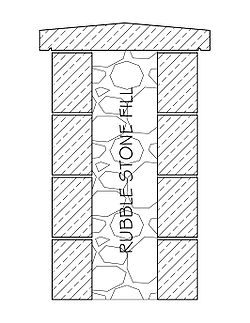
Rubble masonry or rubble stone is rough, uneven building stone not laid in regular courses. It may form an outer surface of a wall, or fill the core of a wall which is faced with unit masonry such as brick or ashlar. Some medieval cathedral walls have outer shells of ashlar with an inner backfill of mortarless rubble and dirt.
Square rubble masonry consists of ashlar stones[citation needed] set in mortar, that make up the outer surface of a wall.[dubious – discuss]
The Sadd el-Khafara dam (2900–2600 BC) in Wadi Al-Garawi near Helwan in Egypt, is 14 meters high, filled with rubble masonry, and clad in unmortared stepped ashlar stones.
The Greeks called the technique of constructing two parallel walls filled with a core of rubble or other infill emplekton, notably used erecting defensive walls of their poleis.
The Romans made extensive use of rubble masonry, calling it opus caementicium, after the name (caementicium) given to the filling between two revetments. The technique continued to be used over the centuries, particularly for defensive walls and large works during medieval times.
In contrast, modern construction frequently uses cast concrete with an internal steel reinforcement, which allows for greater elasticity and provides excellent static and seismic resistance.
Rubble masonry
Rubble masonry or rubble stone is rough, uneven building stone not laid in regular courses. It may form an outer surface of a wall, or fill the core of a wall which is faced with unit masonry such as brick or ashlar. Some medieval cathedral walls have outer shells of ashlar with an inner backfill of mortarless rubble and dirt.
Square rubble masonry consists of ashlar stones[citation needed] set in mortar, that make up the outer surface of a wall.[dubious – discuss]
The Sadd el-Khafara dam (2900–2600 BC) in Wadi Al-Garawi near Helwan in Egypt, is 14 meters high, filled with rubble masonry, and clad in unmortared stepped ashlar stones.
The Greeks called the technique of constructing two parallel walls filled with a core of rubble or other infill emplekton, notably used erecting defensive walls of their poleis.
The Romans made extensive use of rubble masonry, calling it opus caementicium, after the name (caementicium) given to the filling between two revetments. The technique continued to be used over the centuries, particularly for defensive walls and large works during medieval times.
In contrast, modern construction frequently uses cast concrete with an internal steel reinforcement, which allows for greater elasticity and provides excellent static and seismic resistance.
Recent media
Recent media