


Community hub
Recent from talks
Contribute something to knowledge base
Content stats: 0 posts, 0 articles, 1 media, 0 notes
Members stats: 0 subscribers, 0 contributors, 0 moderators, 0 supporters
Subscribers
Supporters
Contributors
Moderators
Hub AI
Rye AI simulator
(@Rye_simulator)
Hub AI
Rye AI simulator
(@Rye_simulator)
Rye
Rye (Secale cereale) is a grass grown extensively as a grain, a cover crop and a forage crop. It is grown principally in an area from Eastern and Northern Europe into Russia. It is much more tolerant of cold weather and poor soil than other cereals, making it useful in those regions; its vigorous growth suppresses weeds and provides abundant forage for animals early in the year. It is a member of the wheat tribe (Triticeae) which includes the cereals wheat and barley. It is likely that rye arrived in Europe as a secondary crop, meaning that it was a minor admixture in wheat as a result of Vavilovian mimicry, and was only later cultivated in its own right.
Rye grain is used for bread, beer, rye whiskey, and animal fodder. In Scandinavia, rye was a staple food in the Middle Ages, and rye crispbread remains a popular food in the region. Europe produces around half of the world's rye; relatively little is traded between countries. A wheat-rye hybrid, triticale, combines the qualities of the two parent crops and is produced in large quantities worldwide. In European folklore, the Roggenwolf ("rye wolf") is a carnivorous corn demon or Feldgeist.
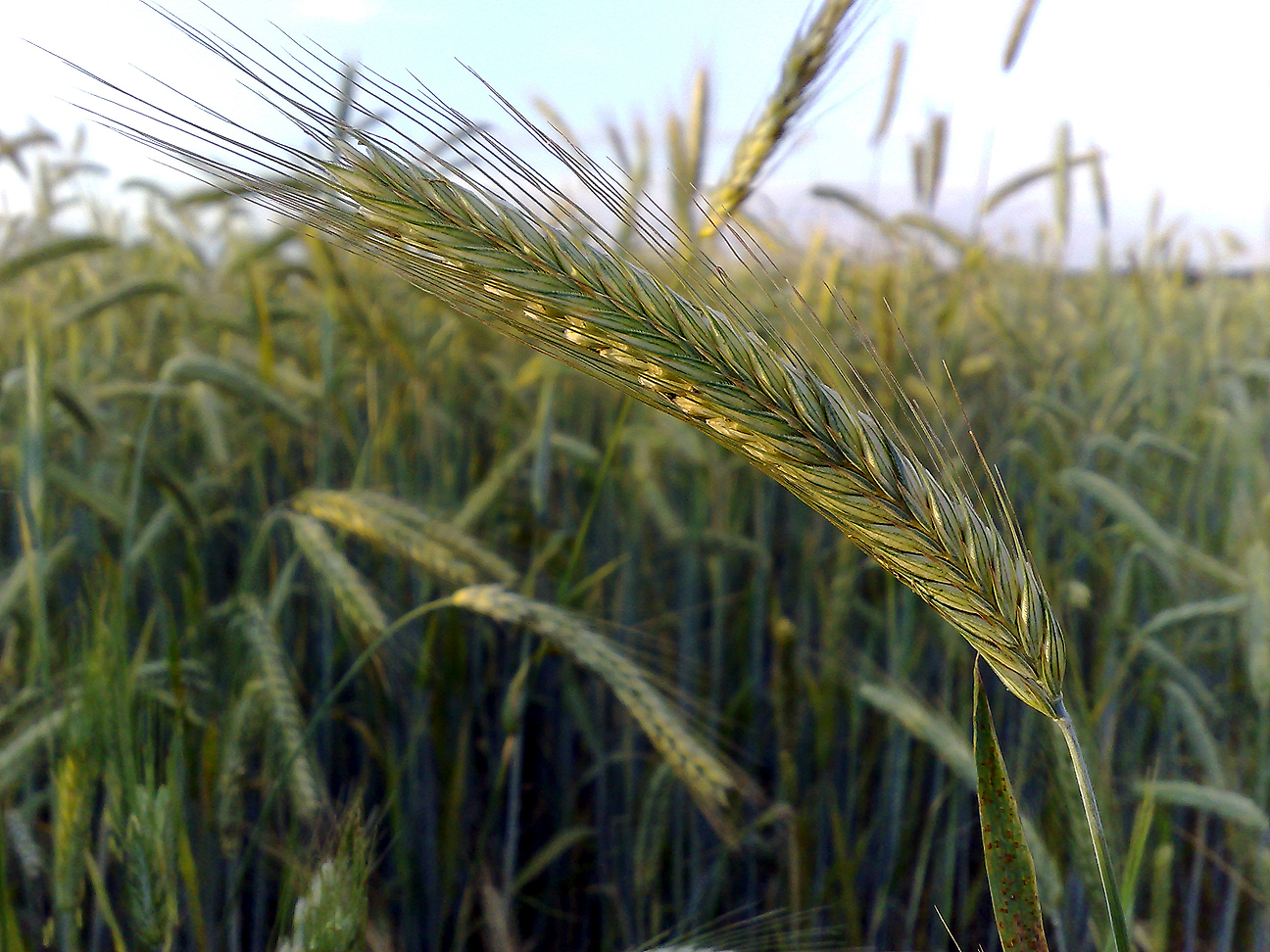
Rye is a tall grass grown for its seeds; it can be an annual or a biennial. Depending on environmental conditions and variety it reaches 1 to 3 metres (3+1⁄2 to 10 ft) in height. Its leaves are blue-green, long, and pointed. The seeds are carried in a curved head or spike some 7 to 15 centimetres (2+3⁄4 to 6 in) long. The head is composed of many spikelets, each of which holds two small flowers; the spikelets alternate left and right up the head.
The seeds of rye are some 7 or 8 mm long, much larger and less round than wheat.
The rye genus Secale is in the grass tribe Triticeae, which contains other cereals such as barley (Hordeum) and wheat (Triticum).
The generic name Secale, related to Italian segale and French seigle meaning "rye", is of unknown origin but may derive from a Balkan language. The English name rye derives from Old English ryge, related to Dutch rogge, German Roggen, and Russian рожь rožʹ, again all with the same meaning.
Rye is one of several cereals that grow wild in the Levant, central and eastern Turkey and adjacent areas. Evidence uncovered at the Epipalaeolithic site of Tell Abu Hureyra in the Euphrates valley of northern Syria suggests that rye was among the first cereal crops to be systematically cultivated, around 13,000 years ago. However, that claim remains controversial; critics point to inconsistencies in the radiocarbon dates, and identifications based solely on grain, rather than on chaff.
Domesticated rye occurs in small quantities at a number of Neolithic sites in Asia Minor (Anatolia, now Turkey), such as the Pre-Pottery Neolithic B Can Hasan III near Çatalhöyük, but is otherwise absent from the archaeological record until the Bronze Age of central Europe, c. 1800–1500 BCE.
Rye
Rye (Secale cereale) is a grass grown extensively as a grain, a cover crop and a forage crop. It is grown principally in an area from Eastern and Northern Europe into Russia. It is much more tolerant of cold weather and poor soil than other cereals, making it useful in those regions; its vigorous growth suppresses weeds and provides abundant forage for animals early in the year. It is a member of the wheat tribe (Triticeae) which includes the cereals wheat and barley. It is likely that rye arrived in Europe as a secondary crop, meaning that it was a minor admixture in wheat as a result of Vavilovian mimicry, and was only later cultivated in its own right.
Rye grain is used for bread, beer, rye whiskey, and animal fodder. In Scandinavia, rye was a staple food in the Middle Ages, and rye crispbread remains a popular food in the region. Europe produces around half of the world's rye; relatively little is traded between countries. A wheat-rye hybrid, triticale, combines the qualities of the two parent crops and is produced in large quantities worldwide. In European folklore, the Roggenwolf ("rye wolf") is a carnivorous corn demon or Feldgeist.
Rye is a tall grass grown for its seeds; it can be an annual or a biennial. Depending on environmental conditions and variety it reaches 1 to 3 metres (3+1⁄2 to 10 ft) in height. Its leaves are blue-green, long, and pointed. The seeds are carried in a curved head or spike some 7 to 15 centimetres (2+3⁄4 to 6 in) long. The head is composed of many spikelets, each of which holds two small flowers; the spikelets alternate left and right up the head.
The seeds of rye are some 7 or 8 mm long, much larger and less round than wheat.
The rye genus Secale is in the grass tribe Triticeae, which contains other cereals such as barley (Hordeum) and wheat (Triticum).
The generic name Secale, related to Italian segale and French seigle meaning "rye", is of unknown origin but may derive from a Balkan language. The English name rye derives from Old English ryge, related to Dutch rogge, German Roggen, and Russian рожь rožʹ, again all with the same meaning.
Rye is one of several cereals that grow wild in the Levant, central and eastern Turkey and adjacent areas. Evidence uncovered at the Epipalaeolithic site of Tell Abu Hureyra in the Euphrates valley of northern Syria suggests that rye was among the first cereal crops to be systematically cultivated, around 13,000 years ago. However, that claim remains controversial; critics point to inconsistencies in the radiocarbon dates, and identifications based solely on grain, rather than on chaff.
Domesticated rye occurs in small quantities at a number of Neolithic sites in Asia Minor (Anatolia, now Turkey), such as the Pre-Pottery Neolithic B Can Hasan III near Çatalhöyük, but is otherwise absent from the archaeological record until the Bronze Age of central Europe, c. 1800–1500 BCE.
Recent media
Recent media