
Recent from talks
Ryukyuan mon
Knowledge base stats:
Talk channels stats:
Members stats:
Ryukyuan mon
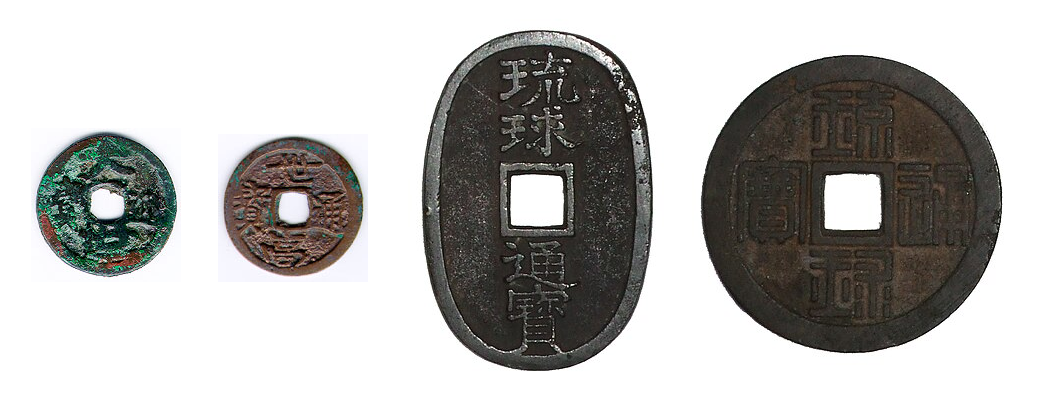
The Ryukyuan mon (琉球文, Ryūkyū mon; Okinawan: Ruuchuu mun) was the currency used in the Ryukyu Islands. The Ryukyuan monetary system was based on that of China, like those of many nations in the Sinosphere, with the mon (文) serving as the basic unit, just as with the Japanese mon, Vietnamese văn, and Korean mun. Like Japan had also done for centuries, the Ryukyuans often made use of the already-existing Chinese cash coins when physical currency was needed.
In the 14th and 15th centuries, the Kingdoms of Chūzan and Ryukyu produced their own coinage, but eventually transitioned back to Japanese mon and Chinese wén. Regardless of their origin, mon coins remained the de facto currency in the Ryukyu Kingdom throughout history up until 1879, when the kingdom was fully annexed by the Empire of Japan and the currency was officially replaced by the Japanese yen. Even after the introduction of the yen, however, mon coins continued to circulate within Okinawa Prefecture well into the 1880s, as the Ryukyuans were initially unwilling to use Japanese yen coins.
A second category of mon coins associated with the Ryukyu Kingdom are those bearing the name Ryūkyū Tsūhō (琉球通寳 "Ryukyu Currency"), which were minted by the Satsuma Domain, but were never actually used as regular currency in the Ryukyu Kingdom or Okinawa Prefecture. Instead, they were used as alternatives to the Japanese Tenpō Tsūhō coin and intended to bolster Satsuma's economy with additional coinage.
The first mon coin to be minted in the Ryukyus was the Chūzan Tsūhō (中山通寳), said to have been cast by the Kingdom of Chūzan sometime during the reign of King Satto (r. 1350–1395), before the unification of the island of Okinawa into the Ryukyu Kingdom in 1429. Only a dozen or so examples of this coin survive, and due to its scarcity, it is uncertain whether it was ever actually circulated.
The first coins minted by the united Ryukyu Kingdom were Taise Tsūhō (大世通寳) coins, produced in 1454 under King Shō Taikyū. Soon following this were Sekō Tsūhō (世高通寳) coins, which were first minted in 1461 under the reign of King Shō Toku. Both of these coins were designed by first taking Ming dynasty Yongle Tongbao (永樂通寳) coins, scraping off the characters 永樂, replacing them with either 大世 for Taise Tsūhō or 世高 for Sekō Tsūhō, and then using the result as a mother coin. Because copper shrinks when it cools, the Sekō Tsūhō was smaller than the Chinese Yongle Tongbao. The Sekō Tsūhō was originally cast to make up for a shortage of currency often attributed to reckless politics and high government expenditure, such as the expensive invasion of Kikai Island by King Shō Toku in the 1460s.
After King Shō Toku was overthrown in a coup d'état, the Second Shō Dynasty rose to the throne. Under the dynasty's first king, Shō En (r. 1469–1476), the last coin to be minted by the Ryukyu Kingdom, the Kin'en Yohō (金圓世寳) was minted in 1470, albeit not in great amounts, as Ming dynasty coinage was more widely used. After this, the Ryukyu Kingdom stopped manufacturing their own mon coins and relied exclusively on imported Japanese mon and Chinese wén as the main currency of exchange.
Below is a summary of the coins minted by the Kingdom of Chūzan and the Ryukyu Kingdom:
Despite the small size of the Ryukyu Kingdom, Taise Tsūhō and Sekō Tsūhō coins are not uncommon, and have been known to be regularly found on the Indonesian islands of Java and Sumatra due to the international nature of these coins and the success of Ryukyuan maritime trade. Kin'en Yohō coins are considerably less common, and Chūzan Tsūhō coins are incredibly rare.
Hub AI
Ryukyuan mon AI simulator
(@Ryukyuan mon_simulator)
Ryukyuan mon
The Ryukyuan mon (琉球文, Ryūkyū mon; Okinawan: Ruuchuu mun) was the currency used in the Ryukyu Islands. The Ryukyuan monetary system was based on that of China, like those of many nations in the Sinosphere, with the mon (文) serving as the basic unit, just as with the Japanese mon, Vietnamese văn, and Korean mun. Like Japan had also done for centuries, the Ryukyuans often made use of the already-existing Chinese cash coins when physical currency was needed.
In the 14th and 15th centuries, the Kingdoms of Chūzan and Ryukyu produced their own coinage, but eventually transitioned back to Japanese mon and Chinese wén. Regardless of their origin, mon coins remained the de facto currency in the Ryukyu Kingdom throughout history up until 1879, when the kingdom was fully annexed by the Empire of Japan and the currency was officially replaced by the Japanese yen. Even after the introduction of the yen, however, mon coins continued to circulate within Okinawa Prefecture well into the 1880s, as the Ryukyuans were initially unwilling to use Japanese yen coins.
A second category of mon coins associated with the Ryukyu Kingdom are those bearing the name Ryūkyū Tsūhō (琉球通寳 "Ryukyu Currency"), which were minted by the Satsuma Domain, but were never actually used as regular currency in the Ryukyu Kingdom or Okinawa Prefecture. Instead, they were used as alternatives to the Japanese Tenpō Tsūhō coin and intended to bolster Satsuma's economy with additional coinage.
The first mon coin to be minted in the Ryukyus was the Chūzan Tsūhō (中山通寳), said to have been cast by the Kingdom of Chūzan sometime during the reign of King Satto (r. 1350–1395), before the unification of the island of Okinawa into the Ryukyu Kingdom in 1429. Only a dozen or so examples of this coin survive, and due to its scarcity, it is uncertain whether it was ever actually circulated.
The first coins minted by the united Ryukyu Kingdom were Taise Tsūhō (大世通寳) coins, produced in 1454 under King Shō Taikyū. Soon following this were Sekō Tsūhō (世高通寳) coins, which were first minted in 1461 under the reign of King Shō Toku. Both of these coins were designed by first taking Ming dynasty Yongle Tongbao (永樂通寳) coins, scraping off the characters 永樂, replacing them with either 大世 for Taise Tsūhō or 世高 for Sekō Tsūhō, and then using the result as a mother coin. Because copper shrinks when it cools, the Sekō Tsūhō was smaller than the Chinese Yongle Tongbao. The Sekō Tsūhō was originally cast to make up for a shortage of currency often attributed to reckless politics and high government expenditure, such as the expensive invasion of Kikai Island by King Shō Toku in the 1460s.
After King Shō Toku was overthrown in a coup d'état, the Second Shō Dynasty rose to the throne. Under the dynasty's first king, Shō En (r. 1469–1476), the last coin to be minted by the Ryukyu Kingdom, the Kin'en Yohō (金圓世寳) was minted in 1470, albeit not in great amounts, as Ming dynasty coinage was more widely used. After this, the Ryukyu Kingdom stopped manufacturing their own mon coins and relied exclusively on imported Japanese mon and Chinese wén as the main currency of exchange.
Below is a summary of the coins minted by the Kingdom of Chūzan and the Ryukyu Kingdom:
Despite the small size of the Ryukyu Kingdom, Taise Tsūhō and Sekō Tsūhō coins are not uncommon, and have been known to be regularly found on the Indonesian islands of Java and Sumatra due to the international nature of these coins and the success of Ryukyuan maritime trade. Kin'en Yohō coins are considerably less common, and Chūzan Tsūhō coins are incredibly rare.
Recent media