


Community hub
STEVE
View on Wikipedia
.jpg)
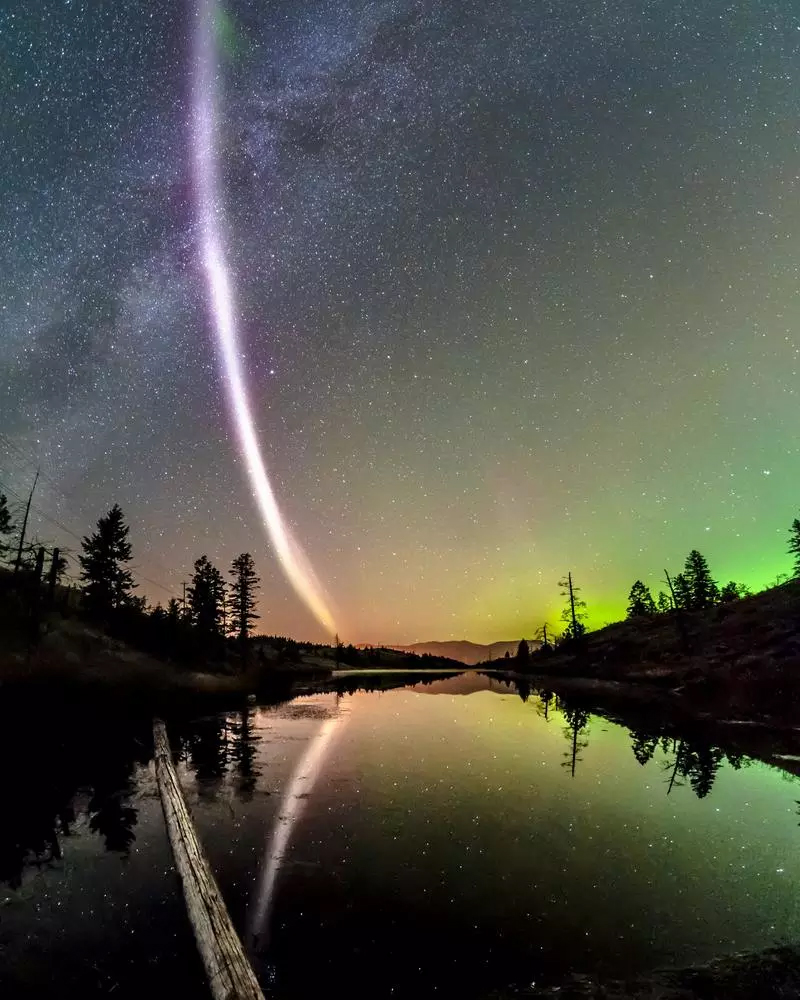
STEVE is an atmospheric optical phenomenon that appears as a purple and green light ribbon in the night sky, named in late 2016 by aurora watchers from Alberta, Canada. The backronym later adopted for the phenomenon is the Strong Thermal Emission Velocity Enhancement. According to analysis of satellite data from the European Space Agency's Swarm mission, the phenomenon is caused by a 25 km (16 mi) wide ribbon of hot plasma at an altitude of 450 km (280 mi), with a temperature of 3,000 °C (3,270 K; 5,430 °F) and flowing at a speed of 6 km/s (3.7 mi/s) (compared to 10 m/s (33 ft/s) outside the ribbon). The phenomenon is not rare, but had not been investigated and described scientifically prior to that time.[1][2][3]
Discovery and naming
[edit]The STEVE phenomenon has been observed by auroral photographers for decades.[3] Some evidence suggests that STEVE observations may have been recorded as early as 1705.[4] Notations resembling the phenomenon exist in some observations from 1911 to the 1950s by Carl Størmer.[5][6]
The first accurate determination of the nature of the phenomenon was not made, however, until after members of a Facebook group, Alberta Aurora Chasers, named it, attributed it to a proton aurora, and began calling it a "proton arc".[7] When physics professor Eric Donovan from the University of Calgary saw their photographs and suspected that their determination was incorrect because proton auroras are not visible,[8] he correlated the time and location of the phenomenon with Swarm satellite data and one of the Alberta Aurora Chaser photographers, Song Despins. She provided GPS coordinates from Vimy, Alberta, that helped Donovan link the data to identify the phenomenon.[1]
One of the aurora watchers, photographer Chris Ratzlaff,[9][10] suggested using the name "Steve" for the phenomenon, in reference to Over the Hedge, an animated comedy movie from 2006. The characters in the movie give the name to a hedge that appears overnight, in order to make it seem more benign.[11] Reports of the heretofore undescribed and unusual "aurora" went viral as an example of citizen science on Aurorasaurus.[12][13]
During the fall meeting of the American Geophysical Union in December 2016, Robert Lysak suggested using a backronym of "Steve" for the phenomenon that would stand for a "Strong Thermal Emission Velocity Enhancement".[14] That acronym, "STEVE", has been adopted by the team at NASA Goddard Space Flight Center that is studying the phenomenon.[15]
| External media | |
|---|---|
| Images | |
 Photograph of the phenomenon Photograph of the phenomenon | |
| Gallery | |
| Video | |
 Time-lapse phenomenon on YouTube Time-lapse phenomenon on YouTube |
Occurrence and cause
[edit]Location and timing
[edit]STEVE phenomena may be spotted further from the poles than the aurora,[16] and as of March 2018, have been observed in the United Kingdom, Canada, Alaska, northern U.S. states, Australia, New Zealand[17] and Denmark.[18] The phenomenon appears as a very narrow arc extending for hundreds or thousands of kilometers, aligned east–west. It generally lasts for twenty minutes to an hour. As of March 2018, STEVE phenomena have only been spotted in the presence of an aurora. None were observed from October 2016 to February 2017, or from October 2017 to February 2018, leading NASA to believe that STEVE phenomena may only appear during certain seasons.[19] However, STEVE phenomena have since been reported and photographed in South Australia during a geomagnetic storm event on 11 October 2024.[20]
Research into cause
[edit]A study published in March 2018 by Elizabeth A. MacDonald and co-authors in the peer-reviewed journal, Science Advances, suggested that the STEVE phenomenon accompanies a subauroral ion drift (SAID),[21] a fast-moving stream of extremely hot particles. STEVE marks the first observed visual effect accompanying a SAID.[19]
In August 2018, researchers determined that the skyglow of the phenomenon was not associated with particle precipitation (electrons or ions) and, as a result, could be generated in the ionosphere.[22]
One proposed mechanism for the glow is that excited nitrogen breaks apart and interacts with oxygen to form glowing nitric oxide.[23]
Association with picket-fence aurora
[edit]Often, although not always, a STEVE phenomenon is observed above a green, "picket-fence" aurora according to a study published in Geophysical Research Letters.[24][25] Although the picket-fence aurora is created through precipitation of electrons, they appear outside the auroral oval and so their formation is different from traditional aurora.[26] The study also showed these phenomena appear in both hemispheres simultaneously. Sightings of picket-fence aurora have been made without observations of STEVE.[27]
The green emissions in the picket fence aurora seem to be related to eddies in the supersonic flow of charged particles, similar to the eddies seen in a river that move more slowly than the water around them. Hence, the green bars in the picket fence are moving more slowly than the structures in the purple emissions and some scientists have speculated they could be caused by turbulence in the charged particles from space.[28]
Research
[edit]2017
[edit]- "How I met Steve" - Eric Donovan's presentation to the 2017 ESA Earth Explorer Missions Science Meeting, March 20, 2017 (1:08:30 - 1:26:00)[29]
- "On the location of Steve, the mysterious subauroral feature"[30]
2018
[edit]- "New Science in Plain Sight: Citizen scientists lead to the discovery of optical structure in the upper atmosphere"[21]
- "On the Origin of STEVE: Particle Precipitation or Ionospheric Skyglow?"[31]
- "Historical observations of STEVE"[32]
- "What else can citizen science and 'amateur' observations reveal about STEVE?"[33]
- "From the spark to the fire, reflections on five years of public participation in aurora research"[34]
- "On the origin and geomagnetic conditions of STEVE's formation"[35]
- "A Statistical Analysis of STEVE"[36]
2019
[edit]- "How Did We Miss This? An Upper Atmospheric Discovery Named STEVE"[37]
- "First Observations From the TREx Spectrograph: The Optical Spectrum of STEVE and the Picket Fence Phenomena"[38]
- "Color Ratios of Subauroral (STEVE) Arcs"[39]
- "A new dataset of STEVE phenomenon related observations spanning multiple solar cycles"[40]
- "Subauroral Green STEVE Arcs: Evidence for Low-Energy Excitation"[41]
- "Magnetospheric Signatures of STEVE: Implications for the Magnetospheric Energy Source and Interhemispheric Conjugacy"[42]
- "High-Latitude Ionospheric Electrodynamics Characterizing Energy and Momentum Deposition during STEVE Events Reported by Citizen Scientists"[43]
- "Steve: The Optical Signature of Intense Subauroral Ion Drifts"[44]
- "Optical Spectra and Emission Altitudes of Double-Layer STEVE: A Case Study"[45]
- "The Vertical Distribution of the Optical Emissions of a Steve and Picket Fence Event"[46]
- "Identifying STEVE's Magnetospheric Driver Using Conjugate Observations in the Magnetosphere and on the Ground"[47]
- "STEVE and the Picket Fence: Evidence of Feedback-Unstable Magnetosphere-Ionosphere Interaction"[48]
- "Possible Evidence of STEVE in Dynamics Explorer-2 Data"[49]
2020
[edit]- "Early Ground-Based Work by Auroral Pioneer Carl Størmer on the High-Altitude Detached Subauroral Arcs Now Known as "STEVE""[50]
- "Early Evidence of Isolated Auroral Structures in the 100 km Height Regime Observed at Subauroral Latitudes by the Aurora Pioneer Carl Størmer"[51]
- "Early Ground-Based Work by Auroral Pioneer Carl Størmer on the High-Altitude Detached Subauroral Arcs Now Known as "STEVE""[52]
- "Magnetospheric Conditions for STEVE and SAID: Particle Injection, Substorm Surge, and Field-Aligned Currents"[53]
- "Neutral Wind Dynamics Preceding the STEVE Occurrence and Their Possible Preconditioning Role in STEVE Formation"[54]
- "A Mechanism for the STEVE Continuum Emission"[55]
- "High-latitude Ionospheric Electrodynamics during STEVE Events"[56]
- "Dynamics of Auroral Precipitation Boundaries Associated With STEVE and SAID"[57]
- "The Apparent Motion of STEVE and the Picket Fence Phenomena"[58]
- "Characteristics of fragmented aurora-like emissions (FAEs) observed on Svalbard"[59]
- "Fragmented Aurora-like Emissions (FAEs) as a new type of aurora-like phenomenon"[60]
2021
[edit]- "Multi-Wavelength Imaging Observations of STEVE at Athabasca, Canada"[61]
- "Registration of synchronous geomagnetic pulsations and proton aurora during the substorm on March 1, 2017"[62]
- "First Simultaneous Observation of STEVE and SAR Arc Combining Data From Citizen Scientists, 630.0 nm All-Sky Images, and Satellites"[63]
- "Proton Aurora and Optical Emissions in the Subauroral Region"[64]
- "Robust techniques to improve high quality triangulations of contemporaneous citizen science observations of STEVE"[65]
- "Comparison of the SAR arc, STEVE and Picket fence dynamics registered at the Maimaga subauroral station on March 1, 2017"[66]
- "Improved Analysis of STEVE Photographs"[67]
2022
[edit]- "Rainbow of the Night: First Direct Observation of a SAR arc evolving into STEVE"[68]
- "Auroral structures: Revealing the importance of meso-scale M-I coupling"[69]
2023
[edit]- "It's Not Easy Being Green: Kinetic Modeling of the Emission Spectrum Observed in STEVE's Picket Fence"[70]
- "Unsolved problems in Strong Thermal Emission Velocity Enhancement (STEVE) and the picket fence"[71]
2024
[edit]- "Unexpected STEVE Observations at High Latitude During Quiet Geomagnetic Conditions"[72]
See also
[edit]References
[edit]- ^ a b McRae, Mike (24 April 2017). "Introducing Steve - a Newly Discovered Astronomical Phenomenon". ScienceAlert.
- ^ "When Swarm Met Steve". esa.int. European Space Agency. 21 April 2017.
- ^ a b "New kind of aurora is not an aurora at all". American Geophysical Union. 20 August 2018. Retrieved 2018-08-21 – via Phys.org.
- ^ Finnegan, James; Asher, David; Nezic, Rok; Byrne, Conor; Bailey, Mark (23 July 2018). "Historical observations of STEVE". The Observatory. 138: 227–245. arXiv:1808.01872. Bibcode:2018Obs...138..227B.
- ^ Hunnekuhl M, MacDonald E (12 February 2020). "Early Ground-Based Work by Auroral Pioneer Carl Størmer on the High-Altitude Detached Subauroral Arcs Now Known as "STEVE"". Space Weather. 18 (3) e2019SW002384. Bibcode:2020SpWea..1802384H. doi:10.1029/2019SW002384.
- ^ "When Størmer Met STEVE". Aurorasaurus. 3 March 2020.
- ^ "Meet Steve". European Space Agency. Retrieved 2017-04-24.
- ^ "Aurora photographers find new night sky lights and call them Steve". BBC News. 23 April 2017.
- ^ ""I propose we call it Steve until then" - Alberta Aurora Chasers". Facebook. February 10, 2016.
- ^ "Amateur Sky-Watchers Discover Celestial Phenomenon, Name It 'Steve'". 24 April 2017.
- ^ "New atmospheric phenomenon named STEVE discovered by aurora watchers". ABC News. 24 April 2017.
- ^ Rozell, Ned (2015-04-02). "Citizen science meets the aurora". University of Alaska Fairbanks Geophysical Institute.
- ^ "7 Things to Know About "STEVE"". Aurorasaurus. 2017-03-14.
- ^ Moravec, Jeff (12 January 2018). "Meet Steve, a sky phenomenon coming into its own". StarTribune. MediaCompany. Retrieved 9 May 2019.
- ^ "Meet 'Steve,' a Totally New Kind of Aurora". 2018-03-14. Archived from the original on March 15, 2018. Retrieved 2018-03-22.
- ^ Saner, Emine (2018-03-19). "'Steve': the mystery purple aurora that rivals the northern lights". the Guardian. Retrieved 2018-03-22.
- ^ Mathewson, Samantha (15 March 2018). "Help NASA Study 'Steve,' a Newfound Aurora Type". Space.com. Retrieved 2019-05-13.
- ^ "Yderst sjældent fænomen set over Danmark - TV 2". 8 October 2024.
- ^ a b Garner, Rob (2018-03-14). "NASA Needs Your Help to Find Steve and Here's How". NASA. Retrieved 2018-03-22.
- ^ Boisvert, Eugene (14 October 2024). "Atmospheric phenomenon Steve spotted over south-east SA following Aurora Australis". ABC News Australia. Retrieved 17 October 2024.
- ^ a b MacDonald, Elizabeth A.; Donovan, Eric; Nishimura, Yukitoshi; Case, Nathan A.; Gillies, D. Megan; Gallardo-Lacourt, Bea; Archer, William E.; Spanswick, Emma L.; Bourassa, Notanee; Connors, Martin; Heavner, Matthew; Jackel, Brian; Kosar, Burcu; Knudsen, David J.; Ratzlaff, Chris; Schofield, Ian (2018-03-01). "New science in plain sight: Citizen scientists lead to the discovery of optical structure in the upper atmosphere". Science Advances. 4 (3) eaaq0030. Bibcode:2018SciA....4...30M. doi:10.1126/sciadv.aaq0030. ISSN 2375-2548. PMC 5851661. PMID 29546244.
- ^ Gallardo-Lacourt, B.; Liang, J.; Nishimura, Y.; Donovan, E. (20 August 2018). "On the Origin of STEVE: Particle Precipitation or Ionospheric Skyglow?". Geophysical Research Letters. 45 (16): 7968. Bibcode:2018GeoRL..45.7968G. doi:10.1029/2018GL078509.
- ^ Kasha Patel (April 1, 2023). "How to find STEVE, the purple streak that looks like an aurora but isn't".
- ^ Andrews, Robin George (3 May 2019). "Steve the odd 'aurora' revealed to be two sky shows in one". National Geographic. Archived from the original on May 4, 2019. Retrieved 4 May 2019.
- ^ Nishimura, Y.; Gallardo-Lacourt, B.; Zou, Y.; Mishin, E.; Knudsen, D.J.; Donovan, E.F.; Angelopoulos, V.; Raybell, R. (16 April 2019). "Magnetospheric signatures of STEVE: Implication for the magnetospheric energy source and inter-hemispheric conjugacy". Geophysical Research Letters. 46 (11): 5637–5644. Bibcode:2019GeoRL..46.5637N. doi:10.1029/2019GL082460.
- ^ Lipuma, Lauren. "Scientists discover what powers celestial phenomenon STEVE". AGU News. American Geophysical Union. Retrieved 4 May 2019.
- ^ Dunlevie, James (2018-11-06). "Aurora Australis with bonus 'picket fence' wows southern lights chasers in Tasmania". ABC News. Australian Broadcasting Corporation. Retrieved 4 May 2019.
- ^ "Aurora-chasing citizen scientists help discover a new feature of STEVE". phys.org. Retrieved 2020-11-14.
- ^ "How I met Steve". Vimeo/European Space Agency. 20 March 2017.
- ^ Gallardo-Lacourt, B.; Nishimura, Y.; Donovan, E.; Gillies, D.M.; Spanswick, E.; Archer, W.E.; MacDonald, E.; Knudsen, D.J. (December 2017). "On the location of Steve, the mysterious subauroral feature". AGU Fall Meeting Abstracts. 2017. Bibcode:2017AGUFMSA51B2387G.
- ^ Gallardo-Lacourt, B.; Liang, J.; Nishimura, Y.; Donovan, E. (February 20, 2018). "On the Origin of STEVE: Particle Precipitation or Ionospheric Skyglow?". Geophysical Research Letters. 45 (16): 7968–7973. Bibcode:2018GeoRL..45.7968G. doi:10.1029/2018GL078509. S2CID 134540082.
- ^ Bailey, M.; Byrne, C.; Nezic, R.; Asher, D.; Finnegan, J. (July 23, 2018). "Historical observations of STEVE". The Observatory. 138: 227–245. arXiv:1808.01872. Bibcode:2018Obs...138..227B.
- ^ MacDonald, E.; Conde, J.M.; Kosar, B.; Lynch, K.A.; Semeter, J.L.; Zeller, N. (December 1, 2018). "What else can citizen science and 'amateur' observations reveal about STEVE?". American Geophysical Union, Fall Meeting 2018. 2018. Bibcode:2018AGUFMSM43A..09M.
- ^ MacDonald, E.; Ratzlaff, C. (December 1, 2018). "From the spark to the fire, reflections on five years of public participation in aurora research". American Geophysical Union, Fall Meeting 2018. 2018. Bibcode:2018AGUFM.U51A..04M.
- ^ Gallardo-Lacourt, B.; Liang, J.; Nishimura, Y.; Donovan, E.; Gillies, D.M.; Perry, G.W.; Archer, W.E.; Nava, O.; Spanswick, E.L. (December 1, 2018). "On the origin and geomagnetic conditions of STEVE's formation". American Geophysical Union, Fall Meeting 2018. 2018. Bibcode:2018AGUFMSM51E2787G.
- ^ Gallardo-Lacourt, B.; Nishimura, e.; Donovan, E.; Gillies, D.M.; Perry, G.W.; Archer, W.E.; Nava, O.; Spanswick, E.L. (November 8, 2018). "A Statistical Analysis of STEVE". Journal of Geophysical Research: Space Physics. 123 (11): 9893–9905. Bibcode:2018JGRA..123.9893G. doi:10.1029/2018JA025368. S2CID 134931832.
- ^ Gallardo-Lacourt, B.; Perry, G. W.; Archer, W. E.; Donovan, E. (March 2019). "How Did We Miss This? An Upper Atmospheric Discovery Named STEVE". Eos Science News by AGU.
- ^ Gillies, D.M.; Donovan, E.; Hampton, D.; Liang, J.; Connors, M.; Nishimura, Y.; Gallardo-Lacourt, B.; Spanswick, E.L. (July 3, 2019). "First Observations From the TREx Spectrograph: The Optical Spectrum of STEVE and the Picket Fence Phenomena". Geophysical Research Letters. 46 (13): 7207–7213. Bibcode:2019GeoRL..46.7207G. doi:10.1029/2019GL083272. S2CID 198413976.
- ^ Mende, S.B.; Turner, C. (June 24, 2019). "Color Ratios of Subauroral (STEVE) Arcs". Journal of Geophysical Research: Space Physics. 124 (7): 5945–5955. Bibcode:2019JGRA..124.5945M. doi:10.1029/2019JA026851. S2CID 197560558.
- ^ MacDonald, E.; Hunnekuhl, M. (December 2019). "A new dataset of STEVE phenomenon related observations spanning multiple solar cycles". American Geophysical Union, Fall Meeting 2019. 2019. Bibcode:2019AGUFMSM11C3299M.
- ^ Mende, S.B.; Harding, B.J.; Turner, C. (December 18, 2019). "Subauroral Green STEVE Arcs: Evidence for Low-Energy Excitation". Geophysical Research Letters. 46 (24): 14256–14262. Bibcode:2019GeoRL..4614256M. doi:10.1029/2019GL086145. S2CID 214009144.
- ^ Nishimura, Y.; Gallardo-Lacourt, B.; Zou, Y.; Mishin, E.; Knudsen, D.J.; Donovan, E.; Angelopoulos, V.; Raybell, R. (April 16, 2019). "Magnetospheric Signatures of STEVE: Implications for the Magnetospheric Energy Source and Interhemispheric Conjugacy". Geophysical Research Letters. 46 (11): 5637–5644. Bibcode:2019GeoRL..46.5637N. doi:10.1029/2019GL082460. S2CID 146182527.
- ^ Svaldi, V.C.; Matsuo, T.; Kilcommons, L.M.; MacDonald, E.; Gallardo-Lacourt, B. (December 1, 2019). "High-Latitude Ionospheric Electrodynamics Characterizing Energy and Momentum Deposition during STEVE Events Reported by Citizen Scientists". American Geophysical Union, Fall Meeting 2019. 2019. Bibcode:2019AGUFMSM11B3283S.
- ^ Archer, W.E.; Gallardo-Lacourt, B.; Perry, G.W.; St.-Maurice, J.P.; Buchert, S.C.; Donovan, E. (June 4, 2019). "Steve: The Optical Signature of Intense Subauroral Ion Drifts". Geophysical Research Letters. 46 (12): 6279–6286. Bibcode:2019GeoRL..46.6279A. doi:10.1029/2019GL082687. S2CID 195545155.
- ^ Liang, J.; Donovan, E.; Connors, M.; Gillies, D.; St-Maurice, J.P.; Jackel, B.; Gallardo-Lacourt, B.; Spanswick, E.; Chu, X. (December 3, 2019). "Optical Spectra and Emission Altitudes of Double-Layer STEVE: A Case Study". Geophysical Research Letters. 46 (23): 13630–13639. Bibcode:2019GeoRL..4613630L. doi:10.1029/2019GL085639. S2CID 212794445.
- ^ Archer, W.E.; St.-Maurice, J.P.; Gallardo-Lacourt, B.; Perry, G.W.; Cully, C.M.; Donovan, E.; Gillies, G.M.; Downie, R.; Smith, J.; Eurich, D. (September 3, 2019). "The Vertical Distribution of the Optical Emissions of a Steve and Picket Fence Event". Geophysical Research Letters. 46 (19): 10719–10725. Bibcode:2019GeoRL..4610719A. doi:10.1029/2019GL084473. S2CID 202900390.
- ^ Chu, X.; Malaspina, D.; Gallardo-Lacourt, B.; Liang, J.; Andersson, L.; Ma, Q.; Artemyev, A.; Liu, J.; Ergun, R.E.; Thaller, S.; Akbari, H.; Akbari, H.; Larsen, B.; Reeves, R.; Wygant, J.; Breneman, A.; Tian, S.; Connors, M.; Donovan, E.; Archer, W.; MacDonald, E. (November 11, 2019). "Identifying STEVE's Magnetospheric Driver Using Conjugate Observations in the Magnetosphere and on the Ground". Geophysical Research Letters. 46 (22): 12665–12674. Bibcode:2019GeoRL..4612665C. doi:10.1029/2019GL082789. S2CID 210258255.
- ^ Mishin, E.; Streltsov, A. (December 10, 2019). "STEVE and the Picket Fence: Evidence of Feedback-Unstable Magnetosphere-Ionosphere Interaction". EPJ Web of Conferences. 46 (24): 14247–14255. Bibcode:2019GeoRL..4614247M. doi:10.1029/2019GL085446. S2CID 213702359.
- ^ Erlandson, R.E. (December 1, 2019). "Possible Evidence of STEVE in Dynamics Explorer-2 Data". American Geophysical Union, Fall Meeting 2019. 2019. Bibcode:2019AGUFMSM22A..01E.
- ^ Hunnekulh, M.; MacDonald, E. (February 12, 2020). "Early Ground-Based Work by Auroral Pioneer Carl Størmer on the High-Altitude Detached Subauroral Arcs Now Known as "STEVE"". Space Weather. 18 (3) e2019SW002384. Bibcode:2020SpWea..1802384H. doi:10.1029/2019SW002384. S2CID 213841874.
- ^ Hunnekuhl, M.; MacDonald, E. (December 1, 2020). "Early Evidence of Isolated Auroral Structures in the 100 km Height Regime Observed at Subauroral Latitudes by the Aurora Pioneer Carl Størmer". American Geophysical Union, Fall Meeting 2020. 2020. Bibcode:2020AGUFMSM044..07H.
- ^ Hunnekuhl, M.; MacDonald, E. (February 12, 2020). "Early Ground-Based Work by Auroral Pioneer Carl Størmer on the High-Altitude Detached Subauroral Arcs Now Known as "STEVE"". Space Weather. 18 (3) e2019SW002384. Bibcode:2020SpWea..1802384H. doi:10.1029/2019SW002384. S2CID 213841874.
- ^ Nishimura, Y.; Yang, J.; Weygand, M.; Wang, W.; Kosar, B.; Donovan, E.; Angelopoulos, V.; Paxton, L.J.; Nishitani, N. (July 13, 2020). "Magnetospheric Conditions for STEVE and SAID: Particle Injection, Substorm Surge, and Field-Aligned Currents". Journal of Geophysical Research: Space Physics. 125 (8) e2020JA027782. Bibcode:2020JGRA..12527782N. doi:10.1029/2020JA027782. S2CID 225441915.
- ^ Liang, J.; Zou, Y.; Nishimura, Y.; Donovan, E. (2021). "Neutral Wind Dynamics Preceding the STEVE Occurrence and Their Possible Preconditioning Role in STEVE Formation". Journal of Geophysical Research: Space Physics. 126 (3) e2020JA028505. Bibcode:2021JGRA..12628505L. doi:10.1029/2020JA028505. S2CID 233894542.
- ^ Harding, B.J.; Mende, S.B.; Triplett, C.; Wu, Y-J.J. (March 18, 2020). "A Mechanism for the STEVE Continuum Emission". Geophysical Research Letters. 47 (7) e2020GL087102. Bibcode:2020GeoRL..4787102H. doi:10.1029/2020GL087102. S2CID 216435319.
- ^ Svaldi, V.C.; Matsuo, T.; Kilcommons, L.M.; Gallardo-Lacourt, B.; McDonald, E. (December 1, 2020). "High-latitude Ionospheric Electrodynamics during STEVE Events". American Geophysical Union, Fall Meeting 2020. 2020. Bibcode:2020AGUFMSA0210010S.
- ^ Nishimura, Y.; Donovan, E.; Angelopoulos, V.; Nishitani, N. (June 18, 2020). "Dynamics of Auroral Precipitation Boundaries Associated With STEVE and SAID". Journal of Geophysical Research: Space Physics. 125 (8) e2020JA028067. Bibcode:2020JGRA..12528067N. doi:10.1029/2020JA028067. S2CID 225490404.
- ^ Gillies, D.M.; Liang, J.; Donovan, E.; Spanswick, E. (October 16, 2020). "The Apparent Motion of STEVE and the Picket Fence Phenomena". Geophysical Research Letters. 47 (20) e2020GL088980. Bibcode:2020GeoRL..4788980G. doi:10.1029/2020GL088980. S2CID 225138775.
- ^ Dreyer, J.; Partamies, N.; Whiter, D.; Ellingsen, P.G.; Baddeley, L.; Buchert, S.C. (2021). "Characteristics of fragmented aurora-like emissions (FAEs) observed on Svalbard". Annales Geophysicae. 39 (2): 277–288. Bibcode:2021AnGeo..39..277D. doi:10.5194/angeo-39-277-2021. hdl:10037/21576. S2CID 233808838.
- ^ Dreyer, J.; Partamies, N.; Whiter, D.; Ellingsen, P.G.; Baddeley, L.; Buchert, S.C. (June 30, 2020). "Fragmented Aurora-like Emissions (FAEs) as a new type of aurora-like phenomenon" (PDF). Annales Geophysicae. Archived from the original (PDF) on 11 August 2020. Retrieved 27 May 2022.
- ^ Yadav, S.; Shiokawa, K.; Otsuka, Y.; Connors, M.; St Maurice, J.-P. (February 2, 2021). "Multi-Wavelength Imaging Observations of STEVE at Athabasca, Canada". Journal of Geophysical Research: Space Physics. 126 (2) 2020JA028622. Bibcode:2021JGRA..126.8622Y. doi:10.1029/2020JA028622. S2CID 234036468.
- ^ Varlamov, I.; Parnikov, S.; Ievenko, I.; Baishev, D.; Shiokawa, K. (November 8, 2021). "Registration of synchronous geomagnetic pulsations and proton aurora during the substorm on March 1, 2017". EPJ Web of Conferences. 254: 02012. Bibcode:2021EPJWC.25402012V. doi:10.1051/epjconf/202125402012. S2CID 243901884.
- ^ Martinis, C.; Nishimura, Y.; Wroten, J.; Bhatt, A.; Dyer, A.; Gallardo-Lacourt, B. (April 6, 2021). "First Simultaneous Observation of STEVE and SAR Arc Combining Data From Citizen Scientists, 630.0 nm All-Sky Images, and Satellites". Geophysical Research Letters. 48 (8) e2020GL092169. Bibcode:2021GeoRL..4892169M. doi:10.1029/2020GL092169. OSTI 1786831. S2CID 233528380.
- ^ Gallardo-Lacourt, B.; Frey, H.U.; Martinis, C. (January 6, 2021). "Proton Aurora and Optical Emissions in the Subauroral Region". Space Science Reviews. 217 (1): 10. Bibcode:2021SSRv..217...10G. doi:10.1007/s11214-020-00776-6. S2CID 230796229.
- ^ Hunnekuhl, M.; MacDonald, E.; Swanson, B.; Voss, S.; Maynard, T.; Chernenkoff, A.; Stone, J.; Standring, W.; Stott, D.; Atkins, R.; Monk, N.; Ward, S. (December 30, 2022). "Robust techniques to improve high quality triangulations of contemporaneous citizen science observations of STEVE". AGU Poster Sessions. 2021. Bibcode:2021AGUFMSA35F1957H.
- ^ Parnikov, S.G.; Ievenko, I.B.; Koltovskoy, I.I. (December 15, 2021). "Comparison of the SAR arc, STEVE and Picket fence dynamics registered at the Maimaga subauroral station on March 1, 2017". In Romanovskii, Oleg A; Matvienko, Gennadii G (eds.). 27th International Symposium on Atmospheric and Ocean Optics, Atmospheric Physics. Vol. 11916. pp. 1615–1619. Bibcode:2021SPIE11916E..7LP. doi:10.1117/12.2603112. ISBN 978-1-5106-4697-1. S2CID 245270235 – via SPIE Digital Library.
- ^ Bennett, C.L.; Bourassa, N. (March 18, 2021). "Improved Analysis of STEVE Photographs". Journal of Geophysical Research: Space Physics. 126 (4) e2020JA027843. Bibcode:2021JGRA..12627843B. doi:10.1029/2020JA027843. S2CID 233738641.
- ^ Martinis, C.; Gallardo-Lacourt, B.; Wroten, J.; Nishimura, Y.; Baumgardner, J.; Knudsen, D.J. (May 2, 2022). "Rainbow of the Night: First Direct Observation of a SAR arc evolving into STEVE". Geophysical Research Letters. 49 (11) e2022GL098511. Bibcode:2022GeoRL..4998511M. doi:10.1029/2022GL098511. S2CID 248703659.
- ^ Lyons, L.R.; Gallardo-Lacourt, B.; Nishimura, Y. (January 1, 2022). "Auroral structures: Revealing the importance of meso-scale M-I coupling". Cross-Scale Coupling and Energy Transfer in the Magnetosphere-Ionosphere-Thermosphere System. pp. 65–101. doi:10.1016/B978-0-12-821366-7.00004-4. ISBN 978-0-12-821366-7. S2CID 245030339.
- ^ Gasque, L.; Janalizadeh, R.; Harding, B.; Yonker, J.; Gillies, M. (November 3, 2023). "It's Not Easy Being Green: Kinetic Modeling of the Emission Spectrum Observed in STEVE's Picket Fence". Geophysical Research Letters. 50 (21) e2023GL106073. Bibcode:2023GeoRL..5006073G. doi:10.1029/2023GL106073.
- ^ Nishimura, Y.; Dyer, A.; Kangas, L.; Donovan, E.; Angelopoulos, V. (January 18, 2023). "Unsolved problems in Strong Thermal Emission Velocity Enhancement (STEVE) and the picket fence". Frontiers in Astronomy and Space Sciences. 50 (21): 3. Bibcode:2023FrASS..1087974N. doi:10.3389/fspas.2023.1087974.
- ^ Gallardo-Lacourt, B.; Nishimura, Y.; Kepko, L.; Spanswick, E. L.; Gillies, D. M.; Knudsen, D. J.; Burchill, J. K.; Skone, S. H.; Pinto, V. A.; Chaddock, D.; Kuzub, J.; Donovan, E. F. (2024). "Unexpected STEVE observations at high latitude during quiet geomagnetic conditions". Geophysical Research Letters. 51 (19) e2024GL110568. Bibcode:2024GeoRL..5110568G. doi:10.1029/2024GL110568.
External links
[edit]

- Eric Donovan's presentation at 2017 ESA Earth Explorer Missions Science Meeting (1:08:30 - 1:26:00)
- Alberta Aurora Chasers
- NASA Goddard with Liz MacDonald (14 March 2018). "The Aurora Named Steve". YouTube.
- STEVE over Copper Harbor May 5, 2021