Hubbry Logo
LabuanLabuanMain
Open search
Labuan
Community hub
Labuan
logo
8 pages, 0 posts
0 subscribers
Be the first to start a discussion here.
Contribute something
Labuan
Labuan
from Wikipedia

Labuan (/ləˈbən/), officially the Federal Territory of Labuan (Malay: Wilayah Persekutuan Labuan), is an island federal territory of Malaysia. It includes Labuan Island and six smaller islands off the coast of the state of Sabah in East Malaysia. Labuan's capital is Victoria, which is best known as an offshore financial centre offering international financial and business services via Labuan IBFC since 1990, as well as being an offshore support hub for deepwater oil and gas activities in the region. It is also a tourist destination for people travelling through Sabah, nearby Bruneians, and scuba divers. The name Labuan derives from the Malay word labuhan, which means "harbour".[5]

Key Information

History

[edit]
Historical affiliations

Sultanate of Brunei 15th century–1846[6][7]
United Kingdom 1846–1848[8][6]
Labuan Crown 1848–1941[6][9][10]
 • British North Borneo 1890–1904
 • United Kingdom 1904–1906
 • Straits Settlements 1907–1941[11][12]
Empire of Japan 1942–1945
British North Borneo Crown 1946–1963[13]
Malaysia 1963–present[14]

For three centuries from the 15th century, the north and west coast of Borneo including the island of Labuan was part of the Sultanate of Brunei.[6][7] In 1775, Labuan was temporarily occupied by the British East India Company after the failure of the company's station at Balambangan Island. The Sultan of Brunei, Omar Ali Saifuddin I tried to secure the British East India Company's support against the Sulu raiders by offering Labuan as an alternative to Balambangan but, instead the company made a second but failed attempt to set up a station on Balambangan. The Sultan's subsequent reoffering of Labuan to the company did not result in the establishment of a permanent British settlement on the island either.[15]

British policy changed in the 19th century, when Labuan started to attract British interest again. Captain Rodney Mundy acquired the island for Britain through the Treaty of Labuan with the Sultan of Brunei, Omar Ali Saifuddin II on 18 December 1846.[16] Mundy took Pengiran Mumin to witness the island's accession to the British Crown on 24 December 1846.[17] Some sources state that during the signing of the treaty, the Sultan had been threatened by a British navy warship ready to fire on the Sultan's palace if he refused to sign the treaty while another source says the island was ceded to Britain as a reward for assistance in combating pirates.[8][18][19]

The main reason why the British acquired the island was to establish a naval station to protect their commercial interest in the region and to suppress piracy in the South China Sea.[6][20][21] The British also believed the island could be the next Singapore.[22] Following the Anglo-Brunei Treaty of Friendship in 1847, which distilled the aforementioned events into a single document - Labuan was ceded to the British in perpetuity.[23] The island became a Crown Colony in 1848 with James Brooke appointed as the first governor and commander-in-chief, with William Napier as his lieutenant-governor.[6][9][10][16] In 1849, the Eastern Archipelago Company became the first of several British companies to try to exploit Labuan coal deposits.[24] The company was formed to exploit coal deposits on the island and adjacent coast of Borneo but soon became involved in a dispute with James Brooke.[6][25][26] Not proving itself a great commercial or strategic asset, administration of Labuan was handed to the British North Borneo Company in 1890.[27][28] The North Borneo Company did not prove that effective a manager either, and in 1904 Malcolm Stewart Hannibal McArthur even proposed handing the island back to Brunei.[29] In 1894, a submarine communications cable was built by the British to link the island's communications with North Borneo, Singapore and Hong Kong for the first time.[30] By 30 October 1906, the British Government proposed to extend the boundaries of the Straits Settlements to include Labuan. The proposal took effect from 1 January 1907.[11][12]

Japanese Navy anchoring at the coast of Labuan on 14 January 1942

In World War II, Labuan was occupied by Japan from 3 January 1942 until June 1945 and garrisoned by units of the Japanese 37th Army, which controlled Northern Borneo.[34] The island served as the administrative centre for the Japanese forces.[35] During the occupation, the Japanese Government changed the island name to Maida Island (前田島 [Maeda-shima]) on 9 December 1942 after Marquis Toshinari Maeda, as a remembrance to the first Japanese commander in northern Borneo. Maeda was killed in an air crash at Bintulu, Sarawak when en route to the island to open the airfield there.[6][35] As the Allied counter-attack came closer, the Japanese also developed Labuan and Brunei Bay as a naval base.[17]

American support craft moving towards Victoria and Brown beach to assist the landing of the members of Australian 24th Infantry Brigade on the island during Operation Oboe Six
Japanese Commander in Borneo, Lieutenant General Masao Baba signing the surrender document dated 9 September 1945 on the Australian 9th Division headquarters in Labuan while being watched by the Australian Major General George Wootten

The liberation of Borneo by the Allied forces began on 10 June 1945 when the Australian Army under the command of Australian Major General George Wootten launched an attack under the codename of Operation Oboe Six. Labuan became the main objective for the Allied forces to repossess.[36] Soon, the 9th Division of the Australian Army launched the attack with support from airstrikes and sea bombardments until the capture of the Labuan airstrip.[37][38] Most of the Labuan island area including the main town of Victoria was under the control of Allied forces within four days of the landing on 10 June.[36] On 9 September 1945, the Japanese Lieutenant General Masao Baba officially surrendered at a place now known as Surrender Point near the Layang-layang beach which he had been brought to the 9th Division headquarters on the island to sign the surrender document in front of the Australian 9th Division Army Commander George Wootten.[39]

The name of Labuan was later restored by the British and the island was administered under the British Military Administration together with the rest of the Straits Settlements. Labuan then on 15 July 1946 joined the North Borneo Crown Colony, which in turn became the state of Sabah and Malaysia in 1963.[6][13] In 1984, the Government of Sabah ceded Labuan to the federal government and later was admitted as a federal territory. This was done so that it could become an offshore financial centre.[14] It was declared an international offshore financial centre and free trade zone in 1990.[40]

Geography

[edit]
A map of Labuan island including its outlying islands

Labuan's area comprises the main island (Labuan Island – 91.64 square kilometres or 35.38 square miles) and six other smaller islands, Burung, Daat, Kuraman, Big Rusukan, Small Rusukan and Papan island with a total area of 91.64 square kilometres (35.38 square miles). The islands lie 8 kilometres (5.0 miles) off the coast of Borneo, adjacent to the Malaysian state of Sabah and to the north of Brunei Darussalam, on the northern edge of Brunei Bay facing the South China Sea. Labuan Island is mainly flat and undulating; its highest point is Bukit Kubong at 148 metres (486 feet) above sea level. Over 70% of the island is still covered with vegetation. The main town area of Victoria is located in a position facing Brunei Bay.

Islands

[edit]
  • Labuan Island
  • Daat Island
  • Papan Island
  • Burung Island
  • Kuraman Island
  • Big Rusukan Island (Pulau Rusukan Besar)
  • Small Rusukan Island (Pulau Rusukan Kecil)

Climate

[edit]

Labuan has a tropical rainforest climate with no dry season. Over the course of a year, the temperature typically varies from 25 to 32 °C (77 to 90 °F) and is rarely below 24 °C (75 °F) or above 33 °C (91 °F). The warm season lasts from 1 April to 13 June with an average daily high temperature above 31 °C (88 °F). The hottest day of the year is 29 April, with an average high of 32 °C (90 °F) and low of 26 °C (79 °F). The cold season lasts from 7 January to 17 February with an average daily high temperature below 30 °C (86 °F). The coldest day of the year is 8 September, with an average low of 25 °C (77 °F) and high of 31 °C (88 °F).[41] The weather station for Labuan is located at Labuan Airport.

Thunderstorms are the most severe precipitation observed in Labuan during 60% of those days with precipitation. They are most likely around October, when they occur very frequently. Meanwhile, the relative humidity for Labuan typically ranges from 63% (mildly humid) to 96% (very humid) over the course of the year, rarely dropping below 53% and reaching as high as 100% (extremely humid).[41]

Climate data for Labuan (Labuan Airport) (1991–2020 normals, extremes 1930–present)
Month Jan Feb Mar Apr May Jun Jul Aug Sep Oct Nov Dec Year
Record high °C (°F) 34.0
(93.2)
35.3
(95.5)
36.4
(97.5)
36.6
(97.9)
35.7
(96.3)
34.9
(94.8)
34.4
(93.9)
35.0
(95.0)
34.2
(93.6)
34.3
(93.7)
34.7
(94.5)
34.4
(93.9)
36.6
(97.9)
Mean daily maximum °C (°F) 30.4
(86.7)
30.6
(87.1)
31.6
(88.9)
32.1
(89.8)
32.1
(89.8)
31.7
(89.1)
31.5
(88.7)
31.6
(88.9)
31.4
(88.5)
31.0
(87.8)
31.1
(88.0)
30.8
(87.4)
31.3
(88.3)
Daily mean °C (°F) 27.3
(81.1)
27.2
(81.0)
27.7
(81.9)
28.3
(82.9)
28.4
(83.1)
28.1
(82.6)
27.9
(82.2)
28.0
(82.4)
27.8
(82.0)
27.5
(81.5)
27.6
(81.7)
27.5
(81.5)
27.8
(82.0)
Mean daily minimum °C (°F) 24.9
(76.8)
24.9
(76.8)
25.1
(77.2)
25.4
(77.7)
25.6
(78.1)
25.2
(77.4)
25.0
(77.0)
25.1
(77.2)
24.9
(76.8)
24.7
(76.5)
24.8
(76.6)
24.9
(76.8)
25
(77)
Record low °C (°F) 21.3
(70.3)
21.1
(70.0)
20.8
(69.4)
21.7
(71.1)
20.4
(68.7)
20.0
(68.0)
19.3
(66.7)
21.2
(70.2)
21.0
(69.8)
21.5
(70.7)
21.9
(71.4)
21.8
(71.2)
19.3
(66.7)
Average precipitation mm (inches) 222.8
(8.77)
105.2
(4.14)
124.4
(4.90)
216.5
(8.52)
267.0
(10.51)
312.1
(12.29)
299.3
(11.78)
311.1
(12.25)
332.9
(13.11)
427.5
(16.83)
364.8
(14.36)
336.4
(13.24)
3,320
(130.7)
Average precipitation days (≥ 1.0 mm) 11.0 7.1 9.0 12.4 14.4 14.5 14.0 13.3 15.4 18.4 17.4 15.3 162.2
Average relative humidity (%) (at 14:00) 73 74 71 70 71 69 69 70 70 72 73 73 71
Mean monthly sunshine hours 202.6 199.8 248.2 250.3 243.1 214.9 220.5 222.3 195.6 206.0 209.7 214.4 2,627.4
Source 1: World Meteorological Organization[42]

Deutscher Wetterdienst (humidity, 1939–1966)[43]

Source 2: Meteo Climat (record highs and lows)[44]

Government

[edit]

Labuan is one of the Malaysian federal government territories. The island is administered by the federal government through the Department of Federal Territories, a department under the Prime Minister's Department (Malaysia). Labuan Corporation is the municipal government for the island and is headed by a chairman who is responsible for the development and administration of the island. Labuan has one representative in each of the Lower and Upper Houses of Parliament. Typically, the current member of the parliament of Labuan will be appointed to become chairman of Labuan Corporation.

The island is represented in the lower house of parliament by MP Suhaili Abdul Rahman of PN and in the upper house by Senator Anifah Aman of Parti Cinta Sabah, making him the first non-Labuan resident senator. Below is the list of administrators of Labuan Corporation from 2001 to the current date:

Name From To
Othman Mohd Rijal 2001 2003
Suhaili Abdul Rahman 2003 2008
Ahmad Phesal Talib 2008 2011
Yussof Mahal 2011 2013
Rozman Haji Isli 2013 2018
Amir Hussein 2019 2021
Bashir Alias 2021 2023
Anifah Aman 2023 Incumbent

Administrative subdivision

[edit]

The Federal Territory is administratively subdivided into the capital Bandar Victoria and 27 kampung (administrative villages),[45][46] and which are ruled by appointed Ketua Kampung (headmen):

  1. Bukit Kalam
  2. Durian Tunjung
  3. Tanjung Aru
  4. Pohon Batu
  5. Batu Arang
  6. Patau-Patau 2
  7. Belukut
  8. Sungai Keling
  9. Sungai Bedaun / Sungai Sembilang
  10. Layang-Layangan
  11. Sungai Labu
  12. Pantai
  13. Gersik / Saguking / Jawa / Parit
  14. Sungai Buton
  15. Kilan / Kilan Pulau Akar
  16. Lajau
  17. Rancha-Rancha
  18. Nagalang / Kerupang
  19. Bebuloh
  20. Sungai Lada
  21. Lubok Temiang
  22. Sungai Bangat
  23. Sungai Miri / Pagar
  24. Patau-Patau 1
  25. Batu Manikar
  26. Bukit Kuda
  27. Ganggarak / Merinding

Security

[edit]

Security is the responsibility of the federal government, with naval patrol vessels, a garrison, and an air detachment based on the island. The vigilance of the local Coast Guard and Customs and Excise contribute to the maintenance of Labuan's reputation and status as an international offshore financial centre and free trade zone.

Demographics

[edit]

Population and religion

[edit]
Historical population
YearPop.±%
1991 54,241—    
2000 70,871+30.7%
2010 83,920+18.4%
2020 95,120+13.3%
Source: [47]
Religion in Labuan – 2020 Census[47]
Religion Percent
Islam
77.2%
Christianity
13.8%
Buddhism
8.1%
Hinduism
0.6%
Other religions
0.2%
No religion / Unknown
0.1%
An-Nur State Mosque, 2021
Kwang Fook Kong Temple

According to Malaysia's Department of Statistics, Labuan's population was 86,908 at the 2010 Census and 95,120 at the 2020 Census.[48] The ethnic composition in 2020 in Labuan was: Malay people including Kedayan and Bruneian Malay (34,068), Kadazan-Dusun including/excluding Rungus (9,408), Bajau (6,866), Murut (1265), Chinese (9,843), Indians (891), Lundayeh and other ethnic groups (21,947), and non-Malaysian citizens (10,832). The majority of Chinese people in Labuan are from the Hokkien dialect group (but has been since decreasing due to migration to the Peninsula as well as overseas); however, there are also many Hakkas, most of whom are migrants or descendants of migrants from mainland Sabah as well as local-born Hakkas, whom are settled for more than 2 to 3 generations in the island dating as long as the colonial period, in which they came as stopover migrants or traders before embarking to the mainland (even when it was still an only island offshore municipality within Sabah state jurisdiction from 1963 to 1984) as well as a negligible minority of Fuzhounese from neighbouring Sarawak, mostly working as government staff and those posted in the petroleum and gas offshore industries and to a lesser extent a large minority of Dayaks also from Sarawak who are resident here and their local-born descendants whom are mostly ethnically Iban with pockets of Bidayuh and Orang Ulu residents.

As of 2010 Census the population of Labuan is 76.0% Muslim, 12.4% Christian, 9.0% Buddhist, 0.4% Hindu, 2.1% follower of other religions, and 0.1% non-religious.

Labuan Ethnic Composition (2010)[49]
Ethnic groups Ethnics Total
Bumiputera Malay 34,068
Kadazan-Dusun (including/excluding Rungus) 9,408
Bajau 6,866
Murut 1,265
Lun Bawang/Lundayeh and Other Bumiputeras
(mostly Dayaks from Sarawak)
21,064
Non-Bumiputeras Chinese 9,843
Indian 891
Others 883
Non-citizen 10,832
Total 95,120

Economy

[edit]
Labuan Port

The economy of Labuan thrives on its vast oil and gas resources and international investment and banking services. Labuan is very much an import-export oriented economy. Virtually all of its commodities including crude oil, methanol, HBI,[clarification needed] gas, flour, animal feed, sea products, and ceramic tiles are exported either to Peninsular Malaysia or overseas. Raw materials, parts, and equipments for industrial uses well as consumer products are imported. In 2004, the total value of Labuan's external trade reached MYR11.8 billion from only MYR5.0 billion in 1995 for a net trade surplus of MYR5.1 billion. Among its major trade partners are India, Peninsular Malaysia, Sarawak, and South Korea. 65% of its exports are petroleum and gas-based products.[50]

The Gross Domestic Product (GDP) of Labuan is estimated at MYR3.63 billion in 2012 with a growth rate of 5.8 per cent. Labuan GDP per capita in 2012 is MYR39,682. The total employment for Labuan is around 39,800 in 2012. The main economic sectors in Labuan is service and manufacturing which contributed 94.6 per cent to the island GDP. The service sector consisted mainly of Finance and Insurance and Real Estate and Business Services. Meanwhile, the manufacturing sector consists mainly of oil and gas industry and support.[51]

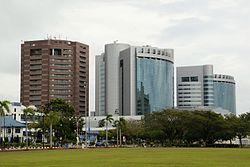
Labuan Financial Park complex, also known as Ujana Kewangan (UK) by many Labuanese.

The Labuan International Business and Financial Centre Labuan IBFC was created as Malaysia's only offshore financial hub in October 1990 and was operating under the name of Labuan International Offshore Financial Centre (IOFC). At the time it was established to strengthen the contribution of financial services to the Gross National Product (GNP) of Malaysia as well as to develop the island and its surrounding vicinity. The jurisdiction, supervised by the Labuan Offshore Financial Services Authority or LOFSA, offers benefits such as 3% tax[52] on net audited results or a flat rate of Malaysian Ringgit (MYR) 20,000 to trading companies; low operational costs; liberal exchange controls; and a host of other advantages including readily available, experienced and professional service providers. In 2010 the notion "offshore" was excluded from all the statutes of Labuan due to world pressure on the tax havens and offshores.

Since its inception, the jurisdiction has expanded to become a base for more than 4,800 offshore companies and 68 licensed banks. The IBFC also has over 370 registered foundations, 100 partnerships, and over 63 licensed trusts.[53] Labuan IBFC is embarking on an aggressive growth strategy to become the premier international business and financial centre in the Asia Pacific region.

Labuan's business focus is on five core areas: offshore holding companies, captive insurance, Shariah-compliant Islamic Finance structures, public and private funds, and wealth management. Labuan IBFC's position is further enhanced by the launch of the Malaysian International Islamic Finance Centre initiative in August 2006.

Development

[edit]

Unlike other federal territory, Labuan is underdeveloped. The island's urban landscape is characterised by a mix of older buildings and limited modern architectural advancements. Key infrastructure projects, such as road networks and public transportation systems, are less advanced nor extensive, resulting in significant traffic issues during peak hours, particularly in the early morning and evening commutes.

Labuan-Menumbok Bridge

[edit]

One of the most anticipated infrastructure projects is the proposed bridge connecting Labuan to Menumbok in mainland Sabah. Like Penang Bridge. Labuan-Menumbok bridge aims to enhance connectivity and stimulate economic growth by providing a direct link between the island and the mainland. The project is expected to reduce travel time, improve the movement of goods and people, and boost tourism in the region, reflecting their commitment to regional development and integration.

The proposal was first introduced in the 1990s. However, it has faced numerous delays due to fact that the feasibility studies for the project were outdated and needed to be updated for the project to proceed smoothly.

Transport

[edit]

Labuan offers two primary modes of transportation for travel to and from the island.

Water ferry

[edit]
White ferry with "Labuan Express 2" painted on the side
A ferry from Labuan in Kota Kinabalu, Sabah

Labuan Ferry: One of the main routes is via water ferry services to Sabah and Sarawak. This ferry service is a vital link for passengers and vehicles, providing a convenient and scenic route across the island's strait.

In May 2024, Prime Minister Datuk Seri Anwar Ibrahim emphasised the need to update existing technical studies to reflect the current situation, such as upgrading works at the terminal, which costed RM22 Million. The funding is intended to enhance the facilities, infrastructure, jetty, and ferry ramp at the terminal. The Prime Minister said the estimated one-hour embarkation time could be reduced by addressing delays caused by immigration checks. He emphasised that efficient services from local enforcement agencies were crucial in resolving congestion issues at the terminal, rather than relying solely on new infrastructure.[54]

Ferry services between Kota Kinabalu, Sabah, and Labuan were suspended after the COVID-19 pandemic in Malaysia. Initially scheduled to resume on 15 December 2024 from Labuan to Jesselton Point, further delays occurred due to a lack of readiness as Jesselton Point.[55] The ferry service eventually resumed on 28 May, although connecting to Kota Kinabalu Port instead of Jesselton Point.[56]

Air travel

[edit]

Labuan Airport facilitates air travel to the major destinations. The airport hosts several airlines:

  • Malaysia Airlines: Provides regular flights to Kuala Lumpur, the capital city of Malaysia, offering connectivity to both domestic and international destinations.
  • AirAsia: Another major airline operating from Labuan Airport, AirAsia also offers flights to Kuala Lumpur, catering to budget-conscious travellers.
  • MASwings: A regional airline, MASwings, operates flights to Miri in Sarawak as well as Kota Kinabalu in the neighbouring state of Sabah, enhancing connectivity within East Malaysia.

These transportation options ensure that W.P. Labuan remains accessible and well-connected, supporting both the local population and visitors to the island.

Places of interest

[edit]
Chimney at the Colliery Fields

There are several attractions and places of interest in Labuan. The Labuan War Cemetery contains various war graves and memorials to the fallen of World War II. This includes British, Australian, Indian, Sarawakian, Bruneian, North Bornean, and Empire troops, with a total of 3,908 graves of fallen soldiers. A memorial service is held on Remembrance Day once every four years. The territory also has a memorial celebrating the surrender of the Japanese to the Australian Forces in 1945. Remnants of Labuan's history as a Royal Navy coaling station include the chimney, a well known local landmark. Labuan also contains a Labuan Maritime Museum.

Labuan is also the base for diving on four popular wreck dives: the Cement wreck, the American wreck (the first USS Salute), the Australian wreck and the Blue Water wreck.[57]

Labuan has many schools. However, it has only one international school, Labuan International School.[58] Other places of interest include the Labuan International Sea Sport Complex. Newly proposed is the Marina Centre and Labuan Square project which were completed in 2010.

Labuan's own institution of higher education is Universiti Malaysia Sabah Labuan International Campus,[59] a branch of Universiti Malaysia Sabah in Sepanggar Bay, Kota Kinabalu. Labuan also has Kolej Matrikulasi Labuan, the only matriculation college in East Malaysia. All pre-university students from Sabah, Sarawak, and Labuan take their courses at this institution.

Postage stamps and postal history

[edit]
1885 2c stamp
Stamp of North Borneo overprinted "Labuan", 1897

A post office was operating in Labuan by 1864, and used a circular date stamp as postmark. The postage stamps of India and Hong Kong were used on some mail, but they were probably carried there by individuals, instead of being on sale in Labuan. Mail was routed through Singapore. From 1867, Labuan officially used the postage stamps of the Straits Settlements but began issuing its own in May 1879.

Although initially the design for the first stamp issue was proposed to be depicting a clump of sago palms, for economic reasons, the queen heads design was finally adopted, having been used initially for postage stamps of Grenada.[60][61] The first stamps of Labuan therefore depict the usual profile of Queen Victoria but are unusual for being inscribed in Malay-Arabic (Jawi) and Chinese scripts in addition to "LABUAN POSTAGE". Perennial shortages necessitated a variety of surcharges in between the several reprints and colour changes of the 1880s. The original stamps were engraved, but the last of the design, in April 1894, were done by lithography.

Beginning in May 1894, the stamps of North Borneo were overprinted "LABUAN". On 24 September 1896, the 50th anniversary of the cession was marked by overprinting "1846 / JUBILEE / 1896" on North Borneo stamps. Additional overprints appeared through the 1890s. In 1899 many types were surcharged with a value of 4 cents.

The last Labuan-only design came out in 1902, depicting a crown and inscribed "LABUAN COLONY". After incorporation into the Straits Settlements in 1906, Labuan ceased issuing its own stamps, although they remained valid for some time. Many of the remainder were cancelled-to-order for sale to collectors and are now worth only pennies; genuine franked/post used stamps are worth much more.

Federal parliament seats

[edit]

List of Labuan representatives in the Federal Parliament (Dewan Rakyat)

Parliament Seat Name Member of Parliament Party
P166 Labuan Suhaili Abdul Rahman PN (BERSATU)

Notable residents

[edit]

Notes

[edit]

References

[edit]

Further reading

[edit]
[edit]
Revisions and contributorsEdit on WikipediaRead on Wikipedia
from Grokipedia

Labuan, officially the of Labuan, is a Malaysian comprising the main island of Labuan and six smaller islets, situated approximately 8 kilometres off the northwestern coast of in the , with a total land area of 92 square kilometres. The territory has a population of 95,120 as recorded in the 2020 , predominantly ethnic Malays and other Bumiputera groups, and is administered directly by the federal government through the Labuan Corporation headquartered in the capital, Victoria.
Originally part of the Bruneian Sultanate, Labuan was ceded in perpetuity to the on 18 December 1846 by Raja Muda Hashim, acting on behalf of Sultan Omar Ali Saifuddin I, primarily to establish a against and facilitate trade in the region. It functioned as a from 1848, was incorporated into the Straits Settlements in 1907, transferred to administration in 1912, and endured Japanese occupation during the Second before reverting to British control in 1946. Following the formation of the Federation of in 1963, Labuan was separated from and elevated to status on 16 April 1984 to enable its development as a hub for activities. Labuan's economy centers on its designation as an International Business and Financial Centre (IBFC) on 1 October 1990, fostering offshore banking, , , leasing, and sectors with tax incentives and a regulatory framework overseen by the Labuan . This financial specialization, combined with its duty-free port status and strategic location, has driven , attracting foreign investment while maintaining a diversified base that includes oil and gas support services, , and fisheries, though challenges persist in and retention.

History

Pre-colonial and early colonial period

Prior to British acquisition, Labuan formed part of the Sultanate's territory, with small coastal settlements primarily inhabited by Brunei Malays engaged in fishing and limited maritime trade. Archaeological and historical records indicate sparse indigenous populations, lacking evidence of large-scale organized societies or extensive trade networks beyond regional exchanges under 's nominal control. The island's strategic location off Borneo's northwest coast made it a peripheral outpost rather than a central hub in pre-colonial Southeast Asian commerce. In 1846, amid efforts to counter piracy and secure commercial interests, , the Rajah of , negotiated the cession of Labuan from the Brunei Sultanate. On 18 December 1846, Sultan signed the Treaty of Labuan with Captain Rodney representing the British Crown, formally transferring sovereignty over the island and its adjacent seas. Brooke, who played a key role in the diplomacy, was appointed the first Governor and Commander-in-Chief of Labuan upon its occupation on 24 December 1846. The establishment of Labuan as a British in 1848 marked its designation as a free port, aimed at promoting legitimate trade while serving as a to suppress rampant by groups such as the Lanun and Balanini in the Sulu and Celebes Seas. Early colonial records describe a modest initial population, predominantly Malay fishermen and a small influx of Chinese traders, though precise figures from the mid-19th century remain undocumented in surviving accounts. This initiative reflected Britain's broader strategy to stabilize regional shipping lanes without deeper administrative integration at the outset.

British colonial administration

Labuan was established as a British Crown Colony in 1848 following its cession from the Sultan of two years prior, operating independently from Settlements to serve as a strategic coaling station and free port. The colony's administration focused on exploiting deposits discovered in the 1840s, which fueled operations that employed hundreds of laborers by the 1860s and supported steamship traffic in the region. Port infrastructure development, including Victoria Harbor enhancements, was prioritized under governors like , linking economic policies directly to expanded trade and naval resupply capabilities. Financial difficulties prompted administrative mergers, with Labuan's governance transferred to the British Company on January 1, 1890, whereby the company's governor assumed dual responsibilities over both territories. This integration aimed to streamline costs and leverage 's resources, though Labuan retained distinct postal emissions until 1906. In 1906, Labuan was incorporated into Settlements, ceasing its standalone status by January 1907, yet postal services maintained ties to until 1912, using overprinted stamps to facilitate mail exchange. These shifts reflected pragmatic responses to fiscal constraints, with infrastructure like lighthouses and railways extended under unified oversight to bolster connectivity. Japanese forces invaded Labuan on January 3, 1942, incorporating it into their occupation administration and exploiting remaining coal resources amid wartime demands. Allied forces, primarily Australian troops, liberated the island in June 1945 during Operation Oboe 6, marking the end of hostilities there. British civil administration resumed shortly after, persisting until July 15, 1946, when Labuan was amalgamated with into a single , concluding its separate colonial phase.

Path to Malaysian federation and federal territory status

Labuan, administered as part of the Crown Colony of , acceded to the newly formed Federation of on 16 September 1963, concurrently with (formerly ), , and . This integration followed the broader agreement among British colonial territories in and the Malayan Federation to establish a unified state, motivated primarily by strategic defense considerations amid regional tensions, including Indonesian opposition known as Konfrontasi, during which Labuan served as a key for forces from 1963 to 1966. The island retained a distinct administrative identity within , preserving its duty-free port status established under British rule, which supported trade and economic activities separate from mainland 's agrarian focus. By the early 1980s, discoveries of offshore oil and gas reserves in the surrounding waters, coupled with the need to revive Labuan's historical role as a free port, prompted a reevaluation of its status to enable targeted federal investment. On 16 April 1984, Labuan was detached from and elevated to status under direct control of the Malaysian federal government, mirroring the administrative model of to streamline development initiatives and bypass state-level constraints. This shift was driven by economic imperatives, including leveraging proximity to resources—such as the nearby Champion and Gumusut fields—and enhancing for logistics, which had gained momentum post-1970s exploration successes in the region. To capitalize further on its strategic position and low operational costs, Labuan was designated an on 1 1990 through the enactment of the Offshore Companies Act. This initiative aimed to position Labuan as a complementary hub to Kuala Lumpur's domestic financial sector, offering incentives like a 3% on trading activities or a flat RM20,000 annual levy for non-trading entities, alongside relaxed regulatory frameworks to attract foreign in banking, , and trust services. By 1999, the centre had registered over 1,900 offshore entities, including 62 banks, underscoring its role in diversifying Malaysia's economy beyond resource extraction toward service-oriented growth. The policy emphasized fiscal neutrality and business facilitation over stringent oversight, aligning with global trends in offshore jurisdictions while integrating Labuan more firmly into federal .

Geography

Location, islands, and physical features

Labuan comprises the main island, Pulau Labuan, and six smaller islets—Burung, Daat, Kuraman, Papan, Rusukan Besar, and Rusukan Kecil—with a total land area of 92 square kilometers. The main island accounts for the majority of this area at approximately 91.64 square kilometers, while the islets contribute minimally due to their small sizes, such as Kuraman at 1.47 square kilometers. Positioned in the , Labuan lies about 8 kilometers northwest of the Sabah coastline on , commanding the entrance to Brunei Bay, with central coordinates at 5°17′N 115°14′E. This strategic offshore location facilitates maritime access but exposes the to sea-level influences. The physical consists primarily of coastal plains fringed by mangroves, interspersed with low hills rising to elevations below 200 meters, exemplified by Bukit Merinding as the . No major rivers traverse the islands, limiting freshwater drainage to small streams and relying on and rainfall for . Extending from the shores are coral reef systems, particularly around the smaller islets within the Labuan , which harbor diverse marine habitats including fringing and patch reefs supporting such as hard corals and associated fish species. These features contribute to the archipelago's ecological value, though coastal development has introduced localized risks to zones.

Climate and environmental conditions

Labuan experiences a tropical equatorial marked by consistently high temperatures, elevated , and substantial throughout the year. Average daily temperatures range from 25°C to 32°C (77°F to 89°F), with minimal seasonal variation due to the region's proximity to the . Relative typically averages 80-85%, contributing to an oppressive feel and frequent that exceeds 80% of the time. The aligns with the northeast from October to March, delivering the bulk of annual rainfall, estimated at approximately 3,000 mm, often in intense, short-duration downpours that can disrupt outdoor activities and stability. Outside this period, lighter southwest winds prevail, but dry spells remain rare, with over 200 rainy days annually supporting lush while challenging habitability through persistent dampness and risks in low-lying areas. These patterns foster a stable environment for tropical and but exacerbate heat stress for residents, as the combination of warmth and limits effective cooling without mechanical aid. Environmental pressures include gradual , averaging 2.9 mm per year in Labuan and surrounding Sabah waters, driven by and potentially amplifying and inundation risks for the island's 92 km² land area. Offshore and gas extraction, a dominant activity in Labuan's surrounding fields, contributes to through and grease discharges and occasional spills, elevating hydrocarbon levels in coastal sediments and threatening coral reefs and fisheries that underpin local ecology. Such , monitored under Malaysian federal guidelines, has prompted assessments of long-term impacts on , though enforcement data from the Department of Environment indicates variable compliance amid economic priorities.

Demographics

The population of Labuan was enumerated at 95,120 in the MyCensus 2020 conducted by the Department of Statistics Malaysia (DOSM). This marked growth from 86,908 residents recorded in the 2010 , reflecting an average annual increase of approximately 0.9% over the decade. Given Labuan's land area of 91.64 km², the 2020 was about 1,038 persons per km², indicative of relatively high on the islands. Most residents are concentrated in the urban center of Victoria (Bandar Labuan), which accounts for the bulk of the territory's inhabited areas, with sparser settlement on peripheral islands. Population trends have been shaped by net in-migration, including expatriates drawn to in offshore and industries, offsetting modest natural increase rates. DOSM estimates continued modest expansion, with the population reaching 99,500 by 2023 and forecasted to approach 102,000 by mid-2025, sustained by job inflows linked to the and despite national declines. These projections incorporate recent migration data and align with slower overall growth compared to mainland , where urban pull factors are more pronounced.

Ethnic composition, languages, and religion

Labuan's exhibits significant ethnic diversity reflective of its position as a with historical ties to indigenous groups, Malay settlers, and immigrant communities from mainland Asia. According to the 2020 Population and Housing Census data from the Department of Statistics Malaysia, the ethnic composition is dominated by Bumiputera groups at 86.2%, encompassing Malays and such as ; Chinese account for 11.7%, Indians 1.1%, and other groups 1.0%. This Bumiputera majority stems from native Bornean s and Malay migration, while the Chinese presence traces to 19th-century trade and labor influxes under British administration. Non-citizens, often expatriates in finance sectors, comprise about 9-11% but are excluded from citizen ethnic tallies. Religion in Labuan aligns closely with ethnic lines, with predominant among Malays and many indigenous converts. The 2020 census records at 77.2% (73,460 individuals), at 13.8% (13,118, largely among non-Malay Bumiputera like ), Buddhists at 8.1% (7,676, primarily Chinese), at 0.6% (612), and others at negligible shares. 's constitutional framework constitutionally identifies Malays as , reinforcing the correlation, though indigenous groups retain higher Christian adherence due to missionary influences from colonial eras. No formal enforcement applies uniquely to Labuan as a , but national policies prioritize Islamic observance. Languages reflect this ethnic mosaic and Labuan's role as a trading hub. serves as the and , while English functions as the in administration, business, and , a legacy of British colonial governance and the territory's offshore status. Chinese communities employ dialects like Hakka and alongside Mandarin, and indigenous groups speak languages such as Dusun or Bajau variants, though these are declining in daily urban use due to and intermarriage. persists in informal settings, but English-Malay bilingualism predominates in professional contexts.

Government and Politics

Administrative structure and governance

Labuan operates as one of Malaysia's three federal territories, administered directly by the federal government without an independent or executive council, distinguishing it from the 13 states that possess such bodies under the Malaysian . This structure ensures centralized federal oversight, with policies tailored to Labuan's role as an and financial hub rather than broader welfare provisions. The , or Governor, heads the territory as a ceremonial figurehead appointed by the () on the recommendation of the , typically for a four-year term. This appointment underscores Labuan's integration into federal authority, with the Governor's role limited to advisory functions and representation rather than executive decision-making. Local administration falls under the , a established in 1984 upon the territory's proclamation as a federal entity on 16 April that year, which handles day-to-day including public services, , and maintenance. Governance emphasizes economic zoning and regulatory incentives, such as those enabling Labuan's status as an International Business and Financial Centre, with federal laws prioritizing low-tax environments and streamlined licensing over expansive social programs. The Labuan Corporation collaborates with federal ministries, particularly the Ministry of Federal Territories, to implement these directives, receiving direct budgetary and policy support from to foster offshore financial activities while maintaining fiscal discipline. This framework, rooted in Labuan's cession from state control in , limits local autonomy to align with national economic objectives.

Security, law enforcement, and local administration

Law enforcement in Labuan is primarily handled by the Royal Police (RMP), which maintains a dedicated contingent focused on maintaining public order and securing the federal territory's maritime borders against illicit cross-border activities. The territory records low crime rates empirically, with the crime index dropping 28.9% in the first half of 2020 to 91 reported cases from 128 in the comparable period of 2019, reflecting effective policing in a of approximately 100,000. Earlier data indicate Labuan achieved the lowest crime index among districts under the Sabah contingent in 2014, underscoring sustained low incidence of index crimes relative to national averages. The Royal Malaysian Customs Department enforces customs regulations in Labuan, leveraging its duty-free status to prioritize anti- operations at ports and ferry terminals. In September 2024, Labuan customs seized contraband goods and vehicles valued at RM1.12 million, including items subject to unpaid duties, as part of routine interdictions. Such measures have also thwarted smuggling attempts, including a 2023 interception of six kilograms of and syabu valued at RM500,000 originating from . Immigration enforcement is conducted by the , with frequent operations targeting illegal entry and human smuggling under the Immigration Regulations 1963 and the Anti-Trafficking in Persons and Anti-Smuggling of Migrants Act 2007 (ATIPSOM). In October 2025, authorities detained 15 migrants, including children, during a crackdown, while a June 2025 raid similarly apprehended 15 individuals for violations. These actions address vulnerabilities posed by Labuan's strategic position near and international shipping routes. Local administration falls under the Labuan District Office, which manages permits for , building approvals, and routine compliance checks to support federal territory operations, though specific audit data remains limited in . RMP and other agencies coordinate to enforce , contributing to Labuan's overall security posture against transnational threats.

Federal parliamentary representation

Labuan is represented in Malaysia's federal parliament by a single seat in the Dewan Rakyat, designated as the Labuan federal constituency (P.169), encompassing the entire federal territory. This representation has been in place since Labuan's designation as a federal territory in 1984, with the MP serving as the sole elected advocate for its residents in national legislative matters. Unlike Malaysia's states, Labuan lacks a state legislative assembly, directing its political influence primarily through this federal parliamentary channel. The constituency has historically been dominated by (BN) candidates, reflecting consistent electoral support for the coalition's platforms until shifts in recent polls. In the 15th held on November 19, 2022, Datuk Abdul Rahman, contesting under , won the seat with 8,400 votes against challengers from BN and , securing a amid a of approximately 69.8%. Following his victory, aligned with the -led unity government in late 2023, which facilitated approvals for constituency development allocations, including funds for local infrastructure and services. Through parliamentary debates and committee engagements, the Labuan MP influences federal allocations, advocating for enhanced funding to address territory-specific priorities such as upgrades and economic support. Key issues raised include disparities in development grants relative to Labuan's revenue contributions—estimated at RM8 billion in taxes in 2022—and calls for revitalizing sectors like offshore finance and via targeted federal investments. These efforts underscore the MP's role in bridging local needs with , as evidenced by persistent Hansard-quoted pleas for equitable resource distribution to mitigate deficits.

Economy

Economic overview and key sectors

Labuan's economy is marked by a high GDP per capita of RM83,596 in 2023, second only to among Malaysian states and territories, reflecting its focus on specialized, high-value activities. The territory's nominal GDP reached RM8.1 billion that year, with a growth rate of 1.8 percent, supported by recovery in trade and resource-based sectors following the disruptions. The services sector forms the backbone of economic output, encompassing , , and retail, while oil and gas extraction, processing, and support services—primarily through operations including the Asian Supply Base—provide substantial contributions, generating around RM2 billion in annual revenue. Petroleum products dominate export activities via Labuan's port facilities, capitalizing on its proximity to major offshore fields in and waters. The duty-free status, in place since 1956, further bolsters retail and tourism-related commerce by attracting cross-border shoppers and visitors, though empirical data indicates variable impacts amid fluctuating regional travel patterns.

International Business and Financial Centre (IBFC)

Labuan and (IBFC) was established by the Malaysian in 1990 as a regulated offshore financial hub to attract activities through a of strategic , English framework, and specialized legislation. Oversight is provided by the Labuan (Labuan FSA), formed in 1996 under the Labuan Financial Services Authority Act, which enforces prudential standards aligned with global norms to foster legitimate . This structure has positioned Labuan as a conduit for cross-border , particularly in , by enabling efficient operations for entities seeking diversified jurisdictions while maintaining transparency and . Key sectors include banking, insurance (with emphasis on captive insurance and retakaful), trusts, and trading companies, supported by over 880 licensed financial institutions as of 2023. Islamic finance has expanded notably, with Islamic banking assets reaching USD2.3 billion after a 21% year-on-year increase, driven by Shariah-compliant products like sukuk issuance and retakaful arrangements that cater to regional demand for ethical financing. Labuan's compliance with Financial Action Task Force (FATF) recommendations, integrated through Malaysia's national anti-money laundering and counter-terrorist financing regime, ensures robust due diligence and reporting, mitigating illicit finance risks and bolstering credibility for participants. Performance indicators reflect sustained growth, with approximately 17,892 Labuan companies registered by early 2023 and licensed entities employing 5,006 personnel, contributing to local economic multipliers without reliance on evasion-driven models. Total sector assets stood at USD83.3 billion in 2023, underscoring the centre's scale in facilitating legitimate , , and trading flows amid competitive global jurisdictions. These outcomes stem from regulatory enhancements that prioritize , attracting entities focused on long-term operational efficiency rather than short-term .

Tax regime, incentives, and offshore status

Labuan entities conducting qualifying offshore business activities under the Labuan Business Activity Tax Act 1990 are taxed at a concessionary rate of 3% on audited net profits from trading operations, while non-trading activities—such as investment holding, estate management, or passive income generation—are exempt from tax at 0%. No capital gains tax applies to offshore entities, and withholding taxes are absent on dividends, interest, or royalties remitted to non-residents, minimizing fiscal burdens on cross-border capital flows. These rates, applicable provided entities meet substance requirements like maintaining a physical office and adequate expenditure in Labuan, structurally incentivize relocation of financial and holding activities by lowering effective tax liabilities compared to onshore Malaysian rates exceeding 24%. Targeted incentives further enhance competitiveness, including income tax exemptions on qualifying receipts for Labuan entities from 2023 to 2027, and pioneer status-like exemptions for approved sectors such as or trading for periods up to 10 years or more upon application. By exempting streams and facilitating 100% without local equity mandates, these measures draw capital inflows through reduced compliance costs and repatriation barriers, as evidenced by the expansion of Labuan's entity base from designation as an International in 1990. Labuan's offshore status is bolstered by adherence to OECD Base Erosion and Profit Shifting (BEPS) standards, mandating economic substance— including full-time employees, core income-generating activities, and minimum operating expenditures—to qualify for preferential treatment, thereby ensuring regimes target genuine economic contributions over nominal tax arbitrage. This framework, enforced by the Labuan Financial Services Authority, aligns with global norms against harmful practices while preserving low-tax appeal, resulting in sustained growth of assets under management and licensed entities since the 1990s.

Criticisms, regulatory compliance, and challenges

Labuan has been labeled a by advocacy organizations like the , which critiques its low-tax regime, offshore financial structures, and historical secrecy features as enabling and base erosion. Such designations, however, rely on broad criteria applied to numerous jurisdictions and have faced methodological criticism for overstating risks without granular evidence of harm. Global scrutiny intensified after the 2016 exposed offshore opacity worldwide, prompting Labuan regulators to affirm commitments to transparency and information exchange. The (FSA) has since aligned anti-money laundering (AML) and counter-terrorist financing (CTF) frameworks with (FATF) recommendations, including enhanced due diligence, suspicious transaction reporting, and risk-based supervision. Regulatory reforms have addressed anonymity concerns, with the Labuan Companies (Amendment) Act 2022 explicitly prohibiting the issuance or conversion of bearer shares in Labuan entities to promote ownership traceability. Malaysia's identifies offshore sectors like Labuan as higher-risk for due to cross-border flows and complex structures, though empirical conviction data remains sparse, reflecting either effective prevention or under-detection rather than systemic prevalence. Critics contend Labuan's economic freedoms—such as deferred taxes and non-resident incentives—divert from Malaysia's mainland, potentially exacerbating fiscal imbalances amid national debt pressures. Yet, Labuan IBFC generated over RM1 billion in federal tax contributions in 2022, the highest since 1990, while sustaining a GDP of RM81,650, underscoring net economic uplift despite transparency gaps. Labuan's alignment with Malaysia's Corruption Perceptions Index score of 50 (out of 100) in 2023 indicates moderate public-sector , bolstered by territory-specific low indices. Ongoing challenges include adapting to evolving OECD common reporting standards and mitigating patronage risks in local to sustain credibility.

Infrastructure and Development

Transportation systems

![Labuan Malaysia Airport-01.jpg][float-right]
Labuan Airport serves as the principal hub, facilitating daily scheduled flights to and primarily via and services. The airport handled roughly 496,000 passenger movements across 2024 quarters, reflecting steady regional demand but constraints from its single and limited aircraft types. This air connectivity supports efficient short-haul travel, though international access requires transiting through Malaysian mainland hubs, highlighting Labuan's peripheral role in national networks.
![Labuan FerryTerminal.jpg][center]
Maritime transport dominates inter-island links, with ferry services connecting Labuan to Menumbok in Sabah via multiple operators offering up to seven round trips daily during peak periods. Vessels include speedboats with 36- to 40-seat capacities for passengers and larger roll-on/roll-off ferries like the Putrajaya 1, which accommodate over 200 passengers alongside 85 vehicles. These services operate frequently, approaching hourly intervals in high demand, yet remain vulnerable to weather disruptions and capacity limits during holidays. No road or rail connections exist to the Sabah mainland, enforcing reliance on sea routes for bulk cargo and vehicular movement.
The island's road infrastructure features approximately 200 km of paved roads, enabling reliable local logistics, public bus routes, and private vehicle use across its compact 92 km² area. This network connects key sites like , terminal, and commercial zones without major highways, minimizing congestion but limiting scalability for growth. Internal mobility depends on these roads, supplemented by and ride-hailing, as no rail system operates on Labuan.

Major infrastructure projects and recent developments

The proposed Labuan-Menumbok Bridge, intended to connect Labuan Island to the mainland over approximately 17 kilometers, remains a priority to enhance connectivity and reduce reliance on services. In May 2025, the contract for a technical was awarded, with RM500,000 allocated by the federal government to evaluate implementation viability, including cost assessments estimated at up to RM6 billion. This could yield economic multipliers through improved flows and efficiency, potentially offsetting high upfront costs by minimizing disruptions and supporting Labuan's role as a financial hub, though detailed cost-benefit analyses emphasize careful evaluation of long-term returns against fiscal constraints. In September 2025, the upgrading of the Patau-Patau 1 Bridge in Labuan's water village was completed nine months ahead of its original March 2026 schedule, at a cost of RM11.1 million. The , initiated in 2023, involved reinforcing a four-kilometer structure using Ultra High Performance to enhance durability and safety for local communities. This early completion exemplifies efficient execution within Malaysia's broader portfolio of 860 nationwide development initiatives valued at RM49.9 billion as of September 2025, which include Labuan-specific utilities upgrades aimed at stabilizing and power supplies. Recent allocations underscore commitments to utility infrastructure, with over RM260 million invested in seven power projects for and Labuan in 2025, focusing on substation upgrades, grid expansions, and monitoring systems to serve around 60,000 users and mitigate supply instability. Additionally, RM454 million was designated for infrastructure enhancements, including major pipe replacements to address chronic shortages. The Labuan Waterfront , approved in 2025, introduces promenades, event spaces, and sea-sport facilities to bolster tourism-related development without overlapping existing transport networks. These efforts align with federal pledges for sustained investment, projecting improved reliability and , though outcomes depend on execution efficacy amid national fiscal priorities.

Culture and Tourism

Tourist attractions and places of interest

Labuan draws visitors for its duty-free shopping privileges, historical remnants from colonial and wartime periods, coastal beaches, and opportunities, leveraging its status as a free port to boost short-stay . In 2023, the territory recorded 331,360 domestic tourists, reflecting steady interest in these accessible attractions despite limited international arrivals. The , a 32-meter brick tower constructed circa 1900 under British administration, represents Labuan's early 20th-century industrial past tied to at Tanjung Kubong, which operated from 1847 to 1911; its precise function—ventilation shaft or signaling post—remains debated among historians. Visitors access it via the adjacent Chimney Museum, which exhibits mining artifacts and clarifies the site's role in the island's resource extraction history. The Labuan War Cemetery serves as a somber site commemorating 3,908 Allied burials from campaigns in , primarily Australian, British, and local forces, with the adjacent Labuan Memorial honoring 2,294 missing personnel, many prisoners of war; maintained by the since 1946, it underscores the island's strategic occupation by Japanese forces from 1941 to 1945. Beaches like Tanjung Batu provide wide sandy expanses suitable for picnics and basic water activities, while more secluded options such as Batu Manikar and Layang-Layang offer cleaner stretches for amid fringing reefs, though seasonal debris from currents can affect appeal. Labuan , encompassing six islands with protected reefs, supports at sites like the American freighter and Japanese vessels sunk during WWII, attracting certified divers to explore marine including corals and schools; day trips typically include guided descents to depths of 18-30 meters. Duty-free exemptions on imports enable bargains on alcohol, , chocolates, and across outlets in the Financial Park Complex and town center, drawing budget-conscious shoppers who account for a core revenue stream from transient visitors exploiting the port's fiscal incentives.

Cultural heritage and notable aspects

Labuan's cultural heritage reflects a fusion of Malay, Chinese, and indigenous Bornean traditions, shaped by its role as a historical trading hub and migration crossroads in . This blend manifests in communal practices emphasizing familial ties, seasonal observances, and artisanal skills passed down through generations, rather than formalized international designations like listings. Local preservation initiatives, often community-led, prioritize intangible elements such as oral histories and craft techniques to maintain continuity amid modernization. Key festivals underscore this heritage, with the harvest celebration—observed on 30 and 31 May by and related indigenous groups—featuring rituals of gratitude to the rice spirit, traditional sumazau dances, and donning of heirloom attire to honor agricultural cycles. Malay residents mark Hari Raya Aidilfitri at the conclusion of with communal prayers, feasting on and , reinforcing Islamic customs integrated into daily life. The Chinese community observes through ancestral reverence, exchanges, and performances symbolizing prosperity. The annual Borneo Arts Festival, organized by Labuan Corporation from 13 to 17 November, promotes intercultural dialogue via music, dance, and , bridging ethnic divides. Efforts to safeguard crafts include workshops reviving Labuan , which incorporates island-specific motifs like marine motifs and floral patterns, serving as a medium for cultural and economic continuity. Among Brunei Malay descendants, traditions of woven fabrics—known for intricate geometric designs and natural dyes—preserve aesthetic and symbolic values tied to identity and rituals. These activities emphasize skill transmission over commercial export, countering erosion from global influences. A notable aspect is the territory's multilingual fabric, where Bahasa Malaysia and English predominate officially, supplemented by Chinese dialects in commerce and social spheres, facilitating trade-rooted interactions without supplanting ethnic vernaculars. This linguistic pragmatism echoes Labuan's mercantile past, enabling fluid communication across communities.

Special Topics

Postal history and postage stamps

Labuan's postal services began formally in the mid-19th century, with a post office operational by 1864 that initially relied on circular date stamps and postage stamps from the Straits Settlements, , and for mail routed via Singapore to starting August 1, 1860. The island's first dedicated postage stamps were issued on May 1, 1879, featuring a profile of with denominations inscribed in English, , and Chinese characters, marking Labuan's autonomy in colonial communications as a British . These early issues, printed in limited quantities, included values from 2 cents to $1 and were followed by surcharges and reprints to address fluctuating postal demands. From 1894, Labuan increasingly utilized overprinted stamps from , incorporating designs like native chieftains and wildlife, alongside some original pictorial issues depicting local scenes such as Dyak headhunters and tobacco plants, continuing until around 1904. In 1907, following administrative transfer to the , unused Labuan stocks were overprinted "Straits Settlements" in black or red, with some surcharged to new values; these remained valid but signaled the end of fully independent designs. During the Japanese occupation from 1941 to 1945, provisional overprints on and Malaya stamps were applied locally, often crudely, to meet wartime needs, though their authenticity requires verification due to forgeries. Post-World War II, Labuan integrated into the Crown Colony of in 1946, adopting stamps overprinted or issued anew until the colony's stamps were superseded. Independent or locally distinct Labuan issues effectively ceased with Malaysia's formation on September 16, 1963, after which federal Malaysian stamps handled all postage, though transitional uses of overprints occurred briefly into 1964. Labuan's philatelic output, spanning roughly 1879 to 1907 with overprints thereafter, holds significant collectible value due to scarce surcharges, varieties, and low print runs; for instance, certain 1890s overprints on bases catalog at thousands in major references like , prized by specialists for rarities such as inverted surcharges or unused high values. Authentication is crucial, as forgeries abound in this niche British colonial series.

Notable residents and figures

James Brooke (1803–1868) served as the first Governor of Labuan from 1848, appointed by the British Crown following the island's cession from in 1846; in this role, he oversaw initial colonial administration and development as a free port and coal station, drawing on his experience as Rajah of to promote trade and suppress piracy in the region. His governance integrated Labuan into strategy, though it faced challenges from inadequate infrastructure and local resistance. Harris Mohd Salleh (born 1927 in Labuan), a longtime Sabah politician, founded the Berjaya party in 1975 and served as Chief Minister of Sabah from 1976 to 1985, advancing state development projects including agriculture and tourism while navigating federal relations amid ethnic tensions. His Labuan origins informed his early career in colonial-era administration before rising to prominence in post-independence Malaysian politics. Suhaili Abdul Rahman (born 1961), the Member of Parliament for Labuan since 2022, has advocated for local infrastructure and economic incentives as a businessman-turned-politician, including support for unity government policies despite party expulsion disputes in 2024 that led to legal challenges over his seat. His tenure emphasizes Labuan's role as a federal territory, focusing on financial services growth and community welfare.

References

Add your contribution
Related Hubs
Contribute something
User Avatar
No comments yet.