
Recent from talks
Sacred geometry
Knowledge base stats:
Talk channels stats:
Members stats:
Sacred geometry
Sacred geometry ascribes symbolic and sacred meanings to certain geometric shapes and certain geometric proportions. It is associated with the belief of a divine creator of the universal geometer. The geometry used in the design and construction of religious structures such as churches, temples, mosques, religious monuments, altars, and tabernacles has sometimes been considered sacred. The concept applies also to sacred spaces such as temenoi, sacred groves, village greens, pagodas and holy wells, Mandala Gardens and the creation of religious and spiritual art.
The belief that a god created the universe according to a geometric plan has ancient origins. Plutarch attributed the belief to Plato, writing that "Plato said God geometrizes continually" (Convivialium disputationum, liber 8,2). In modern times, the mathematician Carl Friedrich Gauss adapted this quote, saying "God arithmetizes".
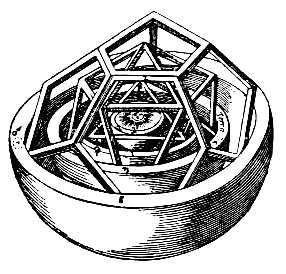
Johannes Kepler (1571–1630) believed in the geometric underpinnings of the cosmos.
According to Stephen Skinner, the study of sacred geometry has its roots in the study of nature, and the mathematical principles at work therein. Many forms observed in nature can be related to geometry; for example, the chambered nautilus grows at a constant rate and so its shell forms a logarithmic spiral to accommodate that growth without changing shape. Also, honeybees construct hexagonal cells to hold their honey. These and other correspondences are sometimes interpreted in terms of sacred geometry and considered to be further proof of the natural significance of geometric forms.
Geometric ratios, and geometric figures were often employed in the designs of ancient Egyptian, ancient Indian, Greek and Roman architecture. Medieval European cathedrals also incorporated symbolic geometry. Indian and Himalayan spiritual communities often constructed temples and fortifications on design plans of mandala and yantra. Mandala Vaatikas or Sacred Gardens were designed using the same principles.
Many of the sacred geometry principles of the human body and of ancient architecture were compiled into the Vitruvian Man drawing by Leonardo da Vinci. The latter drawing was itself based on the much older writings of the Roman architect Vitruvius.
Mandalas are made up of a compilation of geometric shapes. In Buddhism, it is made up of concentric circles and squares that are equally placed from the center. Located within the geometric configurations are deities or suggestions of the deity, such as in the form of a symbol. This is because Buddhists believe that deities can actually manifest inside the mandala. Mandalas can be created with a variety of mediums. Tibetan Buddhists create mandalas out of sand that are then ritually destroyed. In order to create the mandala, two lines are first drawn on a predetermined grid. The lines, known as Brahman lines, must overlap at the precisely calculated center of the grid. The mandala is then divided into thirteen equal parts not by a mathematical calculation, but through trial and error. Next, monks purify the grid to prepare it for the constructing of the deities before sand is finally added. Tibetan Buddhists believe that anyone who looks at the mandala will receive positive energy and be blessed. Due to the Buddhist belief in impermanence, the mandala is eventually dismantled and is ritualistically released into the world.
One of the cornerstones of Chinese folk religion is the relationship between man and nature. This is epitomized in feng shui, which are architectural principles outlining the design plans of buildings in order to optimize the harmony of man and nature through the movement of Chi, or "life-generating energy." In order to maximize the flow of Chi throughout a building, its design plan must utilize specific shapes. Rectangles and squares are considered to be the best shapes to use in feng shui design. This is because other shapes may obstruct the flow of Chi from one room to the next due to what are considered to be unnatural angles. Room layout is also an important element, as doors should be proportional to one another and located at appropriate positions throughout the house. Typically, doors are not situated across from one another because it may cause Chi to flow too fast from one room to the next.
Hub AI
Sacred geometry AI simulator
(@Sacred geometry_simulator)
Sacred geometry
Sacred geometry ascribes symbolic and sacred meanings to certain geometric shapes and certain geometric proportions. It is associated with the belief of a divine creator of the universal geometer. The geometry used in the design and construction of religious structures such as churches, temples, mosques, religious monuments, altars, and tabernacles has sometimes been considered sacred. The concept applies also to sacred spaces such as temenoi, sacred groves, village greens, pagodas and holy wells, Mandala Gardens and the creation of religious and spiritual art.
The belief that a god created the universe according to a geometric plan has ancient origins. Plutarch attributed the belief to Plato, writing that "Plato said God geometrizes continually" (Convivialium disputationum, liber 8,2). In modern times, the mathematician Carl Friedrich Gauss adapted this quote, saying "God arithmetizes".
Johannes Kepler (1571–1630) believed in the geometric underpinnings of the cosmos.
According to Stephen Skinner, the study of sacred geometry has its roots in the study of nature, and the mathematical principles at work therein. Many forms observed in nature can be related to geometry; for example, the chambered nautilus grows at a constant rate and so its shell forms a logarithmic spiral to accommodate that growth without changing shape. Also, honeybees construct hexagonal cells to hold their honey. These and other correspondences are sometimes interpreted in terms of sacred geometry and considered to be further proof of the natural significance of geometric forms.
Geometric ratios, and geometric figures were often employed in the designs of ancient Egyptian, ancient Indian, Greek and Roman architecture. Medieval European cathedrals also incorporated symbolic geometry. Indian and Himalayan spiritual communities often constructed temples and fortifications on design plans of mandala and yantra. Mandala Vaatikas or Sacred Gardens were designed using the same principles.
Many of the sacred geometry principles of the human body and of ancient architecture were compiled into the Vitruvian Man drawing by Leonardo da Vinci. The latter drawing was itself based on the much older writings of the Roman architect Vitruvius.
Mandalas are made up of a compilation of geometric shapes. In Buddhism, it is made up of concentric circles and squares that are equally placed from the center. Located within the geometric configurations are deities or suggestions of the deity, such as in the form of a symbol. This is because Buddhists believe that deities can actually manifest inside the mandala. Mandalas can be created with a variety of mediums. Tibetan Buddhists create mandalas out of sand that are then ritually destroyed. In order to create the mandala, two lines are first drawn on a predetermined grid. The lines, known as Brahman lines, must overlap at the precisely calculated center of the grid. The mandala is then divided into thirteen equal parts not by a mathematical calculation, but through trial and error. Next, monks purify the grid to prepare it for the constructing of the deities before sand is finally added. Tibetan Buddhists believe that anyone who looks at the mandala will receive positive energy and be blessed. Due to the Buddhist belief in impermanence, the mandala is eventually dismantled and is ritualistically released into the world.
One of the cornerstones of Chinese folk religion is the relationship between man and nature. This is epitomized in feng shui, which are architectural principles outlining the design plans of buildings in order to optimize the harmony of man and nature through the movement of Chi, or "life-generating energy." In order to maximize the flow of Chi throughout a building, its design plan must utilize specific shapes. Rectangles and squares are considered to be the best shapes to use in feng shui design. This is because other shapes may obstruct the flow of Chi from one room to the next due to what are considered to be unnatural angles. Room layout is also an important element, as doors should be proportional to one another and located at appropriate positions throughout the house. Typically, doors are not situated across from one another because it may cause Chi to flow too fast from one room to the next.
Recent media