


Community hub
Recent from talks
Contribute something
Nothing was collected or created yet.
Golden-handed tamarin
View on Wikipedia
| Golden-handed tamarin[1] | |
|---|---|

| |
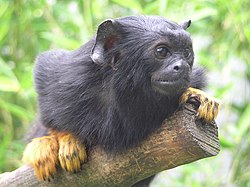
| At Parc Zoologique et Botanique de Mulhouse, France | |
Scientific classification 
| |
| Kingdom: | Animalia |
| Phylum: | Chordata |
| Class: | Mammalia |
| Order: | Primates |
| Suborder: | Haplorhini |
| Family: | Callitrichidae |
| Genus: | Saguinus |
| Species: | S. midas
|
| Binomial name | |
| Saguinus midas | |

| |
| Range of the Midas Tamarin | |
| Synonyms | |
|
Simia midas Linnaeus, 1758 | |

The golden-handed tamarin (Saguinus midas), also known as the red-handed tamarin or Midas tamarin, is a New World monkey belonging to the family Callitrichidae.
Distribution and habitat
[edit]This species is native to wooded areas north of the Amazon River in Brazil, Guyana, French Guiana, Suriname, and possibly Venezuela.[2] A population of tamarins south of the Amazon River that lack the contrasting feet and hands was previously believed to be a sub-population of golden-handed tamarins but is now treated as a separate species, the black tamarin.
Populations of golden-handed tamarins appear to be expanding into the historical range of the pied tamarin, with the golden-handed tamarin gradually displacing the pied tamarin through interspecific competition.[2][4]
This species prefers trees with small crowns.[5]
Description
[edit]
The golden-handed tamarin's body measures 20.5–28 centimetres (8.1–11.0 in); including the tail it measures 31–44 centimetres (12–17 in). It weighs 400–550 grams (0.88–1.21 lb).
The fur of the golden-handed tamarin is dark brown or black, with contrasting golden-orange hair on its feet and hands (hence the common name). The dark face is hairless, the big ears stick out of the fur. As with all marmosets, there are claws instead of nails on the fingers and toes (with the exception of the big toe). Furthermore, the thumb is not opposable.[5]
Biology and behavior
[edit]The life expectancy of Saguinus midas is approximately 10 years in the wild [5] and 16 years in captivity. These tamarins live in cooperative groups of 4 to 15 members with little competition within group even between breeding males. Adults can reach sexual maturity aged 16–20 months.[5] Only one female in the group will breed during breeding season with the other females suppressing the instinct. The gestation period is 140–170 days[5] and mothers typically give birth to two offspring. Young tamarins are cared for primarily by the father and turned over to the mother only to nurse, however the entire group helps with the care of the young. Defense is a priority in a group, and when one tamarin is threatened the others will rush to its defense. The golden-handed tamarin is territorial and can be aggressive, with sharp canines and claws instead of fingernails on all fingers and all but the large toe.
The golden-handed tamarin is an exceptional climber and spends most of its time among the vines and branches of the trees.[5] It is quick and agile and is a superb jumper known to jump distances of over 60 feet (18 m) from a tree to the ground with no sign of injury. It is an omnivore.[5] Its diet consists of leaves, plant exudates, fruit, flowers, eggs, insects and other arthropods, frogs, spiders, lizards, and nectar.[2][5] Its natural predators include small cats, birds of prey, and snakes.
References
[edit]- ^ Groves, C. P. (2005). Wilson, D. E.; Reeder, D. M. (eds.). Mammal Species of the World: A Taxonomic and Geographic Reference (3rd ed.). Baltimore: Johns Hopkins University Press. p. 135. ISBN 0-801-88221-4. OCLC 62265494.
- ^ a b c d Mittermeier, R.A.; Urbani, B.; Rylands, A.B.; Régis, T. (2021). "Saguinus midas". IUCN Red List of Threatened Species. 2021 e.T41525A192552538. doi:10.2305/IUCN.UK.2021-1.RLTS.T41525A192552538.en. Retrieved 19 November 2021.
- ^ Linnaeus, Carl (1758). Systema naturæ. Regnum animale (10th ed.). p. 28. Retrieved 19 November 2012.
- ^ Röhe, F. (2006). Área de contato entre as distribuições geográficas de Saguinus midas e Saguinus bicolor (Callitrichidae-Primates): a importância de interações e fatores ecológicos. Dissertação de Mestrado — INPA/UFAM. p. 71.
- ^ a b c d e f g h Animal Diversity
Golden-handed tamarin
View on GrokipediaTaxonomy and nomenclature
Classification
The golden-handed tamarin is scientifically classified within the domain Eukarya, kingdom Animalia, phylum Chordata, class Mammalia, order Primates, suborder Haplorhini, infraorder Simiiformes, parvorder Platyrrhini, family Callitrichidae, genus Saguinus, and species S. midas.[4] Its binomial nomenclature is Saguinus midas (Linnaeus, 1758).[5] No subspecies are currently recognized for S. midas, though historical taxonomy included variations such as S. midas niger, which is now treated as the distinct species Saguinus niger.[6] The species belongs to the genus Saguinus, which encompasses various tamarin species characterized by the absence of a prominent mane, distinguishing them from the lion tamarins of the genus Leontopithecus that possess thick facial manes resembling those of lions.[7][8]Etymology and synonyms
The scientific name of the golden-handed tamarin is Saguinus midas. The genus name Saguinus originates from the Portuguese term "sagui," meaning a small monkey or marmoset, derived from the Old Tupi indigenous language word "sagûi," and was coined by the German zoologist Johann Christian Fabricius in 1804 to denote likeness to these primates (-inus suffix in Latin).[9] The specific epithet midas refers to King Midas from Greek mythology, who possessed the ability to turn objects to gold with his touch, an allusion to the tamarin's distinctive golden-orange coloration on its hands and feet.[2] Common names for the species include golden-handed tamarin, red-handed tamarin (emphasizing the reddish hue of the hands in some lighting), and Midas tamarin, reflecting both its appearance and the mythological reference.[4] The species was originally described by Swedish naturalist Carl Linnaeus in 1758 under the name Simia midas in his Systema Naturae, placing it initially among the broad category of "apes" or non-human primates.[4] Historical taxonomic revisions led to several synonyms due to misclassifications under other genera, such as Callithrix midas, Cebus midas, Cebus tamarin, Sagouin midas, Simia lacepedii, and Cercopithecus midas, as early classifications shifted tamarins between marmoset-like and capuchin-like groupings before the modern recognition within Callitrichidae.[4] This naming history underscores the evolving understanding of New World primate diversity, with the mythological association highlighting the species' visually striking features since its initial description.[2]Physical description
Morphology and size
The golden-handed tamarin (Saguinus midas) is a small-bodied primate with a head-body length ranging from 20.5 to 28 cm and a tail length of 31.5 to 44 cm.[1] Adult weights typically range from 500 to 600 g, with females slightly heavier than males on average.[2] These dimensions contribute to its compact build, suited for navigating dense forest canopies.[2] Key anatomical features include a non-opposable thumb, lacking the saddle joint found in many other primates, which limits grasping capabilities.[1] The fingers and toes bear sharp claws for enhanced traction during movement, except for the big toe, which retains a flattened nail typical of primates.[2] The tamarin possesses prominent, protruding ears and a hairless face, providing acute sensory perception in its environment.[2] Its limbs exhibit an agile structure with flexible joints that facilitate rapid arboreal locomotion.[2] Sexual dimorphism is minimal, with males generally slightly smaller than females in body size and weight, though variations occur based on reproductive status.[2]Coloration and adaptations
The golden-handed tamarin exhibits a distinctive fur coloration that aids in its identification within tropical forest environments. The body is covered in glossy black fur, often with subtle orange marbling along the back, while the hands and feet feature striking golden-orange to reddish hues that extend partially up the forearms in some individuals.[2][1] Facial features contribute to the species' expressive appearance, with dark, largely hairless skin surrounding forward-facing eyes that enhance depth perception for navigating dense arboreal habitats. Unlike many other tamarins in its genus, it lacks a whitish mustache-like fringe of hairs around the mouth, and the ears are large and protruding without prominent tufts.[2][1] Key physical adaptations tied to appearance include specialized claws on all digits except the big toe, which bears a flattened nail, facilitating secure gripping on tree bark and branches. The long, non-prehensile tail provides balance during agile movements through the canopy, remaining dark-furred to blend with the body's overall tone.[2][1]Distribution and habitat
Geographic range
The golden-handed tamarin (Saguinus midas) is native to northern South America, primarily north of the Amazon River and east of the Rio Negro, Rio Branco, and Essequibo River. Its confirmed distribution spans Guyana, Suriname, French Guiana, and northern Brazil, specifically the states of Amapá, northern Pará, and Amazonas. There is also possible occurrence in southern Venezuela, particularly in the northeastern Guayana region, though records remain unconfirmed.[3][10][11] The species' extent of occurrence is estimated at approximately 1.51 million km², encompassing a broad but discontinuous range fragmented by major river systems such as the Amazon and its tributaries, which act as natural barriers to dispersal. Populations are thus isolated in pockets of suitable habitat within this area, with no evidence of major range contractions in recent decades.[10] In terms of range dynamics, the golden-handed tamarin has been expanding southward since the 1990s, particularly into central Amazonia near Manaus, Brazil, where its range now overlaps with that of the critically endangered pied tamarin (Saguinus bicolor). This expansion, facilitated by human-altered landscapes like roads, involves competitive displacement of the pied tamarin through resource competition and niche overlap, leading to assessments of the golden-handed tamarin as having invasive potential in these overlapping zones. No significant historical range reductions have been documented for the species overall.[10]Habitat types
The golden-handed tamarin (Saguinus midas) primarily inhabits tropical rainforests, including both primary and secondary growth forests, as well as wooded savannas in lowland regions. These environments provide the dense vegetation necessary for their arboreal lifestyle, with a preference for areas north of the Amazon River where forest cover supports their movement and resource needs.[1][2] Within these habitats, the species shows structural preferences for trees with small crowns, typically less than 15 meters in diameter, which facilitate easy navigation through leaping and climbing. They predominantly utilize the understory and mid-canopy layers, rarely venturing into the upper canopy or ground level, allowing access to insects, fruits, and exudates while minimizing exposure to predators. This vertical stratification helps them exploit fragmented resources in the forest's lower tiers.[1][12] The golden-handed tamarin occurs mainly at low elevations, up to approximately 200 meters, in lowland and hilly forests of the Guiana Shield, though it may occur in montane forests at higher elevations. Their adaptability extends to disturbed habitats, such as forest edges and selectively logged areas, where they can persist due to flexible foraging and ranging behaviors; however, they avoid open grasslands lacking sufficient tree cover. This resilience contributes to their stable population status in moderately altered landscapes.[2][3]Behavior and ecology
Social organization
Golden-handed tamarins live in stable social groups ranging from 4 to 15 individuals, typically consisting of 6 to 10 members, including multi-male and multi-female compositions with a dominant breeding pair.[2][1] These groups are often extended family units formed by kin, where one primary breeding female mates with one or more males, and non-breeding adults, including offspring from previous litters, serve as helpers.[2] The social structure is hierarchical, with the alpha pair maintaining dominance and little intragroup aggression, though reproductive suppression occurs in subordinate females.[1] Allomaternal care is prevalent, as all group members, particularly males and older siblings, participate in carrying and protecting infants to enhance survival rates.[2][1] Communication among golden-handed tamarins is multifaceted, relying on vocalizations, olfactory signals, and visual cues to maintain cohesion and coordinate activities. They produce long calls to advertise territory and locate group members over distances, chirps as alarm signals in response to predators, and trills during agonistic encounters.[2][13][14] Scent marking with sternal and genital glands conveys individual identity, reproductive status, and territorial boundaries, often applied to branches and trunks.[2][1] Visual displays, such as piloerection and rapid movements, supplement these signals during close-range interactions.[15] These tamarins exhibit strong territoriality, with home ranges varying from 10 to 40 hectares depending on habitat quality and group size, defended primarily through vocal threats and occasional chases against intruders from neighboring groups.[1][2] They are strictly diurnal, with activity patterns centered on foraging and patrolling boundaries during daylight hours to minimize overlap with other groups.[1] Territorial vocalizations may converge acoustically with those of sympatric species like the pied tamarin to reduce conflict in overlapping areas.[16] Within groups, interactions emphasize cooperation and bonding, including cooperative hunting of insects where members flush and capture prey together, and frequent grooming sessions that reinforce social ties and reduce tension.[2][17] Aggression is directed mainly outward, with unified displays and pursuits against intruders to protect resources, while internal dynamics promote tolerance and prosocial behaviors like food sharing among non-kin.[2][16]Diet and foraging
The golden-handed tamarin (Saguinus midas) exhibits an omnivorous diet dominated by fruits and arthropods, with fruits and flowers comprising a significant portion year-round alongside insects and other invertebrates that form substantial proportions of intake.[18] The remainder includes leaves, seeds, nectar, eggs, small vertebrates such as frogs and lizards, and plant exudates like gum, reflecting opportunistic feeding on available resources in their forest habitat.[2] This balanced insectivorous-frugivorous composition, where fruits and insects each account for roughly equal shares by volume, supports their metabolic demands while minimizing competition with fruit specialists.[12] Foraging occurs actively during daylight hours in a primarily arboreal manner, with individuals leaping between vertical tree trunks and branches over distances up to 18 meters, aided by their lightweight build and claw-like nails that facilitate clinging and precise movements.[1] They employ claws to probe bark, crevices, and foliage for hidden insects, spending considerable time scanning and manipulating substrates to capture prey.[15] Group foraging involves coordinated efforts, including brief vigilance by some members to allow others to feed uninterrupted.[2] Seasonal shifts in diet address fluctuations in resource availability, with greater reliance on fruits during the wet season when production peaks, and increased consumption of insects and gum during the dry season to compensate for fruit scarcity.[19] These adaptations align with the species' high energetic requirements stemming from their small body size (averaging 500–600 grams), necessitating a nutrient-dense, diverse intake to maintain activity levels and reproduction.[18] Gum feeding is facilitated by their specialized lower incisors and canine-like teeth, which aid in accessing and processing exudates from tree wounds.[15]Reproduction
The golden-handed tamarin (Saguinus midas) exhibits a flexible mating system within its small social groups, typically involving a single breeding female who mates with one or more resident males, resulting in either monogamous pairs or rare polyandry.[2][1] Breeding occurs year-round in their tropical habitat, though it peaks during the rainy season when food resources are more abundant.[15] Gestation lasts 140–145 days, after which the female gives birth to a litter of 1–3 offspring, most commonly twins weighing about 45 grams each.[1] Infants are altricial and dependent, initially carried almost exclusively by the father and older siblings during travel and foraging, with the mother providing nursing for the first 2–3 months.[2][1] Weaning occurs around 2–3 months of age, and young reach sexual maturity at 16–20 months.[1] Parental investment is communal, with alloparenting by non-breeding group members—particularly adult males and subadults—essential for infant survival through carrying, grooming, and food sharing.[2][1] Disruption of group stability, such as through deaths or evictions of key caregivers, leads to high infant mortality rates, as the cooperative care system cannot compensate for the loss.[20] In the wild, individuals have an average life expectancy of about 10 years, though they can live up to 20 years in captivity under optimal conditions.[2][1]Conservation
Status and population
The golden-handed tamarin (Saguinus midas) is classified as Least Concern on the IUCN Red List, with its 2015 assessment (2021 Red List update) indicating a stable population trend that persists as of 2025.[3] This status is supported by the species' extensive distribution across northern Amazonia, spanning Brazil, Guyana, Suriname, and French Guiana, which buffers it against region-specific risks.[3] Global population estimates remain imprecise owing to the challenges of censusing in vast, remote tropical forests, though densities in prime habitats typically range from 10 to 20 individuals per square kilometer based on field studies. In core range areas, populations are generally stable or showing slight increases, facilitated by the species' adaptability to varied forest types.[10] Range expansion has been documented into adjacent territories, suggesting growth potential, although localized declines occur proximate to expanding human settlements.[21] Monitoring efforts encompass the species within broader primate assessments by the IUCN Species Survival Commission's Primate Specialist Group, which compiles data on distribution, abundance, and habitat integrity through collaborative surveys. Furthermore, S. midas is appended to CITES Appendix II, enabling regulated international trade to sustain wild populations without overexploitation.[22]Threats
The primary threats to the golden-handed tamarin (Saguinus midas) stem from anthropogenic habitat alteration in the Amazon basin, where deforestation for agriculture, logging, and human settlement has significantly reduced forest cover essential for their arboreal lifestyle.[3] This habitat loss leads to fragmentation, which limits the tamarins' mobility across their home ranges and increases isolation of subpopulations, exacerbating vulnerability to local extinctions.[1] In particular, expansion of urban areas like Manaus has intensified these pressures, converting continuous forests into isolated patches unsuitable for long-distance travel.[10] In overlapping ranges, the golden-handed tamarin aggressively competes with the critically endangered pied tamarin (Saguinus bicolor), displacing it through interspecific aggression and resource competition for food and sleeping sites.[10] This dynamic, facilitated by habitat fragmentation and human-mediated range expansions via roads, positions S. midas as a potential invasive species southward into S. bicolor's restricted distribution, with significant niche overlap (Schoener's D = 0.39) threatening the latter's persistence.[10] Natural predation poses an ongoing risk, with frequent attacks by raptors such as harpy eagles (Harpia harpyja) documented in wild populations, alongside threats from ocelots (Leopardus pardalis) and snakes in the understory.[23] Disturbed habitats amplify this danger by reducing cover and increasing encounter rates with ground-dwelling predators like ocelots.[3] Additional risks include incidental hunting for the pet trade, though its impact remains low due to the species' relative abundance, and potential disease transmission from humans via increased contact in fragmented, urban-proximate forests.[3] Zoonotic pathogens, including mycobacteria, have been reported in captive individuals, highlighting risks in wild settings near human settlements.[24] Emerging climate influences in the Amazon may further disrupt fruit availability, a key dietary component, through altered precipitation patterns and increased drought frequency, potentially straining foraging efficiency in already degraded habitats.[25]Conservation measures
The golden-handed tamarin (Saguinus midas) benefits from its occurrence in several large protected areas across its range in northern South America. In Brazil, populations inhabit the Tumucumaque Mountains National Park, a vast reserve covering over 3.8 million hectares of Amazonian rainforest that safeguards biodiversity in the states of Amapá and Pará.[26] In Suriname, the species is present within the Central Suriname Nature Reserve, a UNESCO World Heritage site spanning 1.6 million hectares of primary tropical forest that connects multiple pre-existing reserves to promote habitat connectivity and primate conservation.[27] In French Guiana, it occurs in the Guiana Amazonian Park, France's largest national park at 2.043 million hectares, which protects extensive lowland and montane forests essential for Amazonian primate species. Conservation initiatives for the golden-handed tamarin are integrated into broader Amazon primate programs coordinated by organizations like the IUCN Primate Specialist Group, emphasizing habitat protection and research. Ex-situ breeding efforts are supported through European Endangered Species Programmes (EEP) and Association of Zoos and Aquariums (AZA) regional collection plans for Callitrichidae, with populations maintained in zoos to ensure genetic diversity and provide data for in-situ management; for example, the New World Primate Taxon Advisory Group includes S. midas in its breeding recommendations to support long-term viability.[28][29] Recent IUCN-supported research has focused on the species' potential invasive impacts, particularly its range expansion into habitats of the critically endangered pied tamarin (Saguinus bicolor), using ecological niche modeling to identify overlap zones and recommend monitoring to mitigate competition risks.[10][30] Regulatory frameworks provide additional safeguards, with the golden-handed tamarin listed under Appendix II of the Convention on International Trade in Endangered Species (CITES), which regulates international trade to prevent unsustainable levels while allowing commerce that does not threaten wild populations.[22] National laws in Brazil, enforced by the Brazilian Institute of Environment and Renewable Natural Resources (IBAMA), prohibit the capture and trade of native primates like S. midas outside approved research or conservation contexts. In Guyana, the Endangered Species Act and Wildlife Management and Conservation Regulations similarly ban unauthorized capture and promote protected status for Amazonian primates. Community-based efforts in Guyana include ecotourism promotion in regions like the North Rupununi, where sightings of the golden-handed tamarin along forest edges raise awareness and generate local income to support conservation, as highlighted in wildlife observation programs.[31] Reforestation projects, such as those under Guyana's Low Carbon Development Strategy, aim to restore and connect fragmented habitats in the Guiana Shield, benefiting primate dispersal and reducing isolation effects on S. midas populations.[32] Future conservation needs prioritize ongoing monitoring of the species' invasive spread, particularly in contact zones with sympatric tamarins, to inform targeted interventions and preserve regional biodiversity.[10] Genetic studies on subspecies variation, such as S. m. midas and S. m. niger, are recommended to guide population management amid habitat changes.[12]References
- https://en.wiktionary.org/wiki/Saguinus