
Recent from talks
Tamarin
Knowledge base stats:
Talk channels stats:
Members stats:
Tamarin
The tamarins are squirrel-sized New World monkeys from the family Callitrichidae in the genus Saguinus. They are the first offshoot in the Callitrichidae tree, and therefore are the sister group of a clade formed by the lion tamarins, Goeldi's monkeys and marmosets.
Hershkovitz (1977) recognised ten species in the genus Saguinus, further divided into 33 morphotypes based on facial pelage. A later classification into two clades was based on variations in dental measurements. A taxonomic review (Rylands et al., 2016) showed the tamarins are a sister group to all other callitrichids, branching off 15–13 million years ago. Within this clade, six species groups are historically recognised, nigricollis, mystax, midas, inustus, bicolor and oedipus, five of which were shown to be valid with Saguinus inustus placed within the midas group. The review noted that the smaller-bodied nigricollis group began diverging 11–8 million years ago, leading the authors to move them to a separate genus, Leontocebus (saddle-back tamarins). While a 2018 study proposed that Leontocebus does not have sufficient divergence from Saguinus to be in its own genus, and thus should be reclassified it as a subgenus of Saguinus, this proposal has since found significant traction. The same study found the mystax group of tamarins to be distinct enough to be classified in the subgenus Tamarinus. As of 2021 this proposal has not been universally accepted by primatologists.
Following the taxonomic review of tamarins by Rylands et al. (2016) and Garbino & Martins-Junior (2018), there are 22 species in the genus Saguinus with 19 subspecies.
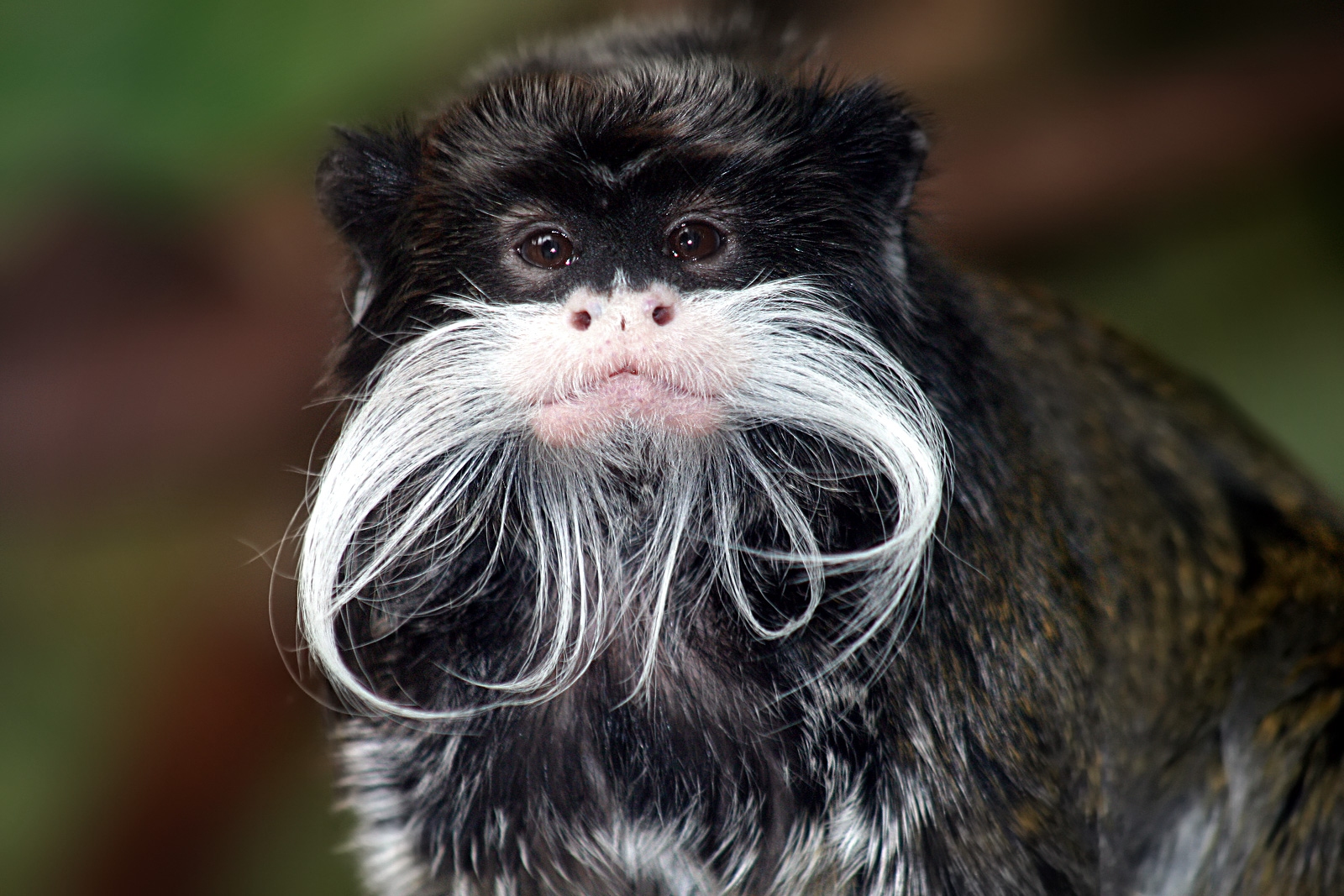
Tamarin species vary considerably in appearance, ranging from nearly all black through mixtures of black, brown and white. Mustache-like facial hairs are typical for many species. Their body size ranges from 13 to 30 cm (5.1 to 11.8 in) (plus a 25-to-44 cm-long (9.8-to-17.3 in) tail). They weigh from 348 to 575 grams (12.3 to 20.3 oz). In captivity, red-bellied tamarins have been recorded living up to 20.5 years, while cotton-top tamarins can live up to 23 years old.
Tamarins are found from southern Central America through to central South America, where they are found in northwestern Colombia, the Amazon basin, and the Guianas.
Tamarins are inhabitants of tropical rainforests and open forest areas. They are diurnal and arboreal, and run and jump quickly through the trees. Tamarins live together in groups of up to 40 members consisting of one or more families. More frequently, though, groups are composed of just three to nine members.
Tamarins are omnivores, eating fruits and other plant parts as well as spiders, insects, small vertebrates and bird eggs.
Gestation is typically 140 days, and births are normally twins. The adult males, subadults, and juveniles in the group assist with caring for the young, bringing them to their mother to nurse. After approximately one month the young begin to eat solid food, although they are not fully weaned for another two to three months. They reach full maturity in their second year. Tamarins are almost exclusively polyandrous.
Hub AI
Tamarin AI simulator
(@Tamarin_simulator)
Tamarin
The tamarins are squirrel-sized New World monkeys from the family Callitrichidae in the genus Saguinus. They are the first offshoot in the Callitrichidae tree, and therefore are the sister group of a clade formed by the lion tamarins, Goeldi's monkeys and marmosets.
Hershkovitz (1977) recognised ten species in the genus Saguinus, further divided into 33 morphotypes based on facial pelage. A later classification into two clades was based on variations in dental measurements. A taxonomic review (Rylands et al., 2016) showed the tamarins are a sister group to all other callitrichids, branching off 15–13 million years ago. Within this clade, six species groups are historically recognised, nigricollis, mystax, midas, inustus, bicolor and oedipus, five of which were shown to be valid with Saguinus inustus placed within the midas group. The review noted that the smaller-bodied nigricollis group began diverging 11–8 million years ago, leading the authors to move them to a separate genus, Leontocebus (saddle-back tamarins). While a 2018 study proposed that Leontocebus does not have sufficient divergence from Saguinus to be in its own genus, and thus should be reclassified it as a subgenus of Saguinus, this proposal has since found significant traction. The same study found the mystax group of tamarins to be distinct enough to be classified in the subgenus Tamarinus. As of 2021 this proposal has not been universally accepted by primatologists.
Following the taxonomic review of tamarins by Rylands et al. (2016) and Garbino & Martins-Junior (2018), there are 22 species in the genus Saguinus with 19 subspecies.
Tamarin species vary considerably in appearance, ranging from nearly all black through mixtures of black, brown and white. Mustache-like facial hairs are typical for many species. Their body size ranges from 13 to 30 cm (5.1 to 11.8 in) (plus a 25-to-44 cm-long (9.8-to-17.3 in) tail). They weigh from 348 to 575 grams (12.3 to 20.3 oz). In captivity, red-bellied tamarins have been recorded living up to 20.5 years, while cotton-top tamarins can live up to 23 years old.
Tamarins are found from southern Central America through to central South America, where they are found in northwestern Colombia, the Amazon basin, and the Guianas.
Tamarins are inhabitants of tropical rainforests and open forest areas. They are diurnal and arboreal, and run and jump quickly through the trees. Tamarins live together in groups of up to 40 members consisting of one or more families. More frequently, though, groups are composed of just three to nine members.
Tamarins are omnivores, eating fruits and other plant parts as well as spiders, insects, small vertebrates and bird eggs.
Gestation is typically 140 days, and births are normally twins. The adult males, subadults, and juveniles in the group assist with caring for the young, bringing them to their mother to nurse. After approximately one month the young begin to eat solid food, although they are not fully weaned for another two to three months. They reach full maturity in their second year. Tamarins are almost exclusively polyandrous.
Recent media