Hubbry Logo
Sam WoSam WoMain
Open search
Sam Wo
Community hub
Sam Wo
logo
8 pages, 0 posts
0 subscribers
Be the first to start a discussion here.
Sam Wo
Sam Wo
from Wikipedia

Sam Wo (traditional Chinese: 三和粥粉麵; simplified Chinese: 三和粥粉面; Jyutping: Saam1wo4 zuk1 fan2min6; pinyin: Sānhé zhōu fěnmiàn, literally "Three Harmonies Porridge and Noodles") was a Chinese restaurant located in San Francisco, California. The restaurant's first location on 813 Washington Street was famous for being a venerable mainstay in the local Chinatown area, having been in the same location since 1912. Sam Wo gained notoriety in the 1960s for being the employer of Edsel Ford Fung, who was known locally as the "world's rudest waiter".[1][2] The restaurant was closed in 2012 due to safety concerns, and reopened in 2015 on nearby Clay Street, and closed again on January 25, 2025. Sam Wo's is set to reopen on Friday, September 5, 2025.[3]

Key Information

History

[edit]

There is no documented history on Sam Wo Restaurant and its early beginnings from its founding in 1912, although it was believed to be the oldest restaurant in Chinatown, built sometime around or after the 1906 San Francisco earthquake.[4] One account states that Sam Wo had occupied the same 813 Washington Street location from 1907.[5] Sam Wo was primarily well known by San Francisco locals for its "famous ... no-frills, late-night food and its you-get-what-you-pay service" and 3 am closing time.[2] In the 1950s Sam Wo was a Beat Generation hangout,[6] featuring poets including Michael McClure, Allen Ginsberg, and Charles Bukowski.[7]

Edsel with "abused" customers in 1982.

The Sam Wo Restaurant was famed as the workplace of Edsel Ford Fung, often called the "world's rudest, worst, most insulting waiter". Fung would refuse to serve customers whose appearance he disliked and would also harass patrons that complained about mistaken orders.[1] After his passing in 1984, he left a lasting impression for a generation of San Franciscans.[1] Some of his signs on the Washington Street eatery remain, such as one that says "No Booze ... No Jive, No Coffee, Milk, Soft Drinks, Fortune Cookies."[1]

813 Washington

[edit]
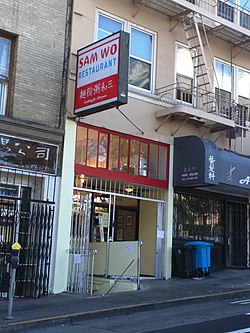
The original location of Sam Wo Restaurant, December 2013.

The unique layout of the original location at 813 Washington had patrons enter through the street-level kitchen after which they would ascend narrow stairways to dining rooms on the second and third stories. A dumbwaiter was used to deliver food to the upper floors, and patrons paid the cashier in front after dining.[8]

Current owner David Ho emigrated to San Francisco in 1981 and began working at the restaurant, taking over ownership in 1986 after his grandfather died.[9]

In April 2012, the San Francisco Health Department ordered the restaurant closed for rodent activity (rat feces in the kitchen) and other food safety and fire code violations.[1][2][6] The restaurant closed on April 20.[2] The restaurant experienced lines out the door on its last day of operation.[10] With Sam Wo closed, late-night dining in Chinatown came to an end, punctuating a decline that had begun in 1977 with the Golden Dragon Massacre, accelerated after the 1989 Loma Prieta earthquake which damaged the Embarcadero Freeway, the main route into Chinatown, and intensified after street sweeping was moved to 2 a.m., which caused many late-night diners to receive parking tickets.[11]

It's sort of like going back in time. I suspect the kitchen hasn't been remodeled since the '40s. It's not sustaining safe practices.

— Lisa O'Malley, Supervisor, San Francisco Department of Public Health, San Francisco Chronicle article, 20 April 2012[8]

Nevertheless, owner David Ho promised to develop a remediation plan and then reopen.[1][2] A representative for the health department expressed hope stating, "...people are so very loyal to that restaurant, and San Francisco is a city where nothing goes down easy. I'm hoping for the best ..."[1] Generally the main problem cited by all the parties involved was the facilities were too old and expensive modernization was needed.[2] At a subsequent hearing on April 24, Ho listened to the "long history of repeat health code violations" and immediate actions to remedy them listed by city inspectors, which included the need for a commercial refrigeration unit; separate sinks for hand washing, dish washing, and food preparation; eliminating rodents; fixing the fire escape; and removing excessive extension cords.[12] The hearing was attended by more than one hundred supporters of the restaurant, and Julie Ho, David's daughter, said "it won't be days and it won't be years — a month or two, probably" before they could reopen.[13] Despite the expense required to revamp the century-old restaurant, the restaurant's landlord expressed support for keeping the restaurant open,[2] although the restaurant's lease was due to expire in October 2012.[12]

Working with the Chinatown Community Development Center, the owner and the Department of Building Inspection agreed on the renovations required to bring the building up to modern codes. The estimated cost of implementing the remodel was $100,000 in September 2012, and a fundraiser was scheduled by the Save Sam Wo Coalition.[14] One year later, the estimated cost of remodeling had soared to $300,000 in September 2013. The extra expense, coupled with unfavorable lease cost and timing, meant that Sam Wo was unable to reopen in its original location.[15] When Ho and community supporters had nearly raised enough money, the building's owner announced the space at 813 Washington had been leased to a planned spa business.[11] Ho trademarked the Sam Wo name to ensure that no one else could open a Sam Wo restaurant.[16]

713 Clay

[edit]

A long time ago, [Sam Wo's] was built from something bad [the 1906 earthquake], and something nice blossomed from it. The restaurant blooming again is something to look forward to.

— David Ho, owner of Sam Wo, San Francisco Chronicle article, 2 October 2015[16]

In 2014, the management announced on Facebook that Sam Wo would return, taking over the space formerly occupied by Anna Bakery, offering the same amenities and baked goods to Anna Bakery's longtime patrons, and planning to reopen in July 2015.[17] The restaurant finally reopened at a new location on October 21, 2015.[18] The new location at 713-715 Clay Street features a basement kitchen, mezzanine level, and dumbwaiter to recreate some of the quirks of the old space.[16]

The new Sam Wo was reviewed in December 2015 by Michael Bauer of the San Francisco Chronicle, who said "[the new space] feels like it's been there for decades, but those in the know can see this is a sanitized, spruced-up version. Fortunately it retains its special character and will begin to feel even more like the original when the windows fog over with layers of grease and the already well-worn stools become as creaky as their predecessors."[19]

The iconic Sam Wo neon sign (in 2014, at 813 Washington)

In April 2016, the neon sign (originally installed in the 1930s, but with the neon tubes unlit since the 80s) was moved to the new location at 713 Clay. The hours at the new location were extended to 3 a.m. on Friday and Saturday nights in May 2016, matching the restaurant's legacy hours.[5][20]

In 2023, owner David Ho stated that he planned to retire when the current lease expires in January 2025; the restaurant will close unless a new co-owner is identified, as the landlord has requested a younger family take over the business before they will sign a long-term lease.[9][21][needs update]

Media legacy

[edit]

Sam Wo was immortalized in multiple media reports throughout the years. Some notable examples include author Armistead Maupin, journalist Herb Caen, and late night talk show host Conan O'Brien (featuring a cameo by Martha Stewart)[22] in their various reports of the experiences with the eatery.[2] Shirley Fong-Torres described Sam Wo and Edsel Fung as one of the main attractions in her 2008 book The Woman Who Ate Chinatown, saying that customers "came to see and be verbally abused by Edsel."[4]

Legendary California poet Gary Snyder recommends "congee at Sam Wo" among other "Things to Do Around San Francisco" in his book Mountains and Rivers Without End.

Sam Wo in San Francisco is unconnected to the like-named Sam Wo restaurant that once operated in New York City's Chinatown, the latter well-known from its mention in the 1979 Woody Allen film Manhattan.

See also

[edit]

References

[edit]
[edit]
Revisions and contributorsEdit on WikipediaRead on Wikipedia
from Grokipedia
Sam Wo is a historic Cantonese restaurant in San Francisco's Chinatown, established in 1908 by three immigrant siblings from Taishan, , during the rebuilding period following the 1906 earthquake, renowned for its authentic dishes such as BBQ pork noodle rolls and its enduring role as a in the neighborhood. Originally located at 813 Washington Street, the restaurant operated continuously for over a century, gaining national fame in the mid-20th century partly due to waiter Fong, who worked there from the to the 1980s and became legendary for his intentionally rude and abrasive service style—berating customers, altering orders without permission, and insulting patrons—which paradoxically attracted celebrities like and , as well as tourists seeking the experience. In 2012, the original site closed due to health code violations and fire safety issues, prompting a relocation to 713 Clay Street and a reopening in 2015 under new investors led by chef David Jitong Ho, who had joined in 1986 and specialized in traditional recipes. The restaurant faced another closure on January 26, 2025, after Ho's retirement and the expiration of its lease, amid challenges from reduced foot traffic post-COVID-19, but it reopened on September 5, 2025, under new ownership with largely the same menu of classic Chinatown fare. As of November 2025, Sam Wo continues to operate as a late-night destination, preserving over 117 years of culinary tradition while symbolizing the resilience of San Francisco's community.

History

Founding and Early Years

Sam Wo Restaurant was established in 1908 by three immigrant siblings from Taishan, , amid the rebuilding efforts following the devastating . The siblings opened the modest eatery at 813 Washington Street in the heart of , a neighborhood that was rapidly reconstituting itself as a vibrant hub for Chinese immigrants displaced by the disaster. Initially operating as a small shop, it catered primarily to late-night crowds seeking affordable sustenance in the post-quake recovery era. The early menu emphasized simple, hearty Cantonese dishes suited to working-class patrons, including barbecue pork rice noodle rolls and porridge (congee), prepared fresh to provide quick, nourishing meals. These offerings reflected the resourcefulness of the immigrant founders, who adapted traditional recipes to the economic constraints and community needs of early 20th-century . The shop's narrow, multi-story layout, with food delivered via a to upper floors, fostered an intimate, no-frills dining experience that quickly drew locals rebuilding their lives. During the 1910s and 1920s, Sam Wo expanded its hours to serve until 3 a.m. daily, solidifying its role as a vital gathering spot for night-shift workers, laborers, and fellow immigrants in the bustling district. This extended operation supported the round-the-clock rhythms of the community, where many toiled in nearby factories, laundries, and service jobs, making the restaurant an essential social and culinary anchor. Under subsequent ownership transitions, these foundational practices laid the groundwork for its enduring legacy as a institution.

Operations at 813 Washington Street

Sam Wo operated from a narrow, three-story building at 813 Washington Street, measuring approximately 10 feet wide and featuring cramped dining rooms on the second and third floors accessible only through the kitchen. The structure, often called the skinniest Chinese restaurant in , included a hand-operated system with ropes and pulleys that delivered food from the ground-floor kitchen to the upper levels, enabling efficient service in the tight space. This setup persisted throughout its tenure, contributing to the restaurant's distinctive, no-frills character despite the building's aging infrastructure. The restaurant maintained extended operational hours, typically open until 3 a.m., aligning with the siu yeh tradition of late-night dining and catering to patrons seeking meals after evening activities. Peak service occurred in the late hours, drawing club-goers, night workers, and locals for quick, affordable bites in a bustling environment. This schedule supported its role as a reliable after-hours destination from the through 2012. During the mid-20th century, Sam Wo's menu evolved to emphasize simple staples adapted for broader American-Chinese palates, including jook () and chow fun noodles prepared fresh daily in the cramped kitchen. Dishes like barbecue pork rice noodle rolls, with scrambled eggs, and wonton soup became enduring favorites, offered at low prices to reflect the restaurant's commitment to accessible, unpretentious fare. The menu remained largely consistent over decades, focusing on these noodle- and porridge-based items without elaborate Americanized additions like egg foo yung or sweet-and-sour preparations. In San Francisco's Chinatown, Sam Wo functioned as a vital community hub for first- and second-generation , hosting informal gatherings and serving as a cultural anchor amid the neighborhood's evolution. It drew both locals and visitors, including Beat poets in the , fostering a sense of continuity and tradition. As one of the city's oldest continuously operating Chinese restaurants, it upheld this role from its early years until its 2012 closure, symbolizing resilience in the face of urban changes.

Relocation to 713 Clay Street

In April 2012, Sam Wo was forced to close its longtime location at 813 Washington Street after accumulating , , , and violations in the century-old structure, including issues like infestations and inadequate facilities such as a missing handwashing . The Ho family, who had owned and operated the restaurant for generations, then initiated a three-year search for a suitable new site within to preserve its legacy. In 2013, they secured 713 Clay Street, a more compact space in the same neighborhood block that had formerly been home to Anna Bakery, which had itself closed due to similar code issues. Reopening preparations in 2015 involved approximately $350,000 in renovations to comply with updated regulations while retaining iconic features under the Ho family's continued ownership. Key adaptations included installing an electric to replicate the original's manual delivery mechanism from the basement kitchen to dining area, alongside salvaging elements like the historic , marble-top tables, and stools for nostalgic continuity. The restaurant officially reopened in October 2015. The relocation presented early operational hurdles, primarily from the new site's reduced footprint, which capped seating at 49 patrons—far fewer than the multi-level original—and necessitated a streamlined focused on core staples like jook and rice noodle rolls to suit the efficient layout. Price adjustments for items like wonton soup, from $4.75 to $6.50, also arose from construction costs, alongside the integration of a new computerized ordering system and entirely refreshed staff.

2012 Closure and 2015 Reopening

Sam Wo abruptly closed its doors on , 2012, after over a century of operation, due to a series of , , and building code violations at its longtime location on 813 Washington Street. The shutdown stemmed from the restaurant's inability to address critical issues such as rodent infestations, lack of handwashing sinks, and structural decay in the aging building, exacerbated by disputes with landlords who refused to allow or fund major renovations amid rising rent demands. Although the Department of Public Health initially granted permission to reopen following a contentious hearing where owner pleaded the case, the necessary overhauls proved financially unfeasible, leading to a prolonged closure. The closure elicited widespread and media backlash, positioning Sam Wo as a cherished landmark emblematic of the neighborhood's immigrant history and late-night dining culture. Supporters, ranging from local residents and politicians to celebrities, rallied at department hearings with emotional testimonials urging preservation of the site's cultural significance. Between 2012 and 2014, initiatives emerged, including fundraisers organized by groups to cover potential repair costs estimated at around $100,000, alongside petitions and media campaigns in outlets like the and Eater SF that highlighted the restaurant's role as a social hub for generations of . These efforts underscored broader concerns about and the erosion of historic businesses in San Francisco's , though they ultimately could not resolve the landlord conflicts. After three years of negotiations and planning, Sam Wo reopened on October 19, 2015, at a new nearby address on 713 Clay Street, with original owner partnering with investor to maintain operational control. The revival incorporated essential updates for health compliance, such as modernized kitchen facilities, , and a streamlined to ensure consistency and regulatory adherence. Despite these changes, the preserved its quintessential no-frills atmosphere, including a custom for counter service and signature dishes like rice noodle rolls, allowing the traditional, brusque dining experience to endure. The reopening drew crowds of well-wishers, affirming the community's commitment to the institution's survival.

2025 Developments

In January 2025, Sam Wo closed its doors on January 26 following the retirement of longtime and co-owner David Jitong Ho, who had led the kitchen for nearly 45 years, compounded by the expiration of the restaurant's at 713 Clay Street. This development sparked widespread concern among patrons and the San Francisco community, with throngs of loyal customers crowding the restaurant for its final meals and fears mounting over the potential permanent loss of a Chinatown landmark. From January to September 2025, the site remained shuttered as co-owner , who had previously helped orchestrate the 2015 reopening, led a nationwide search for suitable new operators to sustain the restaurant's operations. interest and media coverage underscored the push to preserve this historic institution, preventing what many viewed as an irreparable blow to Chinatown's cultural fabric. On September 5, 2025, Sam Wo reopened under a new ownership team comprising and Norris Song, the latter an established restaurateur with ventures including Kitchen & Zhen in Millbrae. The partners emphasized their dedication to community preservation, aiming to honor the restaurant's legacy through continued operation at the Clay Street location. As of November 2025, Sam Wo remains fully operational, with the new owners committing to retain core classic menu items like jook and stuffed pancakes while integrating into broader revitalization initiatives for San Francisco's . This resurgence supports ongoing efforts to bolster the neighborhood's economic and cultural vitality amid post-pandemic recovery.

Cuisine and Operations

Signature Dishes and Menu

Sam Wo's menu centers on classic dishes prepared with traditional techniques, emphasizing hearty, flavorful options that blend simplicity with bold seasonings, often at budget-friendly prices to appeal to a wide range of diners in San Francisco's . A cornerstone of the menu is jook, the rice porridge known as a comforting staple, available in variations such as fish jook served with a Chinese donut for added texture, pork with preserved thousand-year-old eggs for a savory depth, chicken for a milder profile, and seafood-infused versions featuring shrimp or mixed proteins. These porridges, simmered to a silky consistency, highlight the restaurant's commitment to nourishing, everyday fare. Noodle dishes form another key category, including chow fun with wide stir-fried with , , or house specialties like BBQ for a glossy, wok-hei-infused result, as well as variations such as BBQ or tossed with crisp . Rice noodle rolls, a signature item filled with BBQ , cilantro, and shredded , are served with a house spicy mustard sauce, offering a fresh, chewy contrast to the 's heartier options. Complementing these are timeless classics like (egg rolls) stuffed with vegetables and , BBQ fried rice blending caramelized grains with tender meat, and simple stir-fries such as with string beans or , all priced accessibly—typically $7 to $15—to draw in locals and tourists alike. The menu has evolved minimally over the decades to preserve its traditional roots, with post-2015 reopening additions like salt-and-pepper chicken wings and walnut prawns introducing subtle variety. Vegetarian options such as and vegetable stir-fries are available. Following the September 2025 reopening, the core menu remains largely unchanged, though new items including , siu mai, and lava buns were added.

Dining Experience and Atmosphere

Sam Wo's dining experience is characterized by its unpretentious, no-frills approach, emphasizing efficiency and tradition in San Francisco's Chinatown. Historically, diners entered through the street-level kitchen at the original 813 Washington Street location, ascending narrow, steep stairs to cramped second- and third-floor dining rooms lit by harsh fluorescent lights. Orders were shouted down a to the kitchen below, creating a chaotic yet intimate rhythm that defined the restaurant's operations for decades. Communal tables encouraged shared seating among strangers, fostering a lively, noisy environment where conversations blended with the clatter of dishes and the hum of the . The service style reinforced the restaurant's raw authenticity, with a cash-only policy and minimal accommodations, such as limited substitutions, contributing to abrupt interactions that some patrons found memorable or off-putting. This brusqueness was epitomized by waiter Fung in the and , whose sharp commands and refusals added to the quirky, unfiltered vibe appealing to locals seeking an unvarnished slice of old-school . The overall atmosphere evoked a timeless, working-class energy—steamy from cooking, filled with the scents of simmering pots, and unadorned by decor beyond faded photos and news clippings—drawing both regulars and tourists in search of genuine cultural immersion. Following the 2012 closure and 2015 reopening at 713 Clay Street, the layout retained core elements like the narrow staircase and upstairs communal tables, but with refinements including acceptance, improved sanitation, and a beer and wine to soften the edges while preserving the retro charm. The fluorescent lighting and compact spaces persisted, maintaining the vibrant, unpretentious buzz, though service shifted to a more polite demeanor. In 2025, after a brief closure earlier in the year, new ownership reopened the restaurant in September, committing to the historical ambiance with no major structural changes, ensuring the noisy, intimate feel endures as a hallmark of Chinatown's enduring culinary scene.

Notable Figures

Edsel Ford Fung

Edsel Ford Fung, born Edsel Y. Fung on May 6, 1927, in San Francisco's , was the son of Fung Lok, the owner of the Sam Wo Restaurant. Raised in the neighborhood, he adopted the middle name "Ford" as a playful nod to the ill-fated automobile model produced by the . Fung began his career at the family-owned establishment as a and gradually rose to become its head waiter and most recognizable figure, serving in that role for decades until his death. Fung earned international notoriety for his brusque and theatrical service style, characterized by rude quips, refusals of special requests, and dramatic order-taking that often involved barking commands or altering customers' choices without consultation. Standing over six feet tall with a military and a perpetual scowl, he greeted patrons with lines like "Sit down and shut up!" and would yell orders down the restaurant's , sometimes spilling food in the process or insisting diners clean their own tables. Despite—or perhaps because of—his abrasive demeanor, which included female customers or photographing them for a wall display, Fung cultivated an act that played on stereotypes of , though he was a native speaker fluent in the language. This persona led to his moniker as the "world's rudest waiter," a title amplified by columnist , who frequently chronicled his antics in the 1960s and 1970s. Fung's outrageous behavior significantly boosted Sam Wo's popularity, drawing crowds of locals, tourists, and celebrities—including and —eager to experience his insults firsthand during the restaurant's peak late-night hours in the 1960s and 1970s. His antics not only sped up table turnover in the cramped, no-frills space but also transformed the modest noodle shop into a cultural landmark, with anecdotes like forcing hesitant diners to order house specials or sweeping patrons out after meals becoming legendary tales shared among San Franciscans. By refusing substitutions—such as denying requests for sweet-and-sour pork or —and demanding a 20% tip, Fung's style ensured repeat visits from those who appreciated the performative rudeness as rather than genuine hostility. Fung passed away on April 24, 1984, at the age of 56, prompting an immediate outpouring of tributes that packed Sam Wo with mourners the following day. His death received widespread media coverage in the and beyond, solidifying his status as a beloved eccentric whose legacy endured through literary references, such as his inspiration for a character in Armistead Maupin's , and ongoing reminiscences in local food writing. Even after his passing, Sam Wo maintained house rules echoing Fung's gruff tone, ensuring his influence lingered in the restaurant's atmosphere.

Key Owners and Chefs

Sam Wo was founded by Gao Xi, who immigrated to from in 1910 and established the restaurant during the post-1906 earthquake rebuilding period. By 1981, ownership had passed through generations to the Ho family, with Jitong Ho's grandfather serving as owner. Jitong Ho immigrated from that same year and joined the restaurant as a chef under his grandfather's guidance, quickly becoming integral to its operations. After his grandfather's passing in 1986, Jitong Ho assumed the role of chef-owner, maintaining traditional recipes and overseeing expansions, including the 2012 closure for relocation from 813 Washington Street to 713 Clay Street and the subsequent 2015 reopening. He partnered with co-owner during this period, navigating challenges like economic shifts in while upholding the eatery's late-night service and community role. David Jitong Ho's era overlapped briefly with the later years of notable figures like waiter Edsel Ford Fung, whose presence contributed to the restaurant's quirky reputation under stable family leadership. By 2025, at age 70 and after 44 years at the restaurant, David Jitong Ho retired due to health issues, leading to a temporary closure on January 26, 2025. A new investment team led by restaurateurs Norris Song, Ming Duong, and acquired the business, emphasizing its ties to the local community and committing to authentic traditions. The transition included training a yet-to-be-publicly named permanent head chef in David Jitong Ho's techniques, with Zhouxi Quan initially stepping in as head chef after intensive preparation by David Jitong Ho himself to ensure recipe fidelity and operational continuity. This handover marked a pivotal shift, allowing Sam Wo to reopen in September 2025 while honoring its century-plus legacy.

Cultural and Media Impact

Media Appearances

Sam Wo has garnered significant media attention over the decades, particularly for its distinctive rude service style, historic status in San Francisco's , and signature dishes like jook (rice porridge) and barbecue pork rice noodle rolls, which have been highlighted in various portrayals that boosted its nationwide. A pivotal national television appearance came in 2007 when comedian filmed a humorous commercial for the during an episode of , showcasing its narrow, multi-level layout, the infamous system for delivering food, and the legacy of brusque service associated with waiter Fong, who ordered patrons to "sit down and shut up." This segment, aired on May 2, 2007, amplified Sam Wo's quirky reputation, drawing laughs and curiosity from viewers across the country by portraying it as an unapologetically authentic late-night eatery. Local television coverage intensified around the restaurant's operational challenges, with extensive segments on its 2012 closure due to health and building code violations. Outlets like ABC7 News reported on the final days at the original 813 Washington Street location, interviewing owners and loyal customers who lamented the end of an era while emphasizing the site's century-old charm and no-frills fare. Similarly, San Francisco and Bay Area aired features in 2025 on the temporary shutdown following longtime chef David Ho's retirement and the subsequent reopening under new ownership, focusing on preserved traditions like handmade rice rolls and the addition of items to attract younger diners. These reports, including a September 3, 2025, segment on the relaunch at 713 Clay Street, underscored Sam Wo's resilience and role as a landmark. In print and online journalism, the has chronicled Sam Wo extensively, including coverage of its 2015 reopening after the 2012 closure and the 2025 developments, such as a September 3 article detailing the investor group's efforts to revive classic menu staples amid economic pressures on historic eateries. An earlier piece marked the passing of Fong in 1984, noting his enduring influence on the restaurant's abrasive hospitality that became a draw for celebrities and locals alike. Food-focused sites like Eater SF have praised its authenticity in reviews, such as a November 12, 2025, post-reopening assessment lauding the "supreme" barbecue noodle rolls as a testament to unchanged techniques despite ownership shifts. Film and documentary cameos have further embedded Sam Wo in cultural narratives. The restaurant's original Washington Street facade appears in the 2004 Spike Lee-directed film , a gritty drama set in that uses the location to evoke urban authenticity in scenes. Additionally, public broadcaster KQED featured Sam Wo prominently in a 2024 episode of its food series No Crumbs, exploring Fong's role as the "world's rudest waiter" through archival footage and interviews, which highlighted how his interactions—such as berating slow customers—turned meals into memorable spectacles and solidified the eatery's fame.

Legacy in San Francisco Chinatown

Sam Wo stands as a powerful symbol of immigrant resilience in 's , embodying the perseverance of early Chinese-American entrepreneurs who rebuilt their community in the face of severe adversity. Founded shortly after the devastating 1906 earthquake and fire by three siblings from Taishan, China—one of the primary regions for Chinese immigration to the U.S.—the restaurant emerged during a period of intense anti-Chinese discrimination, including the of 1882 and widespread urban displacement. Despite these challenges, Sam Wo's establishment at 813 Washington Street marked a testament to the entrepreneurial spirit that helped reconstruct as a vibrant ethnic enclave amid broader societal exclusion and economic barriers. The restaurant's no-frills approach to late-night has profoundly influenced dining culture in , inspiring a lineage of affordable, unpretentious eateries that prioritize community accessibility over luxury. Operating until the early morning hours and serving simple, hearty dishes like rice noodle rolls and , Sam Wo set a model for resilient, working-class establishments that catered to night-shift laborers and locals, fostering a casual atmosphere that became synonymous with authentic experiences. Its 2025 reopening under new ownership further bolsters post-pandemic recovery efforts in the neighborhood, revitalizing foot traffic and economic vitality in an area still grappling with business closures and demographic shifts. Preservation initiatives have played a central role in safeguarding Sam Wo's historical footprint, underscoring its status as a cultural anchor. Designated as a Legacy Business by the Office of Economic and Workforce Development in 2016, the restaurant committed to upholding its culinary traditions, including handmade noodles and classic siu yeh (late-night) fare, while maintaining iconic elements like its vintage neon sign and original fixtures. Community-driven campaigns, such as those following its 2012 closure due to violations, demonstrated collective resolve to prevent its permanent loss, ensuring continuity through relocations and revivals. Over its more than 116 years, Sam Wo has served as a touchstone for San Francisco's multicultural identity, weaving threads of heritage preservation into the city's social fabric through ongoing community engagement. As one of Chinatown's oldest continuously operating establishments, it has hosted generations of diners, from writers to modern tourists, reinforcing the neighborhood's role as a beacon of Chinese-American history.

References

Add your contribution
Related Hubs
User Avatar
No comments yet.