Hubbry Logo
SamosirSamosirMain
Open search
Samosir
Community hub
Samosir
logo
8 pages, 0 posts
0 subscribers
Be the first to start a discussion here.
Samosir
Samosir
from Wikipedia

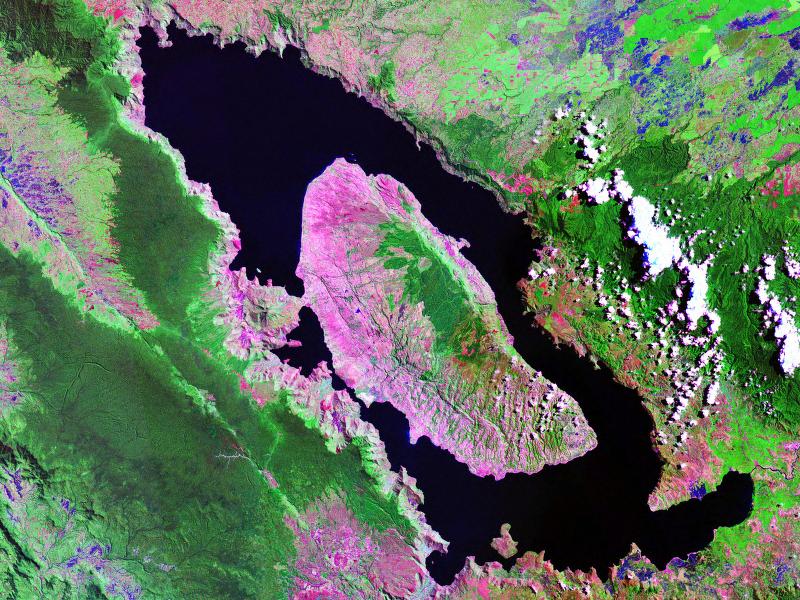
Samosir, or Samosir Island, is a large volcanic island in Lake Toba, located in North Sumatra Province on the island of Sumatra in Indonesia. Administratively, Samosir Island is governed as six of the nine districts within Samosir Regency. The lake and island were formed after the eruption of the Toba supervolcano some 75,000 years ago.[2]

Key Information

At 630 square kilometres (243 sq mi), Samosir is the largest island within an island and the fourth largest lake island in the world.[3] It also contains two smaller lakes, Lake Sidihoni and Lake Aek Natonang [id]. Across the lake on the east of the island lies the Uluan Peninsula. The island was historically linked to the mainland of Sumatra on its western part by a narrow isthmus connecting the town of Pangururan on Samosir and Tele on mainland Sumatra, but it was split by the Tano Ponggol Canal and bridge in 1906, which was widened in 2019.[4] Tele consequently offers one of the best views of Lake Toba and Samosir Island. One of the most important objects on the island is a Lutheran church, and opposite it is a huge hill.

Tourism

[edit]

Samosir is a popular tourist destination due to its exotic history and the vistas it offers, including of the huge hill opposite the Lutheran church. The tourist resorts are concentrated in the Tuktuk [id] area. The island is the centre of the Batak culture and many of the Toba Batak traditional houses (rumah adat) remain on the island. Most of the tourist accommodations are concentrated in the small town of Tuktuk, which is located a one-hour ferry ride across the lake from the town of Parapat. The passenger ferry leaves from Tiga Raja harbor every hour between 8.30 and 19.00. For those running late, there is an option to take the passenger boat from Ajibata to Tomok until 8.30 pm. A car ferry leaves the mainland from Ajibata and lands in the small town of Tomok, about a 10-minute drive from Tuktuk until 9 pm. There are also other passenger ferries and individual hotels may also have ferries available.

[edit]

References

[edit]
Revisions and contributorsEdit on WikipediaRead on Wikipedia
from Grokipedia
Samosir Island is a situated at the heart of in , , renowned as the largest island in a lake with an area of 630 square kilometers. Formed through volcanic upheavals between 30,000 and 100,000 years ago, it occupies nearly half of the lake's surface and is connected to the Sumatran mainland by a narrow , creating a of dramatic features, highland plateaus, and serene waters. The island's geology is inextricably linked to the Toba supervolcano, which erupted approximately 74,000 years ago in one of Earth's most powerful events, forming the 1,145-square-kilometer at an elevation of about 900 meters. Samosir itself emerged from and andesitic rocks, with later eruptions contributing to sites like Pusuk Buhit, and its diverse terrain includes hilly undulations rising to 1,700 meters, supporting terraces, grazing, and fishing communities. In 2020, the Toba Caldera, including Samosir, was designated a Global , highlighting its 16 geosites such as Sipiso-piso Waterfall and formations that underscore the region's geoheritage; the status was reaffirmed in September 2025 following a review. Culturally, Samosir is the ancestral homeland of the Batak Toba people, whose traditions revolve around the dalihan na tolu clan system, traditional stilt houses known as rumah bolon, and rituals like the sigale-gale dance and mangapuli ceremonies. Megalithic sites, including 400-year-old tombs in Tomok and judgment stones in Ambarita's Huta Siallagan village, reflect ancient and , often carved from durable Toba . Predominantly Christian since the , the Batak Toba integrate ancestral beliefs with modern practices, fostering a vibrant heritage that draws tourists to explore villages, attend cultural performances, and witness tied to lake conservation. Samosir Regency, spanning the island and adjacent lake areas, supports a population of around 136,441 as per the 2020 census, sustaining an economy centered on , , and artisanal crafts.

Geography

Location and formation

Samosir is situated in Province, , forming the central island within , which is recognized as the world's largest volcanic lake. This expansive body of water occupies a formed by ancient volcanic activity, with Samosir emerging as a prominent feature amid its waters. The island's formation traces back to the cataclysmic eruption of the Toba supervolcano approximately 74,000 years ago, one of the most powerful volcanic events in Earth's history. This eruption ejected vast amounts of magma, leading to the collapse of the and the creation of a massive that eventually filled with rainwater and runoff to form . Samosir itself developed as a resurgent dome, a geological uplift caused by renewed magmatic pressure beneath the caldera floor post-eruption. Samosir maintains a physical connection to the Sumatran mainland through a narrow at Pangururan, rendering it technically a in geological terms despite its common designation as an island. This linkage spans the western edge, bridging the island to the adjacent terrain near the town of Tele. Covering approximately 630 square kilometers, Samosir accounts for nearly half the surface area of , which spans 1,130 square kilometers and plunges to depths of up to 505 meters.

Physical features

Samosir Island features a rugged highland terrain characterized by steep slopes covered in dense pine forests, rising from the surrounding at approximately 900 meters above to elevated plateaus and peaks. The landscape transitions from lakeside lowlands to mountainous highlands, with the island's highest point being Mount Pusuk Buhit, reaching an elevation of 1,982 meters. This topography, shaped by ancient volcanic activity, includes undulating hills and valleys that contribute to the island's dramatic vistas and accessibility challenges in certain areas. The island hosts several internal water bodies of volcanic origin, adding to its unique hydrological profile. In the northern region lies Lake Sidihoni, a formed within an ancient volcanic depression, offering serene, enclosed waters amid the highlands. To the south, the smaller Lake Aek Natonang, also volcanic in formation, provides a contrasting shallow basin that reflects the island's geological history. These lakes, remnants of post-eruption processes, enhance the island's diverse micro-environments without significantly altering its overall . Samosir's climate is characteristically cool for a tropical highland setting, with average temperatures ranging from 18°C to 25°C year-round, influenced by its elevation and proximity to . This temperate weather supports comfortable conditions, though early mornings and higher elevations can feel cooler. Annual rainfall averages around 2,800 mm, with a wetter season from late March to late December, peaking from October to December, fostering the island's verdant landscapes while occasionally leading to misty conditions that envelop the slopes. The island's flora thrives in diverse ecosystems, including subtropical pine forests dominated by the endemic Sumatran pine (), which blankets the steeper slopes and benefits from the nutrient-rich volcanic soils. These forests intermingle with lush broadleaf vegetation in lower areas, creating biodiversity hotspots that support a variety of plant species adapted to the highland conditions. Fauna, while less abundant than in surrounding Sumatran rainforests, includes birds, small mammals, and that inhabit these pine-dominated habitats, with the volcanic terrain promoting localized in the overall ecosystem.

History

Geological origins

The geological origins of Samosir Island are inextricably linked to the cataclysmic Youngest Toba Tuff (YTT) supereruption from the Toba supervolcano, which occurred approximately 74,000 years ago and is recognized as the largest known eruption in the period. This event, rated at (VEI) 8, ejected at least 2,800 km³ of dense rock equivalent material, primarily in the form of pyroclastic flows and widespread fallout that blanketed much of and beyond. The eruption triggered a prolonged , with stratospheric aerosols causing estimated at 3–5°C for several years, which disrupted ecosystems and likely contributed to a severe bottleneck in human populations through reduced and food resources. The immediate aftermath reshaped the regional landscape, collapsing the magma chamber roof to form a vast approximately 100 km long and 30 km wide, now occupied by , with ejecta layers of rhyolitic and prominently preserved in surrounding geological strata. Following the eruption, the Toba underwent significant as the emptied adjusted, but subsequent resurgence—driven by renewed magmatic intrusion into the shallow crust—uplifted the floor, giving rise to Samosir Island as a prominent resurgent dome. This process initiated shortly after the YTT event, with the island, initially submerged beneath lake waters around 33,700 years ago, experiencing approximately 700 m of differential uplift as a tilted block, accommodated by normal faulting along the Samosir Fault system. Uplift rates varied, peaking at about 4.9 cm per year between 33,700 and 22,500 years ago before slowing to roughly 0.7 cm per year in more recent times, resulting in Samosir's current emergence as the largest island in . The island's core consists predominantly of thick intracaldera deposits from the YTT, including welded rhyolitic and , overlain by up to 100 m of post-uplift lake sediments; minor andesitic breccias occur at basal levels, reflecting the volcano's broader compositional range. Ongoing geothermal activity underscores the Toba system's persistent dynamism, with numerous hot springs emanating from fault zones around , including near Samosir, indicative of shallow linked to residual magmatic heat. The region lies within the active Sumatran , part of the , where subduction-related seismicity is high, prompting continuous monitoring by geological agencies due to the potential for renewed activity in this supervolcanic field. Over the long term, the YTT's voluminous ash deposits have enriched the island's soils, forming fertile andosols that enhance through high nutrient retention and water-holding capacity derived from and minerals. This volcanic legacy has thus contributed to the structural framework of the while fostering a geologically productive landscape.

Human settlement and development

Human settlement on Samosir Island traces back to the broader Austronesian migrations into Sumatra, with linguistic and archaeological evidence indicating that Austronesian speakers arrived in the region from Taiwan and the Philippines via Borneo, establishing early communities around Lake Toba by approximately 3,000–4,000 years ago. The Batak ancestors, part of these Proto-Malayan groups, developed villages along the lake's shores, including Samosir, where megalithic structures linked to death rituals provide material evidence of proto-historic habitation tied to Austronesian cultural practices. Local oral traditions further describe the island's initial colonization through the legend of King Sidabutar, regarded as the first settler in the 16th century, who arrived from the mainland and founded a settlement in what is now Tomok village, symbolizing the establishment of Batak social structures. In the pre-colonial , Samosir emerged as a central spiritual and political hub for the Toba , with the development of kingdoms under the Sisingamangaraja dynasty, which ruled from around 1550 to 1907 and traced its legitimacy to the sacred site of Pusuk Buhit on the island's northwest slope. This mountain, considered the birthplace of the mythical ancestor Si Raja , served as the origin point for Batak cosmology and lineages, fostering a network of villages (huta) governed by () and priest-kings who mediated spiritual and communal affairs across the lake region. The dynasty's influence reinforced Samosir's role as a ceremonial center, where rituals and alliances among Batak subgroups solidified social cohesion before external pressures disrupted traditional autonomy. The colonial period began with Dutch incursions into Batak lands in the 1820s, initially tied to the Padri Wars (1803–1837), a conflict between Islamic reformers and local chieftains in that spilled over, prompting Dutch intervention to secure trade routes and buffer zones around . By the 1830s, Dutch forces occupied southern territories, including parts adjacent to Samosir, leading to sporadic resistance from local rulers who viewed the intruders as threats to sovereignty. Missionary activities intensified from the mid-19th century, with the German Rhenish Missionary Society, led by Ludwig Ingwer Nommensen starting in 1861, establishing stations on Samosir and converting significant portions of the Toba population to Lutheran by the early , often integrating Christian tenets with existing animist beliefs. This era culminated in armed confrontations, including the prolonged resistance by Sisingamangaraja XII against Dutch expansion until his defeat and death in 1907, marking the full imposition of colonial administration over the island. Following Indonesia's in 1945, Samosir integrated into the new republic as part of province, with its communities participating in the national struggle against lingering Dutch forces until full sovereignty was achieved in 1949. Administratively, the island remained under Toba Samosir Regency until 2003, when Law No. 36 of 2003 separated its western districts to form the independent Samosir Regency, enhancing local governance and infrastructure to support growing regional needs. In the post-2010s, developments focused on improving connectivity and public services on the island, including the 2020 designation of the Toba Caldera as a Global , building on its historical role as a cultural heartland while adapting to modern Indonesian frameworks.

Administration and Demographics

Government structure

Samosir Regency, known as Kabupaten Samosir, was established on December 18, 2003, through the enactment of Law No. 36 of 2003, which separated it from the former Toba Samosir Regency, and it forms part of Province in . The administrative capital is located in Pangururan, a town on the western coast of Samosir Island. This regency operates as a second-level within Indonesia's decentralized governance framework, emphasizing local autonomy while adhering to national directives. Administratively, Samosir Regency is subdivided into 9 districts (kecamatan)—namely Harian, Nainggolan, Onan Runggu, Palipi, Pangururan, Ronggur Nihuta, Sianjur Mula-mula, Simanindo, and Sitio-tio—and 134 villages, comprising rural desa and urban kelurahan. The regency is headed by a (bupati) and (wakil bupati), who are directly elected by the public for five-year terms, with the possibility of re-election. As of 2025, the positions are held by Vandiko Timotius Gultom, who began his second term on February 20, 2025, and Ariston Tua Sidauruk, following their victory in the 2024 regional election. The regency council (Dewan Perwakilan Rakyat Daerah, or DPRD) provides legislative oversight, consisting of elected representatives who approve budgets and policies. Governance in Samosir aligns with Indonesia's unitary republic system under the 1945 Constitution, granting regional authorities powers in areas like public services, , and , subject to coordination with provincial and central governments. Local policies prioritize to regulate development around and measures, such as those outlined in Regent Decree No. 67 of 2023, which promotes sustainable tourist villages based on cultural wisdom to mitigate ecological impacts. A key recent initiative is the 2025 announcement of a 22-kilometer beach development corridor along 's shoreline, aimed at enhancing infrastructure while complying with Global standards for the Toba . Due to its insular geography amid , Samosir encounters infrastructure challenges, including limited road connectivity, ferry dependencies for mainland access, and vulnerability to natural hazards like landslides and seismic activity from the surrounding volcanic . Disaster management is handled through the local Badan Penanggulangan Bencana Daerah (BPBD), which collaborates with Province's BPBD and the national Badan Nasional Penanggulangan Bencana (BNPB) for , early warning systems, and response planning, as emphasized in local policies integrating school-based programs.

Population and ethnic groups

Samosir Regency recorded a population of 136,441 at the 2020 Census, with an estimated total of 143,071 by mid-2024 according to official projections from Indonesia's Central Bureau of Statistics (BPS); the mid-2025 projection is approximately 145,500. This reflects a (CAGR) of approximately 1.2% from 2020 to mid-2024, driven by natural increase and limited migration. The stands at around 99 people per square kilometer based on the regency's land area of 1,444.25 km², with higher concentrations in subdistricts like Pangururan and Simanindo due to administrative and economic centers. The ethnic composition of Samosir Regency is overwhelmingly dominated by the , who constitute over 95% of the residents and trace their origins to the Lake Toba region. Small minorities include Javanese migrants engaged in and , as well as a Chinese-Indonesian community involved in commerce, particularly in urban areas like Pangururan. Within the population, there are influences from Karo subgroups originating from the mainland, reflecting historical intermarriages and migrations across . The primary language spoken is Toba Batak, an Austronesian language used in daily communication and cultural practices, alongside Indonesian as the official for administration and education. rates exceed 95% among adults aged 15 and over, supported by educational concentrated in the regency capital of Pangururan, which hosts key schools and literacy programs. Social organization in Samosir follows a patrilineal clan-based system known as marga, where family names determine ties, , prohibitions, and land rights, fostering strong community bonds among Toba residents. Gender distribution remains nearly balanced, with mid-2024 estimates showing approximately 71,600 males and 71,500 females, reflecting stable demographic patterns.

Culture

Batak traditions and architecture

The traditional architecture of the Toba Batak people on Samosir Island exemplifies their cultural identity through the distinctive rumah bolon (large houses) and rumah adat (customary houses). These structures are elevated on wooden stilts approximately 1.75 meters high to protect against flooding from Lake Toba and wildlife, with floors and walls constructed from local timber and thatched roofs. The roofs are steeply pitched in a saddle shape, symbolizing the horns of a water buffalo—a revered animal representing wealth and status in Batak society—and often adorned with carved gables featuring geometric motifs that evoke cosmological patterns. In villages like Tomok and Ambarita, these houses form communal clusters, reflecting the patrilineal clan-based organization where extended families reside together, emphasizing social cohesion and ancestral continuity. Central to Batak customs are practices that reinforce community bonds and life transitions, including ulos weaving, a skill passed down through generations of women using back-strap looms to create patterned cloths from cotton or silk threads dyed with natural pigments. Ulos serves as ceremonial fabric in rites of passage, such as wrapping newborns for protection, draping brides during weddings to signify unity, or covering the deceased to guide their spirits—each motif carrying symbolic meanings like fertility or harmony. Accompanying these rituals is the gondang music ensemble, comprising tuned taganing drums (a set of five small drums in a wooden frame), gongs (ogung), a large bass drum (gordang), and double-reed winds (sarune bolon), which provide rhythmic and melodic foundations for ceremonies, evoking ancestral calls and communal participation. The Tor Tor dance, performed in synchronized groups, mimics natural elements like bird flights or water flows through graceful, undulating arm and hand movements, symbolizing respect for nature and spiritual balance during rituals. Batak arts and crafts on Samosir highlight expressive forms tied to lifecycle events, notably the Sigale-gale puppet performances, where life-sized wooden figures carved in human likeness are manipulated by puppeteers with strings to dance and "speak" during funerals, offering solace to mourners by representing the departed soul's journey. Intricate wood carvings, often in low relief with motifs of serpents, hornbills, and abstract fertility symbols, decorate tombs and serve as symbolic adat houses for the dead, believed to house and protect ancestral spirits from malevolent forces. Pre-colonial historical practices included judgment sessions in Ambarita's stone chairs, where clan elders seated accused individuals on megalithic thrones under a to deliberate . Social norms among the Toba Batak emphasize patrilineal (marga) structures, where descent and trace through the male line, though women hold influential roles in rituals and traditions that subtly shape family dynamics. Communal feasts, such as mangulosi during weddings, involve collective sharing of , , and ulos cloths among kin groups, reinforcing alliances and reciprocity across clans. Strict taboos govern behavior, including prohibitions on inter-clan marriages to avoid incestuous unions and preserve lineage purity, as well as dietary restrictions during mourning periods, such as avoiding certain meats to honor the deceased. These norms maintain harmony within Samosir's tight-knit communities, where violations could disrupt ancestral blessings and social order.

Religion and festivals

The religious landscape of Samosir is dominated by , with approximately 97% of the Toba population adhering to the faith, primarily through the Batak Protestant Christian Church (HKBP), which constitutes the majority, alongside a smaller Catholic minority. Conversions began in 1861 when German missionaries from the Rhenish Missionary Society arrived in the region, establishing the HKBP as Indonesia's largest Lutheran denomination and significantly transforming local beliefs from animism to . Despite widespread , remnants of animist traditions persist, particularly at sacred sites like Pusuk Buhit, a hill revered as the mythical origin of the people where rituals honor ancestral spirits. Prior to Christian influence, traditional Batak spirituality centered on the worship of deities such as Mula Jadi Nabolon, the supreme creator god in Toba Batak mythology, who is depicted as the origin of the and humanity through myths involving cosmic eggs and divine lineage. This pre-Christian system emphasized reverence for ancestral spirits (begitu), integrated into rituals like tomb ceremonies where offerings maintain harmony between the living and the deceased, elements that continue subtly in contemporary practices despite official church doctrines. Key festivals on Samosir blend Christian observances with indigenous customs. The annual Festival, held in July, features cultural parades, traditional s, and music performances that highlight heritage while attracting community participation. Sigale-gale, a wooden symbolizing the soul of the departed, is performed during funerals, especially for those without male heirs, invoking ancestral presence through rhythmic movements and gondang music. and are marked by vibrant church services incorporating hymns in the Toba language, often accompanied by communal singing that fuses Lutheran with local melodies. The ritual, known as Mandok Hata, occurs around late December or early January, involving reflective prayers and family gatherings to seek blessings for the coming year, sometimes extending into feasts honoring elders. Syncretism is evident in the integration of Christian and indigenous elements, such as the use of ulos—traditional woven cloths symbolizing protection and blessings—during church ceremonies like baptisms and weddings, where they are draped over participants to signify spiritual continuity despite historical tensions with missionary prohibitions. This blending reflects ongoing efforts to reconcile faith with , allowing animist motifs to inform Christian rituals without overt conflict.

Economy

Tourism industry

Samosir serves as a premier cultural and natural destination within , drawing visitors to its array of attractions that blend heritage with scenic landscapes. The tomb of King Sidabutar in Tomok village features a stone and traditional sigale-gale statue, symbolizing ancient royalty and drawing those interested in indigenous history. In Ambarita, megalithic stone chairs and tables, remnants of judicial practices, offer insights into pre-colonial rituals and megalithic culture. Natural sites include hot springs near Pangururan for therapeutic soaks amid volcanic terrain, while boat tours across provide panoramic views of the and surrounding cliffs. Hiking trails to Pusuk Buhit mountain, revered as the people's mythical origin site, combine moderate treks with opportunities to observe local flora and traditional villages. Tourist infrastructure centers on Tuk Tuk village, the island's primary hub, accessible via frequent ferries from Parapat on the mainland, operating hourly from 8 a.m. to 5 p.m. The village hosts a range of accommodations, from budget homestays offering authentic experiences to mid-range hotels with lake views, supporting an eco-tourism emphasis that promotes sustainable practices like waste reduction and cultural preservation. Indonesia's expanded visa policies, including visa-free entry for 13 countries and electronic visa-on-arrival for 97 others as of late 2024 with further 2025 additions like , , and , have facilitated easier access and contributed to rising international arrivals at destinations like Samosir. Visitor numbers to Samosir surpassed 1 million annually in the pre-COVID era, primarily domestic travelers exploring the island's sites, but dropped sharply during the pandemic before rebounding to around 1.77 million in 2024, with forecasts indicating continued growth. To capitalize on this momentum, the Samosir Regency government announced plans in July 2025 for a 22-kilometer beachfront corridor along , stretching from Tano Ponggol in Pangururan to Simanindo Port, featuring enhanced leisure facilities, water activities, and eco-friendly infrastructure to align with the "New Balis" initiative. Despite these advancements, tourism faces challenges such as overcrowding in Tuk Tuk during peak seasons like and , straining local resources and visitor experiences. Environmental concerns, particularly plastic waste accumulation in from tourism activities, threaten water quality and despite ongoing efforts. Promotion as part of the Toba Caldera Global , designated in 2020, underscores geoheritage conservation to mitigate these issues while attracting sustainable travelers.

Agriculture and fisheries

Samosir's agriculture benefits from the fertile volcanic soils surrounding , which support a variety of crops including , , , and cloves. Rice cultivation is prevalent, with both irrigated systems relying on sources like the Efrata waterfall in Harian sub-district and highland non-irrigated methods using water via pumps or rainfall in areas like Pangururan sub-district. farming, particularly in Simanindo District, is a key activity, rated moderately sustainable with an overall index of 51.93 based on economic, ecological, social, technological, and institutional dimensions. production in the region is also sustainable across multiple dimensions, with indices ranging from 50.08 to 61.31, though improvements in technology and economics are recommended for long-term viability. Cloves are grown on smallholder plots, contributing to local spice production amid challenges like outbreaks. Fisheries form a vital part of Samosir's economy, centered on where tilapia and are the primary species farmed in floating net cages. initiatives promote sustainability, including the stocking of over 450,000 fry in Toba and Samosir regencies from 2019 to 2021 to bolster fish populations. Total fish production from reached 47,478 tons in 2010, with Samosir Regency as a dominant area, though recent mass die-offs, such as hundreds of tons in 2025, highlight ongoing environmental pressures. Livestock rearing, including water buffalo and pigs, is integrated with crop farming, where animal waste supports and smallholder operations often combine rearing with or fields. Forestry activities focus on timber extraction, with community-managed stands in areas like Ronggur Nihuta Village providing non-timber products such as , though illegal tapping poses risks to forest health. The , , and fisheries sectors underscore their economic importance in the broader Toba area. Village fund programs under Indonesia's 2014 Village Law have boosted rural output by enhancing and farmer access to resources, leading to improved in underdeveloped areas like Samosir. Challenges include climate adaptation for farmers, who adjust planting schedules, diversify crops, and use pumping systems in response to erratic rainfall. Some farmers link to through farm stays, offering experiences in organic production and field walks.

References

Add your contribution
Related Hubs
User Avatar
No comments yet.