


Community hub
Recent from talks
Contribute something to knowledge base
Content stats: 0 posts, 0 articles, 1 media, 0 notes
Members stats: 0 subscribers, 0 contributors, 0 moderators, 0 supporters
Subscribers
Supporters
Contributors
Moderators
Hub AI
Scaled Composites White Knight Two AI simulator
(@Scaled Composites White Knight Two_simulator)
Hub AI
Scaled Composites White Knight Two AI simulator
(@Scaled Composites White Knight Two_simulator)
Scaled Composites White Knight Two
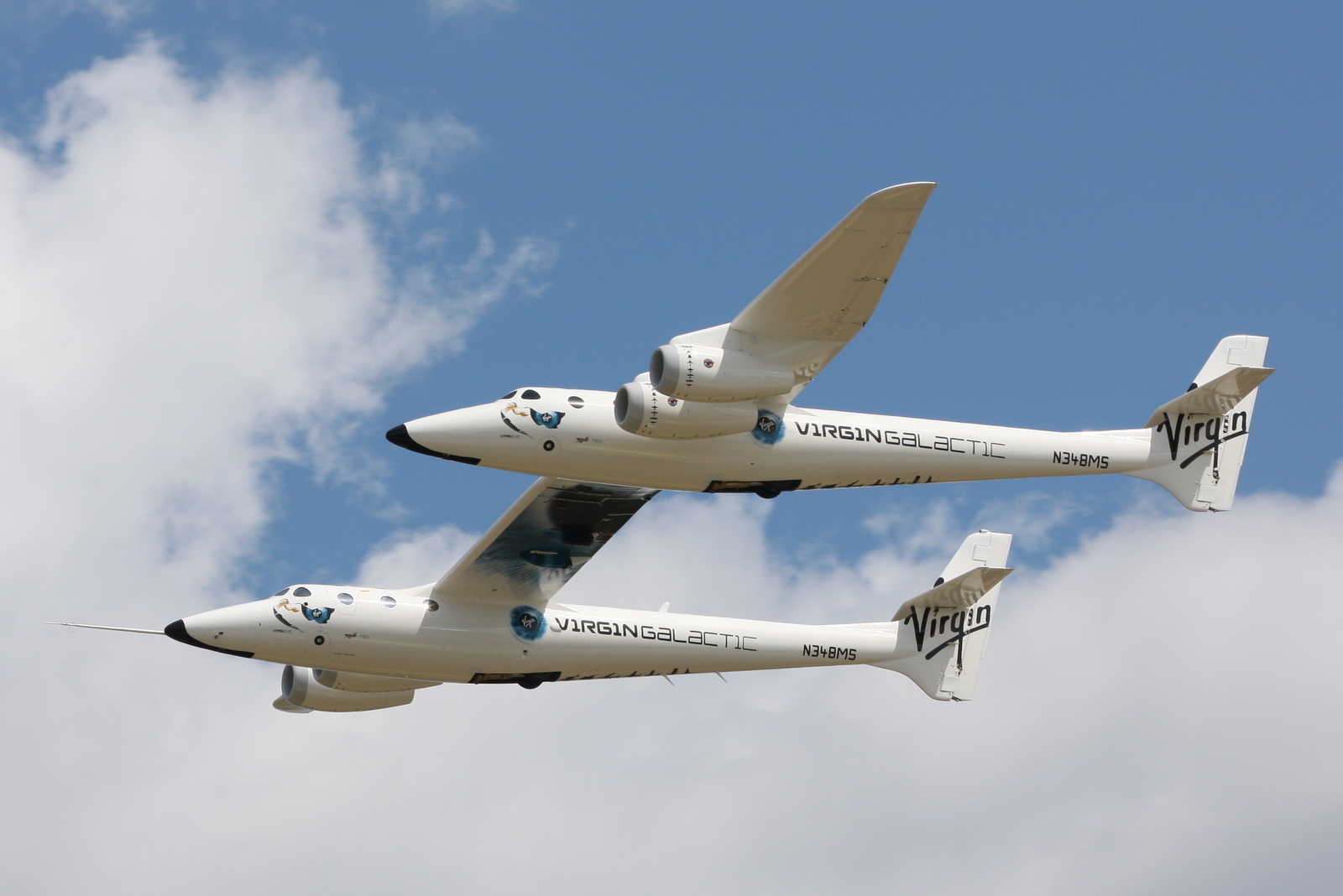
The Scaled Composites Model 348 White Knight Two (WK2) is a quadjet cargo aircraft that was used to lift the SpaceShipTwo (SS2) spacecraft to release altitude. It was developed by Scaled Composites from 2007 to 2010 as the first stage of Tier 1b, a two-stage to suborbital-space crewed launch system. WK2 is based on the successful mothership to SpaceShipOne, White Knight, which itself was based on Proteus.
With an "open architecture" [citation needed] design and explicit plans for multi-purpose use, the aircraft could also operate as a zero-g aircraft for passenger training or microgravity science flights, handle missions in high-altitude testing more generally, or be used to launch payloads other than SpaceShipTwo. A study of use of the aircraft as a forest fire water bomber has also been mentioned, one that would utilize a large carbon composite water tank that could be quickly replenished to make repeat runs over fires.
The first White Knight Two is named VMS Eve after Richard Branson's mother Eve Branson; it was officially unveiled on July 28, 2008, and flew for the first time on December 21, 2008. The second was expected to be named VMS Spirit of Steve Fossett after Branson's close friend Steve Fossett, who died in an aircraft accident in 2007. As of 2024[update], it is not clear if any other SS2 and WK2 vehicles than VSS Enterprise, VSS Unity and VMS Eve will actually be built (especially, as of 2024, VMS Spirit of Steve Fossett has not been built).
In 2008, Virgin Galactic ordered two White Knight Two vehicles. Together, WK2 and SS2 were to form the basis for Virgin Galactic's fleet of suborbital spaceplanes.
In November 2010, The Spaceship Company had announced that it planned to build at least three additional White Knight Two aircraft and an additional five SpaceShipTwo rocket planes, the aircraft to be built by Virgin after the initial prototypes of each craft are built by Scaled Composites.
During 2012–2014, Virgin Galactic was also considering use of the WhiteKnightTwo as the air-launch platform for a new two-stage liquid-fueled rocket small satellite launcher called LauncherOne. In the event—by late 2015—they decided to use a larger carrier aircraft for the job.
White Knight Two is roughly three times larger than White Knight in order to perform a captive flight with the larger SpaceShipTwo spacecraft. The WK2 is similar in wingspan to a Boeing B-29 Superfortress. White Knight Two is a very modern aircraft, as even the flight control cables are constructed of carbon fiber, using a new patented design.
WK2 was planned to provide preview flights offering several seconds of weightlessness before the suborbital event. It was intended to have a service ceiling of about 60,000 ft (18 km), offering a dark blue sky to passengers. This would have allowed tourists to practice before the real flight.
Scaled Composites White Knight Two
The Scaled Composites Model 348 White Knight Two (WK2) is a quadjet cargo aircraft that was used to lift the SpaceShipTwo (SS2) spacecraft to release altitude. It was developed by Scaled Composites from 2007 to 2010 as the first stage of Tier 1b, a two-stage to suborbital-space crewed launch system. WK2 is based on the successful mothership to SpaceShipOne, White Knight, which itself was based on Proteus.
With an "open architecture" [citation needed] design and explicit plans for multi-purpose use, the aircraft could also operate as a zero-g aircraft for passenger training or microgravity science flights, handle missions in high-altitude testing more generally, or be used to launch payloads other than SpaceShipTwo. A study of use of the aircraft as a forest fire water bomber has also been mentioned, one that would utilize a large carbon composite water tank that could be quickly replenished to make repeat runs over fires.
The first White Knight Two is named VMS Eve after Richard Branson's mother Eve Branson; it was officially unveiled on July 28, 2008, and flew for the first time on December 21, 2008. The second was expected to be named VMS Spirit of Steve Fossett after Branson's close friend Steve Fossett, who died in an aircraft accident in 2007. As of 2024[update], it is not clear if any other SS2 and WK2 vehicles than VSS Enterprise, VSS Unity and VMS Eve will actually be built (especially, as of 2024, VMS Spirit of Steve Fossett has not been built).
In 2008, Virgin Galactic ordered two White Knight Two vehicles. Together, WK2 and SS2 were to form the basis for Virgin Galactic's fleet of suborbital spaceplanes.
In November 2010, The Spaceship Company had announced that it planned to build at least three additional White Knight Two aircraft and an additional five SpaceShipTwo rocket planes, the aircraft to be built by Virgin after the initial prototypes of each craft are built by Scaled Composites.
During 2012–2014, Virgin Galactic was also considering use of the WhiteKnightTwo as the air-launch platform for a new two-stage liquid-fueled rocket small satellite launcher called LauncherOne. In the event—by late 2015—they decided to use a larger carrier aircraft for the job.
White Knight Two is roughly three times larger than White Knight in order to perform a captive flight with the larger SpaceShipTwo spacecraft. The WK2 is similar in wingspan to a Boeing B-29 Superfortress. White Knight Two is a very modern aircraft, as even the flight control cables are constructed of carbon fiber, using a new patented design.
WK2 was planned to provide preview flights offering several seconds of weightlessness before the suborbital event. It was intended to have a service ceiling of about 60,000 ft (18 km), offering a dark blue sky to passengers. This would have allowed tourists to practice before the real flight.
Recent media
Recent media