


Community hub
Recent from talks
Contribute something
Nothing was collected or created yet.
VSS Enterprise
View on Wikipedia
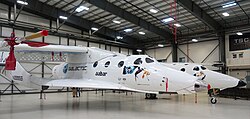
VSS Enterprise (tail number: N339SS[1]) was the first SpaceShipTwo (SS2) spaceplane, built by Scaled Composites for Virgin Galactic. It had been planned to be the first of five commercial suborbital SS2 spacecraft planned by Virgin Galactic, but only one other was ever built.[2][3]
Key Information


It was also the first ship of the Scaled Composites Model 339 SpaceShipTwo class, based on upscaling the design of record-breaking SpaceShipOne.
The VSS Enterprise's name was an acknowledgement of the USS Enterprise from the Star Trek television series.[4] The spaceplane also shared its name with NASA's prototype Space Shuttle orbiter, as well as the aircraft carrier USS Enterprise. It was rolled out on 7 December 2009.[5]
SpaceShipTwo made its first powered flight in April 2013. Richard Branson said it "couldn't have gone more smoothly".[6]
Enterprise was destroyed during a powered test flight on 31 October 2014, killing one pilot, Michael Alsbury, and seriously injuring another, Peter Siebold.[7] This was the first spacecraft-related accident in which part, but not all, of the crew survived. An investigation revealed the accident was caused by premature deployment of the "feathering" system, the ship's descent device; the NTSB also faulted the spacecraft's design for lacking fail-safe mechanisms that could have deterred or prevented early deployment.[8][9][10]
Flight test program
[edit]Initial projections by Virgin Galactic in 2008 called for test flights to begin in late 2009 and commercial service to start in 2011.[11][12] This schedule was not achieved, with captive carry and glide flight tests beginning in 2010, and the first test flight under rocket power in 2013.
In October 2009, Virgin Galactic CEO Will Whitehorn outlined the flight test program for SpaceShipTwo. The test program includes seven phases:
- Vehicle ground testing
- Captive carry under White Knight Two
- Unpowered glide testing
- Subsonic testing with only a brief firing of the rocket
- Supersonic atmospheric testing
- Full flight into suborbital space
- Execute a detailed and lengthy appraisal process with the FAA/AST to demonstrate the system's robustness and eventually obtain a commercial launch license to begin commercial operations.[13]
On 22 March 2010, the SpaceShipTwo vehicle VSS Enterprise underwent a captive carry test flight, with the parent White Knight Two aircraft, VMS Eve, performing a short flight while carrying the Enterprise.[14] A second test flight was made on 16 May 2010,[15] reaching SS2's launch altitude (51,000 feet) and lasting nearly five hours, in order to facilitate "cold soak" testing of SS2's avionics and pressurization system. Thereafter, "a simulated spaceship descent/glide mission was made from [launch] altitude."[16] Between these two flights, the SpaceShipTwo airframe was modified by the addition of two interior fins, with one fin being added to the inside (rocket-side) of each of the craft's twin vertical stabilizers.[17]
On 15 July 2010, VSS Enterprise made its first crewed flight. The craft remained attached to VMS Eve as planned, and underwent a series of combined vehicle systems tests. The flight lasted a total of 6 hours and 21 minutes. A second, similar crewed flight of VSS Enterprise and VMS Eve was carried out on 30 September 2010, lasting approximately 5 hours. Among the objectives of these flights was the improvement of pilot proficiency, and the results of the flights were deemed to show that the systems were capable of supporting future glide missions.[15]
On 10 October 2010, VSS Enterprise made its first crewed gliding test flight. It was released from VMS Eve at 45,000 ft (13,700 metres) and glided to a safe landing at the Mojave Air and Spaceport.[18][19][20] A second gliding test flight took place on 28 October 2010[21] and a third on 17 November 2010.[22] As of December 2010[update], Scaled reported that the flight test program was exceeding expectations.[23] The fourth test flight took place on 13 January 2011,[24] while the fifth and sixth glide flights occurred on 22 and 27 April 2011, respectively.[15] Following this, the feathered reentry configuration was tested in flight on 4 May 2011,[15] with weekly test flights continuing through the end of May.[15] On 9 June 2011, SS2 failed to separate from White Knight Two during its 11th planned glide flight due to a technical problem.[15] Testing resumed with five successful glide flights in June 2011.[15]
In July 2011, after 15 successful glide flights, flight testing of SS2 was halted for two months while planned revisions to the spaceplane were made.[25] Flight tests resumed in late September 2011, although the 16th glide flight – on 29 September – was marred by a brief loss of control aboard SS2, forcing the crew to utilise the feathered wing configuration to land safely.[26][27] This test was followed by another hiatus, during which some of the spacecraft's engine components were installed.[28] In June 2012, Scaled Composites received an FAA permit to conduct rocket-powered supersonic test flights.[29] SpaceShipTwo flight tests resumed in June 2012.[28][30]
In September 2012, Virgin Galactic announced that the unpowered subsonic glide flight test program was essentially complete. The company thereafter stated its intention to fit the hybrid rocket motor and control system to the vehicle, before resuming the glide flight test program with the rocket motor installed, in order to recharacterize the spacecraft's glide performance with slightly different weight distribution and aerodynamics.[31] In October 2012, Scaled Composites installed key components of the rocket motor, and SpaceShipTwo performed its first glide flight with the engine installed in December 2012.[32][33]
The spacecraft's first powered test flight took place on 29 April 2013, briefly driving SpaceShipTwo to a supersonic velocity.[34][35][36] Richard Branson said it "couldn't have gone more smoothly".[6]
On 5 September 2013, the second powered flight was made by the SpaceShipTwo. It broke the sound barrier, reached Mach 1.43, and climbed to 69,000 feet (21 km) over the Mojave Desert under rocket power and descended using its tilt-wing "feathering" maneuver.[37] Space journalist Doug Messier reported that "the engine plume featured white smoke, not the black smoke seen on the April flight."[38]
On 10 January 2014, the third powered flight climbed higher than the previous flights, testing a new coating on the tail boom and other systems.[39]
List of test flights
[edit]Legend
[edit]| Code | Detail |
|---|---|
| GFxx | Glide Flight |
| CCxx | Captive Carry Flight |
| CFxx | Cold Flow Flight |
| PFxx | Powered Flight |
| Fxx | Feathering deployed |
Flights
[edit]| Flight designation | Date | Duration | Maximum altitude | Top speed | Pilot / co-pilot | Notes |
|---|---|---|---|---|---|---|
| 41 / GF01 | 10 October 2010 | 13 min | 46,000 feet (14,000 m) | 180 knots (210 mph; 330 km/h) EAS 2 g | Siebold / Alsbury | |
| 44 / GF02 | 28 October 2010 | 10 min, 51 sec | 230 knots (260 mph; 430 km/h) EAS 3 g | Stucky / Alsbury | ||
| 45 / GF03 | 17 November 2010 | 11 min, 39 sec | 246 knots (283 mph; 456 km/h) EAS 3.5 g | Siebold / Nichols | ||
| 47 / GF04 | 13 January 2011 | 11 min, 34 sec | 250 knots (290 mph; 460 km/h) EAS 3.8 g | Stucky / Nichols | ||
| 56 / GF05 | 22 April 2011 | 14 min, 31 sec | Siebold / Shane | |||
| 57 / GF06 | 27 April 2011 | 16 min, 7 sec | Stucky / Alsbury | |||
| 58 / GF07 | 4 May 2011 | 11 min, 5 sec | 51,500 feet (15,700 m) | 15,500 feet per minute (4,700 m/min) | Siebold / Nichols | F01 |
| 59 / GF08 | 10 May 2011 | 13 min, 2 sec | Stucky / Shane | |||
| 60 / GF09 | 19 May 2011 | 11 min, 32 sec | Siebold / Binnie | |||
| 61 / GF10 | 25 May 2011 | 10 min, 14 sec | Above 50,000 feet (15,000 m) | Stucky / Binnie | F02 | |
| 62 / (CC12) | 9 June 2011 | Siebold / Shane | Release failure during flight intended as GF11 | |||
| 64 / GF11 | 14 June 2011 | 13 min, 18 sec | Siebold / Shane | |||
| 65 / GF12 | 15 June 2011 | 10 min, 32 sec | Stucky / Nichols | |||
| 66 / GF13 | 21 June 2011 | 8 min, 55 sec | Siebold / Nichols | |||
| 67 / GF14 | 23 June 2011 | 7 min, 33 sec | Stucky / Nichols | |||
| 68 / GF15 | 27 June 2011 | 7 min, 39 sec | Siebold / Binnie | |||
| 73 / GF16 | 29 September 2011 | 7 min, 15 sec | Stucky / Nichols / Persall | F03 | ||
| 87 / GF17 | 26 June 2012 | 11 min, 22 sec | Siebold / Alsbury | |||
| 88 / GF18 | 29 June 2012 | 13 min | Stucky / Mackay | |||
| 90 / GF19 | 18 July 2012 | 10 min, 39 sec | Siebold / Nichols | |||
| 91 / GF20 | 2 August 2012 | 8 min | Stucky / Nichols | F04 | ||
| 92 / GF21 | 7 August 2012 | 9 min, 52 sec | Siebold / Colmer | F05 | ||
| 93 / GF22 | 11 August 2012 | 8 min, 2 sec | Stucky / Binnie | |||
| 109 / GF23 | 19 December 2012 | 13 min, 24 sec | Stucky / Alsbury | |||
| 113 / GF24 | 3 April 2013 | 9 min | Stucky / Nichols | F06 | ||
| 114 / CF01 | 12 April 2013 | 10 min, 48 sec | Stucky / Alsbury | |||
| 115 / PF01[44][45] | 29 April 2013 | 13 min | 56,000 feet (17,000 m) | Mach 1.22 | Stucky / Alsbury | |
| 130 / GF25 | 25 July 2013 | 11 min, 52 sec | Stucky / Mackay | |||
| 131 / GF26 | 8 August 2013 | 10 min | Stucky / Mackay | F07 | ||
| 132 / PF02 | 5 September 2013 | 14 min | 69,000 feet (21,000 m) | Mach 1.43 | Stucky / Nichols | F08 |
| 141 / GF27 | 11 December 2013. | 11 min | Stucky / Masucci | |||
| 147 / PF03 | 10 January 2014 | 12 min, 43 sec | 72,000 feet (22,000 m)[46] | Mach 1.4 | Mackay / Stucky[47] | F09 |
| 149 / GF28 | 17 January 2014 | 14 min, 12 sec | Siebold / Sturckow | |||
| 156 / GF29[48] | 29 July 2014 | 12 min | Masucci / Siebold | |||
| 164 / CF02[48] | 28 August 2014 | 13 min | Siebold / Alsbury | |||
| 170 / GF30[49] | 7 October 2014 | 10 min, 30 sec | Siebold / Sturckow[50] | F10 | ||
| ?? / PF04 | 31 October 2014 | 0 min, 13 sec | roughly 50,000 feet (15,000 m)[51] | ? (at least Mach 0.92) | Siebold / Alsbury[52] | Unintended feathering destroys vehicle in-flight |
First commercial spacecraft accident
[edit]On 31 October 2014, Enterprise broke apart in flight during a powered test flight over California's Mojave Desert.[53][54][55] The flight began smoothly, with Enterprise being dropped from its WhiteKnightTwo carrier and igniting its engine at an altitude of 50,000 feet (15,000 m).[53] About 60 to 90 seconds into the flight, an "anomaly" was reported that resulted in destruction of the ship.[53] The pilot in command, Peter Siebold, escaped from the craft and parachuted to safety; the copilot, Michael Alsbury, was killed in the crash.[53][10]
The National Transportation Safety Board conducted an independent investigation into the accident. In July 2015, the NTSB released a report that cited inadequate design safeguards, poor pilot training, lack of rigorous federal oversight and a potentially anxious co-pilot without recent flight experience as important factors in the crash.[10] The NTSB determined that the crash resulted from the co-pilot's premature deployment of the feathering mechanism, which is normally used to aid a safe descent. The NTSB also faulted the ship's designers for failing to protect against human error, noting that the spacecraft lacked fail-safe systems that would have prevented or deterred a premature deployment of the feathering mechanism.[10] The NTSB recommended that the FAA establish human factors guidance specific to commercial spaceflight operators and create a more rigorous application process for experimental spaceflight permits.[10]
Image gallery
[edit]- Virgin Galactic VSS Enterprise
-
 Enterprise in flight slung under VMS Eve
 -
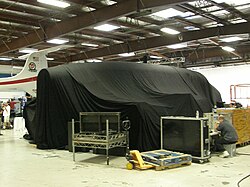 Enterprise under construction and under wraps in 2008
 -
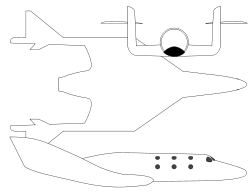 A 3-view of the SS2

_cr8.jpg)

See also
[edit]References
[edit]- ^ "FAA N Number Registration for "VSS Enterprise"". Archived from the original on 3 March 2016. Retrieved 28 July 2008.
- ^ "Virgin Galactic to Offer Public Space Flights". Space.com. Associated Press. 27 September 2004. Retrieved 12 August 2008.
- ^ "Scaled Composites PROJECTS". Scaled.com. Archived from the original on 28 June 2017. Retrieved 19 March 2010.
- ^ "SpaceShipTwo". SpaceTourism.ws. Archived from the original on 17 October 2008. Retrieved 12 August 2008.
- ^ "SpaceShipTwo Roll Out". Virgingalactic.com. 8 December 2009. Archived from the original on 13 December 2009.
- ^ a b "SpaceShipTwo makes first powered flight". 3 News NZ. 30 April 2013. Archived from the original on 30 December 2013. Retrieved 29 November 2018.
- ^ Clark, Stephen (31 October 2014). "Virgin Galactic's SpaceShipTwo rocket plane crashes on test flight". SpaceflightNow. Retrieved 31 October 2014.
- ^ Chang, Kenneth (3 November 2014). "Investigators Focus on Tail Booms in Crash of Space Plane". New York Times. Retrieved 3 November 2014.
- ^ Melley, Brian (3 November 2014). "Spaceship's descent device deployed prematurely". AP News. Archived from the original on 3 November 2014. Retrieved 3 November 2014.
- ^ a b c d e "Lack of Consideration for Human Factors Led to In-Flight Breakup of SpaceShipTwo". NTSB. 28 July 2015. Retrieved 29 July 2015.
- ^ Coppinger, Rob (21 December 2008). "SpaceShipTwo's mothership maiden flight". Flightglobal.com. Retrieved 25 March 2010.
- ^ Schwartz, John (23 January 2008). "New Tourist Spacecraft Unveiled". New York Times. Retrieved 12 August 2008.
- ^ Will Whitehorn (27 October 2009). International Astronautical Congress 2009: Civilian Access to Space (video). Daejeon, Korea: Flightglobal Hyperbola, Rob Coppinger.
- ^ "Maiden flight for Branson's SpaceShipTwo". ABC News. (Australian Broadcasting Corporation). 23 March 2010. Archived from the original on 24 March 2010.
- ^ a b c d e f g "Test Summaries". Scaled Composites. 11 August 2012. Archived from the original on 17 June 2017. Retrieved 17 August 2012.
- ^ "SpaceShipTwo Flown To Launch Altitude". Aviation Week. 20 May 2010. Retrieved 21 May 2010.[permanent dead link]
- ^ "SS2 modifications". HobbySpace.com. 21 May 2010. Archived from the original on 21 January 2012. Retrieved 21 January 2012.
- ^ "VSS Enterprise Completes First Manned Glide Flight" (Press release). Virgin Galactic News. 10 October 2010. Archived from the original on 24 November 2011. Retrieved 21 November 2011.
- ^ "SpaceShipTwo flies free for first time". Cosmic Log. MSNBC. Archived from the original on 12 October 2010. Retrieved 10 October 2010.
- ^ "SS2 Test Moves Virgin Closer to Goal". Aviation Week. 21 October 2010. Retrieved 23 October 2010.[permanent dead link]
- ^ "Virgin Galactic's SpaceShipTwo Spaceliner Completes 2nd Glide Flight". Space.com. 29 October 2011. Retrieved 26 October 2011.
- ^ David, Leonard (19 November 2010). "Virgin Galactic's spaceship aces 3rd glide flight". NBC News. Retrieved 22 November 2010.[dead link]
- ^ "SS2 Glide Tests Exceed Expected Progress". Aviation Week. 23 December 2010. Retrieved 24 December 2010.[permanent dead link]
- ^ "Test Flights Continue" (Press release). Virgin Galactic News. Archived from the original on 10 August 2012.
- ^ David, Leonard (28 July 2011). "Private Rocket Ship for Space Tourists Takes Break from Test Flights". Space.com. Retrieved 30 July 2011.
- ^ "Private spaceship briefly hurtled out of control". NBC News. 17 October 2011. Archived from the original on 3 November 2014. Retrieved 18 October 2011.
- ^ "Virgin Galactic's private spaceship makes safe landing after tense test flight". Space.com. 17 October 2011. Retrieved 18 October 2011.
- ^ a b "SpaceShipTwo to resume flight tests as early as June". Flightglobal.com. 11 May 2012. Retrieved 21 May 2012.
- ^ "SpaceShipTwo Gets Thumbs Up for Rocket-Powered Flights". Flying Magazine. 1 June 2012. Archived from the original on 5 September 2012. Retrieved 24 August 2012.
- ^ "Virgin Galactic successfully completes SpaceShipTwo glide flight test and rocket motor firing on same day". SpaceRef.com. 28 June 2012. Archived from the original on 28 July 2020. Retrieved 24 August 2012.
- ^ Rosenberg, Zach (13 September 2012). "Virgin Galactic finishes unpowered flight test". FlightGlobal.com. Retrieved 26 September 2012.
- ^ "SpaceShipTwo straps on its engine". NBC. 20 December 2012. Retrieved 20 December 2012.
- ^ "SpaceShipTwo Fitted With Rocket Propulsion System". Aviation Week. 22 October 2012. Archived from the original on 12 October 2013. Retrieved 14 November 2012.
- ^ "SpaceShipTwo Test Summaries". Scaled Composites. 29 April 2013. Archived from the original on 16 August 2013. Retrieved 29 April 2013.
- ^ "Virgin Galactic Breaks Speed of Sound in First Rocket-Powered Flight of SpaceShipTwo" (Press release). Virgin Galactic. 29 April 2013. Archived from the original on 30 April 2013. Retrieved 29 April 2013.
- ^ "SpaceShipTwo makes first powered flight". 3 News NZ. 30 April 2013. Archived from the original on 30 December 2013. Retrieved 24 July 2013.
- ^ "Virgin Galactic's SpaceShipTwo Succeeds in Second Rocket-Powered Flight". Forbes. Retrieved 6 September 2013.
- ^ Foust, Jeff (6 September 2013). "SpaceShipTwo flies a little higher and a little faster". NewSpace Journal. Retrieved 7 September 2013.
- ^ "Virgin Galactic Reaches New Heights in Third Supersonic Test Flight" (Press release). Virgin Galactic. 10 January 2014. Archived from the original on 7 April 2014. Retrieved 10 January 2014.
- ^ "SpaceShipTwo straps on its engine". NBC. 20 December 2012. Retrieved 20 December 2012.
- ^ "Space Ship Completes 24th Test Flight in Mojave". Hispanic Business. 4 April 2013. Archived from the original on 30 December 2013. Retrieved 5 April 2013.
- ^ "Virgin Galactic's SpaceShipTwo Crashes During Flight Test". NBC News. 31 October 2014.
- ^ SpaceShipTwo (SS2) History, skyrocket.de
- ^ "Virgin Galactic Breaks Speed of Sound in First Rocket-Powered Flight of SpaceShipTwo" (Press release). Virgin Galactic. 29 April 2013. Archived from the original on 30 April 2013. Retrieved 29 April 2013.
- ^ "SpaceShipTwo PF01: SS2 and WK2 preps underway". NewSpaceWatch.com. 28 April 2013. Retrieved 29 April 2013.
- ^ "Virgin Galactic Reaches New Heights in Third Supersonic Test Flight" (Press release). Virgin Galactic. 10 January 2014. Archived from the original on 7 April 2014. Retrieved 10 January 2014.
- ^ "Virgin Galactic spaceship makes third powered test flight". Chicago Tribune. 10 January 2014. Archived from the original on 10 January 2014. Retrieved 10 January 2014.
- ^ a b Boyle, Alan (29 August 2014). "Virgin Galactic's SpaceShipTwo Glides Through a Dry Run". NBC News. Retrieved 29 August 2014.
- ^ Wall, Mike (8 October 2014). "Virgin Galactic's SpaceShipTwo Aces Glide Test Flight". Space.com. Retrieved 8 October 2014.
- ^ "Virgin Galactic's SpaceShipTwo Glides Through Test Run". NBC News. 7 October 2014. Retrieved 11 July 2021.
- ^ Klotz, Irene (3 November 2014). "Rocket plane's tail activated prematurely in fatal crash". Reuters. Retrieved 9 June 2018.
- ^ Pope, Stephen (31 October 2014). "SpaceShipTwo crashes in Mojave Desert". flyingmag.com. Retrieved 31 October 2014.
- ^ a b c d Chang, Kenneth; Schwartz, John (31 October 2014). "Virgin Galactic's SpaceShipTwo Crashes in New Setback for Commercial Spaceflight". New York Times. Retrieved 1 November 2014.
- ^ Rogers, Adam (31 October 2014). "Space Tourism Isn't Worth Dying For". Wired. Retrieved 1 November 2014.
- ^ "Virgin Galactic spacecraft crash kills pilot". BBC. 31 October 2014. Retrieved 8 November 2014.
External links
[edit]
- Enterprise construction sequence images
- Virgin Galactic's Third Powered Flight - 14 Jan 2014 Official video on Virgin Galactic YouTube channel
- Virgin Galactic, National Geographic Channel, documentary of the conception, design, build and early flights of VSS Enterprise, 2012.
- NTSB B-Roll of the SpaceShipTwo Crash Scene in Mojave, Calif. - 1 Nov 2014 Official video on NTSB YouTube channel
| Related companies |  | |
|---|---|---|
| Notable people |
| |
| Background | ||
| Programs / ships | ||
| Related topics | ||
Parent company: Virgin Group | |
| Staff |
|
| Vehicle classes | |
| Vehicles |
|
| Spaceports | |
| Accidents and incidents | |
| Spaceflight | |
| Related companies |
|
| Related topics | |
