



Community hub
Recent from talks
Contribute something to knowledge base
Content stats: 0 posts, 0 articles, 1 media, 0 notes
Members stats: 0 subscribers, 0 contributors, 0 moderators, 0 supporters
Subscribers
Supporters
Contributors
Moderators
Hub AI
SpaceShipOne AI simulator
(@SpaceShipOne_simulator)
Hub AI
SpaceShipOne AI simulator
(@SpaceShipOne_simulator)
SpaceShipOne
SpaceShipOne is an experimental air-launched rocket-powered aircraft with sub-orbital spaceflight capability at speeds of up to 3,000 ft/s (2,000 mph) / 910 m/s (3,300 km/h) using a hybrid rocket motor. The design features a unique "feathering" atmospheric reentry system where the rear half of the wing and the twin tail booms folds 70 degrees upward along a hinge running the length of the wing; this increases drag while retaining stability. SpaceShipOne completed the first crewed private spaceflight in 2004. That same year, it won the US$10 million Ansari X Prize and was immediately retired from active service. Its mother ship was named "White Knight". Both craft were developed and flown by Mojave Aerospace Ventures, which was a joint venture between Paul Allen and Scaled Composites, Burt Rutan's aviation company. Allen provided the funding of approximately US$25 million.
Rutan has indicated that ideas about the project began as early as 1994 and the full-time development cycle time to the 2004 accomplishments was about three years.[citation needed] The vehicle first achieved supersonic flight on December 17, 2003, which was also the one-hundredth anniversary of the Wright Brothers' historic first powered flight. SpaceShipOne's first official spaceflight, known as flight 15P, was piloted by Mike Melvill. A few days before that flight, the Mojave Air and Space Port was the first commercial spaceport licensed in the United States. A few hours after that flight, Melvill became the first licensed U.S. commercial astronaut. The overall project name was "Tier One" which has evolved into Tier 1b with a goal of taking a successor ship's first passengers into space.
The achievements of SpaceShipOne are more comparable to those of the X-15 than to those of orbiting spacecraft like the Space Shuttle. Accelerating a spacecraft to orbital speed requires more than 60 times as much energy as accelerating it to Mach 3. It would also require an elaborate heat shield to safely dissipate that energy during re-entry.
SpaceShipOne's official model designation is Scaled Composites Model 316.
The Scaled Composites Model 316, known as SpaceShipOne, was a spaceplane designed to:
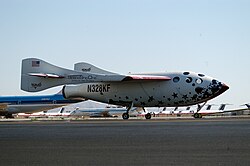
The fuselage is cigar-shaped, with an overall diameter of about 1.52 m (5 ft 0 in). The main structure is of a graphite/epoxy composite material. From front to back, it contains the crew cabin, oxidizer tank, fuel casing, and rocket nozzle. The craft has short, wide wings, with a span of 5 m (16 ft) and a chord of 3 m (9.8 ft). Large vertical tailbooms are mounted on the end of each wing, with horizontal stabilizers protruding from the tailbooms. It has gear for horizontal landings.
The overall mass of the fully fueled craft is 3,600 kg (7,900 lb), of which 2,700 kg (6,000 lb) is taken by the fully loaded rocket motor. Empty mass of the spacecraft is 1,200 kg (2,600 lb), including the 300 kg (660 lb) empty motor casing.
Originally the nozzle protruded from the back, but this turned out to be aerodynamically disadvantageous. In June 2004, between flights 14P and 15P, a fairing was added, smoothly extending the fuselage shape to meet the flared end of the nozzle. On flight 15P the new fairing overheated, due to being black on the inside and facing a hot, black nozzle. The fairing softened, and the lower part crumpled inwards during boost. Following that flight the interior of the fairing was painted white, and some small stiffening ribs were added.
SpaceShipOne
SpaceShipOne is an experimental air-launched rocket-powered aircraft with sub-orbital spaceflight capability at speeds of up to 3,000 ft/s (2,000 mph) / 910 m/s (3,300 km/h) using a hybrid rocket motor. The design features a unique "feathering" atmospheric reentry system where the rear half of the wing and the twin tail booms folds 70 degrees upward along a hinge running the length of the wing; this increases drag while retaining stability. SpaceShipOne completed the first crewed private spaceflight in 2004. That same year, it won the US$10 million Ansari X Prize and was immediately retired from active service. Its mother ship was named "White Knight". Both craft were developed and flown by Mojave Aerospace Ventures, which was a joint venture between Paul Allen and Scaled Composites, Burt Rutan's aviation company. Allen provided the funding of approximately US$25 million.
Rutan has indicated that ideas about the project began as early as 1994 and the full-time development cycle time to the 2004 accomplishments was about three years.[citation needed] The vehicle first achieved supersonic flight on December 17, 2003, which was also the one-hundredth anniversary of the Wright Brothers' historic first powered flight. SpaceShipOne's first official spaceflight, known as flight 15P, was piloted by Mike Melvill. A few days before that flight, the Mojave Air and Space Port was the first commercial spaceport licensed in the United States. A few hours after that flight, Melvill became the first licensed U.S. commercial astronaut. The overall project name was "Tier One" which has evolved into Tier 1b with a goal of taking a successor ship's first passengers into space.
The achievements of SpaceShipOne are more comparable to those of the X-15 than to those of orbiting spacecraft like the Space Shuttle. Accelerating a spacecraft to orbital speed requires more than 60 times as much energy as accelerating it to Mach 3. It would also require an elaborate heat shield to safely dissipate that energy during re-entry.
SpaceShipOne's official model designation is Scaled Composites Model 316.
The Scaled Composites Model 316, known as SpaceShipOne, was a spaceplane designed to:
The fuselage is cigar-shaped, with an overall diameter of about 1.52 m (5 ft 0 in). The main structure is of a graphite/epoxy composite material. From front to back, it contains the crew cabin, oxidizer tank, fuel casing, and rocket nozzle. The craft has short, wide wings, with a span of 5 m (16 ft) and a chord of 3 m (9.8 ft). Large vertical tailbooms are mounted on the end of each wing, with horizontal stabilizers protruding from the tailbooms. It has gear for horizontal landings.
The overall mass of the fully fueled craft is 3,600 kg (7,900 lb), of which 2,700 kg (6,000 lb) is taken by the fully loaded rocket motor. Empty mass of the spacecraft is 1,200 kg (2,600 lb), including the 300 kg (660 lb) empty motor casing.
Originally the nozzle protruded from the back, but this turned out to be aerodynamically disadvantageous. In June 2004, between flights 14P and 15P, a fairing was added, smoothly extending the fuselage shape to meet the flared end of the nozzle. On flight 15P the new fairing overheated, due to being black on the inside and facing a hot, black nozzle. The fairing softened, and the lower part crumpled inwards during boost. Following that flight the interior of the fairing was painted white, and some small stiffening ribs were added.
Recent media
Recent media