Hubbry Logo
ScheurebeScheurebeMain
Open search
Scheurebe
Community hub
Scheurebe
logo
8 pages, 0 posts
0 subscribers
Be the first to start a discussion here.
Scheurebe
Scheurebe
from Wikipedia
Scheurebe
Grape (Vitis)
Scheurebe
SpeciesVitis vinifera
Also calledSämling 88, Scheu, Dr. Wagnerrebe
OriginAlzey, Germany
Notable regionsAustria, Germany
Notable winesTrockenbeerenauslese from Lake Neusiedl
VIVC number10818

Scheurebe (German pronunciation: [ˈʃɔɪˌʁeːbə] ) or Sämling 88 is a white wine grape variety. It is primarily grown in Germany and Austria, where it often is called Sämling 88 (English: Seedling 88), and some parts of the New World. Scheurebe wines are highly aromatic, and the variety is often used for sweet wines, although dry Scheurebe wines have become more common in Germany.[1][2][3]

History and parentage

[edit]

Scheurebe was created by German viticulturalist Dr. Georg Scheu (1879–1949) in 1916, when he was working as director of a grape-breeding institute in Alzey in Rheinhessen, by crossing Riesling with an unknown wild vine.[4][5] According to the German grape-breeder Helmut Becker, Scheu's purpose was to create a superior version of Silvaner, with more aroma and greater resistance to frost damage and chlorosis.[1] It was long assumed that Scheurebe was Silvaner x Riesling, but DNA analysis in the late 1990s ruled out Silvaner as a parent, while confirming Riesling as the father. It is known that Scheu was working on wild vines, so it is possible that a misidentification of the cross took place.[5] According to official Austrian sources it is in fact a cross between Riesling and Bouquet Blanc (Bukettraube).[6]

Seedling (in German Sämling) number 88 was simply Scheu's serial number for the vine plant selected for its properties. It was named in Scheu's honour in 1945.[2][7] The Rebe suffix is simply the German word for vine. Scheurebe received varietal protection and was released for general cultivation in Germany in 1956, after Scheu's death.[5]

Varietal character

[edit]

When produced from fully ripe grapes, Scheurebe wines are dominated by rich blackcurrant aromas supplemented by grapefruit. Well-made dry Scheurebe wines can be quite full-bodied, but dry wines made from not fully ripe grapes tend to be dominated by the grapefruit component, and display it in an aggressive manner which makes for a clumsy, unattractive wine. Scheurebe therefore tends to be easier to use for sweet wines made from grapes that are fully ripe, overripe or affected by noble rot. Well-made sweet Scheurebe wines can show intense aromas of blood grape and honey.[1][2]

It has been pointed out that Scheurebe retains quite a bit of Riesling character, although it is somewhat less acidic and can tend to be more clumsy.[1] Just as Riesling, its wines tend to show terroir variation, and it has been called the single new breed variety of German origin that deserves serious attention for the quality of its wines.[2][3]

Scheurebe in various regions

[edit]

Germany

[edit]

In 2018, there were 1,412 hectares (3,490 acres) of Scheurebe in Germany, or 1.7% of the total vineyard surface.[8] Plantings are most common in Palatinate, Rheinhessen and Nahe.[9] The trend for planted area is decreasing, just as for all other German white "new breeds" since the 1980s. It is possible that the reason for Scheurebe's continued decline, despite being appreciated by many international wine critics, is because it is associated with sweet wines while there has been a large-scale move to dry wines in some German regions where Scheurebe has been commonly planted.[2] While overall German plantations of Scheurebe has continued to decrease, some top estates in the Palatinate have in fact reintroduced small amounts of Scheurebe in their vineyards from the mid-1990s.[2]

Austria

[edit]

In Austria, the variety is found primarily in Burgenland and Styria, but the total amount of Scheurebe cultivated is much smaller than in Germany. It is however used for some highly rated sweet wines, such as concentrated noble rot-affected Trockenbeerenauslesen in the Neusiedlersee region, where producers include Alois Kracher.[2][10]

Other locations

[edit]

Some Scheurebe is grown in California, Oregon, Western Australia, and Nova Scotia, Canada. It has also recently been introduced in Switzerland where it is cultivated by a handful of wine-growers in Geneva.

Synonyms

[edit]

Synonyms for Scheurebe include Alzey S. 88, Dr. Wagnerrebe, S 88, Sämling, Sämling 88, Scheu, Scheu 88 and Scheu Riesling.[2][4]

References

[edit]
Revisions and contributorsEdit on WikipediaRead on Wikipedia
from Grokipedia
Scheurebe, also known as Sämling 88, is a variety originating from , bred in 1916 by viticulturist Dr. Georg Scheu at the Landesanstalt für Rebenzüchtung in as a cross between and Bukettraube (itself a hybrid of and ). This aromatic is prized for its vigorous growth, high yield, resistance to winter frosts and dryness, and early-to-mid ripening, typically harvested in early October. The variety produces full-bodied wines with pronounced acidity, offering a complex bouquet that often features , tropical fruits like and , stone fruits such as , and citrus notes including grapefruit and , sometimes with muscat-like floral undertones or hints. These characteristics make Scheurebe versatile for both dry table wines and sweeter styles like Prädikatswein, , Strohwein, and Schilfwein, with well-ripened examples exhibiting excellent aging potential due to their zesty balance. Primarily cultivated in —where it covers significant acreage in regions like Rheinhessen, Pfalz, Nahe, and Franken—and (notably and Steiermark, with about 293 hectares as of 2024), Scheurebe has seen fluctuating popularity but remains valued for its distinctive profile in these areas. Smaller plantings exist elsewhere in and beyond, though it is not widely grown internationally. Despite early misconceptions about its parentage (once thought to involve directly), DNA analysis has confirmed its Riesling-Bukettraube lineage, underscoring its role in modern German and Austrian .

Origins

History of Development

Scheurebe was created in 1916 by German viticulturist Dr. Georg Scheu (1879–1949) at the breeding station in Rheinhessen, , amid early 20th-century initiatives to breed disease-resistant grape hybrids in response to challenges like devastation and the need for more robust varieties. Scheu sought to develop a vine that combined the aromatic quality and finesse of with the higher yields and adaptability of , though subsequent genetic studies identified the actual parentage as a cross between and the obscure Bukettraube. The new seedling was initially propagated anonymously under the designation Sämling 88 (Seedling 88), Scheu's serial code for the promising plant selected from numerous crossings. During the Nazi era in the , it was temporarily renamed Dr. Wagner-Rebe after a regional Nazi agricultural leader, but following and efforts, it reverted to Sämling 88. The variety received its permanent name, Scheurebe—meaning "Scheu's vine"—in 1956, in honor of its creator following his death in 1949. In 1956, Scheurebe was granted varietal protection and officially released for commercial cultivation by the German Federal Institute for , transitioning it from experimental trials to approved widespread planting. This approval came at a pivotal time for German , as vineyards were being rebuilt after the devastation of . Early adoption of Scheurebe occurred primarily in the and , driven by its promising yields and flavor potential, with initial focus on the Rheinhessen and Pfalz regions where it showed strong adaptation to local soils and climates. By this period, it began gaining traction among growers seeking versatile grapes for both dry and sweet styles amid postwar economic recovery.

Parentage and Genetics

Scheurebe originated from a controlled crossbreeding between (Vitis vinifera 'Riesling') as the female parent and Bukettraube (also known as Bouquet Blanc) as the male parent. This pedigree was confirmed through molecular marker analysis, establishing Scheurebe's lineage within . Bukettraube itself is a hybrid of and , both V. vinifera varieties, contributing to Scheurebe's status as an intraspecific cross rather than involving wild Vitis species like V. riparia. For much of the 20th century, Scheurebe was misattributed as a direct Silvaner × Riesling cross, based on the breeder's initial records. Microsatellite DNA profiling in the late 1990s and early 2000s excluded Silvaner as a parent while confirming Riesling's contribution, revealing the second parent as an unidentified variety. Further analysis in 2012 by researchers at the Julius Kühn Institute identified Bukettraube as the true pollen donor through advanced genotyping, resolving the longstanding uncertainty. The genetic profile of Scheurebe reflects inheritance of key aromatic traits, such as production, from , which imparts its distinctive floral and fruity bouquet. This is documented in the Vitis International Variety Catalogue (VIVC) under variety number 10818, where its V. vinifera subsp. sativa classification underscores its development as a novel through modern breeding, distinct from ancient, naturally occurring pure lines. The hybrid nature enhances its adaptability but positions it outside traditional V. vinifera lineages, influencing regulatory and ampelographic categorizations in .

Characteristics

Viticultural Traits

Scheurebe exhibits a vigorous growth habit, characterized by strong shoot development and prolonged wood maturation, which supports extended leaf assimilation for optimal quality. This vigor contributes to a high yield potential, often reaching medium-high levels of around 100 hl/ha in managed vineyards, though unmanaged vines can exceed 150 hl/ha, leading to overcropping that dilutes quality; thus, canopy management practices such as shoot thinning and positioning are essential to balance vigor and fruit load. The variety displays medium budburst timing, rendering it moderately susceptible to spring frosts in regions prone to late cold snaps, though it demonstrates strong resistance to winter cold in established plantings. Scheurebe also shows good tolerance to and performs well on limestone-rich soils, with notable resistance to lime-induced , making it suitable for warmer, drier sites. It prefers sheltered locations with excellent drainage to mitigate excess moisture, as poor drainage can exacerbate disease pressures. Ripening occurs in the early to mid-season, with harvest typically spanning late September to early October in German growing areas, aligning closely with due to its parentage. Scheurebe is notably susceptible to powdery mildew (Oidium) and botrytis bunch rot, particularly in humid conditions, necessitating vigilant site selection, regular applications, and cultural practices like green harvesting to reduce cluster density and concentrate flavors while minimizing rot risks. These traits underscore the importance of well-ventilated canopies and optimal planting densities to sustain healthy vine performance and fruit quality.

Ampelographic Features

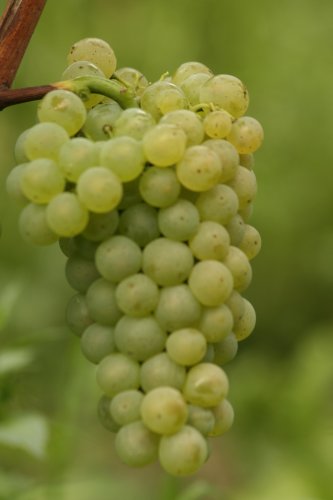
Scheurebe vines display an overall upright growth habit with long internodes, distinguishing them from the lankier structure of vines. The leaves are medium-sized, five-lobed with serrated edges and a dark green color persisting into late autumn, exhibiting moderate coloration in the veins; young shoots feature reddish tips that are nearly hairless. Clusters are medium-sized, conical to cylindrical in shape with a medium-dense structure, typically weighing 200-300 g. Berries are medium-large and oval-shaped, featuring thick greenish-yellow skins that turn golden at full ripeness; the variety shows high potential for sugar accumulation, up to 120° Oechsle in warm vintages. Detailed ampelographic descriptors for Scheurebe, including these morphological traits, are registered in the VIVC database.

Wine Production

Flavor and Aroma Profile

Scheurebe wines exhibit a pronounced aromatic profile, characterized by intense notes of bud (cassis), grapefruit, and tropical fruits such as passion fruit and in dry styles. In sweeter versions, including late-harvest and selections, the aromas evolve to include honey, ripe peach, and candied orange peel, often with underlying stone fruit depth. The variety's high acidity, typically 6-8 g/L expressed as , provides structural balance alongside a full body and moderate alcohol levels of 12-14% ABV, offering a finesse reminiscent of but with enhanced opulence and richness. Due to its mid-ripening tendency, Scheurebe requires careful harvest timing to optimize these elements and avoid unripe conditions. influences the expression, with soils imparting mineral-driven, effusive grapefruit character, while volcanic sites enhance fruity intensity; overripe grapes can introduce smoky or herbal undertones. In bottle aging, Scheurebe displays youthful vibrancy that matures over 3-5 years into more complex nutty and floral notes, though early picking risks off-flavors such as vegetal or unpleasant herbaceous tones.

Styles and Winemaking

Scheurebe wines are produced in a range of styles, including sweet varieties such as Auslese and utilizing late-harvest or noble rot-affected grapes to concentrate sugars while relying on the variety's inherent high acidity for balance. These botrytized examples, particularly those crafted through selective harvesting of individually affected berries around in , develop concentrated flavors of and spice, with process managed to promote desirable without excessive oxidation. Since the , dry trocken versions have gained popularity, especially in Germany's Rheinhessen region, where they showcase vibrant fruit purity and lively acidity without residual sweetness. Winemaking for Scheurebe emphasizes preserving its aromatic profile, with commonly employed at controlled low temperatures (around 16-18°C) to retain fresh, notes like and grapefruit. For premium dry wines, barrel aging—often in neutral large formats like Stückfässer—adds richer texture and subtle complexity, while sweet styles may undergo partial to halt at desired sweetness levels. Lees aging in further enhances in both dry and off-dry expressions. Dry Scheurebe pairs well with seafood dishes or goat cheese, highlighting its crisp acidity against milder flavors, while sweet versions complement richer fare like foie gras or blue cheese, where their opulence provides contrast. Top botrytized examples demonstrate strong aging potential, evolving over 10 or more years to reveal layered honeyed and nutty depths balanced by persistent acidity. A key challenge in Scheurebe production is avoiding herbaceous or green notes, which arise from unripe grapes; optimal ripeness at harvest is thus critical to emphasize the variety's signature fruity aromatics. Modern trends include shifts toward organic and biodynamic farming practices among producers, aimed at enhancing grape purity and expression while reducing chemical interventions.

Cultivation

In Germany

Scheurebe cultivation in Germany reached its historical peak during the 1980s and 1990s, when plantings expanded significantly due to the variety's aromatic appeal and adaptability, accounting for up to 4.4% of white grape acreage by 1985. However, plantings subsequently declined as growers prioritized , which dominates German for its prestige and market demand, leading to a reduction from over 3,600 hectares in 1995 to 1,412 hectares nationwide in 2018. By 2023, the total had stabilized at 1,499 hectares, and 2024 data indicates continued stability around 1,500 hectares with slight regional increases (e.g., Pfalz ~326 ha, Franken 214 ha, Nahe ~98 ha), reflecting a plateau amid broader trends in white grape cultivation. The variety thrives in Germany's warmer microclimates, particularly along the Upper Rhine Valley, where the Pfalz and Rheinhessen regions provide the ideal combination of heat, shelter from winds, and well-drained soils for its vigorous growth. Rheinhessen, the birthplace of Scheurebe in , remains the leading area with 743 hectares in 2023 (stable into 2024), representing nearly half of national plantings and emphasizing its role as the origin site for experimental breeding. The Pfalz follows with approximately 328 hectares in 2023 (~326 ha in 2024), accounting for about 22% of the total and serving as the largest hub for commercial production, while smaller but significant plantings occur in Franken (208 hectares in 2023; 214 ha in 2024) and Nahe (101 hectares in 2023; ~98 ha in 2024), where the variety contributes to diverse regional expressions. Notable producers have elevated Scheurebe through high-quality single-varietal bottlings and contributions to regional blends, particularly in dry styles that highlight its grapefruit and tropical fruit notes. In the Pfalz, Weingut Pfeffingen stands out for its longstanding commitment to the , producing acclaimed dry Scheurebe wines from estate vineyards in Ungstein since the 1970s, often praised for their vibrant acidity and aromatic intensity. These efforts include both standalone varietals and blends that enhance Pfalz's reputation for modern, food-friendly whites, with Scheurebe adding aromatic depth to cuvées alongside varieties like . Contemporary challenges for Scheurebe include competition from more marketable grapes, but trends are positive due to , which has warmed Germany's growing conditions and improved ripening for balanced dry styles with enhanced fruit concentration and lower acidity risks. In Rheinhessen, government-backed initiatives like the Rheinhessen Selection program support heritage varieties such as Scheurebe by promoting sustainable cultivation of traditional grapes in dry expressions from old vines, fostering and regional identity. This support, combined with rising consumer interest in aromatic whites, suggests potential for modest expansion in suitable sites.

In Austria

In , Scheurebe, also known as Sämling 88, is primarily cultivated in and , where it occupies 117 hectares and 135 hectares respectively, contributing to a national total of 293 hectares as of the 2023–2024 (stable into 2024). These regions leverage the variety's vigorous growth and resistance to winter frosts, allowing adaptation to variable climates, including recent fluctuations through 2025. Plantings have slowly declined from historical highs in the late , driven by the labor-intensive nature of premium sweet wine production amid shifting market preferences. Austrian viticulture favors Scheurebe for noble sweet wines, particularly in Burgenland's Neusiedlersee area around , where the humid Pannonian climate promotes for concentrated styles like and Strohwein. In contrast, Styria's cooler, elevated sites support emerging dry expressions, often full-bodied with aromatic notes of , , and stone fruit. As a classified aromatic specialty variety, Scheurebe holds cultural significance in , exemplified by producers like Kracher in , whose botrytized dessert wines have become iconic benchmarks for the grape's opulent potential. Despite the decline in acreage, its frost resilience continues to support niche cultivation in these key areas.

In Other Regions

Scheurebe's cultivation outside Germany and Austria remains experimental and limited, with small-scale trials in the and select European regions adapting the variety to diverse climates. In the United States, plantings began in Oregon's during the 1980s, when German immigrant vintner Boehm established vines at his estate, now High Pass Winery near Junction City, using cuttings imported from . These efforts have yielded aromatic dry white wines, exemplified by High Pass Winery's 2024 Scheurebe vintage, which highlights the grape's floral and citrus notes in a cool-climate expression. In , Scheurebe trials emerged more recently in the Alexander Valley (Sonoma County), with notable plantings by producers like those at Garden Creek Vineyards, focusing on small lots of the rare white hybrid for premium whites. Across these areas, total plantings are modest, estimated at under 10 hectares, underscoring the variety's niche status without widespread commercial adoption. Further afield, Scheurebe has been introduced in Western Australia's cool-climate Pemberton region, where winemaker Larry Cherubino incorporates small quantities into blends with varieties like Pinot Grigio and to capture its aromatic intensity. In , , the grape thrives in the maritime conditions at estates like & Vineyards, producing acclaimed dry whites and leveraging its late-ripening traits for styles that emphasize concentrated fruit and acidity. Recent expansions include Switzerland's region, where a handful of growers cultivate around 7 hectares as of 2024, experimenting with the hybrid's resilience in lacustrine terroirs to yield balanced, fruit-driven wines. Adapting Scheurebe to non-continental climates presents challenges, such as managing its tendency toward high sugars and variable acidity in warmer or humid sites, yet successes have emerged in high-acid, fruit-forward styles that suit cooler zones. Despite these adaptations, the variety lacks significant commercial scale globally, remaining a niche option for innovative producers. Looking ahead, Scheurebe's hybrid vigor positions it as a candidate for climate-resilient viticulture amid global warming, with ongoing interest in its aromatic profile for sustainable, low-intervention wines in evolving cool-climate regions like Oregon's High Pass Winery.

Nomenclature

Synonyms

Scheurebe is known by several synonyms stemming from its breeding history and regional naming conventions. The primary synonym, Sämling 88, refers to its original designation as the 88th seedling in the breeding program of German viticulturalist Georg Scheu, and it remains in use today, particularly in Austria where the variety is often labeled as such on wine bottles and in official statistics. Another early name, Scheu Riesling, arose from an initial misnomer based on the mistaken belief that the variety was a direct cross between Riesling and Silvaner, a confusion that persisted in some early documentation before genetic analysis clarified its true parentage as Riesling and Bukettraube. Dr. Wagnerrebe was the name assigned to the variety in 1936 in honor of the Nazi-era peasant leader Dr. Richard Wagner in Rheinhessen, but following the end of World War II in 1945, due to its political connotations, the name was discontinued in favor of the seedling code, and later officially renamed Scheurebe in 1956 to honor its breeder Georg Scheu. Additional synonyms include S. 88, which acknowledges the breeding station where Scheu conducted his work in Rheinhessen, and the abbreviated S-88, a shorthand for the seedling number commonly used in technical and catalog references. In English-speaking regions, it is occasionally referred to as 88, a direct translation of Sämling 88 that appears in some international wine literature and import documentation. Regional variations such as Scheu 88 appear in older German texts and records, reflecting informal abbreviations tied to the breeder's . The usage of these synonyms has evolved over time, with Sämling 88 serving as the dominant identifier from the variety's release in the 1920s through the mid-20th century, appearing in nursery catalogs and trial plantings well into the 1970s even after the official naming as Scheurebe in 1956 to honor Scheu. This persistence highlights the variety's strong ties to German and Austrian viticulture, where no major international synonyms have emerged beyond these, underscoring its limited cultivation outside .

Classifications and VIVC

Scheurebe is classified as an aromatic hybrid within the viticultural systems of and , valued for its intense fruity aromas rather than inclusion among the traditional "noble" varieties such as or , though it is widely recognized for specialty wine production. In the Vitis International Variety Catalogue (VIVC), Scheurebe is registered under number 10818 as a wine variety, with passport data detailing its origin as a 1916 crossing bred by Georg Scheu at the Alzey breeding institute in , along with synonyms such as Sämling 88. The variety features medium-sized, conical bunches and greenish-yellow berries. This entry confirms its hybrid status, listing the breeder's pedigree as × but noting the marker-verified parentage as × Bukettrebe. Legally, Scheurebe is approved for quality wine production in under the Prädikatswein category and in as Qualitätswein, enabling its use in both dry and sweet styles across various regions without restrictive (PDO) limitations that confine certain varieties to specific areas. DNA-based parentage verification, integrated into the VIVC in 2012 following large-scale analyses of grapevine cultivars, resolved earlier uncertainties about its lineage and has supported ongoing evaluations of its adaptability to variations as of 2025, including assessments of its vigor and resistance to environmental stresses in breeding programs.

References

Add your contribution
Related Hubs
User Avatar
No comments yet.