


Community hub
Recent from talks
Contribute something
Nothing was collected or created yet.
Schoenocaulon
View on Wikipedia
| Schoenocaulon | |
|---|---|

| |
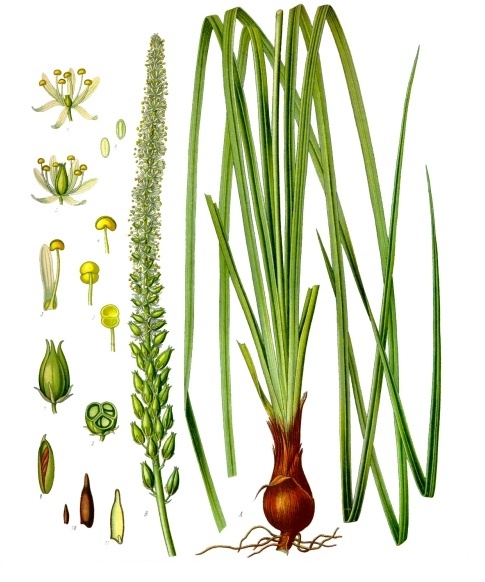
| Schoenocaulon officinale[1] | |
Scientific classification 
| |
| Kingdom: | Plantae |
| Clade: | Tracheophytes |
| Clade: | Angiosperms |
| Clade: | Monocots |
| Order: | Liliales |
| Family: | Melanthiaceae |
| Tribe: | Melanthieae |
| Genus: | Schoenocaulon A.Gray |
| Synonyms[2] | |
| |
Schoenocaulon is a North American genus of perennial herbaceous flowering plants, ranging from the southern United States to Peru.[3] It is a member of the Melanthiaceae, according to the APG III classification system, and is placed in the tribe Melanthieae. Unlike other genera in the tribe, the flowers are arranged in a spike; depending on the species the flower stalks for each flower are either very short or completely absent.[4] Feathershank is a common name,[5] the medicinally used S. officinale is called Sabadilla (pronunciation: /sab-uh-dil-uh/, IPA: /ˌsæb əˈdɪl ə/).
Plants generally grow in chaparral, oak, or pine forests. Grazing has narrowed the natural ranges of some species to only steep, rocky terrain.[6] Mexico is the center of Schoenocaulon diversity, with 22 endemic species - some with distributions limited to single mountain ranges.[4] The two species with the widest distributions, S. yucatanense (sometimes treated as part of S. ghiesbreghtii) and S. officinale (sabadilla), may have been spread by pre-Columbians who used the seeds as pesticides.[4]
The petal and sepal color varies by species, with some shade of green being most common, but with maroon, cream, and bright red also represented.[4]
- species[2]
- Schoenocaulon calcicola - Oaxaca
- Schoenocaulon caricifolium - Tamaulipas
- Schoenocaulon comatum - San Luis Potosí, Puebla, Oaxaca
- Schoenocaulon conzattii - Oaxaca
- Schoenocaulon dubium - Florida
- Schoenocaulon frameae - Puebla
- Schoenocaulon ghiesbreghtii - S Texas to Veracruz
- Schoenocaulon ignigenum - Tamaulipas, Nuevo León
- Schoenocaulon intermedium - San Luis Potosí, Hidalgo
- Schoenocaulon jaliscense - Jalisco, Oaxaca
- Schoenocaulon macrocarpum - Tamaulipas, Nuevo León
- Schoenocaulon madidorum - Veracruz, Puebla, Oaxaca
- Schoenocaulon megarrhizum - Chihuahua, Sonora, Sinaloa
- Schoenocaulon mortonii - México State, Jalisco, Michoacán
- Schoenocaulon oaxacense - Oaxaca
- Schoenocaulon obtusum - Hidalgo, México State
- Schoenocaulon officinale - C + S Mexico, Central America, Venezuela - sabadilla
- Schoenocaulon pellucidum - Nayarit
- Schoenocaulon plumosum - Coahuila, Nuevo León, Tamaulipas
- Schoenocaulon pringlei - Hidalgo, Veracruz, México State, D.F.
- Schoenocaulon rzedowskii - Mexico, Puebla
- Schoenocaulon tenorioi - Oaxaca, Puebla
- Schoenocaulon tenue - Morelos
- Schoenocaulon tenuifolium - Oaxaca, Puebla
- Schoenocaulon texanum - New Mexico, Texas, Chihuahua, Coahuila, Nuevo León
- Schoenocaulon tigrense - Jalisco
References
[edit]- ^ 1897 illustration from Franz Eugen Köhler, Köhler's Medizinal-Pflanzen
- ^ a b Kew World Checklist of Selected Plant Families
- ^ Zomlefer, Wendy B.; Judd, Walter S. (2008). "Two New Species of Schoenocaulon (Liliales: Melanthiaceae) from Mexico Supported by ITS Sequence Data". Systematic Botany. 33 (1): 117–124. Bibcode:2008SysBo..33..117Z. doi:10.1600/036364408783887474. S2CID 86685454.
- ^ a b c d Zomlefer, Wendy B.; Whitten, W. Mark; Williams, Norris H.; Judd, Walter S. (2006), "Infrageneric phylogeny of Schoenocaulon (Liliales: Melanthiaceae) with clarification of cryptic species based on ITS sequence data and geographical distribution", American Journal of Botany, 93 (8): 1178–1192, Bibcode:2006AmJB...93.1178Z, doi:10.3732/ajb.93.8.1178, PMID 21642183
- ^ NRCS. "Schoenocaulon". PLANTS Database. United States Department of Agriculture (USDA). Retrieved 7 November 2015.
- ^ Frame, D. 1990. A revision of Schoenocaulon (Liliaceae: Melanthieae). Ph. D. Thesis. The City University of New York. New York. 269 pp.
.JPG) | This Liliales article is a stub. You can help Wikipedia by expanding it. |