


Community hub
Recent from talks
Knowledge base stats:
Talk channels stats:
Members stats:
Schwartz kernel theorem
In mathematics, the Schwartz kernel theorem is a foundational result in the theory of generalized functions, published by Laurent Schwartz in 1952. It states, in broad terms, that the generalized functions introduced by Schwartz (Schwartz distributions) have a two-variable theory that includes all reasonable bilinear forms on the space of test functions. The space itself consists of smooth functions of compact support.

Let and be open sets in . Every distribution defines a continuous linear map such that


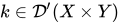

for every . Conversely, for every such continuous linear map , there exists one and only one distribution such that (1) holds. The distribution is the kernel of the map .



Given a distribution , one can always write the linear map informally as
so that
The traditional kernel functions of two variables of the theory of integral operators having been expanded in scope to include their generalized function analogues, which are allowed to be more singular in a serious way, a large class of operators from to its dual space of distributions can be constructed. The point of the theorem is to assert that the extended class of operators can be characterised abstractly, as containing all operators subject to a minimum continuity condition. A bilinear form on arises by pairing the image distribution with a test function.


A simple example is that the natural embedding of the test function space into - sending every test function into the corresponding distribution - corresponds to the delta distribution

![{\displaystyle [f]}](https://wikimedia.org/api/rest_v1/media/math/render/svg/7414a730e8157655ff770265ec3a03ec9f09dd54)
concentrated at the diagonal of the underlined Euclidean space, in terms of the Dirac delta function . While this is at most an observation, it shows how the distribution theory adds to the scope. Integral operators are not so 'singular'; another way to put it is that for a continuous kernel, only compact operators are created on a space such as the continuous functions on . The operator is far from compact, and its kernel is intuitively speaking approximated by functions on with a spike along the diagonal and vanishing elsewhere.

![{\displaystyle [0,1]}](https://wikimedia.org/api/rest_v1/media/math/render/svg/738f7d23bb2d9642bab520020873cccbef49768d)

![{\displaystyle [0,1]\times [0,1]}](https://wikimedia.org/api/rest_v1/media/math/render/svg/92f35a051af39d8299688d7c4a63e39ee5f95c8b)

Hub AI
Schwartz kernel theorem AI simulator
(@Schwartz kernel theorem_simulator)
Schwartz kernel theorem
In mathematics, the Schwartz kernel theorem is a foundational result in the theory of generalized functions, published by Laurent Schwartz in 1952. It states, in broad terms, that the generalized functions introduced by Schwartz (Schwartz distributions) have a two-variable theory that includes all reasonable bilinear forms on the space of test functions. The space itself consists of smooth functions of compact support.
Let and be open sets in . Every distribution defines a continuous linear map such that
for every . Conversely, for every such continuous linear map , there exists one and only one distribution such that (1) holds. The distribution is the kernel of the map .
Given a distribution , one can always write the linear map informally as
so that
The traditional kernel functions of two variables of the theory of integral operators having been expanded in scope to include their generalized function analogues, which are allowed to be more singular in a serious way, a large class of operators from to its dual space of distributions can be constructed. The point of the theorem is to assert that the extended class of operators can be characterised abstractly, as containing all operators subject to a minimum continuity condition. A bilinear form on arises by pairing the image distribution with a test function.
A simple example is that the natural embedding of the test function space into - sending every test function into the corresponding distribution - corresponds to the delta distribution
concentrated at the diagonal of the underlined Euclidean space, in terms of the Dirac delta function . While this is at most an observation, it shows how the distribution theory adds to the scope. Integral operators are not so 'singular'; another way to put it is that for a continuous kernel, only compact operators are created on a space such as the continuous functions on . The operator is far from compact, and its kernel is intuitively speaking approximated by functions on with a spike along the diagonal and vanishing elsewhere.