Hubbry Logo
Common scoldCommon scoldMain
Open search
Common scold
Community hub
Common scold
logo
8 pages, 0 posts
0 subscribers
Be the first to start a discussion here.
Common scold
Common scold
from Wikipedia

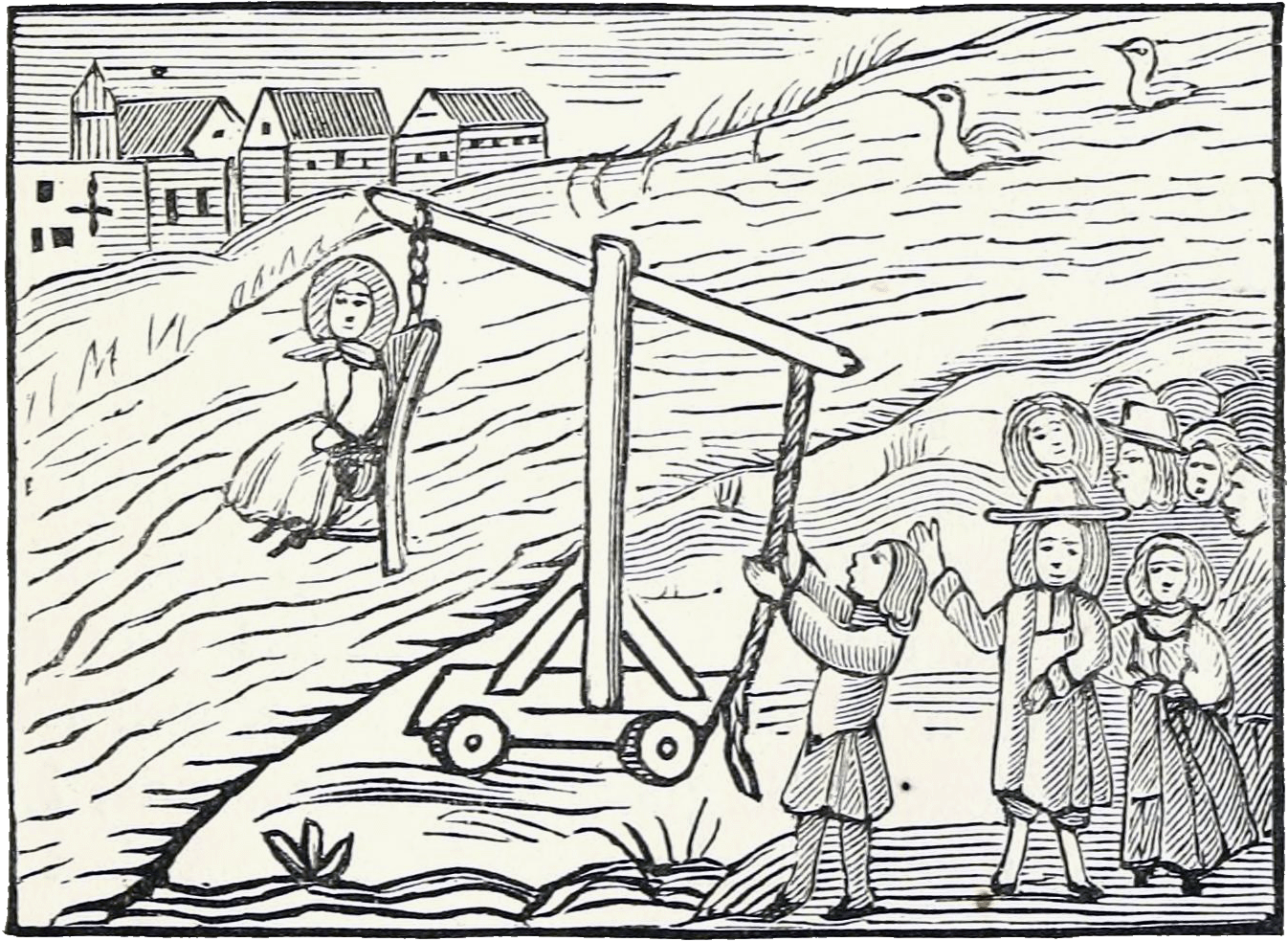
Punishing a common scold in the ducking stool

In the common law of crime in England and Wales, a common scold was a type of public nuisance—a troublesome and angry person who broke the public peace by habitually chastising, arguing, and quarrelling with their neighbours. Most punished for scolding were women, though men could be found to be scolds.

The offence, which carried across in the English colonisation of the Americas, was punished by fines and public humiliation: dunking (being arm-fastened into a chair and dunked into a river or pond); parading through the street; being put in the scold's bridle (branks) or the stocks. Selling bad bread or bad ale was also punished in these ways in some parts of England in medieval centuries.

None of the physical punishments is known to have been administered (such as by magistrates) since an instance in 1817 that involved a wheeling through the streets. Washington D.C. authorities imposed a fine against a writer against clerics, declared a common scold, in 1829. The offence and punishment were abolished in England and Wales in 1967, and formally in New Jersey in 1972.

The offence and its punishment

[edit]

Medieval England

[edit]

The offence of scolding developed from the late Middle Ages in England. A British historian suggests attempts to control and punish 'bad speech' increased after the Black Death, when demographic shift led to greater resistance and threats to the status quo.[1] This included prosecutions for scolding. Scolds were described using Latin terms, including objurgator, garulator, rixator and litigator, found in masculine and feminine forms (objurgatrix, etc.) in medieval legal records and all referring to negative forms of speech, chatter, quarrelling or reproachment. These offences were commonly presented and punished in manorial or borough courts that governed the behaviour of peasants and townspeople across England; with a scarce few to the parish vestry.[2] The most common punishment was a fine.

Some historians write of scolding and bad speech coded as feminine offences by the late medieval period. Women of all marital statuses were prosecuted for scolding. The married were featured most often, whereas widows were only rarely labelled scolds.[3] In places such as Exeter scolds were typically poorer women—elsewhere scolds could include members of the local elite.[4] Women who were also charged with matters such as violence, nightwandering, eavesdropping, flirting or adultery were also likely to be labelled scolds.[5] People were in some parts frequently labelled 'common scolds', indicating the impact of their behaviour and speech on a community. Karen Jones identified 13 men prosecuted for scolding in Kent's secular courts, compared to 94 women and 2 couples.[6]

Many of the male minority convicted were co-accused with their wives. In 1434, Helen Bradwall (wife of Peter Bradwall), scolded Hugh Welesson and his wife Isabel in Middlewich, calling Isabel a "child murderer" and Hugh a "skallet [wretched] knave". Isabel and Hugh also scolded Helen, calling her a "lesyng blebberer" (lying blatherer). All parties were fined for the offences—Hugh and Isabel: jointly.[7] Like women, male scolds were often accused of many other offences, such as fornication, theft, illegal trading, and assault.[8]

Later punishments of scolding

[edit]
A branked scold in Colonial New England, from a lithograph in A Brief History of the United States by Joel Dorman Steele and Esther Baker Steele from 1885

Later legal treatises reflect the dominance of scolding as a charge levied against women. In the Commentaries on the Laws of England, Blackstone outlines the offence:

Lastly, a common scold, communis rixatrix, (for our law-latin confines it to the feminine gender) is a public nuisance to her neighbourhood. For which offence she may be indicted; and, if convicted, shall be sentenced to be placed in a certain engine of correction called the trebucket, castigatory, or cucking stool, which in the Saxon language signifies the scolding stool; though now it is frequently corrupted into ducking stool, because the residue of the judgment is, that, when she is so placed therein, she shall be plunged in the water for her punishment.

— Bl. Comm. IV:13.5.8, p. 169

Scold's bridles or branks were used as a punishment.[9][circular reference]

This ascribes the shift to ducking stool to a folk etymology. Other writers disagree with this: the Domesday Book notes the use of a form of cucking stool at Chester as a cathedra stercoris, a "dung chair", whose punishment apparently involved exposing the sitter's buttocks to onlookers. This seat served to punish not only scolds, but also brewers and bakers who sold bad ale or bread, whereas the ducking stool dunked its victim into the water.

French traveller and writer Francois Maximilian Misson recorded the means used in England in the early 18th century:[10]

The way of punishing scolding women is pleasant enough. They fasten an armchair to the end of two beams twelve or fifteen feet long, and parallel to each other, so that these two pieces of wood with their two ends embrace the chair, which hangs between them by a sort of axle, by which means it plays freely, and always remains in the natural horizontal position in which a chair should be, that a person may sit conveniently in it, whether you raise it or let it down. They set up a post on the bank of a pond or river, and over this post they lay, almost in equilibrio, the two pieces of wood, at one end of which the chair hangs just over the water. They place the woman in this chair and so plunge her into the water as often as the sentence directs, in order to cool her immoderate heat.

The ducking stool, rather than being fixed by the water, could be mounted on wheels to allow the convict to be paraded through the streets before punishment was carried out. Another method of ducking was to use the tumbrel: a chair on two wheels with two long shafts fixed to joining axles. This would be pushed into the water and the shafts would be released, tipping the chair up backwards and ducking the occupant.[11]

A scold's bridle, known in Scotland as a brank, consists of a locking metal mask or head cage that contains a tab that fits in the mouth to inhibit talking. Some have claimed that convicted common scolds had to wear such a device as a preventive or punitive measure. Legal sources do not mention them in the context. Anecdotes report their use as a public punishment.[12][13]

In 17th-century New England and Long Island, scolds or those convicted of similar offences—men and women—could be sentenced to stand with their tongue in a cleft stick, a more primitive but easier-to-construct version of the bridle—alternatively, to the ducking stool.[14][10]

Prosecutions

[edit]
This woodcut shows the wheels on a ducking stool mount which allowed the occupant to be wheeled through the streets before being ducked.

A plaque on the Fye Bridge in Norwich, England, claims to mark the site of a cucking stool, and that from 1562 to 1597 strumpets (flirtatious or promiscuous young women) and common scolds suffered dunking there. In the Percy Anecdotes, published pseudonymously by Thomas Byerley and Joseph Clinton Robertson in 1821–1823, the authors state that "How long the ducking-stool has been in disuse in England does not appear."[15] The Anecdotes also suggest penological ineffectiveness as grounds for the stool's disuse; the text relates the 1681 case of a Mrs. Finch, who had received three convictions and duckings as a common scold. On her fourth conviction, the King's Bench declined to dunk her again, ordering a fine of three marks and jail until payment took place.

The Percy Anecdotes also quote a pastoral poem by John Gay (1685–1732), who wrote that:

I'll speed me to the pond, where the high stool
On the long plank, hangs o'er the muddy pool,
That stool the dread of ev'ry scolding quean.[16]

and a 1780 poem by Benjamin West, who wrote that:

There stands, my friend, in yonder pool,
An engine call'd a ducking-stool;
By legal pow'r commanded down,
The joy and terror of the town.
If jarring females kindle strife ...[17]

While these literary sources do not prove that the punishment still took place, they do provide evidence that it had not been forgotten.

In The Queen v Foxby, 6 Mod. 11 (1704), counsel for the accused stated that he knew of no law for the dunking of scolds. Lord Chief Justice John Holt of the Queen's Bench apparently pronounced this error, for he announced that it was "better ducking in a Trinity, than a Michaelmas term", i.e. better carried out in summer than in winter. The tenor of Holt's remarks suggests that he found the punishment a rare or dead local custom seen by the sovereign's court as risible.[18]

The last recorded uses of ducking stool were

  • a Mrs. Ganble at Plymouth (1808)
  • Jenny Pipes, a "notorious" scold from Leominster (1809)
  • Sarah Leeke (1817) from Leominster was sentenced to be ducked but the water in the pond was so low that the authorities merely wheeled her round the town in the chair.[11]

In 1812, federal enforcement of common law offences was held to be unconstitutional by the Supreme Court in United States v. Hudson and Goodwin. Nevertheless, in 1829, a Washington, D.C., court found the American anti-clerical writer Anne Royall guilty of being a common scold, the outcome of a campaign launched by local clergymen. A traditional "engine" for intended punishment was built by sailors at the Navy Yard. The court ruled the punishment of the ducking-stool obsolete and instead imposed a fine of ten dollars.[19]

Current status of the law

[edit]

Counsel in Sykes v. Director of Public Prosecutions [1962] AC 528 said he could find no cases for more than a century and described the offence as "obsolete". Section 13(1)(a) of the Criminal Law Act 1967 abolished it.

The common law offence endured in New Jersey until struck down in 1972 in State v. Palendrano by Circuit Judge McGann, who found it had been subsumed in the provisions of the Disorderly Conduct Act of 1898, was bad for vagueness and offended the 14th Amendment to the US Constitution for sex discrimination. It was also opined that the punishment of ducking could amount to a corpor(e)al punishment, in which case that punishment was unlawful under the New Jersey Constitution of 1844 or since 1776.[20]

In the United States, many states have laws restricting public profanity, excessive noise, and disorderly conduct. None of these laws carry the distinctive punishment originally reserved for the common scold, nor are they gender-centric as the offence was.

See also

[edit]

References

[edit]
[edit]
Revisions and contributorsEdit on WikipediaRead on Wikipedia
from Grokipedia

A common scold, known in Law Latin as communis rixatrix, was a category of public nuisance under English common law, specifically applied to women who habitually disturbed the neighborhood peace through quarrelsome, abusive, or scolding behavior. This offence, rooted in Saxon traditions, targeted disruptions to social order rather than mere private disputes, positioning the scold as an offender against the community at large. Conviction typically resulted in public humiliation via the cucking-stool—a device for exposure and sometimes immersion in water—or, in later practices, the branks, an iron gag and muzzle designed to silence the offender. The gendered nature of the charge reflected prevailing views on female conduct, with punishments emphasizing restraint and degradation to deter repetition, though enforcement waned by the 19th century as common law evolved and such summary justice fell into desuetude. Transmitted to American colonies, the practice exemplified early mechanisms for maintaining communal harmony through corporal correction, often without formal trial, highlighting tensions between individual expression and collective tranquility in pre-modern societies.

Definition and Etymology

A common scold, or communis rixatrix in legal Latin, constituted a public nuisance under English common law, defined as a woman whose habitual quarrelsome, brawling, or abusive conduct disrupted neighborhood peace and harmony. This offense was explicitly gendered, confined to females as reflected in the law's terminology and application, distinguishing it from broader nuisance categories. Sir William Blackstone described it as behavior rendering the offender "a public nuisance to her neighborhood," prosecutable via indictment and jury determination of the nuisance's severity. The core legal elements required proof of persistent, rather than isolated, actions: specifically, repeated instances of boisterous or disorderly verbal altercations—such as wrangling, chastising, or arguing—that escalated to public discord rather than private disputes. Courts assessed whether the conduct habitually broke the peace, increasing neighborhood strife and qualifying as a communal annoyance indictable at common law. No formal mens rea beyond the nuisance's public impact was emphasized in foundational treatises; the offense hinged on the objective effects of the woman's "troublesome and angry" demeanor on social order.

Linguistic Origins

The noun scold entered Middle English around 1175, denoting a person given to abusive or ribald speech, with its earliest recorded use appearing in the Ormulum, a 12th-century biblical gloss. This term derives from Old Norse skáld ("poet"), via Scandinavian influence during the Viking Age, where skaldic poets were known for composing verses that could satirize, mock, or libel targets, blending artistry with verbal aggression. The semantic shift from poetic satire to general chiding reflects how such bards' feared rhetorical power—capable of shaming individuals publicly—evolved into a broader connotation of quarrelsome or nagging behavior, particularly associated with women by the 13th century. By the late 14th century, scold developed a verbal form in Middle English scolden, meaning "to be abusive" or "to quarrel," emphasizing undignified vehemence in reproof rather than formal criticism. This usage solidified in legal and social contexts, where the term targeted habitual disruptors of communal harmony. The adjective "common" prefixed to scold emerged in the late 15th century, translating the Latin legal phrase communis rixatrix ("common brawler" or "quarrelsome woman"), to denote a public nuisance who disturbed neighborhood peace through persistent scolding, gossip, or contention. Here, "common" carried the sense of "public" or "affecting the community at large," akin to other common-law offenses like common barratry (stirring lawsuits), underscoring the offense's status as a shared societal burden rather than private discord. The phrase common scold thus crystallized in English common law by the early modern period, reflecting not only linguistic borrowing from Norse poetic traditions but also the integration of gendered Roman-Danish legal terminology into vernacular jurisprudence. Its persistence into the 18th and 19th centuries in Anglo-American courts highlights a continuity in associating verbal excess with female agency, though prosecutions waned as statutory reforms prioritized due process over summary communal sanctions.

Historical Origins and Social Context

Emergence in Medieval England

The designation of "common scold" (communis litigatrix or similar phrasing in Latin records) first appeared in English court rolls during the mid-fourteenth century, marking the formal recognition of habitual verbal disruption as a punishable offense in local jurisdictions. This emergence coincided with broader efforts in manorial, leet, and borough courts to regulate minor breaches of peace that undermined communal cohesion in agrarian societies, where interpersonal harmony was essential for cooperative labor and dispute resolution. Prosecutions typically targeted women whose persistent quarreling, abuse, or gossip was deemed to sow discord among neighbors, reflecting a gendered enforcement pattern wherein female speech was scrutinized more intensely than equivalent male behaviors, often labeled differently as affrays or assaults. Court records from this period, such as those from Peterborough abbey's estates, document presentments of individuals as "common scold," with fines or amercements imposed to deter recurrence. By the early fifteenth century, such cases proliferated; for instance, on July 23, 1426, the borough court of Middlewich in Cheshire addressed ten scolding accusations in a single session, indicating the offense's integration into routine judicial oversight of social conduct. These proceedings occurred in secular venues like view of frankpledge courts, distinct from ecclesiastical handling of defamation, though influenced by clerical rhetoric post-Fourth Lateran Council (1215), which had vilified scolding wives in moral treatises as threats to household and divine order. The legal framework lacked statutory codification at this stage, relying instead on customary law and jury presentments, which allowed juries—often comprising local men—to define scolding subjectively based on community standards of decorum. This localized enforcement underscored causal links between unchecked verbal aggression and broader risks of feud or economic disruption in tight-knit medieval settlements, prioritizing empirical communal testimony over abstract rights. Evidence from sampled rolls across counties like Essex and Cheshire shows scolding prosecutions peaking sporadically amid demographic stresses, such as post-Black Death labor shortages, when social tensions amplified scrutiny of disruptive individuals. Punishments remained mild, typically monetary penalties rather than corporal measures, signaling the offense's role as a prophylactic against escalation rather than a grave crime.

Role in Maintaining Social Order

Prosecutions for being a common scold functioned as a mechanism of social control in late medieval and early modern England, aimed at preserving communal harmony by suppressing habitual verbal contentiousness that disrupted neighborhood relations. In tightly knit communities where interpersonal conflicts could escalate into broader feuds, scolding—characterized by persistent nagging, slander, or brawling—was viewed as a threat to the ideal of "good neighborhood," prompting presentments in manorial, ecclesiastical, and quarter sessions courts to restore order. The offense disproportionately targeted women, reinforcing patriarchal norms by punishing behaviors perceived as challenges to male authority and female domestic roles, such as rejecting spousal control or engaging in public disputes that undermined household stability. Scholarly analysis posits that these prosecutions served as public reminders of expected submissiveness, thereby maintaining the equilibrium of gender hierarchies essential to societal structure, with punishments like ducking intended to deter repetition and signal communal disapproval. For instance, in 1615, the Oxford Sessions ordered the ducking of Katherine Forrest and Elizabeth Slye for "common strife and scolding," a penalty deferred only upon their repentance, illustrating enforcement's role in reintegrating offenders into normative behavior. This legal tool gained prominence during periods of perceived social crisis, with an epidemic of scold prosecutions between 1560 and 1640 reflecting heightened efforts to counteract disorder amid economic and religious upheavals, as authorities sought to mitigate the chaos from "unruly tongues" that could fracture social cohesion. By framing disruptive female speech as a public nuisance akin to barratry but gendered toward women, the offense enabled communities to regulate informal power dynamics, prioritizing stability over individual expression and ensuring that verbal rebellion did not erode the mutual obligations underpinning medieval and early modern society.

Nature of the Offense

Behaviors Constituting Scolding

The offense of being a common scold involved habitual verbal conduct that disturbed the public peace and constituted a nuisance to the neighborhood, primarily through contentious speech rather than physical acts. Core behaviors included persistent chiding, railing, and brawling with words—such as loud, abusive arguments or quarrels with neighbors that escalated into public disruptions. These actions were prosecuted when they repeatedly breached communal order, often involving women who wrangled or scolded in a manner that claimed unauthorized authority to rebuke others, thereby inverting social hierarchies through speech. Historical indictments reveal specific manifestations, such as spreading rumors to sow discord among neighbors or engaging in "exorbitancy of the tongue" via common railing against household members or community figures. For instance, in 1507, Alice Offam faced charges for carrying tales and inciting strife, illustrating how verbal provocation of conflict qualified as scolding. Such behaviors were deemed nuisances under common law because they undermined neighborhood tranquility without physical violence, focusing instead on the corrosive effect of repeated verbal aggression. The requirement of habituality set scolding apart from mere rudeness; isolated outbursts did not suffice for indictment, but patterns of "constant scolding" that habitually disturbed peace did, as recognized in legal precedents from medieval to early modern England. This emphasis on recurrence reflected the offense's roots in maintaining social equilibrium, where unchecked contentious speech was viewed causally as eroding cooperative community bonds. The offense of common scold was classified as a public nuisance under English common law, targeting habitual verbal contentiousness that disrupted neighborhood harmony, rather than isolated acts or specific harms associated with other verbal or disruptive crimes. Unlike defamation or slander, which necessitated proof of particular false statements imputing moral turpitude or professional incompetence to an identifiable individual, thereby damaging their reputation, scolding did not require demonstrating falsity, targeted malice, or individualized reputational injury; it encompassed broader, repetitive railing, chiding, or quarreling that annoyed the community generally, often without formal ecclesiastical involvement post-Reformation. This distinction aligned scolding with summary misdemeanors enforceable by local justices, whereas defamation could proceed as a civil action or criminal libel with potential for damages or imprisonment based on the statement's content. In contrast to breach of the peace, which typically involved immediate, overt disturbances—such as tumultuous assemblies, physical fights, or cries likely to provoke violence—common scolding emphasized a notorious pattern of shrewish behavior over time, without requiring contemporaneous alarm or physical elements; a single heated exchange might constitute a minor affray, but repeated scolding elevated it to indictable nuisance status. Prosecutions for scolding thus hinged on community testimony of ongoing disruption, as noted in 17th-century legal summaries describing the offender as "a troublesome and angry woman, who by her brawling and wrangling amongst her neighbours, or elsewhere, disturbs the peace." This habitual threshold differentiated it from transient disorders, allowing punishment like ducking only upon conviction of chronicity, not episodic misconduct. The offense was also gendered, applying almost exclusively to women, whereas analogous male conduct—such as habitually stirring quarrels or frivolous litigation—fell under common barratry, defined as vexatiously exciting lawsuits or neighborhood strife through legal means, rather than everyday verbal abuse; barratry targeted court abuse with penalties like fines or abjuration, reflecting a distinction between domestic nagging and institutional mischief. Unlike physical nuisances (e.g., obstructing highways) or moral offenses like nightwalking, scolding lacked tangible elements, focusing solely on linguistic aggression as a breach of social order, punishable summarily without jury trial in many cases until the 19th century.

Punishments and Enforcement Practices

Traditional Methods of Punishment

![Ducking stool illustration][float-right] The primary traditional punishments for common scolds focused on public shaming and physical restraint to enforce social norms against habitual verbal abuse. These methods, prevalent in England from the medieval period through the early modern era, targeted women accused of disruptive quarreling, emphasizing humiliation over lethal force. Cucking stools, also known as stools of repentance, involved seating the offender in a chair mounted on a pole, which was then paraded through town or positioned in a public place for ridicule by onlookers. This evolved into the ducking stool variant by the 16th century, where the chair was submerged in water—often a river or pond—for repeated dunkings to induce discomfort and deter repetition. Records indicate use against scolds as early as the 13th century, with the punishment administered by local authorities to restore community order without formal execution. The scold's bridle, or branks, consisted of an iron framework fitted over the head with a metal bit or gag forced into the mouth to restrict speech and cause pain. Introduced around the 16th century in Scotland and northern England, it was locked in place and sometimes attached to a chain for parading the wearer through streets, where crowds could pelt them with refuse. This device aimed to physically silence the scold while amplifying public derision, and its application was noted in kirk sessions and town courts up to the 19th century in some regions. Less frequently, scolds faced the pillory, a wooden frame locking the head and hands upright for exposure to public scorn, though this was more common for other petty offenses. Fines accompanied these humiliations in many cases, but the emphasis remained on visible deterrence through communal enforcement rather than incarceration.

Variations and Regional Differences

Punishments for common scolds varied by region, with England favoring stool-based humiliations while Scotland emphasized gagging devices. In England, the cucking stool involved strapping the offender to a chair and parading them through town for public ridicule, often without immersion. This differed from the ducking stool, a variant where the chair was lowered into water, more commonly applied in areas with accessible rivers or ponds during the early modern period. Local practices influenced execution; for instance, Oxford acquired a cucking stool in 1579 for such punishments. In Scotland and northern England, the scold's bridle, or branks, emerged as a prominent alternative, first recorded in 1567. This iron device featured a muzzle and tongue plate to silence the wearer, enforced by town councils and kirk sessions rather than formal courts, with widespread adoption in Scottish burghs by the late 16th century. English instances occurred, such as in Lancashire into the 19th century, but branks were less systematic than stools. English practices extended to the American colonies, where ducking stools replicated metropolitan customs, as evidenced by Plymouth's use in the 17th century. Colonial adaptations included fines, whippings, or stocks alongside dunking, particularly in Virginia, reflecting resource constraints or judicial preferences over transatlantic stool transport. Branks appeared sporadically in colonial contexts, underscoring continuity with British regionalism.

Prosecutions and Patterns

Historical Frequency and Demographics

Prosecutions for being a common scold were primarily conducted in ecclesiastical courts, quarter sessions, and local jurisdictions such as manorial or borough courts across England, spanning the late medieval period but peaking during the early modern era from roughly 1550 to 1700 amid rising population pressures and community tensions. Records indicate variable but generally modest frequency relative to other offenses; for example, in the Middlesex Sessions between 1613 and 1617, 15 scolding cases were documented, while the Westminster Court of Burgesses handled 52 such cases from 1610 to 1616. In rural ecclesiastical settings, the Archdeaconry of Wiltshire recorded 37 cases over the period 1586 to 1599. Church court visitations further illustrate this pattern, with scolding comprising just over 1 percent of total prosecutions in the Diocese of Bath and Wells in 1594, though it represented a substantial share—up to 62 percent—of offenses attributed to women in such proceedings. Demographically, those prosecuted were overwhelmingly women, as the offense was framed around controlling perceived disorderly female speech that breached social or charitable norms, with men rarely charged under this category and instead facing distinct penalties for analogous conduct like direct assaults on officials. Most identified scolds were married women of lower socioeconomic status, such as laborers or tradeswomen in industries like wool processing, whose verbal disruptions often stemmed from domestic or neighborhood conflicts. Cases spanned urban centers like London and provincial rural areas, reflecting localized enforcement to preserve communal order rather than widespread epidemic prosecution. By the 18th century, such cases had declined, with isolated instances like the 1745 ducking of Mary Stemp in Kingston-upon-Thames before crowds of 2,000 to 3,000 onlookers marking rarer public spectacles.

Notable Examples and Case Studies

One notable late instance of the common scold punishment occurred in Leominster, Herefordshire, in 1809, involving Jenny Pipes, also known as Jane Corran. Convicted as a "notorious scold," Pipes was paraded through the town before being strapped to a ducking stool and immersed in the river near Kenwater Bridge three times, marking one of the final recorded uses of the practice in England. In 1817, Sarah Leeke faced a similar conviction in the same town for scolding. Although sentenced to ducking, the low water level in the river prevented immersion; instead, she was wheeled through Leominster in the stool as a form of public humiliation. Earlier records from church and manorial courts in late medieval England document numerous anonymous prosecutions for scolding, often involving women accused of habitual verbal abuse disturbing neighbors, but named cases are scarce due to the local nature of enforcement. For instance, Essex manorial rolls from the 14th-15th centuries present women as common scolds for brawling and railing, reflecting enforcement to maintain community peace.

Factors Leading to Decline

The prosecutions for being a common scold peaked between approximately 1560 and 1640, a period historian David Underdown associates with a broader "crisis of order" in England, characterized by social upheaval, population pressures, and efforts to enforce patriarchal and communal norms through local courts. Following the Restoration in 1660, records from regions like Norfolk indicate a marked decline, with annual prosecutions dropping from an average of under two per year in the early 17th century to negligible levels, reflecting reduced reliance on such customary offenses amid stabilizing social structures and waning influence of ecclesiastical and manorial courts. A key factor in the practical obsolescence of scold punishments was the broader 18th-century shift away from public shaming and corporal penalties, driven by evolving humanitarian sensibilities and legal scrutiny that rendered archaic practices like ducking increasingly untenable. Incidents such as the 1731 ducking in Nottingham, where the punished woman died from exposure, prompted backlash, including the prosecution of the mayor involved and the destruction of the local ducking stool, highlighting risks of abuse and contributing to hesitancy in enforcement. By the late 18th century, England curtailed convictions for common scolds alongside other gender-specific harsh penalties, aligning with a general desuetude where duckings became rare and legally questionable due to deviation from customary norms. Urbanization and industrialization further eroded the offense's relevance by diluting tight-knit rural communities where habitual scolding could disrupt public harmony, replacing them with anonymous settings less amenable to communal policing. The last recorded ducking occurred in 1809 against Jenny Pipes in Wiltshire, and an attempted one in 1817 failed due to insufficient water levels, symbolizing the punishment's impracticality. Although the offense lingered on statute books—abolished formally in England and Wales only by the Criminal Law Act 1967 amid a cleanup of obsolete common law crimes—no prosecutions occurred for over a century prior, as behaviors once deemed scolding were redirected to modern equivalents like public nuisance or disorderly conduct under codified statutes.

Formal Abolition and Modern Equivalents

The offense of common scold, a common law misdemeanor in England and Wales, was formally abolished by the Criminal Law Act 1967, which eliminated several obsolete common law crimes including maintenance, champerty, embracery, and being a common scold. This legislative change reflected broader reforms to modernize criminal law by removing archaic offenses that had fallen into disuse, with no recorded prosecutions in England for decades prior. In the United States, where the offense had been adopted from English common law in colonial times, abolition varied by jurisdiction; it persisted on statute books in some states longer, with formal repeal in New Jersey occurring in 1972. Prosecutions in American courts continued sporadically into the 20th century, particularly in Pennsylvania, where women were indicted for unruly speech as late as the mid-1900s, though convictions were increasingly challenged on grounds of vagueness and cruelty. No direct legal equivalent to the common scold exists in modern Anglo-American jurisprudence, as the offense's gender-specific nature—targeting women for habitual verbal quarreling—and its reliance on subjective community standards conflicted with constitutional protections for free speech and equal protection under the law. Instead, analogous behaviors involving repeated public disturbances or quarreling are addressed through gender-neutral statutes such as disorderly conduct, breach of the peace, or public nuisance laws, which require demonstrable harm like threats or disruption rather than mere scolding. For instance, under contemporary U.S. model penal codes, habitual public brawling could result in misdemeanor charges emphasizing immediate risk to public order, contrasting with the common scold's focus on chronic neighborhood annoyance without mandatory physical punishment. In domestic contexts, persistent verbal abuse might invoke civil remedies like restraining orders or family court interventions for emotional harassment, but these prioritize evidence of harm over moral judgments on speech alone. The shift underscores a legal evolution toward protecting expressive freedoms while curbing only conduct posing clear threats, rendering the scold's punitive framework incompatible with due process norms established post-1960s.

Interpretations and Controversies

Contemporary Critiques and Gender Perspectives

Contemporary analyses, particularly within gender studies, portray the common scold prosecutions as instruments of patriarchal control aimed at curtailing women's verbal agency and enforcing submissive roles. Scholars argue that the legal construct vilified "unideal" female speech—such as quarreling or gossip—as a societal threat, leading to public humiliations like the scold's bridle or cucking stool to restore order and deter rebellion against male authority. This perspective frames scolding laws as reflective of broader anxieties over women deviating from domestic silence, with empirical patterns showing prosecutions overwhelmingly targeting women whose nagging disrupted neighborhood peace. Feminist critiques extend this to modern parallels, positing that historical silencing persists in cultural dismissals of women's assertiveness, such as labeling outspoken females as "shrill" or "nagging" in media and politics. For instance, examinations of 17th- and 18th-century English and American cases highlight how ducking or muzzling punished habitual female quarreling, akin to contemporary shaming of public female figures for perceived verbal excess. These views, often drawn from interdisciplinary works, emphasize the gendered evolution of the scold from a late medieval nuisance offense into a tool for gender norm enforcement, where men's aggression was redirected toward physical crimes rather than verbal ones. However, closer scrutiny of primary court records reveals that the offense prioritized community cohesion over explicit misogyny, with "scold" designations applied to behaviors fostering discord irrespective of sex, though women's verbal conflicts—stemming from limited outlets for grievance in patriarchal structures—predominated. This disparity aligns with causal patterns in pre-modern societies, where female socialization emphasized relational harmony, rendering public scolding a more visible breach than male equivalents prosecuted as assault or barratry. Interpretations overstressing inherent sexism, prevalent in some academic gender analyses, may underweight these pragmatic enforcement dynamics, as evidenced by occasional male scold indictments and the offense's roots in maintaining civic order rather than targeted female subjugation.

Contextual Defenses and Comparative Analysis

In the historical context of early modern England, punishments for common scolds were defended as necessary measures to preserve public peace in small, interdependent communities where habitual verbal abuse—characterized by persistent quarreling, chastising, and neighborhood disputes—constituted a tangible disruption to social harmony. Legal authorities classified scolding as a public nuisance akin to other petty offenses that eroded communal cohesion, justifying interventions like the ducking stool or scold's bridle as proportionate deterrents that emphasized humiliation over lethality to encourage behavioral reform and warn onlookers against similar conduct. Such methods aligned with broader penal philosophies of the era, which prioritized visible retribution and prevention of recidivism in lieu of fines or imprisonment, which were less feasible in resource-scarce locales; records indicate these punishments were invoked sparingly after initial warnings, suggesting efficacy in curbing repeated offenses without escalating to violence. Comparatively, scold punishments paralleled other nuisance-based sanctions, such as the pillory or stocks for dishonest tradesmen and eavesdroppers, which similarly targeted non-violent but corrosive behaviors through public shaming to reinforce norms of civility. Unlike capital penalties for property crimes, which addressed direct threats to survival in agrarian societies, scold sanctions were milder and rehabilitative in intent, often applied after communal tolerance thresholds were exceeded, with prosecutions reflecting neighbor-initiated complaints rather than systematic gender targeting—though women predominated due to their roles in domestic and marketplace interactions. In contemporary terms, these align with statutes on disorderly conduct or public nuisance, where chronic verbal harassment prompts civil restraints or fines to safeguard collective tranquility, underscoring a continuity in addressing speech-induced disturbances absent lethal force. This framework reveals scold laws as pragmatic responses to causal disruptions in pre-industrial order, unburdened by modern egalitarian overlays that may overlook empirical patterns of complaint origins.

References

Add your contribution
Related Hubs
User Avatar
No comments yet.