Hubbry Logo
ScrotiferaScrotiferaMain
Open search
Scrotifera
Community hub
Scrotifera
logo
8 pages, 0 posts
0 subscribers
Be the first to start a discussion here.
Scrotifera
Scrotifera
from Wikipedia

Scrotifera
Temporal range: 66.3–0 Ma[1] Late Cretaceous to present
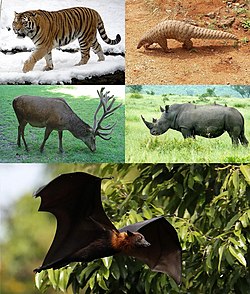
From top to right: tiger, Indian pangolin, red deer, white rhino and Lyle's flying fox. Representing the living orders: Carnivora, Pholidota, Artiodactyla, Perissodactyla and Chiroptera, comprising Scrotifera.
Scientific classification Edit this classification
Kingdom: Animalia
Phylum: Chordata
Class: Mammalia
Superorder: Laurasiatheria
Clade: Scrotifera
Waddell et al., 1999[2]
Subgroups
Synonyms
  • Variamana (Springer, 2005)[3]

Scrotifera ("scrotum bearers") is a clade of placental mammals that groups together grandorder Ferungulata, Chiroptera (bats), other extinct members and their common ancestors. The clade Scrotifera is a sister group to the order Eulipotyphla (true insectivores) based on evidence from molecular phylogenetics,[2] and together they make superorder Laurasiatheria. The last common ancestor of Scrotifera is supposed to have diversified ca. 73.1[4] to 85.5[5] million years ago.

Etymology

[edit]

Peter Waddell, then of the Institute of Statistical Mathematics, explains the etymology of the clade's name as follows:

The name comes from the word scrotum, a pouch in which the testes permanently reside in the adult male. All members of the group have a postpenile scrotum, often prominently displayed, except for some aquatic forms and pangolin (which has the testes just below the skin). It appears to be an ancestral character for this group, yet other orders generally lack this as an ancestral feature, with the probable exception of Primates.[2]

Classification and phylogeny

[edit]

History of phylogeny

[edit]

In 2006, the clade Pegasoferae (a clade of mammals that includes orders Chiroptera, Carnivora, Perissodactyla and Pholidota) was proposed as part of the clade Scrotifera and a sister group to the order Artiodactyla, based on genomic research in molecular systematics.[6] The monophyly of the group is not well supported, and recent studies have indicated that this clade is not a natural grouping.[5][7]

According to a 2022 study, two extinct species (Eosoricodon terrigena and "Wyonycteris" microtis) were identified as outside of the family Nyctitheriidae and more closely related mammals to bats.[8] In another 2022 study, the extinct genus Acmeodon was recognized as not a member of the extinct order Cimolesta but a basal laurasiatherian mammal in the clade Scrotifera.[9][10]

Taxonomy

[edit]
Former classification (Nishihara, 2006): Current classification:

See also

[edit]

References

[edit]
Revisions and contributorsEdit on WikipediaRead on Wikipedia
from Grokipedia
Scrotifera is a of placental mammals within the superorder , comprising the orders Chiroptera (bats), (carnivorans), Pholidota (pangolins), (odd-toed ungulates), and Cetartiodactyla (even-toed ungulates and cetaceans). The name Scrotifera, meaning "scrotum-bearers" in Latin, alludes to the external in males of most of these groups (though secondarily lost in cetaceans), distinguishing them from where testes are typically abdominal. First proposed in 1999 based on molecular data, the unites these diverse lineages that diverged rapidly in the , approximately 82–74 million years ago. Within , Scrotifera is the sister group to (shrews, moles, and hedgehogs), with phylogenomic analyses consistently supporting Chiroptera as the basal branch and the remaining orders forming the subclade Fereuungulata ( + Pholidota + + Cetartiodactyla). This topology has been robustly confirmed by large-scale genomic datasets, including over 2 million base pairs from 1608 exons and rare genomic changes like chromosomal deletions, resolving earlier uncertainties from smaller datasets. The clade's underscores the rapid diversification of laurasiatherians following the Cretaceous-Paleogene , with Scrotifera encompassing over 70% of laurasiatherian today, including ecologically dominant groups like bats, whales, horses, and big cats.

Definition and Etymology

Definition

Scrotifera is a monophyletic of placental mammals that includes the order Chiroptera (bats) and the Fereuungulata (comprising , Pholidota, , and Cetartiodactyla), along with their and all descendants. The name derives from the shared anatomical feature of scrotal testes in males of these groups. Within the broader mammalian phylogeny, Scrotifera occupies a central position inside the superorder , forming one major subclade alongside (which encompasses groups such as Erinaceomorpha and ). This placement excludes other laurasiatherian lineages like those in , which branch basal to Scrotifera in reconstructed trees. itself is part of the larger , sister to , but Scrotifera specifically defines the derived interordinal relationships within excluding lipotyphlan insectivores. The clade's is robustly supported by molecular evidence from multi-locus and phylogenomic datasets, including analyses and ultraconserved elements that resolve placental relationships. More recent whole-genome phylogenies from 241 species confirm this with high congruence in models, partitioned concatenations, and rare genomic changes, showing minimal conflict for the Scrotifera node.

Etymology

The name Scrotifera derives from the Latin scrotum ("scrotum" or "bag") and ferre ("to bear" or "to carry"), collectively meaning "scrotum-bearers" or "those bearing a ." The term was coined in 1999 by Peter J. Waddell, Ying Cao, Julia Hauf, and Masami Hasegawa in a study employing novel phylogenetic methods to analyze complete sequences from over 40 mammalian species. This nomenclature highlights the diagnostic anatomical trait of scrotal containment of descended testes in members, distinguishing them from non-scrotiferan placental mammals—such as () and (Hyracoidea), which exhibit intra-abdominal testes. It marked the first formal taxonomic application of the name to designate the monophyletic grouping of Chiroptera (bats) and Fereuungulata within .

Key Characteristics

Anatomical Features

Scrotifera members are characterized by the presence of a that externally houses the testes, a key synapomorphy enabling by keeping testicular temperature 2–3°C below core body temperature (typically 34–35°C) to optimize , though this feature is absent in basal forms such as pteropodid bats, which retain abdominal testes. This likely arose post-Cretaceous-Paleogene in association with increased endothermy and locomotion in early members of the . Cranial and dental morphology in Scrotifera varies widely to support diverse diets, reflecting ecological specialization rather than uniform synapomorphies across the . Herbivorous lineages, including perissodactyls and many cetartiodactyls, commonly feature high-crowned () molars that resist abrasion from gritty forage like grasses, allowing prolonged grinding efficiency as crowns wear down over time. In contrast, carnivorans exhibit specialized teeth—paired upper (P4) and lower (m1) molars modified with shearing blades—for efficiently slicing flesh and tendons, a hallmark of their predatory . Skeletal adaptations underscore the locomotor diversity within Scrotifera, with modifications enabling flight, rapid terrestrial running, and predation. Bats possess a highly flexible vertebral column and elongated manual digits supporting a (wing membrane), facilitating powered flight and maneuverability. ungulates, such as those in perissodactyl and cetartiodactyl orders, show elongated metapodials and reduced side toes, enhancing stride length and speed for predator evasion on open terrain. Carnivorans often have robust limb bones and semi-digitigrade posture suited for agile stalking and pouncing. Sensory systems in Scrotifera are tuned to specific niches, with notable specializations in audition and olfaction. Many bats employ laryngeal echolocation, producing ultrasonic pulses via modified larynx and nasal structures to detect prey and obstacles in low-light environments. Carnivorans and pangolins demonstrate enhanced olfaction through expanded olfactory receptor gene repertoires and large olfactory bulbs, aiding in scent-based hunting, territory marking, and locating hidden prey like ants in soil. Unlike non-scrotiferan clades such as Afrotheria, Scrotifera lacks derived traits like the elongated proboscis of elephants, which serves as a manipulative feeding appendage.

Reproductive Adaptations

Scrotifera encompasses a diverse of placental mammals characterized by the descent of testes into a , a key reproductive adaptation that maintains testicular temperatures approximately 2-3°C below core body temperature to facilitate optimal . This descent typically occurs in two phases: an initial transabdominal migration during fetal development, driven by insulin-like peptide 3 (INSL3) produced by Leydig cells, followed by an inguinoscrotal phase that may happen or postnatally depending on the species. The cooler scrotal environment is essential for production, as elevated temperatures impair development and reduce , a observed across endothermic mammals. Hormonal regulation in Scrotifera relies on , which synthesize testosterone in the testicular interstitium, and Sertoli cells within the seminiferous tubules, which nurture developing germ cells. The scrotal cooling enhances Leydig cell steroidogenesis, promoting higher testosterone output critical for male reproductive physiology, while Sertoli cells provide structural and nutritional support for under these thermoregulated conditions. Genetic factors such as the INSL3 gene and its receptor RXFP2 orchestrate scrotal development and descent, with functional versions conserved across Scrotifera but lost or mutated in afrotherians, which retain internal testes. This adaptation confers an evolutionary advantage by improving quality and in lineages, contrasting with the heat-sensitive internal testes of afrotherians that limit spermatogenic efficiency. Reproductive strategies within Scrotifera exhibit variations influenced by , including seasonal breeding in temperate-zone bats (Chiroptera), where aligns with spring for summer births, and continuous breeding in tropical ungulates such as certain , enabling year-round in stable environments. Delayed implantation, a post-fertilization allowing blastocyst dormancy, occurs in carnivorans like mustelids and pinnipeds (seals), as well as in some cetartiodactyls such as , synchronizing births with optimal conditions despite variable mating times. These mechanisms, underpinned by scrotal , enhance reproductive success across diverse habitats in the .

Evolutionary History

Origins and Age

The origins of the Scrotifera clade, a major subgroup within the superorder , are estimated to date back to the period, with interordinal divergences within occurring between 81.6 and 73.6 million years ago (95% : 67.9–88.3 Ma), based on fossil-calibrated Bayesian timetrees derived from genomic data. A comprehensive analysis integrating phylogenomic sequences from 241 mammal genomes placed the crown age of at 102 Ma (95% : 90.4–114.5 Ma), with early divergences within and , including the stem leading to Scrotifera, occurring in this timeframe. These estimates highlight a pre-K-Pg (Cretaceous-Paleogene boundary at 66 Ma) origin for the clade, contrasting with the post-boundary emergence of most modern placental orders, though estimates vary across studies (e.g., ~90–107 Ma in earlier analyses). The divergence of Scrotifera from other laurasiatherian lineages, such as , is inferred to have taken place in the , with Scrotifera's most recent common ancestor (MRCA) of extant members estimated at ~78 Ma based on initial . This pre-K-Pg timing facilitates understanding of a rapid radiation in the wake of the end-Cretaceous mass extinction that eliminated non-avian dinosaurs and opened ecological niches, though post-extinction diversification shaped modern orders. models show interordinal splits within between 81.6 and 73.6 Ma (95% : 67.9–88.3 Ma). The earliest inferred ancestor was a small, boreoeutherian-like , likely insectivorous and adapted to forested habitats in (encompassing present-day , , and ), reflecting the boreoeutherian affinity of early laurasiatherians. These temporal estimates rely on robust fossil calibrations to anchor molecular clocks, including the early Eocene bat Onychonycteris finneyi from the Green River Formation, dated to approximately 52.5 Ma and representing one of the oldest known chiropterans, and the early carnivoran-like Miacis species from the Wasatchian stage, around 55 Ma, which constrains the base of Carnivora within Scrotifera. Such priors, combined with relaxed-clock models like those in BEAST, ensure that divergence times account for rate heterogeneity across lineages while incorporating uncertainties from the fossil record.

Major Divergences

The major divergences within Scrotifera occurred rapidly in the to early , with cladogenesis beginning ~78 Ma, marking a period of intense among laurasiatherian mammals around the Cretaceous-Paleogene (K-Pg) approximately 66 million years ago. The initial split separated Chiroptera (bats) from Fereuungulata around 65–70 million years ago, during the early , as surviving lineages recovered from the mass extinction and began exploiting newly available ecological opportunities in a post-dinosaur world. This bifurcation is supported by phylogenomic analyses indicating a narrow temporal window for the event, consistent with the broader laurasiatherian radiation. Within Fereuungulata, further branching unfolded during the Eocene epoch (approximately 56–34 million years ago), with the key separation of (encompassing and Pholidota) from Euungulata ( and Cetartiodactyla) estimated at around 60 million years ago. This division was part of a broader Eocene diversification driven by global warming, rising sea levels, and the expansion of forested habitats, which provided niches for carnivorous and herbivorous adaptations. The rapid succession of these events—multiple orders emerging within 10–15 million years—reflects the "laurasiatherian anomaly zone," a period of incomplete lineage sorting and contradictory phylogenetic signals that complicated early reconstructions but was clarified through genome-level and analyses. Ecological drivers significantly influenced these divergences, enabling distinct adaptive radiations. In Chiroptera, the evolution of powered flight by approximately 64–52 million years ago allowed bats to occupy aerial niches, such as insectivory in , which terrestrial competitors could not access, thereby reducing competition and promoting isolation from Fereuungulata lineages. Conversely, in Euungulata, the development of locomotion in ungulates facilitated exploitation of emerging open habitats; following the Eocene, cooling climates and the spread of C4 grasslands during the (~8–3 million years ago) selected for elongated limbs and high-speed grazing strategies, further differentiating perissodactyls and cetartiodactyls from the more predatory . These adaptations underscore how post-K-Pg environmental shifts propelled Scrotifera's internal diversification into specialized ecological roles.

Phylogeny and Classification

Historical Development

The recognition of Scrotifera as a clade within Laurasiatheria emerged from early molecular phylogenetic studies in the late 1990s and early 2000s that challenged traditional morphology-based classifications of placental mammals. These analyses, drawing on mitochondrial DNA (mtDNA) and nuclear DNA (nuDNA) sequences, revealed unexpected groupings among laurasiatherian orders, including the merger of Cetacea (whales and dolphins) with Artiodactyla (even-toed ungulates) into the monophyletic Cetartiodactyla, thereby redefining evolutionary relationships previously separated by anatomical traits like foot structure. A seminal contribution came from Waddell et al. in 1999, who formally named Scrotifera using novel phylogenetic methods on mtDNA datasets, including amino acid-invariant positions and noncoding signatures; their relaxed clock Bayesian approaches on combined mtDNA and nuDNA data positioned Scrotifera as the sister clade to Eulipotyphla, encompassing Chiroptera (bats), Ferae (Carnivora and Pholidota), Perissodactyla (odd-toed ungulates), and Cetartiodactyla. Subsequent work in the mid-2000s further illuminated the structure of , indirectly bolstering the Scrotifera framework by highlighting internal complexities. Hallström et al. in 2007 applied phylogenomic analyses to over 1.4 million base pairs of nuDNA from 19 placental mammals, confirming the four major eutherian superorders (including ) and supporting Scrotifera's through robust , while noting short internal branches that complicated deeper resolutions. Around the same period, the 2006 proposal of Pegasoferae by Nishihara et al., based on retroposon insertions shared among Chiroptera, , , and Pholidota, suggested an alternative that excluded Cetartiodactyla from this subgroup; this finding underscored the rapid diversification within Scrotifera but reinforced its overall cohesion by demonstrating shared ancient insertions consistent with a laurasiatherian origin. Early proposals faced controversies due to the " anomaly zone," characterized by short evolutionary branches and incomplete lineage sorting (ILS) that generated conflicting phylogenetic signals across datasets, leading to debates over internal relationships like the position of Chiroptera relative to orders. These issues were particularly evident in mtDNA-heavy studies, where rapid around 80–70 million years ago produced an anomaly zone prone to gene tree discordance. Resolution advanced through phylogenomic approaches using genome-scale data to stabilize laurasiatherian interordinal ties. For example, Tsagkogeorga et al. in 2013 used mitogenomic and nuclear phylogenomic data to affirm Chiroptera's basal position within Scrotifera via maximum likelihood and Bayesian methods, reducing support for alternatives like Pegasoferae. By the post-2010 era, consensus on Scrotifera solidified with high posterior probabilities in large-scale datasets, as exemplified by Foley et al. in , who analyzed and sequence data across laurasiatherians and identified persistent but minor contradictory signals attributable to ILS in the anomaly zone; nevertheless, their integrated phylogenomic tree provided strong support (>95%) for Scrotifera's , integrating over 10,000 loci to resolve the rapid early divergences. Recent large-scale genomic analyses as of 2023 continue to corroborate this . This high-impact work emphasized that while branch shortness persists as a challenge, genome-wide evidence overwhelmingly validates Scrotifera as a natural grouping, guiding modern taxonomic frameworks.

Current Taxonomy and Relationships

The current taxonomy recognizes Scrotifera as a monophyletic within the superorder , comprising the order Chiroptera (bats) and the Fereuungulata. Fereuungulata further divides into (Carnivora and Pholidota) and Euungulata ( and Cetartiodactyla). This hierarchical structure positions Chiroptera as the to Fereuungulata, forming the defining relationship of Scrotifera. Phylogenetic support for this arrangement is robust, derived from large-scale molecular datasets including thousands of genes and retroposon insertions. Bayesian analyses yield posterior probabilities exceeding 0.99 for key nodes such as Scrotifera, Fereuungulata, , and Euungulata, while maximum likelihood bootstraps surpass 94%. Topological tests, including approximately unbiased (AU) tests, reject alternative placements like Chiroptera sister to (p < 0.05), confirming the exclusion of such groupings. Within , Scrotifera is the to , with the divergence of these lineages estimated at approximately 75 million years ago based on fossil-calibrated molecular clocks. Transcriptomic and phylogenomic data from over 2,000 coding sequences further corroborate this topology, highlighting rapid diversification within Scrotifera during the . Alternative hypotheses, such as the "Ptero-Dasy-Peg" grouping linking Chiroptera with and elements of , receive only rare support from early retroposon studies but are dismissed by comprehensive transcriptomic analyses that favor the Chiroptera-Fereuungulata association. These conflicting signals underscore the role of incomplete lineage sorting in early laurasiatherian evolution, yet modern datasets consistently uphold the current Scrotifera phylogeny.

Composition

Living Orders

Scrotifera encompasses five extant orders: Chiroptera, , Pholidota, , and Cetartiodactyla. These orders collectively represent a major portion of mammalian diversity, with over 2,100 living species that occupy diverse ecological roles across terrestrial, aerial, and marine environments. The order Chiroptera comprises approximately 1,500 species, accounting for about one-fifth of all mammal species and making bats the only mammals capable of sustained flight. This order is divided into the suborders (including megabats and some microbats) and (primarily microbats), reflecting adaptations for echolocation, frugivory, and insectivory in varied habitats worldwide. Carnivora includes around 286 species, encompassing families such as (cats), (dogs), and Ursidae (bears), with characteristic adapted for shearing flesh, though dietary habits range from strict carnivory to omnivory. These mammals exhibit high morphological diversity, from aquatic pinnipeds to arboreal procyonids, and are distributed across all continents except . The order Pholidota consists of 8 species of pangolins, unique among mammals for their keratinous scales and specialized for myrmecophagy, using long, sticky tongues to consume ants and termites while employing powerful claws for digging and defense. Found in Africa and Asia, these nocturnal, primarily terrestrial animals face severe threats from habitat loss and poaching. Perissodactyla, the odd-toed ungulates, includes 17 species across three families: Equidae (horses, zebras, and asses), Rhinocerotidae (rhinoceroses), and Tapiridae (tapirs). These herbivores feature a single central toe bearing most of their weight, with body sizes ranging from the 200-kg tapirs to the 2,000-kg rhinos, and they inhabit grasslands, forests, and savannas primarily in Africa, Asia, and the Americas. The most species-rich order within Scrotifera is Cetartiodactyla, with approximately 332 species that unite even-toed ungulates (such as , deer, and pigs) and cetaceans (whales, dolphins, and porpoises), highlighting the evolutionary fusion of the terrestrial Artiodactyla and the aquatic (cetaceans plus hippopotamuses). This order dominates large herbivore niches on land and fills key marine predator and filter-feeder roles, with species distributed globally from savannas to oceans.

Extinct Members

The fossil record of Scrotifera, a encompassing Chiroptera and Fereuungulata within , is dominated by Eocene and later taxa, with stem and basal forms providing key insights into early diversification. Although molecular phylogenies support a deeper origin, direct evidence prior to the is scarce, emphasizing reliance on post-Cretaceous-Paleogene boundary specimens. Stem Chiroptera are represented by early Eocene fossils such as , known from articulated skeletons in the Green River Formation of , dating to approximately 52 million years ago (Ma). These specimens reveal primitive flight adaptations, including well-developed patagia (wing membranes) supported by elongated finger bones and a keeled , indicating powered flight shortly after the clade's emergence. Similarly, from the same formation exhibits comparable traits, underscoring rapid evolution of aerial locomotion in early bats. Within basal Fereuungulata, the family includes late to Eocene forms ancestral to , such as from early Eocene deposits around 55 Ma in . These small, carnivorous mammals, roughly the size of a , possessed limbs and shearing suited for a predatory lifestyle, bridging miacoid ancestors to modern carnivorans. Early (Pholidota) relatives, like Eomanis waldi from the middle Eocene Messel Pit in (~47 Ma), show scaled and myrmecophagous akin to extant species, marking the initial radiation of this enigmatic lineage. Extinct perissodactyls within Scrotifera include diverse Eocene- families, such as , which comprised hornless, forms with elongated limbs adapted for swift terrestrial locomotion. Representatives like Hyracodon from North American sites (~30 Ma) reached lengths of up to 2 meters, exemplifying early rhinocerotoid experimentation before the dominance of modern equids and rhinoceroses. Notably, the gigantic titanotheres (), such as Titanotherium (now classified under Megacerops), from White River Formation deposits (~34-30 Ma), attained shoulder heights exceeding 2.5 meters and Y-shaped horns, representing one of the largest herbivorous radiations in the before their extinction. Cetartiodactyla fossils highlight early and cetacean divergences, with Diacodexis from Eocene European and North American sites (~50 Ma) as the oldest known , a rabbit-sized with limbs and simple molars indicative of habits. Basal cetaceans like Pakicetus from early Eocene fluvial deposits in (~53 Ma) reveal terrestrial origins, featuring artiodactyl-like ankles and auditory adaptations foreshadowing aquatic lifestyles in whales. The Scrotifera fossil record remains sparse before the Eocene, with no confirmed pre-Paleocene specimens despite molecular timetrees inferring origins for around 80-100 Ma, suggesting potential undescribed forms in sediments that have yet to be discovered. This gap likely stems from taphonomic biases and the K-Pg mass extinction, limiting direct evidence of stem lineages.

References

Add your contribution
Related Hubs
User Avatar
No comments yet.