



Community hub
Recent from talks
Knowledge base stats:
Talk channels stats:
Members stats:
Scud missile
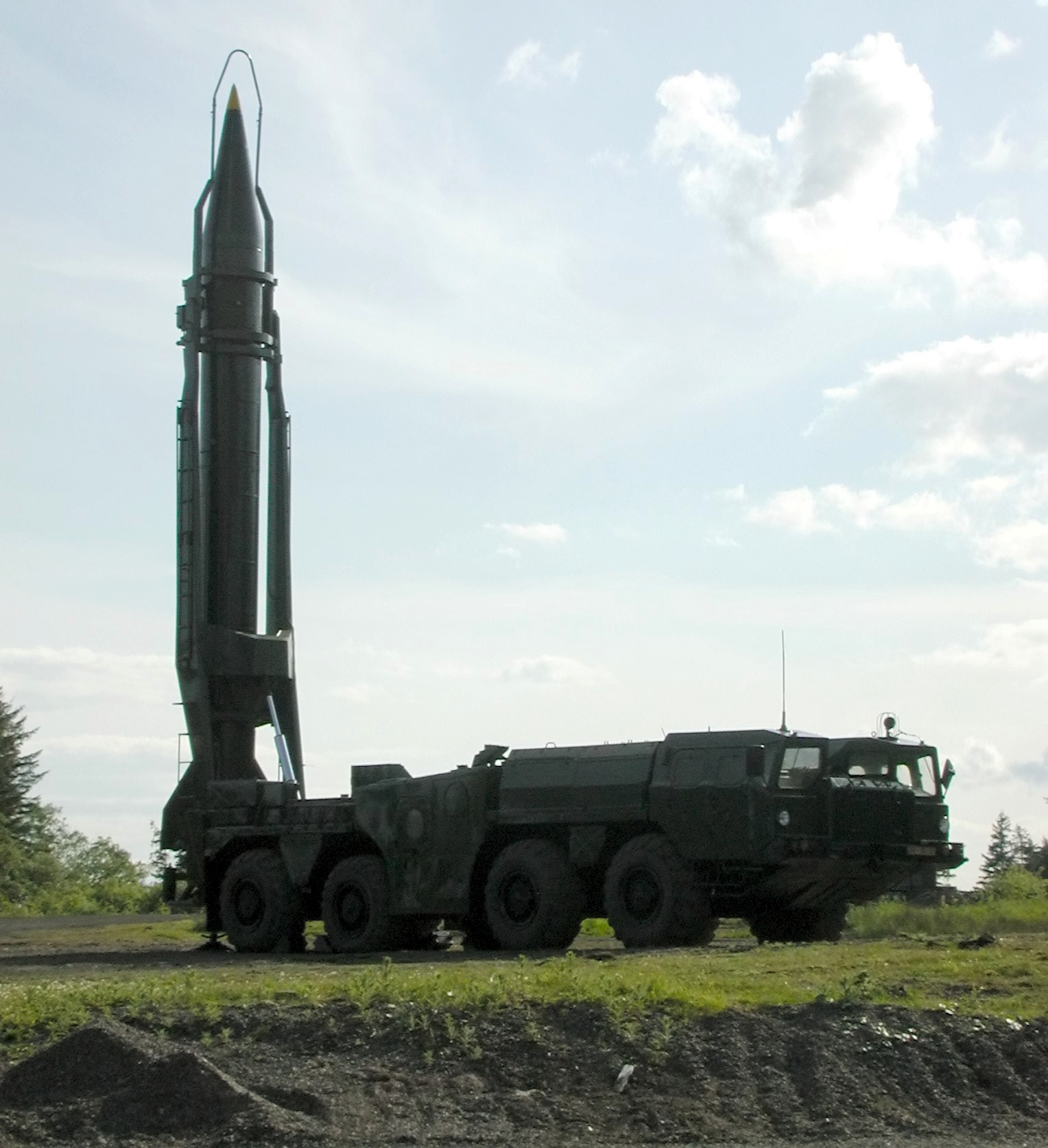
A Scud missile is one of a series of tactical ballistic missiles developed by the Soviet Union during the Cold War. It was exported widely to both Second and Third World countries. The term comes from the NATO reporting name attached to the missile by Western intelligence agencies. The Russian names for the missile are the R-11 (the first version), and the R-17 (later R-300) Elbrus (later developments). The name Scud has been widely used to refer to these missiles and the wide variety of derivative variants developed in other countries based on the Soviet design.
Scud missiles have been used in combat since the 1970s, mostly in wars in the Middle East. They became familiar to the Western public during the 1991 Persian Gulf War, when Iraq fired dozens at Saudi Arabia and Israel. In Russian service, it has been replaced by the 9K720 Iskander.
The first use of the term Scud was in the NATO name SS-1b Scud-A, applied to the R-11 Zemlya ballistic missile. The earlier R-1 missile had carried the NATO name SS-1 Scunner, but was of a very different design, almost directly a copy of the German V-2 rocket. The R-11 used technology gained from the V-2 as well, but was a new design, smaller and differently shaped than the V-2 and R-1 weapons. The R-11 was developed by the Korolyev OKB and entered service in 1957. The most revolutionary innovation in the R-11 was the engine, designed by A. M. Isaev. Far simpler than the V-2's multi-chamber design, and employing an anti-oscillation baffle to prevent chugging, it was a forerunner to the larger engines used in Soviet launch vehicles.[citation needed]
Further developed variants were the R-17 (later R-300) Elbrus / SS-1c Scud-B in 1961 and the SS-1d Scud-C in 1965, both of which could carry either a conventional high-explosive, a 5- to 80-kiloton thermonuclear, or a chemical (thickened VX) warhead. The SS-1e Scud-D variant developed in the 1980s can deliver a terminally guided warhead capable of greater precision.[citation needed]
All models are 11.35 m (37.2 ft) long (except Scud-A, which is 1 m (3 ft 3 in) shorter) and 0.88 m (2 ft 11 in) in diameter. They are propelled by a single liquid-fuel rocket engine burning kerosene and corrosion-inhibited red fuming nitric acid (IRFNA) with a mixture of 50% triethylamine and 50% xylidine (Russian TG-02 like German Tonka 250) as liquid igniter (self-ignition with IRFNA) in all models.[citation needed]
The missile reaches a maximum speed of Mach 5.[citation needed]
The first of the "Scud" series, designated R-11 (SS-1B Scud-A) originated in a 1951 requirement for a ballistic missile with similar performance to the German V-2 rocket. The R-11 was developed by engineer Viktor Makeev, who was then working in the OKB-1, headed by Sergey Korolev. It first flew on 18 April 1953, was fitted with an Isayev engine using kerosene and nitric acid as propellant. On 13 December 1953, a production order was passed with SKB-385 in Zlatoust, a factory dedicated to producing long-range rockets. In June 1955, Makeev was appointed chief designer of the SKB-385 to oversee the program and, in July, the R-11 was formally accepted into military service. The definitive R-11M, designed to carry a nuclear warhead, was accepted officially into service on 1 April 1958. The launch system was placed on an IS-2 chassis and received the GRAU designation 8K11; only 100 Scud-A launchers were built.
The R-11M had a maximum range of 270 km, but when carrying a nuclear warhead, this was reduced to 150 km. Its purpose was strictly as a mobile nuclear strike vector, giving the Soviet Army the ability to hit European targets from forward areas, armed with a nuclear warhead with an estimated yield of 50 kilotons.
Hub AI
Scud missile AI simulator
(@Scud missile_simulator)
Scud missile
A Scud missile is one of a series of tactical ballistic missiles developed by the Soviet Union during the Cold War. It was exported widely to both Second and Third World countries. The term comes from the NATO reporting name attached to the missile by Western intelligence agencies. The Russian names for the missile are the R-11 (the first version), and the R-17 (later R-300) Elbrus (later developments). The name Scud has been widely used to refer to these missiles and the wide variety of derivative variants developed in other countries based on the Soviet design.
Scud missiles have been used in combat since the 1970s, mostly in wars in the Middle East. They became familiar to the Western public during the 1991 Persian Gulf War, when Iraq fired dozens at Saudi Arabia and Israel. In Russian service, it has been replaced by the 9K720 Iskander.
The first use of the term Scud was in the NATO name SS-1b Scud-A, applied to the R-11 Zemlya ballistic missile. The earlier R-1 missile had carried the NATO name SS-1 Scunner, but was of a very different design, almost directly a copy of the German V-2 rocket. The R-11 used technology gained from the V-2 as well, but was a new design, smaller and differently shaped than the V-2 and R-1 weapons. The R-11 was developed by the Korolyev OKB and entered service in 1957. The most revolutionary innovation in the R-11 was the engine, designed by A. M. Isaev. Far simpler than the V-2's multi-chamber design, and employing an anti-oscillation baffle to prevent chugging, it was a forerunner to the larger engines used in Soviet launch vehicles.[citation needed]
Further developed variants were the R-17 (later R-300) Elbrus / SS-1c Scud-B in 1961 and the SS-1d Scud-C in 1965, both of which could carry either a conventional high-explosive, a 5- to 80-kiloton thermonuclear, or a chemical (thickened VX) warhead. The SS-1e Scud-D variant developed in the 1980s can deliver a terminally guided warhead capable of greater precision.[citation needed]
All models are 11.35 m (37.2 ft) long (except Scud-A, which is 1 m (3 ft 3 in) shorter) and 0.88 m (2 ft 11 in) in diameter. They are propelled by a single liquid-fuel rocket engine burning kerosene and corrosion-inhibited red fuming nitric acid (IRFNA) with a mixture of 50% triethylamine and 50% xylidine (Russian TG-02 like German Tonka 250) as liquid igniter (self-ignition with IRFNA) in all models.[citation needed]
The missile reaches a maximum speed of Mach 5.[citation needed]
The first of the "Scud" series, designated R-11 (SS-1B Scud-A) originated in a 1951 requirement for a ballistic missile with similar performance to the German V-2 rocket. The R-11 was developed by engineer Viktor Makeev, who was then working in the OKB-1, headed by Sergey Korolev. It first flew on 18 April 1953, was fitted with an Isayev engine using kerosene and nitric acid as propellant. On 13 December 1953, a production order was passed with SKB-385 in Zlatoust, a factory dedicated to producing long-range rockets. In June 1955, Makeev was appointed chief designer of the SKB-385 to oversee the program and, in July, the R-11 was formally accepted into military service. The definitive R-11M, designed to carry a nuclear warhead, was accepted officially into service on 1 April 1958. The launch system was placed on an IS-2 chassis and received the GRAU designation 8K11; only 100 Scud-A launchers were built.
The R-11M had a maximum range of 270 km, but when carrying a nuclear warhead, this was reduced to 150 km. Its purpose was strictly as a mobile nuclear strike vector, giving the Soviet Army the ability to hit European targets from forward areas, armed with a nuclear warhead with an estimated yield of 50 kilotons.