Hubbry Logo
ScullerySculleryMain
Open search
Scullery
Community hub
Scullery
logo
8 pages, 0 posts
0 subscribers
Be the first to start a discussion here.
Scullery
Scullery
from Wikipedia
Not found
Revisions and contributorsEdit on WikipediaRead on Wikipedia
from Grokipedia
A scullery is a small or area adjacent to the main in a traditional , primarily used for dishes, pots and pans, and storing , often serving as an extension to handle messy tasks away from the primary cooking space. The term derives from the Latin word scutella, meaning a or dish, reflecting its original purpose related to dish handling. Historically, sculleries trace their origins to , where they functioned as storage spaces for plates and dishes in mansions and monasteries. By the Georgian and Victorian eras, they became integral to the service quarters of larger homes, forming part of a suite of utility rooms—including the and —dedicated to household chores like and scrubbing, typically managed by lower-ranking staff such as scullery maids. These rooms were often compact, cool, and positioned near the back entrance for easy access to water sources and outdoor drainage, emphasizing functionality over aesthetics in pre-modern domestic design. In and home design, sculleries have experienced a revival, particularly in custom-built or renovated homes, where they act as "dirty kitchens" or overflow areas for food preparation, appliance storage, and cleanup, helping maintain a clutter-free main . This modern adaptation highlights their enduring practicality, blending historical utility with today's emphasis on organized, multifunctional living spaces.

Etymology and Origins

Etymology

The term "scullery" originates from the Latin scutella, denoting a , platter, or dish-stand, which evolved through escuille or escuelle (a dish or bowl) into escuelerie, referring to the office or department responsible for handling plates and utensils. This form entered as scullerye in the mid-15th century, initially describing a room or area dedicated to dish-related tasks. The word is closely linked to scull, a term for a kitchen servant or menial worker tasked with dirty chores like , stemming from the same Latin root via escuillon (a or scullion's tool). By the , "scullery" had solidified in English usage to mean a specialized space for such labor, often associated with the scullion's domain. In the , Samuel Johnson's A Dictionary of the English Language (1755) defined "scullery" as "the place where common utensils, as kettles or dishes, are cleaned and kept," emphasizing its role in utensil maintenance. By the early , architectural texts like Joseph Gwilt's An Encyclopaedia of Architecture (1842) described it as "the apartment for washing up dishes, etc., in a ," portraying it as a back-kitchen for rough, preparatory work.

Historical Origins

The scullery emerged in medieval European manors as a dedicated extension of the , primarily for servants to handle washing and storage of utensils, separating these tasks from main cooking areas to maintain efficiency in large . In 14th-century , household accounts from manors document the scullery as a distinct department, with records detailing wages paid to scullions for dish-related duties alongside allocations for the saucery, hall, and other service areas. These spaces were often modest outbuildings or adjacent rooms in castles and , reflecting the of labor in feudal where scullions, typically the lowest-ranked servants, managed soiled items to prevent contamination of preparation zones. By the 17th and 18th centuries, the scullery expanded significantly in British houses, driven by the growth in staff sizes and evolving standards of domestic management amid post-Restoration prosperity. Accounts from estates like those in highlight sculleries integrated into basement service quarters, supporting larger retinues of servants in opulent homes where specialized rooms facilitated the demands of entertaining and daily operations. In the (1837–1901), the scullery became standardized in middle-class homes, reflecting industrialization's push for efficient domestic labor and sanitation reforms that addressed urban health crises. The Public Health Act of 1875 consolidated earlier legislation by mandating local authorities to enforce better water supply, , and housing standards, leading to the routine incorporation of sculleries as rear extensions in terraced and suburban dwellings to handle wet tasks away from living areas. This era's model homes, often built under byelaw regulations, featured sculleries with floors and drains to comply with hygiene requirements, making the space a hallmark of respectable urban and suburban . Regional variations emerged as British influences spread, with colonial American homes adapting the scullery model by the late , often as separate outbuildings near the main in and Williamsburg-style plantations to support enslaved or indentured labor in agrarian settings.

Traditional Uses

In Household Settings

In traditional 19th-century British households, particularly those of the upper and middle classes, the scullery served as a dedicated space for essential domestic tasks that supported the main 's operations. Core responsibilities included washing dishes, pots, pans, and utensils after meals, as well as preparing perishables such as , , and for cooking. Scullery maids, often the youngest and lowest-ranking female servants, handled these duties under the supervision of the cook or kitchen maid, ensuring that soiled items were managed efficiently without disrupting food preparation in the primary area. The scullery played a crucial role in class-structured households by isolating the "dirty work" assigned to scullery maids, thereby maintaining order and in the main reserved for higher-ranking staff and oversight. As the lowest tier of domestics, scullery maids toiled in this separate to scrub floors, clean stoves, and carry water, preventing the mess of cleaning from contaminating cooking surfaces or dining areas. This division of labor enhanced household efficiency, especially during large entertainments when overflow from elaborate meals—such as extra and vegetable prep—could overwhelm the . In Mrs. Isabella Beeton's Book of Household Management (1861), the scullery is recommended as a vital adjunct for such scenarios, with maids assisting the cook in gravy and preparation while keeping utensils spotless to support seamless service. During Jane Austen's (early 19th century), sculleries in British estates like those depicted in her novels functioned similarly in gentry households, where maids rose at dawn for grueling routines of dishwashing and produce handling to sustain daily family life and occasional balls. By the Victorian period, this setup aligned with emerging principles, as the scullery's isolation of soiled tasks reduced contamination risks in line with the late-1800s germ theory, which emphasized separating clean and dirty processes to safeguard health. Beeton underscored this by stating that "no health but life may be said to depend on the of culinary utensils," highlighting the scullery's contribution to preventing illness through meticulous separation. Similar separations appeared in institutional settings like hospitals, but in homes, they reinforced domestic sanitation amid growing awareness of microscopic pathogens.

In Institutional Settings

In the 19th century, hospitals increasingly incorporated dedicated sculleries as essential spaces for the sterilization of medical dishes, linens, and instruments to uphold sanitation standards and curb the spread of infections. Florence Nightingale, a pivotal figure in nursing reform, emphasized the necessity of separate sculleries in her 1859 publication Notes on Hospitals, arguing that they were critical for isolating dirty processes from patient areas and preventing cross-contamination in overcrowded wards. These facilities featured porcelain sinks and efficient drainage systems to facilitate thorough cleaning, reflecting Nightingale's broader advocacy for pavilion-style hospital architecture that prioritized ventilation and hygiene. Under the Poor Law Amendment Act of 1834, which centralized in Britain through and asylums, sculleries became integral to institutional operations, managing the high-volume cleanup of communal meals for hundreds of residents daily. Workhouse designs typically included rear ranges with kitchens and adjacent sculleries equipped for large-scale dishwashing and waste disposal, ensuring compliance with emerging sanitary regulations amid the era's emphasis on deterrence and self-sufficiency. In asylums, similar setups handled not only dietary needs but also the washing of personal items, adapting household-scale dishwashing principles to institutional demands while adhering to protocols for vulnerable populations. Late 19th- and early 20th-century hospitals in the United States, influenced by Nightingale's pavilion model, such as (opened 1889), incorporated separate utility areas for rigorous sterilization routines, including boiling and chemical treatments for utensils and fabrics, to support infection control measures before the widespread availability of antibiotics and to mitigate hospital-acquired infections in surgical and medical wards. Following , the adoption of centralized laundry and sterilization services contributed to the decline of on-site sculleries in urban hospitals, as improved efficiency and standardization across facilities serving multiple institutions. However, in rural institutions with limited access to external services, sculleries remained in use for local cleaning and processing well into the 1970s, maintaining traditional roles amid slower modernization. Unlike domestic sculleries, institutional versions emphasized and for intensive protocols.

Design and Architecture

Key Features

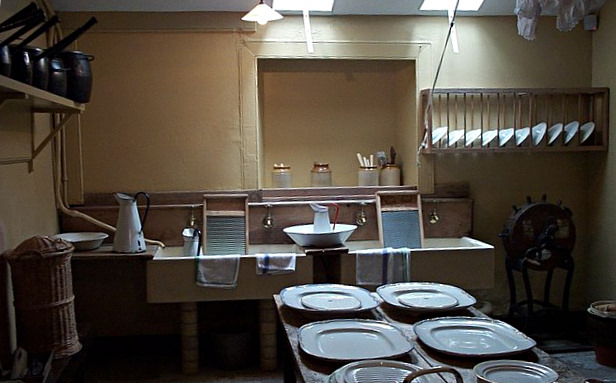
Sculleries were equipped with deep stone or sinks designed for heavy-duty washing, often measuring up to 3 to 4 feet in length and 21 inches in depth, accompanied by drainboards or slop stones tilted for efficient drainage into buckets or . These fixtures supported the intensive cleaning of pots, pans, and utensils, while drying racks or plate racks positioned above the sinks allowed for air-drying of dishware to prevent moisture buildup. From the onward, coal-fired boilers, typically made of or iron and integrated into open or closed ranges, provided a reliable source of hot water essential for and tasks in the space. Storage solutions emphasized practicality and organization, featuring open shelving along walls for pots, pans, and china to facilitate quick access during workflows, alongside larder cupboards or closets dedicated to and utensils kept separate to avoid dampness. Flooring consisted of durable quarry tiles, stone slabs, or later surfaces sloped toward drain traps, enabling easy rinsing and preventing water accumulation in this high-moisture environment. Ventilation was achieved through small windows, vents, or direct access to outer passages to expel , odors, and generated during , maintaining a cooler atmosphere conducive to the room's functions. By the late , evolved from natural sources under sink placements to gas jets, with early electric options emerging in larger establishments for safer illumination during extended hours. These elements were often positioned adjacent to the to streamline the transfer of soiled items, enhancing overall household efficiency. Material choices in sculleries progressed from wood framing and walls in the 1700s, which offered basic enclosure but were prone to wear, to more robust Victorian-era constructions using glazed bricks for lower walls and or glazed for sinks by the mid-19th century, prioritizing , water resistance, and longevity in wet conditions. This shift reflected broader advances in and building techniques, reducing mold and facilitating thorough cleaning.

Layout and Placement

In English Georgian homes spanning 1714 to 1830, the scullery was typically positioned adjacent to the main , either as a rear extension or within the level of townhouses, facilitating efficient while isolating messy tasks. This adjacency allowed for a connecting , often placed near the , through which dirty dishes and utensils could be passed without entering the primary cooking space, thereby preventing contamination and odors from spreading. Such configurations optimized the division of labor in households reliant on servants, with the scullery serving as an extension for washing and initial preparation. Size variations in sculleries reflected and house type, particularly in the , varying according to the but typically compact in middle-class homes to accommodate sinks, dressers, and storage, and even smaller in cottages. These rooms were frequently part of larger multi-room service suites that incorporated adjacent pantries and larders, forming a dedicated back-of-house zone for and . In smaller terrace houses, the scullery's compact layout included essential doors linking it to the , , and storage areas like coal holes, ensuring practical access without intruding on living spaces. Zonal separation was a key principle in 18th-century , positioning sculleries away from dining and reception areas to conceal servants' labor and maintain the elegance of principal rooms. This design hid the utilitarian aspects of domestic work, with basements housing sculleries, kitchens, and stores accessible via tradesmen's entrances to avoid disrupting family activities above ground. Adaptations in non-British contexts included integration into designs in from the onward, where sculleries formed part of the single-story Federation-style layouts, often extending rearward to support the informal, open-plan living common in suburban homes. In 19th-century urban settings, such as English townhouses functioning as multi-family dwellings, sculleries were commonly relegated to spaces to maximize upper-floor living areas while providing dedicated utility zones below. Fixtures like stone sinks were seamlessly integrated into these layouts to handle washing without requiring separate expansions. In other regions, such as , similar utility spaces known as butler's pantries or back s adopted comparable features like deep sinks and separate storage, often in colonial and Victorian-style homes to manage household chores discreetly.

Modern Adaptations

Contemporary Home Design

In contemporary residential architecture, sculleries have been reinterpreted as butler's pantries or prep s, particularly in luxury U.S. custom homes built after , where they serve as discreet zones for hiding appliances and maintaining a streamlined main kitchen aesthetic. These spaces often feature concealed dishwashers, microwaves, and small refrigerators behind cabinetry doors, allowing homeowners to keep everyday clutter out of sight during entertaining or daily use. For instance, high-end builds in areas like and New York incorporate these elements to support open-plan living while preserving visual order. Modern sculleries integrate advanced amenities tailored to efficiency, including counters for durable prep surfaces, integrated dishwashers for quick cleanup, and walk-in storage solutions for bulk groceries and serveware, aligning with trends identified in National Kitchen & Bath Association (NKBA) reports from 2015 onward. The NKBA's 2024 Kitchen Trends report highlights butler's pantries as walk-in areas with counters dedicated to minor food preparation and storage, emphasizing their role in enhancing functionality without overwhelming the primary . These features draw brief inspiration from traditional designs but adapt them for seamless appliance integration and easy maintenance. Space planning for contemporary sculleries typically involves compact additions of 10-20 square feet adjacent to open-plan , prioritizing clutter reduction by segregating messy tasks like washing and prepping from social areas. This sizing supports efficient in homes where the kitchen doubles as a living hub, enabling cooks to stay organized without disrupting guests. In such layouts, the scullery acts as a buffer, with doors or half-walls concealing appliances and sinks to promote a tidy environment. In , sculleries have gained popularity in the 2020s for their utility in supporting entertaining and cleanup, with builders like Plunkett Homes promoting them as additional prep and storage spaces. The resurgence of sculleries in home design gained momentum following the 2008 housing crisis, as increased emphasis on home cooking—accelerated by the —and prompted homeowners to seek multifunctional spaces that separate messy preparation from social areas. This trend reflects a broader shift toward practical, zoned s in new builds and renovations, allowing main areas to remain clutter-free during daily use or virtual meetings. According to Houzz's 2023 U.S. Emerging Summer Trends Report, searches for "scullery kitchen" surged by 38% year-over-year, signaling strong consumer interest in these secondary spaces. Media has played a pivotal role in popularizing sculleries, with shows highlighting their utility for organization and aesthetics. For instance, in episodes of Home Town (2016–present), hosts and Napier have championed sculleries as a revival of historical functionality, converting original kitchens into dedicated prep zones with features like dishwashers and ample storage to streamline modern workflows. Such portrayals emphasize sculleries' ability to hide everyday chaos, inspiring viewers to incorporate them for enhanced home efficiency. From a sustainability perspective, contemporary sculleries contribute to energy-efficient designs by offloading intensive tasks like and bulk prep from the primary , potentially reducing overall utility demands through targeted appliance use and better workflow zoning. This aligns with principles that prioritize resource conservation in residential spaces, as seen in designs that minimize main-area lighting and heating needs during high-activity periods. Globally, sculleries have seen varied adoption; in , they have gained traction in eco-focused homes since the mid-2010s, often integrated into sustainable builds for their space-saving and low-impact qualities, as noted in local design reports. In contrast, favors streamlined integrated and modular kitchens that incorporate utility features like tall storage cabinets, reflecting a preference for compact, multifunctional layouts in urban settings. This revival echoes Victorian-era functionality, where sculleries supported efficient household operations in larger homes. As of 2025, sculleries continue to be a prominent trend in kitchen design, featured in forecasts for their in creating organized, spaces.

References

Add your contribution
Related Hubs
User Avatar
No comments yet.