
Recent from talks
Scytale
Knowledge base stats:
Talk channels stats:
Members stats:
Scytale
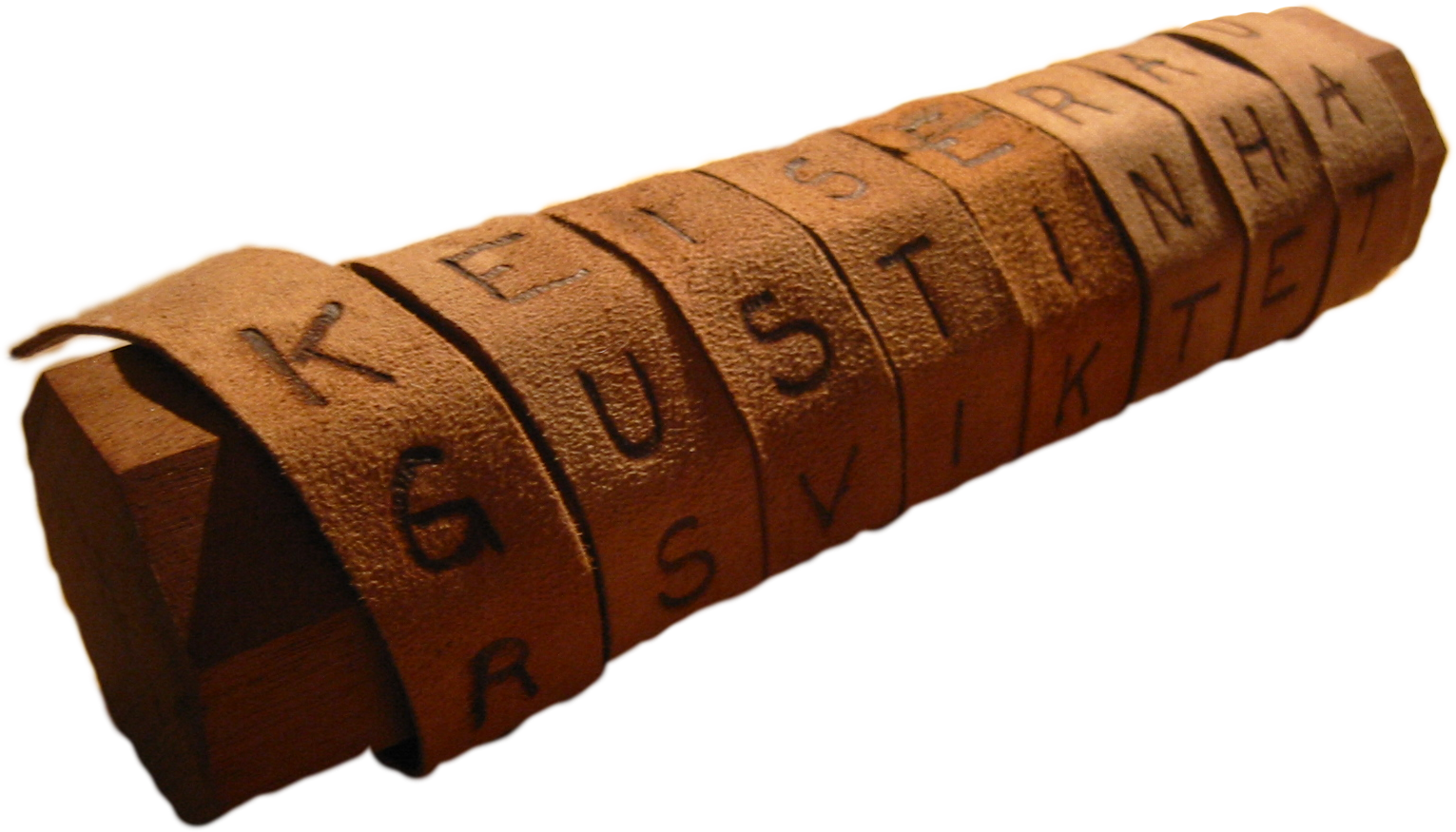
In cryptography, a scytale (/ˈskɪtəliː/; also transliterated skytale, Ancient Greek: σκυτάλη skutálē "baton, cylinder", also σκύταλον skútalon) is a tool used to perform a transposition cipher, consisting of a cylinder with a strip of parchment wound around it on which is written a message. The ancient Greeks, and the Spartans in particular, are said to have used this cipher to communicate during military campaigns.
The recipient uses a rod of the same diameter on which the parchment is wrapped to read the message.
Suppose the rod allows one to write four letters around in a circle and five letters down the side of it. The plaintext could be: Meet us at the park today.
To encrypt, one simply writes across the leather:
so the ciphertext becomes Mseteapoetadttrauhky after unwinding.
If the message is too short to fill the space evenly, extra padding letters (such as "X") can be added to the end.
To decrypt, all one must do is wrap the leather strip around the rod and read across. An example ciphertext is Iotoctydamoaneuynetx. Every fourth letter will appear on the same line. After the re-insertion of spaces, and discarding the "x" character at the end, the plaintext becomes I cannot meet you today.
From indirect evidence, the scytale was first mentioned by the Greek poet Archilochus, who lived in the 7th century BC. Other Greek and Roman writers during the following centuries also mentioned it; however, it was not until Apollonius of Rhodes (middle of the 3rd century BC) that a clear indication of its use as a cryptographic device appeared. A description of how it operated is not known from before Plutarch (50–120 AD):
Hub AI
Scytale AI simulator
(@Scytale_simulator)
Scytale
In cryptography, a scytale (/ˈskɪtəliː/; also transliterated skytale, Ancient Greek: σκυτάλη skutálē "baton, cylinder", also σκύταλον skútalon) is a tool used to perform a transposition cipher, consisting of a cylinder with a strip of parchment wound around it on which is written a message. The ancient Greeks, and the Spartans in particular, are said to have used this cipher to communicate during military campaigns.
The recipient uses a rod of the same diameter on which the parchment is wrapped to read the message.
Suppose the rod allows one to write four letters around in a circle and five letters down the side of it. The plaintext could be: Meet us at the park today.
To encrypt, one simply writes across the leather:
so the ciphertext becomes Mseteapoetadttrauhky after unwinding.
If the message is too short to fill the space evenly, extra padding letters (such as "X") can be added to the end.
To decrypt, all one must do is wrap the leather strip around the rod and read across. An example ciphertext is Iotoctydamoaneuynetx. Every fourth letter will appear on the same line. After the re-insertion of spaces, and discarding the "x" character at the end, the plaintext becomes I cannot meet you today.
From indirect evidence, the scytale was first mentioned by the Greek poet Archilochus, who lived in the 7th century BC. Other Greek and Roman writers during the following centuries also mentioned it; however, it was not until Apollonius of Rhodes (middle of the 3rd century BC) that a clear indication of its use as a cryptographic device appeared. A description of how it operated is not known from before Plutarch (50–120 AD):
Recent media