Hubbry Logo
search
logo
Scytale
Scytale
current hub
2263776

Scytale

logo
Community Hub0 Subscribers
Read side by side
from Wikipedia
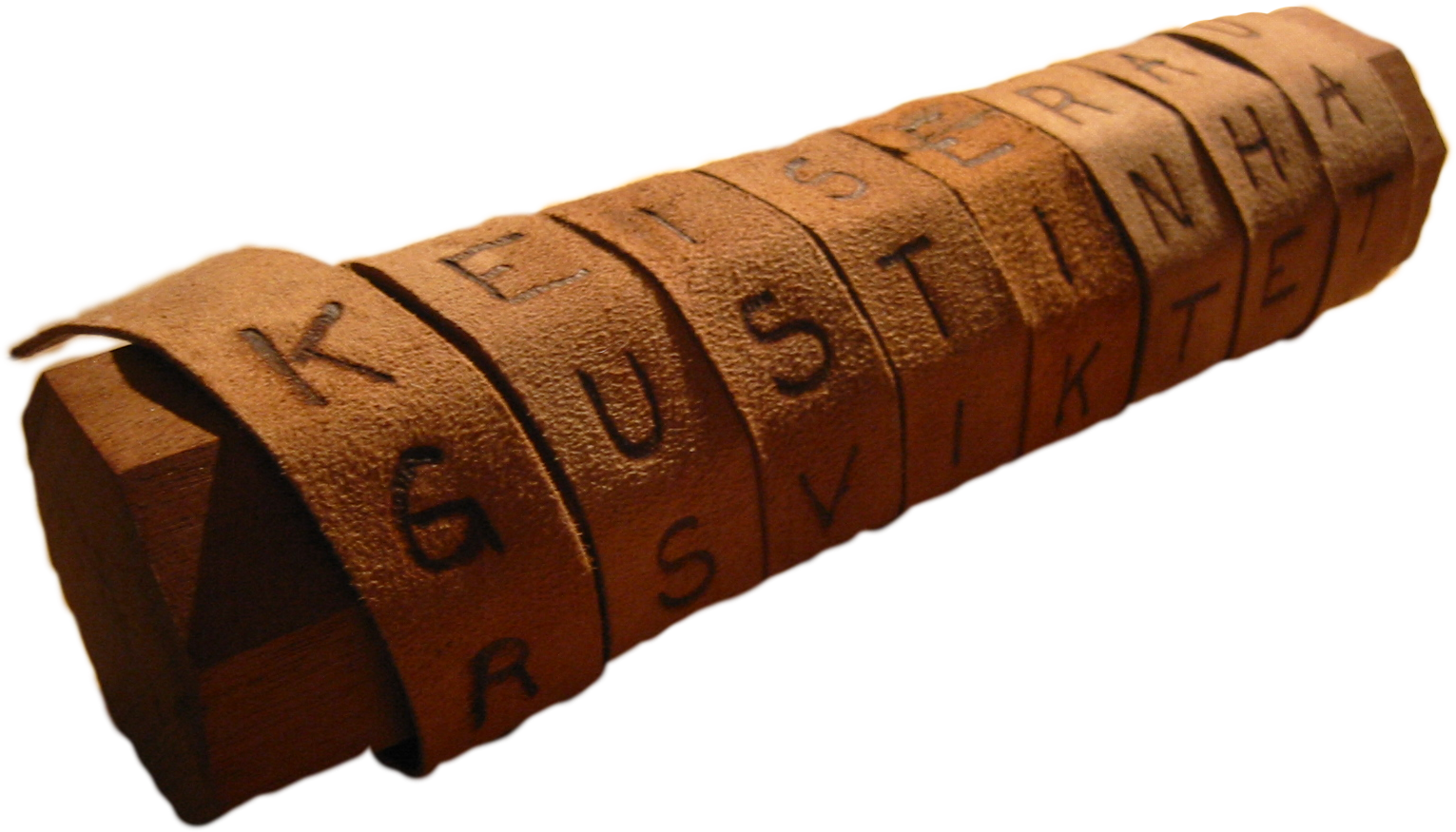
A scytale with a leather strip

In cryptography, a scytale (/ˈskɪtəl/; also transliterated skytale, Ancient Greek: σκυτάλη skutálē "baton, cylinder", also σκύταλον skútalon) is a tool used to perform a transposition cipher, consisting of a cylinder with a strip of parchment wound around it on which is written a message. The ancient Greeks, and the Spartans in particular, are said to have used this cipher to communicate during military campaigns.

The recipient uses a rod of the same diameter on which the parchment is wrapped to read the message.

Encrypting

[edit]

Suppose the rod allows one to write four letters around in a circle and five letters down the side of it. The plaintext could be: Meet us at the park today.

To encrypt, one simply writes across the leather:

_____________________________________________________________
       |   |   |   |   |   |  |
       | M | e | e | t | u |  |
     __| s | a | t | t | h |__|
    |  | e | p | a | r | k |
    |  | t | o | d | a | y |
    |  |   |   |   |   |   |
_____________________________________________________________

so the ciphertext becomes Mseteapoetadttrauhky after unwinding.

If the message is too short to fill the space evenly, extra padding letters (such as "X") can be added to the end.[1]

Decrypting

[edit]

To decrypt, all one must do is wrap the leather strip around the rod and read across. An example ciphertext is Iotoctydamoaneuynetx. Every fourth letter will appear on the same line. After the re-insertion of spaces, and discarding the "x" character at the end, the plaintext becomes I cannot meet you today.

History

[edit]

From indirect evidence, the scytale was first mentioned by the Greek poet Archilochus, who lived in the 7th century BC. Other Greek and Roman writers during the following centuries also mentioned it; however, it was not until Apollonius of Rhodes (middle of the 3rd century BC) that a clear indication of its use as a cryptographic device appeared. A description of how it operated is not known from before Plutarch (50–120 AD):

The dispatch-scroll is of the following character. When the ephors send out an admiral or a general, they make two round pieces of wood exactly alike in length and thickness, so that each corresponds to the other in its dimensions, and keep one themselves, while they give the other to their envoy. These pieces of wood they call scytalae. Whenever, then, they wish to send some secret and important message, they make a scroll of parchment long and narrow, like a leathern strap, and wind it round their scytale, leaving no vacant space thereon, but covering its surface all round with the parchment. After doing this, they write what they wish on the parchment, just as it lies wrapped about the scytale; and when they have written their message, they take the parchment off and send it, without the piece of wood, to the commander. He, when he has received it, cannot otherwise get any meaning out of it,--since the letters have no connection, but are disarranged,--unless he takes his own scytale and winds the strip of parchment about it, so that, when its spiral course is restored perfectly, and that which follows is joined to that which precedes, he reads around the staff, and so discovers the continuity of the message. And the parchment, like the staff, is called scytale, as the thing measured bears the name of the measure.

— Plutarch, Lives (Lysander 19), ed. Bernadotte Perrin.

Due to difficulties in reconciling the description of Plutarch with the earlier accounts, and circumstantial evidence such as the cryptographic weakness of the device, several authors have suggested that the scytale was used for conveying messages in plaintext and that Plutarch's description is mythological.[2]

Message authentication hypothesis

[edit]

An alternative hypothesis is that the scytale was used for message authentication rather than encryption.[3] Only if the sender wrote the message around a scytale of the same diameter as the receiver's would the receiver be able to read it. It would therefore be difficult for enemy spies to inject false messages into the communication between two commanders.

Nonetheless, any person intercepting a scytale message, and having heard about the method, could with little difficulty find out the rod size needed (a kind of brute-force attack); once knowing that, it would be easy to supplant the sender and forge new messages.

See also

[edit]

References

[edit]

Further reading

[edit]
Revisions and contributorsEdit on WikipediaRead on Wikipedia
from Grokipedia
The scytale (Greek: σκυτάλη, skytálē, meaning "baton" or "staff") is an ancient Greek cryptographic tool, primarily associated with the Spartans, consisting of a wooden cylinder or rod around which a narrow strip of parchment or leather is wrapped to inscribe a message in a continuous spiral; when unwound, the text appears as a jumbled sequence of letters that can only be reconstituted into readable form by rewinding the strip onto an identical rod of the same diameter and length, functioning as one of the earliest known transposition ciphers.[1][2] The device's origins trace back to at least the 7th century BCE, with the earliest surviving mention in a fragment by the poet Archilochus, who referred to the scytale as a staff used by messengers, though without explicit cryptographic context.[1] The most detailed ancient account, however, comes from Plutarch's 1st-century CE Life of Lysander, which recounts how Spartan ephors employed matching scytalae to send encrypted orders to commanders like Lysander, ensuring that only the intended recipient could decode the dispatch by rewinding the strip around their personal baton.[2] Beyond cryptography, the scytale served multiple roles in Spartan society, including as a walking staff for envoys, a symbol of authority, or even a tool for message authentication to verify the legitimacy of bearers, reflecting the device's practical integration into military and diplomatic practices.[3] While effective for short messages in an era of limited alternatives, its security relied on the secrecy of the rod's dimensions and was vulnerable to cryptanalysis if the circumference was estimated, limiting its sophistication compared to later ciphers but marking a foundational step in the history of secure communication.

Definition and Principles

Physical Description

The scytale device consists of a cylindrical wooden staff, referred to as the baton or scytale, paired with a narrow strip of parchment designed for wrapping around it. According to Plutarch, the ephors prepared two identical round pieces of wood, alike in length and thickness, ensuring that the sender and recipient could use matching batons for secure communication. The staff's smooth surface facilitated the helical wrapping of the strip, which was wound in a spiral course to cover the entire surface completely, leaving no vacant spaces.[4] The strip itself is described as long and narrow, akin to a leathern strap, allowing it to encircle the baton multiple times without overlapping edges. Plutarch notes that the message was inscribed directly on this wrapped strip, after which it was unwound and dispatched separately from the staff. This construction emphasized precision in the baton's dimensions, as any mismatch in size between the sender's and recipient's staffs would render the text unreadable when rewound.[4] Aulus Gellius provides a complementary account, identifying the strip as a lorum, a term denoting a thin leather strap or parchment band suitable for inscription. Variations in the device's construction likely accommodated different message lengths, with the baton's proportions determining the strip's wrapping pattern, though exact measurements are not specified in ancient descriptions. The tactile simplicity of the wooden baton—smooth and uniform—made it a practical field tool for ancient military use.[1]

Transposition Mechanism

The scytale functions as a transposition cipher, a method of encryption that rearranges the positions of plaintext characters according to a predetermined pattern while leaving the characters themselves unchanged, with decryption relying on knowledge of the key embodied by the baton's diameter to reverse the rearrangement.[5] This principle ensures that without the matching baton, the recipient cannot realign the characters into their original order, as the transposition disrupts the sequential flow of the message.[6] When the narrow strip of parchment or leather is wrapped helically around the baton without overlapping or gaps, it forms a virtual grid on the cylindrical surface, where each complete helical turn contributes to the columns in the grid. The plaintext message is then inscribed column-wise down these positions, with characters placed sequentially along each column, spanning the length of the baton (writing parallel to the axis at successive angular positions around the circumference). Upon unwrapping the strip, the characters appear in a jumbled sequence that corresponds to a row-wise reading of the original grid, yielding the ciphertext as a linear string of rearranged characters.[7][8] The diameter of the baton serves as the critical key element, dictating the circumference of the cylinder and thereby determining the number of columns $ n $ in the grid (approximately the circumference divided by the letter width). A larger diameter results in more columns for a given letter size, altering the transposition pattern, while the baton's length influences the number of rows. Mathematically, for a plaintext message of length $ L $, the grid has $ n $ columns and approximately $ m = \lceil L / n \rceil $ rows (with padding if $ L $ is not divisible by $ n $). The plaintext is written column by column, and the ciphertext is produced by reading the grid row by row, concatenating the $ n $ characters from each of the $ m $ rows sequentially.[6] A representative example illustrates this process with the plaintext "ATTACKATDAWN" ($ L = 12 $) on a scytale yielding $ n = 3 $ columns and $ m = 4 $ rows. The message is written column-wise down the turns on the wrapped strip:
  • Column 1: A T T A
  • Column 2: C K A T
  • Column 3: D A W N
When unwrapped, the strip presents the characters in the row-wise order: first row A C D, second T K A, third T A W, fourth A T N, producing the ciphertext "ACDTKATAWATN". To decrypt, the recipient wraps the strip around an identical baton, realigning the characters into the grid, and reads column by column to recover the plaintext.[9][8]

Operational Methods

Encryption Procedure

The encryption procedure for the scytale, as described by the ancient Greek biographer Plutarch in his Life of Lysander, involves using a cylindrical baton and a narrow strip of parchment to transpose the letters of a plaintext message into a seemingly disordered ciphertext.[10] This method relies on the transposition principle, where the physical alignment of the strip around the baton creates a grid-like surface for writing.[1] Note that while ancient sources provide general outlines, precise procedural details such as writing direction are based on modern reconstructions. The first step is to select a baton of appropriate diameter and length, then wrap a strip of parchment tightly around it in a helical manner, ensuring the edges align precisely without gaps or overlaps to form a continuous, flat writing surface.[10] The wrapping must cover the entire surface of the baton evenly, as any misalignment would disrupt the readability upon reassembly.[1] Next, the plaintext message is written horizontally across the turns of the wrapped strip, proceeding row-wise character by character to fill the implicit grid formed by the helical wraps.[10] This is typically done using a stylus or similar writing implement on the parchment surface, with care taken to inscribe each character clearly within its allocated space.[1] Once the message is fully inscribed, the strip is carefully unwrapped from the baton, producing the ciphertext as a linear sequence of characters that appears jumbled and meaningless when read in order.[10] Even tension must be maintained during unwrapping to prevent shifts in the strip that could misalign the characters.[1] The jumbling occurs because the strip's linear order corresponds to reading the grid column-wise. If the message length does not exactly fill the grid defined by the baton's dimensions and the strip's wraps, the strip can be padded with null characters or left with partial rows, though in practice, the strip's length is often pre-cut to match the expected message size for completeness.[1] A representative example illustrates this process: Consider the plaintext "MEETATDUSK" encrypted on a scytale producing a 4-row grid (implying 4 helical turns around the baton, with 3 full rows written). When wrapped and written row-wise, the grid appears as:
MEET
ATDU
SK
(padded if needed)
Unwrapping the strip yields the ciphertext read column-wise as "MASETKEDTU", with nulls or spaces for incomplete sections.[9]

Decryption Procedure

To decrypt a message encrypted with the scytale, the recipient must possess a baton (scytale) identical in diameter to the one used for encryption, as this dimension determines the helical wrapping that realigns the transposed letters. According to Plutarch, Spartan commanders relied on matching scytalae to decode messages swiftly, ensuring secure communication during military campaigns.[10] The process reverses the transposition by reforming the original grid layout on the baton. The parchment or leather strip bearing the ciphertext is then wrapped around the matching baton, starting from one end to ensure the letters align without gaps or overlaps.[11] Next, the strip's starting point is aligned precisely on the baton, and it is re-wrapped helically in the same direction and tension as during encryption to reconstruct the original columnar grid. This physical rearrangement positions the letters back into their sequential rows across the baton's surface. Aulus Gellius describes this reassembly as essential for legibility, noting that the scytale's uniformity allowed messengers to decode without additional instructions. The final step is to read the message row-wise along the wrapped strip's turns, retrieving the plaintext in its natural order. For instance, the ciphertext "ROEOERNMICTINESNFMCG" (24 letters), when re-wrapped on a baton with a circumference accommodating 4 letters per turn (6 turns total), yields the plaintext "REINFORCEMENTSCOMEATONCE".[11] If the baton's diameter mismatches even slightly, the letters fail to align into coherent rows, producing unreadable text and highlighting the method's reliance on an exact replica for success. Practical challenges include preserving the strip's orientation to avoid reversing the helical direction during re-wrapping and verifying alignment by scanning for emerging meaningful words, as misalignment could introduce errors in urgent field conditions.[3]

Historical Usage

Spartan Origins

The scytale, a cylindrical staff used for encoding messages, originated in ancient Sparta within the Laconia region during the 5th century BCE. It served as a key tool for secure military communication among Spartan forces, reflecting the society's structured hierarchy and need for discreet orders during campaigns. The device's early adoption is tied to Sparta's ephors, who issued scytalae to generals and admirals before deployment, ensuring that sensitive directives could only be deciphered by authorized recipients using a matching staff.[3] In the cultural context of Sparta, a militaristic polis emphasizing brevity in speech—exemplified by the laconic style—and operational secrecy in warfare, the scytale provided a practical, low-tech alternative to wax seals or verbal messengers. This innovation aligned with Spartan practices of mētis, or cunning intelligence, and was integrated into institutions like the krypteia, the secret police force of young warriors tasked with maintaining control over helots through covert actions. The scytale's portability made it ideal for field use, facilitating rapid yet protected signaling in an era of frequent inter-polis conflicts.[12][13] The timeline of its earliest documented use aligns with the Peloponnesian War (431–404 BCE), where it enabled confidential exchanges, such as the ephors' recall of admiral Lysander from the Hellespont in 405 BCE, as recorded by Plutarch. While Plutarch highlights its role in transmitting Spartan orders, the device remained predominantly a Spartan military asset, with limited adoption by other Greek city-states due to its specialized design and the unique demands of Laconian governance. It persisted as a primarily Spartan tool until references in the Roman era, without widespread diffusion into broader Hellenistic practices.[3][12]

Evidence from Ancient Sources

The most detailed ancient account of the scytale as a cryptographic device comes from Plutarch's 1st-century CE Parallel Lives, specifically in the Life of Lysander (chapter 19). He explains the scytale as a Spartan ephoral invention, where officials maintained identical wooden batons for wrapping parchment strips to compose and transmit naval orders during the Peloponnesian War (431–404 BCE). Plutarch details the process: the sender wraps a long, narrow parchment around the scytale, inscribes the message across the turns, unwraps it to form an incoherent string of letters, and dispatches it; the recipient then realigns it on a matching scytale to reveal the plaintext. He cites a specific incident where the ephors sent a scytale-encoded message to Lysander at the Hellespont, ordering his recall following a complaint by the Persian satrap Pharnabazus about the pillaging by Lysander's forces. This example illustrates the device's practical application in high-stakes wartime communication.[10] No direct archaeological artifacts of the scytale have been recovered, with evidence limited to indirect Spartan military relics such as batons from sanctuary deposits at sites like the Menelaion or Artemis Orthia temple, which match textual descriptions of wooden or ivory cylinders but lack inscriptions confirming cryptographic function. Modern replicas, constructed from ancient wood-turning techniques evidenced in Spartan artifacts, rely solely on these literary accounts for authenticity. The absence of physical scytalae underscores significant gaps in the historical record, as surviving evidence depends heavily on secondary Hellenistic and Roman interpretations rather than contemporary Spartan inscriptions or devices, potentially due to the perishable nature of parchment and the secrecy of military tools.[14]

Cryptographic Evaluation

Security Limitations

The security of the scytale depends entirely on the secrecy of the baton's diameter, which determines the transposition grid. If an adversary captures the baton or measures its dimensions using calipers or iterative trials to match the strip's wrapping, they can replicate the device and decrypt the message with minimal effort.[15] As a transposition cipher, the scytale preserves the frequency distribution of letters from the plaintext, offering no obfuscation against statistical analysis of language patterns. This limitation becomes pronounced in longer messages, where attackers can employ cribs—assumed common words or phrases—to probe and identify the rearrangement pattern, facilitating recovery of the original text.[16] Without knowledge of the key, breaking the scytale involves testing possible diameters, equivalent to trying different numbers of rows $ r $ in the grid such that $ r $ divides the message length $ L $ (or approximately up to $ \sqrt{L} $ candidates to cover viable dimensions). Each trial requires rearranging the ciphertext into a grid and reading it column-wise to check for coherence. The cipher's limited key space makes it vulnerable to exhaustive search. The cipher's strengths lie in its operational simplicity, requiring no advanced literacy or computational aids, which suited Spartan military contexts where messengers needed only basic training to encode and decode. It also resists opportunistic interception, as destroying the leather strip after transmission leaves no recoverable plaintext without the precise baton dimensions.[3] No historical records document successful breaks of scytale messages in antiquity, though the system was theoretically susceptible to physical replication of the baton or compromise via insider knowledge of its specifications.[15] Quantitatively, the scytale proves adequate for brief military dispatches under 100 characters, where the modest key space (around 10 possibilities) deters manual brute-force without specialized tools, but it falters for extended texts owing to the grid's inherent predictability and ease of exhaustive search.[17]

Authentication Hypothesis

The authentication hypothesis proposes that the scytale functioned primarily as a tool for verifying the integrity and authenticity of messages in ancient Spartan communications, rather than solely for encrypting content to prevent interception. This interpretation, advanced by modern scholars, emphasizes the device's role in countering forgery amid the Spartans' rigid military hierarchy and suspicion of deceitful orders. For instance, David Kahn's seminal work The Codebreakers (1967) discusses the scytale's historical context, suggesting its practical value lay in ensuring reliable transmission of commands over long distances, where tampering could undermine command integrity. Further elaboration appears in Frank Russell's Information Gathering in Classical Greece (1999), which posits the scytale as a verification mechanism tailored to Sparta's paranoid culture of loyalty and fear of false directives from ephors or kings. The mechanism underpinning this hypothesis involves the recipient re-wrapping the transmitted parchment strip around a scytale rod of identical diameter to the sender's. If the message reforms into coherent, continuous text, it confirms no alterations occurred during transit; any tampering—such as insertions, deletions, or substitutions—would misalign the characters, rendering the text gibberish and exposing potential forgery. This positional check provides integrity assurance without relying on substitution ciphers, distinguishing it from pure encryption methods. As detailed in Russell's analysis, this approach was particularly suited to short, imperative military orders, where verifying origin outweighed hiding content from eavesdroppers who might lack the exact rod dimensions. Ancient descriptions, such as Plutarch's in Life of Lysander (19.5–7), underscore this by focusing on the "continuity" achieved upon re-wrapping, implying an emphasis on alignment verification over obscurity. Supporting evidence draws from ancient sources that highlight procedural checks for message validity, fitting Sparta's documented aversion to unauthorized commands that could incite mutiny or strategic errors. Plutarch notes the scytale's use in wartime dispatches, where misalignment would signal unreliability, aligning with broader Greek accounts of Spartan caution against impostors in signaling systems. This resonates with the ephors' oversight role, where authenticity trumped secrecy for internal coordination. However, counterarguments maintain that authentication was incidental, as Plutarch explicitly terms the scytale a "cipher" for secret writing, indicating transposition as the core intent to obscure messages from outsiders. Recent scholarship, such as Martine L. M. Diepenbroek's 2021 thesis Myths and Histories of the Spartan Scytale, argues that the device was a sophisticated transposition cipher with security comparable to other ancient methods, challenging interpretations that minimize its encryption role while acknowledging potential for dual use in authentication and secrecy.[18] The implications of the hypothesis frame the scytale as an early precursor to message authentication codes (MACs) in modern cryptography, offering verifiable integrity through shared physical parameters without computational substitution. Scholarly debate continues on the balance between authentication and encryption functions, with the authentication view as an alternative hypothesis rather than the consensus primary purpose.

Modern Perspectives

Contemporary Reconstructions

Modern reconstructions of the scytale employ accessible materials to replicate the ancient device for educational and experimental purposes. Common implementations use wooden dowels, pencils, or plastic rods as the baton, paired with strips of paper or parchment for the message strip, allowing users to wrap the strip helically around the baton and write along its length to demonstrate transposition encryption.[19][20] These replicas prioritize precise diameter control, often measured with calipers to ensure consistent wrapping and accurate decryption when the strip is rewound on a matching baton.[19] In educational settings, such as university computer science and cybersecurity courses, physical scytale models are used to teach transposition ciphers through hands-on activities, enabling students to encrypt and decrypt short messages and understand the role of the baton's dimensions as the key.[21][20] Science museums and outreach programs also incorporate scytale activities in STEM initiatives focused on ancient technologies, where participants construct devices from household items like cylinders and paper to explore cryptography concepts.[22] Digital simulations extend the scytale's accessibility beyond physical builds. Open-source software like CrypTool provides a dedicated scytale module for visualizing and performing encryption/decryption, treating the baton's diameter as the key parameter in the transposition algorithm.[15] Python libraries, such as the scytale-cipher package, offer script-based emulations for programmatic testing of the cipher on longer texts, facilitating computational analysis of its mechanics.[23] Advancements in the 2020s include 3D-printed batons designed specifically for cryptography education, enabling customizable diameters and scalable models that support extended message lengths while adhering to ancient helical wrapping principles. These modern versions align closely with textual descriptions from ancient sources by maintaining the core baton-and-strip design but enhance usability through durable, reproducible materials.[24]

Comparisons with Other Ciphers

The scytale, as a transposition cipher that rearranges the order of letters in a message using a cylindrical rod of specific diameter, fundamentally differs from the Caesar cipher, which employs a simple substitution method by shifting each letter in the plaintext by a fixed number of positions in the alphabet.[12][25] While the Caesar cipher's security relies on concealing the shift value and is vulnerable to frequency analysis, the scytale's strength depends on physical possession of a matching rod, making it more resistant to interception without the key but susceptible to physical compromise or reconstruction attempts.[14] In comparison to the Polybius square, another ancient Greek cryptographic tool developed in the 2nd century BCE, the scytale operates without a grid-based substitution of letters into digraphs or numerical coordinates, instead using a physical transposition mechanism that requires no memorized table.[25] The Polybius square facilitates encoding via a 5x5 grid (often combining I/J) for brevity in signaling, such as with torches, whereas the scytale's portability suited field messengers, emphasizing ease of use over combinatorial complexity.[14] Modern transposition ciphers like the rail fence cipher serve as a software-based analog to the scytale, both involving columnar or diagonal rearrangement of plaintext into rows before reading off sequentially.[8] The rail fence writes the message in a zigzag pattern across a fixed number of "rails," sharing the scytale's weakness to known-plaintext attacks that reveal patterns in letter frequencies, though the scytale predates it by centuries as one of the earliest documented transposition systems.[8] Regarding authentication, the scytale has been hypothesized to function not only as an encryption device but also as a primitive message verification tool, akin to modern hash-based message authentication codes (HMAC), where the rod ensures the message originates from an authorized sender by matching the unwrapping pattern.[1][3] Unlike HMAC, which combines a cryptographic hash function with a secret key for computational integrity and resistance to forgery, the scytale's analog approach provides basic origin assurance but lacks resistance to tampering without digital hashing.[1] Today, it holds niche relevance in discussions of steganography and early cryptography, contrasting with complex polyalphabetic systems like the Vigenère cipher, which uses multiple Caesar shifts keyed to a repeating word for greater resistance to frequency analysis, while the scytale's simplicity made it ideal for Spartan messengers requiring quick, low-tech deployment.[14][25]
User Avatar
No comments yet.