
Selberg integral
View on WikipediaIn mathematics, the Selberg integral is a generalization of Euler beta function to n dimensions introduced by Atle Selberg.[1] It has applications in statistical mechanics, multivariable orthogonal polynomials, random matrix theory, Calogero–Moser–Sutherland model, and Knizhnik–Zamolodchikov equations.[2]
Selberg's integral formula
[edit]When , we have

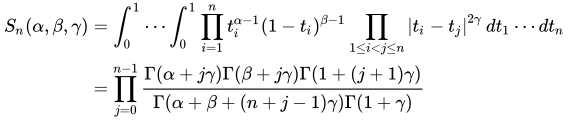
Selberg's formula implies Dixon's identity for well poised hypergeometric series, and some special cases of Dyson's conjecture. This is a corollary of Aomoto.
Aomoto's integral formula
[edit]Aomoto proved a slightly more general integral formula.[3] With the same conditions as Selberg's formula,


A proof is found in Chapter 8 of Andrews, Askey & Roy (1999).[4]
Mehta's integral
[edit]When ,


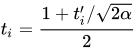
It is a corollary of Selberg, by setting , and change of variables with , then taking .


This was conjectured by Mehta & Dyson (1963), who were unaware of Selberg's earlier work.[5]
It is the partition function for a gas of point charges moving on a line that are attracted to the origin.[6]
In particular, when , the term on the right is .


Macdonald's integral
[edit]Macdonald (1982) conjectured the following extension of Mehta's integral to all finite root systems, Mehta's original case corresponding to the An−1 root system.[7]

The product is over the roots r of the roots system and the numbers dj are the degrees of the generators of the ring of invariants of the reflection group. Opdam (1989) gave a uniform proof for all crystallographic reflection groups.[8] Several years later he proved it in full generality, making use of computer-aided calculations by Garvan.[9]
References
[edit]- ^ Selberg, Atle (1944). "Remarks on a multiple integral". Norsk Mat. Tidsskr. 26: 71–78. MR 0018287.
- ^ Forrester, Peter J.; Warnaar, S. Ole (2008). "The importance of the Selberg integral". Bull. Amer. Math. Soc. 45 (4): 489–534. arXiv:0710.3981. doi:10.1090/S0273-0979-08-01221-4. S2CID 14185100.
- ^ Aomoto, K (1987). "On the complex Selberg integral". The Quarterly Journal of Mathematics. 38 (4): 385–399. doi:10.1093/qmath/38.4.385.
- ^ Andrews, George; Askey, Richard; Roy, Ranjan (1999). "The Selberg integral and its applications". Special functions. Encyclopedia of Mathematics and its Applications. Vol. 71. Cambridge University Press. ISBN 978-0-521-62321-6. MR 1688958.
- ^ Mehta, Madan Lal; Dyson, Freeman J. (1963). "Statistical theory of the energy levels of complex systems. V". Journal of Mathematical Physics. 4 (5): 713–719. Bibcode:1963JMP.....4..713M. doi:10.1063/1.1704009. MR 0151232.
- ^ Mehta, Madan Lal (2004). Random matrices. Pure and Applied Mathematics (Amsterdam). Vol. 142 (3rd ed.). Elsevier/Academic Press, Amsterdam. ISBN 978-0-12-088409-4. MR 2129906.
- ^ Macdonald, I. G. (1982). "Some conjectures for root systems". SIAM Journal on Mathematical Analysis. 13 (6): 988–1007. doi:10.1137/0513070. ISSN 0036-1410. MR 0674768.
- ^ Opdam, E.M. (1989). "Some applications of hypergeometric shift operators". Invent. Math. 98 (1): 275–282. Bibcode:1989InMat..98....1O. doi:10.1007/BF01388841. MR 1010152. S2CID 54571505.
- ^ Opdam, E.M. (1993). "Dunkl operators, Bessel functions and the discriminant of a finite Coxeter group". Compositio Mathematica. 85 (3): 333–373. MR 1214452. Zbl 0778.33009.
Further reading
[edit]- Forrester, Peter (2010). "4. The Selberg integral". Log-gases and random matrices. London Mathematical Society monographs. Princeton: Princeton University Press. ISBN 978-0-691-12829-0.