Hubbry Logo
Orthogonal polynomialsOrthogonal polynomialsMain
Open search
Orthogonal polynomials
Community hub
Orthogonal polynomials
logo
7 pages, 0 posts
0 subscribers
Be the first to start a discussion here.
Orthogonal polynomials
from Wikipedia

In mathematics, an orthogonal polynomial sequence is a family of polynomials such that any two different polynomials in the sequence are orthogonal to each other under some inner product.

The most widely used orthogonal polynomials are the classical orthogonal polynomials, consisting of the Hermite polynomials, the Laguerre polynomials and the Jacobi polynomials. The Gegenbauer polynomials form the most important class of Jacobi polynomials; they include the Chebyshev polynomials, and the Legendre polynomials as special cases. These are frequently given by the Rodrigues' formula.

The field of orthogonal polynomials developed in the late 19th century from a study of continued fractions by P. L. Chebyshev and was pursued by A. A. Markov and T. J. Stieltjes. They appear in a wide variety of fields: numerical analysis (quadrature rules), probability theory, representation theory (of Lie groups, quantum groups, and related objects), enumerative combinatorics, algebraic combinatorics, mathematical physics (the theory of random matrices, integrable systems, etc.), and number theory. Some of the mathematicians who have worked on orthogonal polynomials include Gábor Szegő, Sergei Bernstein, Naum Akhiezer, Arthur Erdélyi, Yakov Geronimus, Wolfgang Hahn, Theodore Seio Chihara, Mourad Ismail, Waleed Al-Salam, Richard Askey, and Rehuel Lobatto.

Definition for 1-variable case for a real measure

[edit]

Given any non-decreasing function α on the real numbers, we can define the Lebesgue–Stieltjes integral of a function f. If this integral is finite for all polynomials f, we can define an inner product on pairs of polynomials f and g by
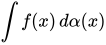
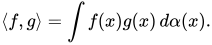
This operation is a positive semidefinite inner product on the vector space of all polynomials, and is positive definite if the function α has an infinite number of points of growth. It induces a notion of orthogonality in the usual way, namely that two polynomials are orthogonal if their inner product is zero.

Then the sequence (Pn)
n=0
of orthogonal polynomials is defined by the relations

In other words, the sequence is obtained from the sequence of monomials 1, x, x2, … by the Gram–Schmidt process with respect to this inner product.

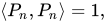
Usually the sequence is required to be orthonormal, namely, however, other normalisations are sometimes used.
Absolutely continuous case

[edit]

Sometimes we have where is a non-negative function with support on some interval [x1, x2] in the real line (where x1 = −∞ and x2 = ∞ are allowed). Such a W is called a weight function.[1] Then the inner product is given by However, there are many examples of orthogonal polynomials where the measure (x) has points with non-zero measure where the function α is discontinuous, so cannot be given by a weight function W as above.

Examples of orthogonal polynomials

[edit]

The most commonly used orthogonal polynomials are orthogonal for a measure with support in a real interval. This includes:

Discrete orthogonal polynomials are orthogonal with respect to some discrete measure. Sometimes the measure has finite support, in which case the family of orthogonal polynomials is finite, rather than an infinite sequence. The Racah polynomials are examples of discrete orthogonal polynomials, and include as special cases the Hahn polynomials and dual Hahn polynomials, which in turn include as special cases the Meixner polynomials, Krawtchouk polynomials, and Charlier polynomials.

Meixner classified all the orthogonal Sheffer sequences: there are only Hermite, Laguerre, Charlier, Meixner, and Meixner–Pollaczek. In some sense Krawtchouk should be on this list too, but they are a finite sequence. These six families correspond to the NEF-QVFs and are martingale polynomials for certain Lévy processes.

Sieved orthogonal polynomials, such as the sieved ultraspherical polynomials, sieved Jacobi polynomials, and sieved Pollaczek polynomials, have modified recurrence relations.

One can also consider orthogonal polynomials for some curve in the complex plane. The most important case (other than real intervals) is when the curve is the unit circle, giving orthogonal polynomials on the unit circle, such as the Rogers–Szegő polynomials.

There are some families of orthogonal polynomials that are orthogonal on plane regions such as triangles or disks. They can sometimes be written in terms of Jacobi polynomials. For example, Zernike polynomials are orthogonal on the unit disk.

The advantage of orthogonality between different orders of Hermite polynomials is applied to Generalized frequency division multiplexing (GFDM) structure. More than one symbol can be carried in each grid of time-frequency lattice.[2]

Properties

[edit]

Orthogonal polynomials of one variable defined by a non-negative measure on the real line have the following properties.

Relation to moments

[edit]

The orthogonal polynomials Pn can be expressed in terms of the moments

as follows:

where the constants cn are arbitrary (depend on the normalization of Pn).

This comes directly from applying the Gram–Schmidt process to the monomials, imposing each polynomial to be orthogonal with respect to the previous ones. For example, orthogonality with prescribes that must have the formwhich can be seen to be consistent with the previously given expression with the determinant.

Recurrence relation

[edit]

The polynomials Pn satisfy a recurrence relation of the form

where An is not 0. The converse is also true; see Favard's theorem.

Christoffel–Darboux formula

[edit]

Zeros

[edit]

If the measure dα is supported on an interval [ab], all the zeros of Pn lie in [ab]. Moreover, the zeros have the following interlacing property: if m < n, there is a zero of Pn between any two zeros of Pm. Electrostatic interpretations of the zeros can be given.[citation needed]

Combinatorial interpretation

[edit]

From the 1980s, with the work of X. G. Viennot, J. Labelle, Y.-N. Yeh, D. Foata, and others, combinatorial interpretations were found for all the classical orthogonal polynomials. [3]

Other types of orthogonal polynomials

[edit]

Multivariate orthogonal polynomials

[edit]

The Macdonald polynomials are orthogonal polynomials in several variables, depending on the choice of an affine root system. They include many other families of multivariable orthogonal polynomials as special cases, including the Jack polynomials, the Hall–Littlewood polynomials, the Heckman–Opdam polynomials, and the Koornwinder polynomials. The Askey–Wilson polynomials are the special case of Macdonald polynomials for a certain non-reduced root system of rank 1.

Multiple orthogonal polynomials

[edit]

Multiple orthogonal polynomials are polynomials in one variable that are orthogonal with respect to a finite family of measures.

Sobolev orthogonal polynomials

[edit]

These are orthogonal polynomials with respect to a Sobolev inner product, i.e. an inner product with derivatives. Including derivatives has big consequences for the polynomials, in general they no longer share some of the nice features of the classical orthogonal polynomials.

Orthogonal polynomials with matrices

[edit]

Orthogonal polynomials with matrices have either coefficients that are matrices or the indeterminate is a matrix.

There are two popular examples: either the coefficients are matrices or :

  • Variante 1: , where are matrices.
  • Variante 2: where is a -matrix and is the identity matrix.

Quantum polynomials

[edit]

Quantum polynomials or q-polynomials are the q-analogs of orthogonal polynomials.

Skew-orthogonal polynomials

[edit]

Orthogonal polynomials can be defined as a vector basis set of a symmetric bilinear form on polynomials. In the basis of the orthogonal polynomials, the bilinear form diagonalizes as . Similarly, given a nondegenerate skew-symmetric bilinear form on polynomials, we can find a pair of vector basis sets and , such that the bilinear form skew-diagonalizes as .

See also

[edit]

References

[edit]
Revisions and contributorsEdit on WikipediaRead on Wikipedia
from Grokipedia
Orthogonal polynomials constitute a sequence of polynomials {Pn(x)}n=0\{P_n(x)\}_{n=0}^\infty, where each Pn(x)P_n(x) is a polynomial of exact degree nn with a positive leading coefficient, that are orthogonal with respect to an inner product defined by a positive w(x)w(x) on a finite or infinite interval IRI \subseteq \mathbb{R}, satisfying IPn(x)Pm(x)w(x)dx=0\int_I P_n(x) P_m(x) w(x) \, dx = 0 for nmn \neq m and often normalized such that I[Pn(x)]2w(x)dx=1\int_I [P_n(x)]^2 w(x) \, dx = 1. This orthogonality condition arises from the L2L^2 inner product f,gw=If(x)g(x)w(x)dx\langle f, g \rangle_w = \int_I f(x) g(x) w(x) \, dx, where w(x)>0w(x) > 0 ensures the polynomials form an for the space of square-integrable functions with respect to this measure. These polynomials, first systematically studied in the 19th century by mathematicians such as , , and Carl Gustav Jacobi, form the foundation of classical families including the Legendre, Hermite, Laguerre, Jacobi, and Chebyshev polynomials, each associated with specific weight functions and intervals (e.g., on [1,1][-1, 1] with w(x)=1w(x) = 1). Their development was advanced by contributions from , Eduard Heine, and Thomas Stieltjes, culminating in Gábor Szegő's comprehensive 1939 monograph that established much of the modern theory. Orthogonal polynomials satisfy a three-term of the form Pn(x)=(Anx+Bn)Pn1(x)CnPn2(x)P_n(x) = (A_n x + B_n) P_{n-1}(x) - C_n P_{n-2}(x) with An>0A_n > 0 and Cn>0C_n > 0, which facilitates their computation and analysis. Additionally, they possess nn real, distinct zeros within the interval of orthogonality, which interlace between consecutive polynomials, a property crucial for applications in root-finding and quadrature. The significance of orthogonal polynomials extends across pure and , serving as essential tools in approximation theory for expanding functions in series (e.g., Fourier-Legendre series), for Gaussian quadrature rules that exactly integrate polynomials up to degree 2n12n-1, and for solving Sturm-Liouville eigenvalue problems and quantum mechanical systems like the (via ). They also connect to such as hypergeometric and , continued fractions via Stieltjes transforms, and moment problems in probability and statistics. In contemporary research, extensions to multiple orthogonal polynomials and non-Hermitian variants have found applications in integrable systems, random matrix theory, and . The Christoffel-Darboux formula further underscores their utility, providing a closed-form kernel for summation: k=0nPk(x)Pk(y)hk=knkn+1hnPn+1(x)Pn(y)Pn(x)Pn+1(y)xy\sum_{k=0}^n \frac{P_k(x) P_k(y)}{h_k} = \frac{k_n}{k_{n+1} h_n} \frac{P_{n+1}(x) P_n(y) - P_n(x) P_{n+1}(y)}{x - y}, where hk=I[Pk(x)]2w(x)dxh_k = \int_I [P_k(x)]^2 w(x) \, dx.

Introduction and Fundamentals

Historical Development

The study of orthogonal polynomials originated in the late 18th century amid efforts to expand functions in series for solving physical problems in and gravitation. In 1782, introduced the generating function approach in his analysis of planetary perturbations, laying the groundwork for the polynomials later formalized by others. This work connected series expansions to , motivating subsequent developments in orthogonal systems. In 1782, developed the in his memoir on the attraction of homogeneous spheroids subjected to gravity, applying them directly to expansions of gravitational potentials in spherical coordinates. 's contributions emphasized their role in solving for axisymmetric problems, marking the first systematic use of such polynomials in . The 19th century saw significant advancements through Pafnuty Chebyshev's investigations into polynomial approximation. In 1859, Chebyshev explored minimax properties of polynomials for discrete measures, establishing foundational results on best uniform approximations and introducing discrete orthogonal analogs that influenced later quadrature and techniques. Early 20th-century progress came from David Hilbert's work on integral equations, where around 1907 he developed methods for orthogonal expansions in infinite-dimensional settings, integrating them into the emerging theory of Hilbert spaces to address Fredholm-type problems. This systematization shifted focus from specific cases to general abstract frameworks, enabling applications in . Key figures and advanced the theory in the , with their collaborative 1925 volume on problems incorporating early treatments of orthogonal polynomials and their connections to complex variables and inequalities. 1939 monograph provided the first comprehensive exposition, synthesizing properties, asymptotics, and applications across branches like continued fractions and moment problems. Post-World War II developments extended classical theory to generalizations, including multivariate cases. In 1975, Tom H. Koornwinder introduced two-variable analogs of , constructing orthogonal systems on non-standard domains and bridging to hypergeometric functions. The field evolved from these classical roots into modern applications in and , with contributions from diverse regions; for instance, Indian mathematician Ambikeshwar Sharma advanced approximation theory post-1950 through studies on lacunary and orthogonal expansions.

Definition and Orthogonality Condition

Orthogonal polynomials arise in the context of Hilbert spaces of square-integrable functions. Consider the space L2(μ)L^2(\mu) consisting of measurable functions ff on R\mathbb{R} (or a subset thereof) such that f2=f(x)2dμ(x)<\|f\|^2 = \int f(x)^2 \, d\mu(x) < \infty, where μ\mu is a positive Borel measure with finite moments xndμ(x)<\int |x|^n \, d\mu(x) < \infty for all nNn \in \mathbb{N}. This space is complete with respect to the norm induced by the inner product f,g=f(x)g(x)dμ(x)\langle f, g \rangle = \int f(x) g(x) \, d\mu(x), ensuring that Cauchy sequences converge to elements within the space, which is essential for series expansions and approximation properties. A sequence of polynomials {Pn(x)}n=0\{P_n(x)\}_{n=0}^\infty is called orthogonal with respect to μ\mu if each PnP_n has exact degree nn and satisfies the orthogonality condition Pm,Pn=0\langle P_m, P_n \rangle = 0 for all mnm \neq n, with Pn,Pn=hn>0\langle P_n, P_n \rangle = h_n > 0. The measure μ\mu can be absolutely continuous, with density w(x)0w(x) \geq 0 so that dμ(x)=w(x)dxd\mu(x) = w(x) \, dx over an interval, or more generally real and positive, encompassing discrete measures supported on countable points {xk}\{x_k\} with masses wk>0w_k > 0 (where f,g=kf(xk)g(xk)wk\langle f, g \rangle = \sum_k f(x_k) g(x_k) w_k) and singular continuous measures without densities, such as those supported on Cantor sets. Normalization of the sequence can be chosen in various ways: monic polynomials have leading coefficient 1; orthonormal polynomials satisfy hn=1h_n = 1; other classical scalings fix specific values like Pn(1)=1P_n(1) = 1. Given a fixed positive measure μ\mu and normalization, the orthogonal polynomials are unique up to a nonzero scalar multiple for each degree, as they are obtained by orthogonalizing the monomial basis via processes like Gram-Schmidt. However, for non-classical measures, the underlying measure may not be uniquely determined by the moments in some indeterminate cases (e.g., Stieltjes ). Modern extensions post-2000 consider with respect to signed or complex measures, where the inner product may involve complex weights, leading to polynomials whose zeros can fill regions in the , as analyzed via Riemann-Hilbert methods for rotationally symmetric potentials.

Construction Methods

One primary method for constructing orthogonal polynomials with respect to a given positive measure μ\mu on the real line is the Gram-Schmidt orthogonalization process applied to the {1,x,x2,}\{1, x, x^2, \dots \}. This iterative procedure generates a sequence of polynomials Pn(x)P_n(x) that satisfy the orthogonality condition Pm,Pn=Pm(x)Pn(x)dμ(x)=0\langle P_m, P_n \rangle = \int P_m(x) P_n(x) \, d\mu(x) = 0 for mnm \neq n. At each step, the monomial xnx^n is projected onto the span of the previous orthogonal polynomials and subtracted to yield Pn(x)=xnk=0n1xn,PkPk,PkPk(x),P_n(x) = x^n - \sum_{k=0}^{n-1} \frac{\langle x^n, P_k \rangle}{\langle P_k, P_k \rangle} P_k(x), with P0(x)=1P_0(x) = 1. This approach ensures the polynomials are monic if desired and directly incorporates the measure through the inner products, making it versatile for arbitrary measures. A complementary theoretical and computational method uses the moments of the measure, defined as μk=xkdμ(x)\mu_k = \int x^k \, d\mu(x) for k=0,1,2,k = 0, 1, 2, \dots. These moments populate the entries of Hankel matrices Hn=(μi+j)0i,jn1H_n = (\mu_{i+j})_{0 \leq i,j \leq n-1}, and the coefficients of the monic orthogonal polynomials Pn(x)=xn+k=0n1an,kxkP_n(x) = x^n + \sum_{k=0}^{n-1} a_{n,k} x^k can be solved via linear systems Hncn=hnH_n \mathbf{c}_n = -\mathbf{h}_n, where cn\mathbf{c}_n collects the coefficients an,ka_{n,k} and hn\mathbf{h}_n is the last column of HnH_n excluding the bottom entry. Determinant-based expressions, such as an,n1=det(Hn)/det(Hn1)a_{n,n-1} = -\det(H_n)/\det(H_{n-1}), provide explicit formulas, though numerical implementation often favors the linear solve for efficiency. Favard's theorem guarantees that any sequence of monic polynomials satisfying a three-term recurrence xPn(x)=Pn+1(x)+αnPn(x)+βnPn1(x)x P_n(x) = P_{n+1}(x) + \alpha_n P_n(x) + \beta_n P_{n-1}(x) with βn>0\beta_n > 0 corresponds to orthogonal polynomials for a unique positive measure, linking moment computations to recurrence-based generation. The approach offers an analytic framework for construction, particularly suited to measures with known closed forms. A , such as the ordinary G(x,t)=n=0Pn(x)tnG(x,t) = \sum_{n=0}^\infty P_n(x) t^n or the exponential variant n=0Pn(x)tnn!\sum_{n=0}^\infty P_n(x) \frac{t^n}{n!}, is derived from the of the measure or by solving associated differential equations. For instance, kernel functions like K(x,t)=n=0Pn(x)Pn(t)hnK(x,t) = \sum_{n=0}^\infty \frac{P_n(x) P_n(t)}{h_n} (with hn=Pn,Pnh_n = \langle P_n, P_n \rangle) reproduce the polynomials via coefficients extraction, enabling explicit construction when the kernel is available. This method shines in theoretical derivations for families with hypergeometric representations, though numerical extraction requires care for convergence. Numerical implementations of these methods, especially Gram-Schmidt and moment-based, encounter stability challenges due to , where accumulated rounding errors lead to loss of and ill-conditioned Hankel matrices for high degrees. The classical Gram-Schmidt exacerbates this through subtractive cancellation in projections, but the modified Gram-Schmidt variant improves robustness by orthogonalizing each new vector against all previous ones sequentially, reducing error propagation. Additional safeguards, like selective reorthogonalization or Stieltjes procedures for moment matching, ensure backward stability, with error bounds scaling as O(nϵκ)O(n \epsilon \kappa), where nn is the degree, ϵ\epsilon machine precision, and κ\kappa the of the moment matrix. Addressing high-degree computations in applications like methods, recent algorithms (post-2020) integrate the (FFT) for efficient evaluation and implicit construction of orthogonal polynomials up to degrees exceeding 10410^4. These leverage asymptotic expansions or non-uniform FFTs to approximate integrals defining inner products in O(nlogn)O(n \log n) time, outperforming direct methods by orders of magnitude while maintaining accuracy; for example, FFT-based Clenshaw-Curtis quadrature enables stable generation via discretized moments for non-classical measures in .

Classical Examples

Continuous Orthogonal Polynomials

Continuous orthogonal polynomials form a class of orthogonal polynomials defined with respect to absolutely continuous measures on real intervals, often unbounded or semi-bounded, where the weight functions ensure the integrals converge. These polynomials satisfy the condition abpm(x)pn(x)w(x)dx=hnδmn\int_a^b p_m(x) p_n(x) w(x) \, dx = h_n \delta_{mn}, with w(x)w(x) the weight function, [a,b][a, b] the interval of , and hn>0h_n > 0 the normalization constant. The classical families—Legendre, Hermite, Laguerre, and Jacobi—emerge as solutions to Sturm-Liouville problems and are characterized by their explicit representations, including formulas. The Legendre polynomials Pn(x)P_n(x) are defined on the interval [1,1][-1, 1] with uniform weight function w(x)=1w(x) = 1. They admit the Pn(x)=12nn!dndxn(x21)n.P_n(x) = \frac{1}{2^n n!} \frac{d^n}{dx^n} (x^2 - 1)^n. Their orthogonality relation is 11Pm(x)Pn(x)dx=22n+1δmn,\int_{-1}^1 P_m(x) P_n(x) \, dx = \frac{2}{2n + 1} \delta_{mn}, where δmn\delta_{mn} is the . Legendre polynomials play a key role in applications such as the expansion of in and . The Hermite polynomials Hn(x)H_n(x), referred to as the physicist's Hermite polynomials, are defined on (,)(-\infty, \infty) with weight function w(x)=ex2w(x) = e^{-x^2}. The Rodrigues formula for them is Hn(x)=(1)nex2dndxnex2.H_n(x) = (-1)^n e^{x^2} \frac{d^n}{dx^n} e^{-x^2}. A probabilist's variant, Hen(x)=2n/2Hn(x/2)\mathit{He}_n(x) = 2^{-n/2} H_n(x / \sqrt{2})
Add your contribution
Related Hubs
User Avatar
No comments yet.