Hubbry Logo
Selective yellowSelective yellowMain
Open search
Selective yellow
Community hub
Selective yellow
logo
8 pages, 0 posts
0 subscribers
Be the first to start a discussion here.
Selective yellow
Selective yellow
from Wikipedia
Selective yellow (approximation)
 
About these coordinates     Colour coordinates
Hex triplet#FFBA00
sRGBB (r, g, b)(255, 186, 0)
HSV (h, s, v)(44°, 100%, 100%)
CIELChuv (L, C, h)(80, 100, 55°)
SourceCIECD
ISCC–NBS descriptorStrong orange yellow
B: Normalized to [0–255] (byte)
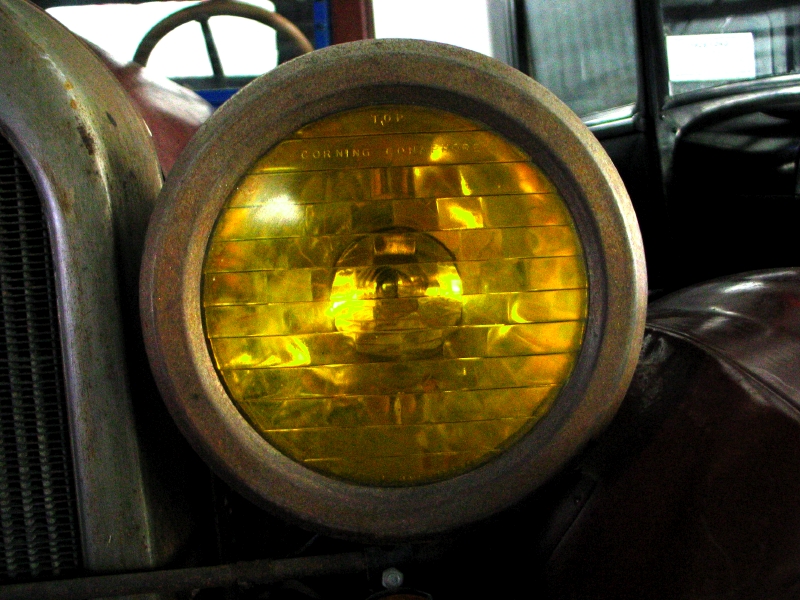
One of the first optic headlamp lenses, the Corning Conaphore made of selective yellow "Noviol" glass.

Selective yellow is a colour for automotive lamps, particularly headlamps and other road-illumination lamps, such as fog lamps.[1] Under ECE regulations, headlamps were formerly permitted to be either white or selective yellow—in France, selective yellow was mandatory for all vehicles' road-illumination lamps until 1993.

Colour

[edit]

Both the internationalized European ECE Regulation 19[2] and North American SAE standard J583[3] permit selective yellow front fog lamps. Meanwhile, ECE Regulation 48 (enforced 08 October 2016) requires new vehicles to be equipped with headlamps emitting white light.[4] However, selective yellow headlamps remain permitted throughout Europe on vehicles already so equipped, as well as in non-European locales, such as Japan[5] and New Zealand.[6]

The intent of selective yellow is to improve vision by removing short, blue to violet wavelengths from the projected light. These wavelengths are difficult for the human visual system to process properly, and they cause perceived dazzle and glare effects in rain, fog and snow.[7] Removing the blue-violet portion of a lamp's output to obtain selective yellow light can entail filter losses of around 15%,[8] though the effect of this reduction is said to be mitigated or countervailed by the increased visual acuity available with yellow rather than white light in bad weather.[7]

A research experiment done in the UK in 1968 using tungsten (non-halogen) lamps found that visual acuity is about 3% better with selective yellow headlamps than with white ones of equal intensity.[9] Research done in the Netherlands in 1976 concluded that yellow and white headlamps are equivalent as regards traffic safety, though yellow light causes less discomfort glare than white light.[10] Researchers note that tungsten filament lamps emit only a small amount of the blue light blocked by a selective-yellow filter,[9] so such filtration makes only a small difference in the characteristics of the light output,[7] and suggest that headlamps using newer kinds of sources such as metal halide (HID) bulbs may, through filtration, give off less visually distracting light while still having greater light output than halogen ones.[7]

Formal definition

[edit]

The UNECE Regulations formally define selective yellow in terms of the CIE 1931 colour space as follows:

Limit towards red
Limit towards green
Limit towards white
Limit towards spectral value

For front fog lamps, the limit towards white is extended:

Limit towards white

The entirety of the basic selective yellow definition lies outside the gamut of the sRGB colour space—such a pure yellow cannot be represented using RGB primaries. The colour swatch above is a desaturated approximation, created by taking the centroid of the standard selective yellow definition at (0.502, 0.477) and moving it towards the D65 white point, until it meets the sRGB gamut triangle at (0.478, 0.458).

References

[edit]
[edit]
Revisions and contributorsEdit on WikipediaRead on Wikipedia
from Grokipedia
Selective yellow is a form of automotive headlamp illumination produced by filtering white light to exclude shorter wavelengths in the blue, indigo, and violet spectrum, resulting in a yellowish tint that enhances contrast and reduces glare for drivers and oncoming traffic. This lighting standard originated in France, where it was mandated by a 1936 decree published in the Journal Officiel de la République Française and became effective for new vehicles in April 1937, with full implementation required by January 1939; the requirement stemmed from experiments by the French Academy of Sciences demonstrating that yellow light minimized visual fatigue and dazzle compared to whiter light sources. The filtration process typically reduces overall light output by 12–18%, yet this loss is generally imperceptible, and selective yellow was enforced on all road vehicles in France until 1993, when European Union regulations permitted a return to white headlamps. Proponents argued that selective yellow improved visibility in adverse weather conditions like fog, rain, and snow by easing the eye's adaptation to low-contrast environments and cutting backscatter from atmospheric particles, though international studies, including a 1976 analysis by the Institute for Road Safety Research (SWOV), found no statistically significant visibility advantage over white light due to the minimal spectral difference. A 2001 study by Bullough and Rea further examined performance in simulated snow driving, revealing that while yellow headlamps were subjectively perceived as less distracting and glaring (with lower discomfort ratings), any objective benefits in tracking tasks under mesopic light levels were small and not significant (p > 0.05), attributing potential gains to optimized scotopic/photopic ratios rather than color alone. Today, selective yellow remains optional in many jurisdictions and is popular for aftermarket fog lamps or auxiliary lights, particularly in regions with frequent poor weather, as it provides a practical means to mitigate glare without substantially compromising illumination intensity.

History

Origins and Introduction

Selective yellow, a filtered light used in automotive headlamps to exclude shorter blue-violet wavelengths, originated in France during the 1930s amid growing concerns over nighttime driving safety in adverse weather. French researchers, including those affiliated with the Academy of Sciences, conducted studies in the early 1930s that highlighted issues with white light's performance in fog, rain, and glare conditions. In response to these findings, the French government enacted on November 3, 1936, mandating selective yellow light for all forward-facing vehicle lamps on new cars registered after April 1, 1937, with full compliance required for existing vehicles by January 1, 1939. This decree was driven by evidence from visibility studies emphasizing the need for light that minimized driver fatigue and improved road illumination under poor conditions. The scientific rationale centered on 1930s French research demonstrating that blue light wavelengths scatter more readily in fog due to atmospheric particles—a phenomenon akin to Rayleigh scattering—resulting in reduced forward penetration and increased backscatter glare toward drivers. By filtering out these shorter wavelengths, selective yellow was selected to enhance visibility, with one study suggesting an 8% improvement in fog. Academy of Sciences experiments in 1934 further confirmed that yellow light limited dazzling effects during oncoming passes, supporting the policy's adoption. Among the first vehicles to incorporate selective yellow headlamps were models from major French manufacturers, such as the and , produced in the late , which featured yellow-tinted lenses or bulbs to meet the new standard. Initial public and industry reception was mixed but ultimately compliant, with drivers subjectively appreciating the reduced glare despite the added cost of yellow filters, which increased production expenses by requiring specialized or coatings that cut light output by about 12%. The mandate reflected a proactive approach to road safety, prioritizing empirical observations from domestic testing over international norms at the time.

Duration and Phase-Out in France

Following the enactment of the law in late 1936, selective yellow became mandatory for all road illumination lamps on new vehicles registered in France starting April 1, 1937, with the requirement extending to all vehicles by January 1, 1939. This applied to both domestically produced and imported vehicles registered in the country, ensuring uniform compliance across the French fleet. The mandate persisted through World War II and the subsequent post-war reconstruction period, remaining in effect for nearly 60 years despite wartime disruptions and economic challenges. The requirement supported a specialized manufacturing ecosystem, including the production of selective yellow bulbs tailored for the French market; this led to dedicated production lines and supply chains, as automakers and suppliers adapted to the unique national specification, which differed from white-light norms elsewhere in Europe. In 1993, the French government ended the mandatory use of selective yellow to align with broader European regulatory harmonization efforts aimed at removing trade and travel barriers through standardized vehicle technical requirements. The policy shift permitted white forward-facing lights as the default while allowing selective yellow as an optional choice, marking the end of the long-standing national standard without citing safety drawbacks as the rationale. This transition reduced the economic incentives for specialized yellow bulb production, shifting market focus toward universal white-light components.

Definition and Properties

Color Specifications

Selective yellow is formally defined in ECE regulations as light emitted from vehicle lamps that appears yellow to the unaided human eye, distinctly different from white or amber hues, and is specified by precise chromaticity boundaries in the CIE 1931 color space. The chromaticity coordinates (x, y) must lie within the area bounded by the following lines and points: the green boundary y = 1.290x - 0.100, the spectral locus, the red boundary y = 0.138 + 0.580x, the yellowish white boundary y = 0.440, and the white boundary y = 0.940 - x, with key intersection points at SY1 (0.454, 0.486), SY2 (0.480, 0.519), SY3 (0.545, 0.454), SY4 (0.521, 0.440), and SY5 (0.500, 0.440). This ensures a warm yellow appearance without excessive orange or green tones. The transmission spectrum of selective yellow filters is designed to eliminate shorter wavelengths while preserving longer ones for effective illumination. Filters block nearly all light below 480 nm (blue-violet range) and significantly attenuate the 480-510 nm blue-green range, while allowing high transmission—typically 80-85%—for wavelengths above 510 nm in the green, yellow, and red spectrum. Above 550 nm, transmission remains in the 80-90% range, minimizing light loss compared to broader filtering methods. Manufacturing standards for selective yellow involve applying specialized coatings or using tinted materials to achieve the required spectral and chromatic properties. Historically and in modern aftermarket applications, this is accomplished through yellow lacquer or paint coatings applied to the interior of headlamp lenses or reflectors, ensuring durability and minimal reflection losses. Bulbs may incorporate selective yellow glass envelopes, though cadmium-based versions are now restricted; alternatively, adhesive films or dichroic filters are used on clear lenses to replicate the effect without altering the bulb itself. These methods maintain overall light output at approximately 83-92% of unfiltered white light while meeting ECE chromaticity requirements.

Optical Characteristics

Selective yellow light is produced by filtering white light sources, such as incandescent or halogen bulbs, to primarily transmit wavelengths in the range of approximately 500 to 700 nm, encompassing green to red portions of the visible spectrum, while attenuating shorter blue and violet wavelengths below about 480 nm. This filtering results in a spectral power distribution with peak intensity in the yellow-green region around 570-590 nm, aligning closely with the peak sensitivity of the human eye under photopic conditions near 555 nm, thereby optimizing perceived brightness despite the removal of shorter wavelengths. The application of selective yellow filters typically reduces overall by 12-15% compared to unfiltered white light, as the attenuation of blue-violet components (which contribute only about 7-8% to total output in standard bulbs) is partially offset by higher transmission in the longer wavelengths. This modest loss enhances contrast for human vision by concentrating energy where the eye is most sensitive, improving without proportionally diminishing illumination effectiveness. Common filter types include absorption-based subtractive filters, such as yellow-tinted glass or coatings that absorb short wavelengths, and dichroic interference filters using multilayer coatings to reflect blue-violet light away from the beam path. These mechanisms selectively attenuate shorter wavelengths (e.g., below 500 nm) with minimal impact on longer ones, preserving beam penetration while altering the spectral composition. The resulting distribution exhibits reduced blue content, which lowers Rayleigh scattering—proportional to the inverse fourth power of wavelength—thereby decreasing atmospheric scatter compared to white light's broader blue-inclusive spectrum.

Effects on Visibility

Benefits in Adverse Weather

Selective yellow light improves visibility in fog, rain, and mist by leveraging its longer wavelengths (approximately 570–590 nm), which experience marginally less scattering from water droplets compared to shorter blue wavelengths in white light. This reduction in scattering minimizes the halo effect and backscatter that can obscure objects, allowing for clearer perception of the road ahead. Studies confirm enhanced object detection in dense fog with yellow-tinted lights; for instance, a 2023 experimental investigation found that warmer halogen headlights (emitting yellow-biased light at 3031 K color temperature) yielded the shortest target detection times, ranging from 11.75 to 100.55 seconds for yellow targets and 6.15 to 137.86 seconds for red targets, outperforming cooler white xenon and LED alternatives. These results stem from yellow light's ability to maintain higher relative luminance and contrast against hazy backgrounds, reducing the visual blur caused by atmospheric particles. In rainy conditions, selective yellow further aids visibility by decreasing specular reflections off wet road surfaces and water droplets, thereby lowering the intensity of directed toward the driver's eyes. French visibility tests from the 1930s, which informed the mandate for selective yellow, demonstrated this enhanced edge definition in misty environments, contributing to the perceived advantages in adverse . Although later international evaluations, such as those summarized in 1976, found no overwhelming superiority over white light, the French adoption persisted based on these early observations of reduced driver and improved hazard recognition in poor conditions.

Glare Reduction Mechanism

Selective yellow reduces headlight primarily by filtering out shorter wavelengths, to which the eye's short-wavelength-sensitive (S-) cones are particularly responsive, thereby minimizing discomfort and temporary for oncoming drivers in clear conditions. This filtering avoids excessive stimulation of S-cones, which correlates strongly with increased discomfort ratings, as demonstrated in psychophysical studies where -enriched elicited higher responses compared to yellow-filtered equivalents. Consequently, selective yellow produces a level equivalent to that of white dimmed by a factor of approximately 2.3, enhancing visual comfort without significantly compromising overall illumination. Selective yellow also mitigates halo effects around headlights in clear air through reduced Rayleigh scattering, where shorter blue wavelengths are preferentially scattered by air molecules, creating diffuse veiling glare and halos that degrade contrast for observers. By transmitting primarily longer wavelengths, selective yellow minimizes this intra-ocular and atmospheric scatter, resulting in sharper light source perception and lower veiling luminance for oncoming traffic. Psychologically, selective yellow is perceived as warmer and less harsh than white light, contributing to greater driver comfort and reduced visual fatigue, as noted in mid-20th-century ergonomic studies on nighttime road illumination. These investigations highlighted how such lighting color influences subjective and relaxation, with some drivers reporting enhanced ease during prolonged exposure without the stark intensity of blue-enriched sources.

Regulations and Standards

French Mandates

The mandate for selective yellow headlights in France originated with the Arrêté du 3 novembre 1936, which required all headlamps to emit yellow light to reduce glare and improve visibility in adverse conditions. This decree took effect for newly registered vehicles starting April 1, 1937, and extended to all vehicles in circulation by January 1, 1939, ensuring uniform compliance across the French road network. Non-compliance carried penalties, including fines. The scope encompassed headlights for dipped and main beams, fog lights, and auxiliary driving lamps on all motor vehicles, including motorcycles and trucks. Imported vehicles were not exempt and required retrofitting with yellow filters or gels to meet the standard before registration or use on public roads, a process often handled by or approved workshops to align foreign projectors with French specifications. Enforcement relied on police checks and, following the introduction of the annual contrôle technique in for cars over four years old, lighting color and functionality were verified during these inspections shortly before the mandate's end. Failure during these inspections could prevent certification until corrections were made, reinforcing the mandate's adherence. Due to material shortages during and immediately after , full enforcement was temporarily suspended, allowing some vehicles to operate without yellow conversion amid wartime restrictions on lighting altogether. The obligation was reinstated progressively in the late 1940s and fully by around 1950 as production resumed, with limited exemptions granted only for technically incompatible imported projectors, such as certain pre-war models, where tinted glass served as an alternative. This phase-out of waivers ensured the selective yellow standard remained a defining feature of French automotive regulations until its abolition in 1993.

International ECE Regulations

The Economic Commission for (UNECE) adopted selective yellow as a permissible color for headlamps in the under its emerging regulations, allowing member states to opt for it as an alternative to white ; this provision was not mandatory outside but stemmed from French lobbying to promote the color's visibility benefits in adverse conditions. Prior to the 02 series of amendments to ECE Regulation 48 in 1993, the regulation permitted selective yellow for dipped- and main-beam headlamps, defining it through specific coordinates lying inside the areas bounded by the lines connecting the following points: SY1 (x=0.50, y=0.40), SY2 (x=0.46, y=0.35), SY3 (x=0.40, y=0.38), SY4 (x=0.44, y=0.44), and back to SY1, along with the requirement that x + y is between 0.84 and 0.95. The photometric performance values for selective yellow were the white standards multiplied by a transmission factor of 0.84 to compensate for the filter's loss of approximately 16%. Harmonization efforts from the through the , driven by working groups like the Groupe des Rapporteurs d'Éclairage et de Signalisations Lumineuses (GRE) under UNECE, sought greater uniformity in light standards across to facilitate and consistency, ultimately rendering selective yellow optional rather than equivalent to by the 02 series of amendments to Regulation 48 in 1993. In non-European contexts, selective yellow saw brief allowances in select Asian markets, such as until the under its domestic standards prior to fuller ECE alignment, while in the United States, aftermarket retrofits to selective yellow for headlamps have been evaluated under guidelines, though generally due to requirements for white light and minimum photometric output.

Modern Applications

In the European Union, following the 1993 amendments to ECE Regulation 48, new vehicles must be equipped with headlamps emitting white light, while selective yellow is permitted exclusively for front fog lamps. However, selective yellow headlamps remain legal for retrofits on existing vehicles originally equipped with them, provided the replacement lamps comply with the regulation's photometric and chromaticity specifications. In the United States, Federal Motor Vehicle Safety Standard (FMVSS) No. 108 permits headlamps to emit white or selective yellow light, as long as they satisfy the minimum photometric performance requirements outlined in the standard and referenced SAE J578 color boundaries. There is no explicit ban on selective yellow, allowing its use in both original equipment and aftermarket applications that meet intensity and visibility criteria. As of 2025, no significant regulatory changes have altered these provisions in the EU or US, with FMVSS 108 maintaining color temperature limits between 2500K and 6000K that encompass selective yellow tones. Globally, selective yellow retains mandatory or preferred status for auxiliary fog lights in fog-prone regions; for instance, India's Automotive Industry Standard (AIS-012) requires front fog lamps to emit white or selective yellow light, reflecting ongoing emphasis on weather-specific adaptations.

Aftermarket and Optional Use

Aftermarket selective yellow solutions enable owners to retrofit standard headlights for penetration without mandatory requirements. LED conversion kits emitting at approximately 3000K , such as those offered by XenonPro, provide a warm output that filters shorter wavelengths, improving contrast in misty conditions while fitting common housings. headlight films from manufacturers like Lamin-x serve as protective overlays, adhering directly to lens surfaces to achieve the selective yellow effect and shield against rock chips or UV degradation, with options compliant for on-road use in various reflector designs. Philips ColorVision bulbs in yellow create a styled yellow glow in the headlight reflector through specialized coatings, projecting road-legal white light that meets ECE R37 standards for beam and intensity, facilitating easy plug-and-play installation in H4 or H7 sockets. In rally and off-road enthusiast applications, selective yellow lights gain popularity for their ability to cut through dust and light fog, offering better than white LEDs. Vehicles in events like the from the 2000s onward have incorporated yellow-tinted auxiliary or fog lamps to maintain visibility during night stages in arid, hazy environments, as exemplified by off-road setups using Rigid Industries' SAE-compliant selective yellow pods rated for extreme . ' selective yellow lens kits for fog lights further support this use, positioned low on for optimal scatter reduction in rainy or foggy trails common to rally terrains. Contemporary optional implementations appear in luxury vehicles and custom markets, where selective yellow enhances aesthetic appeal alongside functional benefits. Porsche models, such as the 911 series, support aftermarket yellow PPF films or tint kits that replicate a motorsport heritage look while preserving lens clarity, available through suppliers like Headlight Armor for precise fitment. In China, the aftermarket scene thrives with custom LED headlight assemblies featuring selective yellow DRLs and beams, tailored for tuning enthusiasts via platforms like Alibaba, where yellow-white hybrid options integrate into popular sedans for urban fog navigation. Despite these advantages, aftermarket selective yellow retrofits present practical limitations. Films and coatings often attenuate overall lumen output by 10-20%, potentially diminishing long-range visibility compared to unmodified white lights. Integration with adaptive headlight systems can lead to non-compliance, as mismatched color spectra disrupt auto-leveling or matrix functions designed for standard 4300K-6000K sources. Regarding , yellow LED bulbs typically general LED lifespans of 20,000-50,000 hours, but user experiences highlight accelerated degradation in high-heat environments due to phosphor coatings, necessitating earlier replacements in intensive off-road scenarios.

References

  1. https://denalielectronics.com/blogs/[blog](/page/Blog)/which-color-lens-is-best-for-my-application
Add your contribution
Related Hubs
User Avatar
No comments yet.