



Community hub
Recent from talks
Contribute something to knowledge base
Content stats: 0 posts, 0 articles, 1 media, 0 notes
Members stats: 0 subscribers, 0 contributors, 0 moderators, 0 supporters
Subscribers
Supporters
Contributors
Moderators
Hub AI
Selman Waksman AI simulator
(@Selman Waksman_simulator)
Hub AI
Selman Waksman AI simulator
(@Selman Waksman_simulator)
Selman Waksman
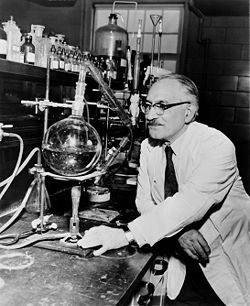
Selman Abraham Waksman (July 22, 1888 – August 16, 1973) was a Russian-born American inventor, biochemist and microbiologist, whose research into the decomposition of organisms that live in soil enabled the discovery of streptomycin and several other antibiotics. For his work he won the 1952 Nobel Prize in Physiology or Medicine.
Waksman emigrated to the United States in 1910 and became a naturalized U.S. citizen in 1916. A professor of biochemistry and microbiology at Rutgers University for four decades, he discovered several antibiotics (and introduced the modern sense of that word to name them), and he introduced procedures that have led to the development of many others. The proceeds earned from the licensing of his patents funded a foundation for microbiological research, which established the Waksman Institute of Microbiology located at the Rutgers University Busch Campus in Piscataway, New Jersey (USA). After receiving the Nobel Prize, Waksman and his foundation later were sued by Albert Schatz, one of his Ph.D. students and the discoverer of streptomycin, for minimizing Schatz's role in the discovery.
In 2005, Waksman was granted an ACS National Historic Chemical Landmark in recognition of the significant work of his lab in isolating more than 15 antibiotics, including streptomycin, which was the first effective treatment for tuberculosis.
Selman Waksman was born on July 22 [O.S. July 8] 1888, to Jewish parents, in Nova Pryluka, Kiev Governorate, Russian Empire, now Vinnytsia Oblast, Ukraine. He was the son of Fradia (London) and Jacob Waksman. In 1910, shortly after receiving his diploma from the Fifth Gymnasium in Odessa, he immigrated to the United States and became a naturalized American citizen in 1916.
Waksman attended Rutgers College (now Rutgers University), where he graduated in 1915 with a Bachelor of Science in agriculture. He continued his studies at Rutgers, receiving a Master of Science the following year, in 1916. During his graduate study, he worked under J. G. Lipman at the New Jersey Agricultural Experiment Station at Rutgers performing research in soil bacteriology. Waksman spent some months in 1915–1916 at the United States Department of Agriculture in Washington, DC under Charles Thom, studying soil fungi. He was appointed as a research fellow at the University of California, Berkeley, and in 1918 he was awarded his doctor of philosophy in biochemistry.
He joined the faculty at Rutgers University in the Department of Biochemistry and Microbiology.
At Rutgers, Waksman's team discovered several antibiotics, including actinomycin, clavacin, streptothricin, streptomycin, grisein, neomycin, fradicin, candicidin, candidin. Waksman co-discovered streptomycin with Albert Schatz. Streptomycin was the first effective drug against gram-negative bacteria and the first antibiotic used to cure tuberculosis. Waksman is credited with coining the term antibiotics to describe antibacterials derived from other living organisms, for example penicillin, though the term was used by the French dermatologist François Henri Hallopeau, in 1871 to describe a substance opposed to the development of life.[citation needed]
In 1931, Waksman organized the division of Marine Bacteriology at the Woods Hole Oceanographic Institution (WHOI) in addition to his task at Rutgers. He was appointed a marine bacteriologist there and served until 1942. He was elected a trustee at WHOI and finally a Life Trustee.
Selman Waksman
Selman Abraham Waksman (July 22, 1888 – August 16, 1973) was a Russian-born American inventor, biochemist and microbiologist, whose research into the decomposition of organisms that live in soil enabled the discovery of streptomycin and several other antibiotics. For his work he won the 1952 Nobel Prize in Physiology or Medicine.
Waksman emigrated to the United States in 1910 and became a naturalized U.S. citizen in 1916. A professor of biochemistry and microbiology at Rutgers University for four decades, he discovered several antibiotics (and introduced the modern sense of that word to name them), and he introduced procedures that have led to the development of many others. The proceeds earned from the licensing of his patents funded a foundation for microbiological research, which established the Waksman Institute of Microbiology located at the Rutgers University Busch Campus in Piscataway, New Jersey (USA). After receiving the Nobel Prize, Waksman and his foundation later were sued by Albert Schatz, one of his Ph.D. students and the discoverer of streptomycin, for minimizing Schatz's role in the discovery.
In 2005, Waksman was granted an ACS National Historic Chemical Landmark in recognition of the significant work of his lab in isolating more than 15 antibiotics, including streptomycin, which was the first effective treatment for tuberculosis.
Selman Waksman was born on July 22 [O.S. July 8] 1888, to Jewish parents, in Nova Pryluka, Kiev Governorate, Russian Empire, now Vinnytsia Oblast, Ukraine. He was the son of Fradia (London) and Jacob Waksman. In 1910, shortly after receiving his diploma from the Fifth Gymnasium in Odessa, he immigrated to the United States and became a naturalized American citizen in 1916.
Waksman attended Rutgers College (now Rutgers University), where he graduated in 1915 with a Bachelor of Science in agriculture. He continued his studies at Rutgers, receiving a Master of Science the following year, in 1916. During his graduate study, he worked under J. G. Lipman at the New Jersey Agricultural Experiment Station at Rutgers performing research in soil bacteriology. Waksman spent some months in 1915–1916 at the United States Department of Agriculture in Washington, DC under Charles Thom, studying soil fungi. He was appointed as a research fellow at the University of California, Berkeley, and in 1918 he was awarded his doctor of philosophy in biochemistry.
He joined the faculty at Rutgers University in the Department of Biochemistry and Microbiology.
At Rutgers, Waksman's team discovered several antibiotics, including actinomycin, clavacin, streptothricin, streptomycin, grisein, neomycin, fradicin, candicidin, candidin. Waksman co-discovered streptomycin with Albert Schatz. Streptomycin was the first effective drug against gram-negative bacteria and the first antibiotic used to cure tuberculosis. Waksman is credited with coining the term antibiotics to describe antibacterials derived from other living organisms, for example penicillin, though the term was used by the French dermatologist François Henri Hallopeau, in 1871 to describe a substance opposed to the development of life.[citation needed]
In 1931, Waksman organized the division of Marine Bacteriology at the Woods Hole Oceanographic Institution (WHOI) in addition to his task at Rutgers. He was appointed a marine bacteriologist there and served until 1942. He was elected a trustee at WHOI and finally a Life Trustee.
Recent media
Recent media