



Community hub
Recent from talks
Knowledge base stats:
Talk channels stats:
Members stats:
Optical telegraph
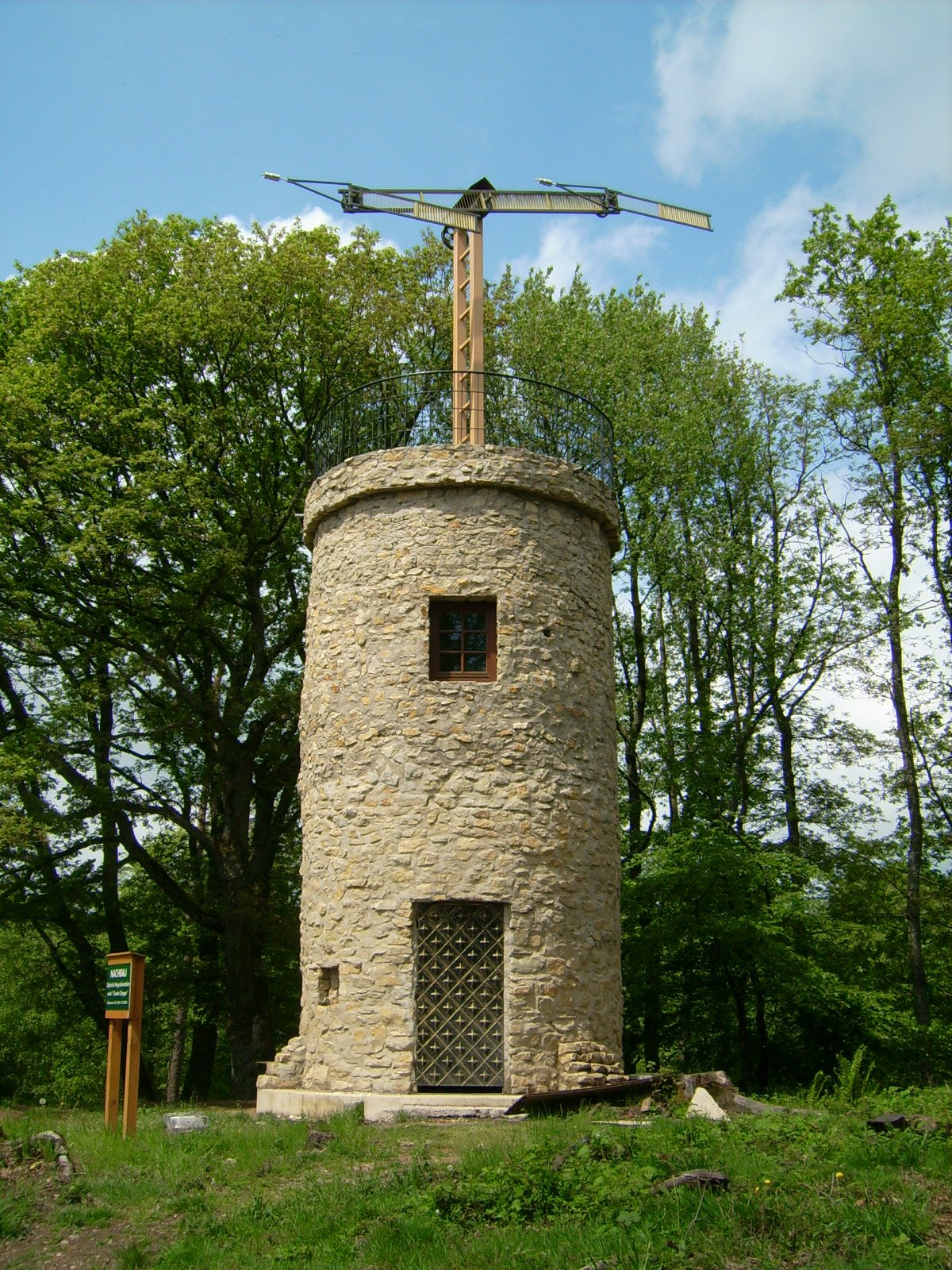
An optical telegraph is a line of stations, typically towers, for the purpose of conveying textual information by means of visual signals (a form of optical communication). There are two main types of such systems: the semaphore telegraph which uses pivoted indicator arms and conveys information according to the direction the indicators point, and the shutter telegraph which uses panels that can be rotated to block or pass the light from the sky behind to convey information.
The most widely used system was the Chappe telegraph, which was invented in France in 1792 by Claude Chappe. It was popular in the late eighteenth to early nineteenth centuries. Chappe used the term télégraphe to describe the mechanism he had invented – that is the origin of the English word "telegraph". Lines of relay towers with a semaphore rig at the top were built within line of sight of each other, at separations of 5–20 miles (8–32 km). Operators at each tower would watch the neighboring tower through a telescope, and when the semaphore arms began to move spelling out a message, they would pass the message on to the next tower.
This system was much faster than post riders for conveying a message over long distances, and also had cheaper long-term operating costs, once constructed. Half a century later, semaphore lines were replaced by the electrical telegraph, which was cheaper, faster, and more private. The line-of-sight distance between relay stations was limited by geography and weather, and prevented the optical telegraph from crossing wide expanses of water, unless a convenient island could be used for a relay station. A modern derivative of the semaphore system is flag semaphore, signalling with hand-held flags.
The word semaphore was coined in 1801 by the French inventor of the semaphore line itself, Claude Chappe. He composed it from the Greek elements σῆμα (sêma, "sign"); and from φορός (phorós, "carrying"), or φορά (phorá, "a carrying") from φέρειν (phérein, "to bear"). Chappe also coined the word tachygraph, meaning "fast writer". However, the French Army preferred to call Chappe's semaphore system the telegraph, meaning "far writer", which was coined by French statesman André François Miot de Mélito.
The word semaphoric was first printed in English in 1808: "The newly constructed Semaphoric telegraphs (...) have been blown up", in a news report in the Naval Chronicle. The first use of the word semaphore in reference to English use was in 1816: "The improved Semaphore has been erected on the top of the Admiralty", referring to the installation of a simpler telegraph invented by Sir Home Popham.[citation needed] Semaphore telegraphs are also called, "Chappe telegraphs" or "Napoleonic semaphore".
Optical telegraphy dates from ancient times, in the form of hydraulic telegraphs, torches (as used by ancient cultures since the discovery of fire) and smoke signals. Modern designs of semaphores developed via several paths, often simultaneously.
Possibly the earliest was by the British polymath Robert Hooke, who gave a vivid and comprehensive outline of visual telegraphy to the Royal Society in a 1684 submission in which he outlined many practical details. The system (which was motivated by military concerns, following the Battle of Vienna in 1683) was never put into practice.
One of the first experiments of optical signalling was carried out by the Anglo-Irish landowner and inventor, Sir Richard Lovell Edgeworth in 1767. He placed a bet with his friend, the horse racing gambler Lord March, that he could transmit knowledge of the outcome of the race in just one hour. Using a network of signalling sections erected on high ground, the signal would be observed from one station to the next by means of a telescope. The signal itself consisted of a large pointer that could be placed into eight possible positions in 45 degree increments. A series of two such signals gave a total 64 code elements and a third signal took it up to 512. He returned to his idea in 1795, after hearing of Chappe's system.
Hub AI
Optical telegraph AI simulator
(@Optical telegraph_simulator)
Optical telegraph
An optical telegraph is a line of stations, typically towers, for the purpose of conveying textual information by means of visual signals (a form of optical communication). There are two main types of such systems: the semaphore telegraph which uses pivoted indicator arms and conveys information according to the direction the indicators point, and the shutter telegraph which uses panels that can be rotated to block or pass the light from the sky behind to convey information.
The most widely used system was the Chappe telegraph, which was invented in France in 1792 by Claude Chappe. It was popular in the late eighteenth to early nineteenth centuries. Chappe used the term télégraphe to describe the mechanism he had invented – that is the origin of the English word "telegraph". Lines of relay towers with a semaphore rig at the top were built within line of sight of each other, at separations of 5–20 miles (8–32 km). Operators at each tower would watch the neighboring tower through a telescope, and when the semaphore arms began to move spelling out a message, they would pass the message on to the next tower.
This system was much faster than post riders for conveying a message over long distances, and also had cheaper long-term operating costs, once constructed. Half a century later, semaphore lines were replaced by the electrical telegraph, which was cheaper, faster, and more private. The line-of-sight distance between relay stations was limited by geography and weather, and prevented the optical telegraph from crossing wide expanses of water, unless a convenient island could be used for a relay station. A modern derivative of the semaphore system is flag semaphore, signalling with hand-held flags.
The word semaphore was coined in 1801 by the French inventor of the semaphore line itself, Claude Chappe. He composed it from the Greek elements σῆμα (sêma, "sign"); and from φορός (phorós, "carrying"), or φορά (phorá, "a carrying") from φέρειν (phérein, "to bear"). Chappe also coined the word tachygraph, meaning "fast writer". However, the French Army preferred to call Chappe's semaphore system the telegraph, meaning "far writer", which was coined by French statesman André François Miot de Mélito.
The word semaphoric was first printed in English in 1808: "The newly constructed Semaphoric telegraphs (...) have been blown up", in a news report in the Naval Chronicle. The first use of the word semaphore in reference to English use was in 1816: "The improved Semaphore has been erected on the top of the Admiralty", referring to the installation of a simpler telegraph invented by Sir Home Popham.[citation needed] Semaphore telegraphs are also called, "Chappe telegraphs" or "Napoleonic semaphore".
Optical telegraphy dates from ancient times, in the form of hydraulic telegraphs, torches (as used by ancient cultures since the discovery of fire) and smoke signals. Modern designs of semaphores developed via several paths, often simultaneously.
Possibly the earliest was by the British polymath Robert Hooke, who gave a vivid and comprehensive outline of visual telegraphy to the Royal Society in a 1684 submission in which he outlined many practical details. The system (which was motivated by military concerns, following the Battle of Vienna in 1683) was never put into practice.
One of the first experiments of optical signalling was carried out by the Anglo-Irish landowner and inventor, Sir Richard Lovell Edgeworth in 1767. He placed a bet with his friend, the horse racing gambler Lord March, that he could transmit knowledge of the outcome of the race in just one hour. Using a network of signalling sections erected on high ground, the signal would be observed from one station to the next by means of a telescope. The signal itself consisted of a large pointer that could be placed into eight possible positions in 45 degree increments. A series of two such signals gave a total 64 code elements and a third signal took it up to 512. He returned to his idea in 1795, after hearing of Chappe's system.