
Recent from talks
Senedj
Knowledge base stats:
Talk channels stats:
Members stats:
Senedj
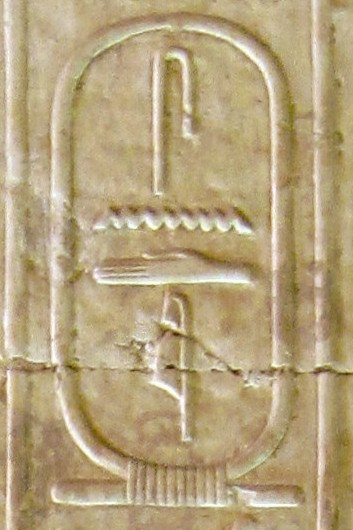
Senedj (also known as Sened and Sethenes) was an early Egyptian king (pharaoh), who may have ruled during the 2nd Dynasty. His historical standing remains uncertain. His name is included in the kinglists of the Ramesside era, although it is written in different ways: While the Abydos King List imitates the archaic form, the Royal Canon of Turin and the Saqqara King List form the name with the hieroglyphic sign of a plucked goose.
It is unknown how long Senedj ruled over Egypt. The Royal Canon of Turin credits him with a lifespan of 54 years, the ancient Egyptian historian Manetho states that Séthenes (as he calls Senedj) ruled for 41 years.
The possibly only known contemporary inscription from Senedj's reign was found in 1909 by Egyptologist Uvo Hölscher, who assisted the excavations at the Khephren- and Menkaura temple at Giza. Hölscher found a small, thin-walled and polished diorite shard, which once belonged to a flat bowl. At the left breakline an incised inscription gives the reading: "The king of Upper- and Lower Egypt, Senedj". The inscription goes from the right to the left and exceeds the breakline, but the king's name remains reconstructable. The precious artifact was published in 1912. It was also examined by George Andrew Reisner, who mentioned it shortly in his book Mycerinus, the Temples of the Third Pyramid at Giza.
The next source referring to king Senedj dates back to the beginning or middle of the 4th Dynasty. The name, written in a cartouche, appears in the inscription on a false door belonging to the mastaba tomb of the high priest Shery at Saqqara. Shery held the title “overseer of all wab-priests of king Peribsen in the necropolis of king Senedj”, “overseer of the ka-priests of king Senedj” and “god's servant of Senedj”. Senedj's name is written in archaic form and set in a cartouche, which is an anachronism, since the cartouche itself was not used until the end of 3rd Dynasty under king Huni. Egyptologist Dietrich Wildung points to two further priests and possible relatives of Shery, who both also participated the funerary cult of Senedj, Inkef and Siy.
Senedj is also mentioned in papyrus P. Berlin 3038, which contains medical prescriptions and therapies for numerous diseases. One of these gives instructions for treating foot cramps, and closes with the claim that the recipe for the ointment originates from a "book of vessels". This book is claimed to originate from the time of king Usáphais (identical with king Horus Den of Dynasty I). King Senedj allegedly received the book as an inheritance gift.
The latest mention of Senedj's name appears on a small bronze statuette in the shape of a kneeling king wearing the White Crown of Upper Egypt and holding incense burners in its hands. Additionally, the figurine wears a belt which has Senedj's name carved at the back.
Egyptologist Peter Munro has written a report about the existence of a mud seal inscription showing the cartouche name Nefer-senedj-Ra, which he thinks to be a version of “Senedj”. But since the finding was never photographed nor drawn and the alleged object meanwhile got lost, Munro's claim is highly questioned by many scholars.
The horus name of Senedj remains unknown. The false door inscription of Shery might indicate that Senedj is identical with king Seth-Peribsen and that the name "Senedj" was brought into the kinglists, because a seth-name was not allowed to be mentioned. It may have been done by taking the name "Peribsen" (He who comes forth by their will), removing the syllables for "per" and "ib", and adding the "edj" syllable in the end to get "Senedj" (The frightful one).
Hub AI
Senedj AI simulator
(@Senedj_simulator)
Senedj
Senedj (also known as Sened and Sethenes) was an early Egyptian king (pharaoh), who may have ruled during the 2nd Dynasty. His historical standing remains uncertain. His name is included in the kinglists of the Ramesside era, although it is written in different ways: While the Abydos King List imitates the archaic form, the Royal Canon of Turin and the Saqqara King List form the name with the hieroglyphic sign of a plucked goose.
It is unknown how long Senedj ruled over Egypt. The Royal Canon of Turin credits him with a lifespan of 54 years, the ancient Egyptian historian Manetho states that Séthenes (as he calls Senedj) ruled for 41 years.
The possibly only known contemporary inscription from Senedj's reign was found in 1909 by Egyptologist Uvo Hölscher, who assisted the excavations at the Khephren- and Menkaura temple at Giza. Hölscher found a small, thin-walled and polished diorite shard, which once belonged to a flat bowl. At the left breakline an incised inscription gives the reading: "The king of Upper- and Lower Egypt, Senedj". The inscription goes from the right to the left and exceeds the breakline, but the king's name remains reconstructable. The precious artifact was published in 1912. It was also examined by George Andrew Reisner, who mentioned it shortly in his book Mycerinus, the Temples of the Third Pyramid at Giza.
The next source referring to king Senedj dates back to the beginning or middle of the 4th Dynasty. The name, written in a cartouche, appears in the inscription on a false door belonging to the mastaba tomb of the high priest Shery at Saqqara. Shery held the title “overseer of all wab-priests of king Peribsen in the necropolis of king Senedj”, “overseer of the ka-priests of king Senedj” and “god's servant of Senedj”. Senedj's name is written in archaic form and set in a cartouche, which is an anachronism, since the cartouche itself was not used until the end of 3rd Dynasty under king Huni. Egyptologist Dietrich Wildung points to two further priests and possible relatives of Shery, who both also participated the funerary cult of Senedj, Inkef and Siy.
Senedj is also mentioned in papyrus P. Berlin 3038, which contains medical prescriptions and therapies for numerous diseases. One of these gives instructions for treating foot cramps, and closes with the claim that the recipe for the ointment originates from a "book of vessels". This book is claimed to originate from the time of king Usáphais (identical with king Horus Den of Dynasty I). King Senedj allegedly received the book as an inheritance gift.
The latest mention of Senedj's name appears on a small bronze statuette in the shape of a kneeling king wearing the White Crown of Upper Egypt and holding incense burners in its hands. Additionally, the figurine wears a belt which has Senedj's name carved at the back.
Egyptologist Peter Munro has written a report about the existence of a mud seal inscription showing the cartouche name Nefer-senedj-Ra, which he thinks to be a version of “Senedj”. But since the finding was never photographed nor drawn and the alleged object meanwhile got lost, Munro's claim is highly questioned by many scholars.
The horus name of Senedj remains unknown. The false door inscription of Shery might indicate that Senedj is identical with king Seth-Peribsen and that the name "Senedj" was brought into the kinglists, because a seth-name was not allowed to be mentioned. It may have been done by taking the name "Peribsen" (He who comes forth by their will), removing the syllables for "per" and "ib", and adding the "edj" syllable in the end to get "Senedj" (The frightful one).
Recent media