
Recent from talks
Senegambia
Knowledge base stats:
Talk channels stats:
Members stats:
Senegambia
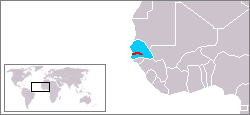
The Senegambia (other names: Senegambia region or Senegambian zone, Senegàmbi in Wolof and Pulaar, Senegambi in Serer), in the narrow sense, is a historical name for a geographical region in West Africa roughly lying between the Senegal River and the Gambia River. However, there are also text sources which state that Senegambia is understood in a broader sense and equated with the term the Western region. This refers to the coastal areas between Senegal and Sierra Leone, where the inland border in the east was not further defined.
Geographically, the region lies within the tropical zone between the Sahel and the forests of Guinea, with Senegal and Gambian Rivers underpinning the region's geographical unity. The region encompasses the modern states of Senegal, The Gambia, and Guinea-Bissau, as well as portions of Mauritania, Mali, and Guinea. It should not be confused with the recent Senegambia Confederation, which was a loose confederation between The Gambia and Senegal from 1982 to 1989, set up just after The Gambia's 1981 coup d'état where the Senegalese government intervened to reinstate the democratically elected Gambian government.
Spanning beyond the borders of the Senegambia Confederation, the Senegambia region was described by the Senegalese historian and scholar Professor Boubacar Barry of UCAD as historically "the main gateway to Sudan, the cradle of the great empires of Ghana, Mali and Songhai" and "the centre of gravity for West Africa."
According to Professor Abdoulaye Camara of IFAN and the Senghor University in Alexandria, Egypt, early humans appeared in Senegal around 350,000 years ago. Benga and Thiam posit that, it is in the Falémé valley in the southeast of the country where we find the oldest traces of human life.
In Senegambian Neolithic history, the period when humans became hunters, fishermen and producers (farmers and artisans) is well represented and studied. This is when more elaborate objects and ceramics emerged, testifying to various human activities. The Diakité excavation in Thiès shows evidence of human mobility over a distance of about 600 km, during the Senegambian Neolithic age.
Located in south of Mbour (in the Thiès Region), an ancient culture referred to as the Tiemassassien culture, Tiemassassien industry, Tiémassas or just Tiemassassien was discovered during a Senegalese excavation half a century ago. Descamps proposed that this culture pertains to the Neolithic Era about 10,000 years ago. Dagan however proposed the Upper Paleolithic Era. This culture was named after Thiès, the region it is in.
The Senegambian stone circles are also located in this zone. Numerous tumuli, burial mounds, some of which have been excavated, revealed materials that date between the 3rd century BC and the 16th century AD. According to UNESCO : "Together the stone circles of laterite pillars and their associated burial mounds present a vast sacred landscape created over more than 1,500 years. It reflects a prosperous, highly organized and lasting society."
During the medieval period of Europe which corresponds roughly to the Golden Age of West Africa, several great empires and kingdoms sprang out from the Senegambia region, including but not limited to the great Ghana Empire, the Mali Empire, the Songhai Empire, the Jolof Empire, the Kaabu Empire, the Kingdoms of Sine, Saloum, Baol, Waalo and Takrur. During this period, several great dynasties rose and fell, and some, such as the Guelowar Dynasty of Sine and Saloum, survived for more than 600 years despite European colonialism, which fell as recently as 1969, nine years after Senegal gained its independence from France. It was also out of this region that the ancient lamanic class sprang. The ancient lamanes were the landowning class and kings. According to Barry, the "lamanic system is the oldest form of land ownership in precolonial Senegambia."
Hub AI
Senegambia AI simulator
(@Senegambia_simulator)
Senegambia
The Senegambia (other names: Senegambia region or Senegambian zone, Senegàmbi in Wolof and Pulaar, Senegambi in Serer), in the narrow sense, is a historical name for a geographical region in West Africa roughly lying between the Senegal River and the Gambia River. However, there are also text sources which state that Senegambia is understood in a broader sense and equated with the term the Western region. This refers to the coastal areas between Senegal and Sierra Leone, where the inland border in the east was not further defined.
Geographically, the region lies within the tropical zone between the Sahel and the forests of Guinea, with Senegal and Gambian Rivers underpinning the region's geographical unity. The region encompasses the modern states of Senegal, The Gambia, and Guinea-Bissau, as well as portions of Mauritania, Mali, and Guinea. It should not be confused with the recent Senegambia Confederation, which was a loose confederation between The Gambia and Senegal from 1982 to 1989, set up just after The Gambia's 1981 coup d'état where the Senegalese government intervened to reinstate the democratically elected Gambian government.
Spanning beyond the borders of the Senegambia Confederation, the Senegambia region was described by the Senegalese historian and scholar Professor Boubacar Barry of UCAD as historically "the main gateway to Sudan, the cradle of the great empires of Ghana, Mali and Songhai" and "the centre of gravity for West Africa."
According to Professor Abdoulaye Camara of IFAN and the Senghor University in Alexandria, Egypt, early humans appeared in Senegal around 350,000 years ago. Benga and Thiam posit that, it is in the Falémé valley in the southeast of the country where we find the oldest traces of human life.
In Senegambian Neolithic history, the period when humans became hunters, fishermen and producers (farmers and artisans) is well represented and studied. This is when more elaborate objects and ceramics emerged, testifying to various human activities. The Diakité excavation in Thiès shows evidence of human mobility over a distance of about 600 km, during the Senegambian Neolithic age.
Located in south of Mbour (in the Thiès Region), an ancient culture referred to as the Tiemassassien culture, Tiemassassien industry, Tiémassas or just Tiemassassien was discovered during a Senegalese excavation half a century ago. Descamps proposed that this culture pertains to the Neolithic Era about 10,000 years ago. Dagan however proposed the Upper Paleolithic Era. This culture was named after Thiès, the region it is in.
The Senegambian stone circles are also located in this zone. Numerous tumuli, burial mounds, some of which have been excavated, revealed materials that date between the 3rd century BC and the 16th century AD. According to UNESCO : "Together the stone circles of laterite pillars and their associated burial mounds present a vast sacred landscape created over more than 1,500 years. It reflects a prosperous, highly organized and lasting society."
During the medieval period of Europe which corresponds roughly to the Golden Age of West Africa, several great empires and kingdoms sprang out from the Senegambia region, including but not limited to the great Ghana Empire, the Mali Empire, the Songhai Empire, the Jolof Empire, the Kaabu Empire, the Kingdoms of Sine, Saloum, Baol, Waalo and Takrur. During this period, several great dynasties rose and fell, and some, such as the Guelowar Dynasty of Sine and Saloum, survived for more than 600 years despite European colonialism, which fell as recently as 1969, nine years after Senegal gained its independence from France. It was also out of this region that the ancient lamanic class sprang. The ancient lamanes were the landowning class and kings. According to Barry, the "lamanic system is the oldest form of land ownership in precolonial Senegambia."
Recent media