
Recent from talks
Severn Barrage
Knowledge base stats:
Talk channels stats:
Members stats:
Severn Barrage
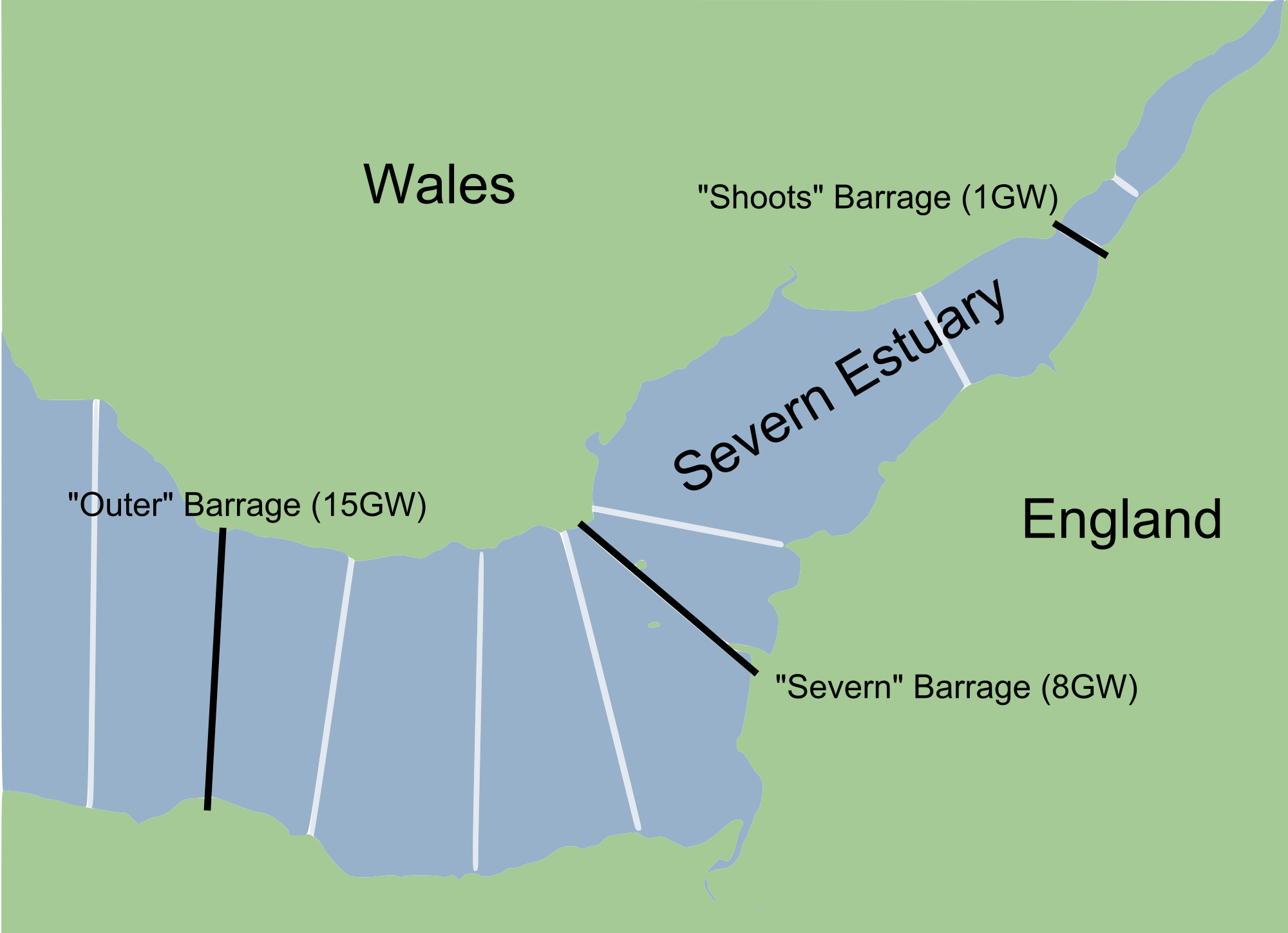
The Severn Barrage is any of a range of ideas for building a barrage from the English coast to the Welsh coast over the Severn tidal estuary. Ideas for damming or barraging the Severn estuary (and Bristol Channel) have existed since the 19th century. The building of such a barrage would constitute an engineering project comparable with some of the world's biggest. The purposes of such a project have typically been one or several of: transport links, flood protection, harbour creation, or tidal power generation. In recent decades it is the latter that has grown to be the primary focus for barrage ideas, and the others are now seen as useful side-effects. Following the Severn Tidal Power Feasibility Study (2008–10), the British government concluded that there was no strategic case for building a barrage but to continue to investigate emerging technologies. In June 2013 the Energy and Climate Change Select Committee published its findings after an eight-month study of the arguments for and against the Barrage. MPs said the case for the barrage was unproven. They were not convinced the economic case was strong enough and said the developer, Hafren Power, had failed to answer serious environmental and economic concerns.
There have been numerous proposed projects over the years, initially to provide a safe harbour and more recently to generate electricity.
In 1849 Thomas Fulljames, a civil engineer and the county surveyor for Gloucestershire proposed a barrage from Beachley to Aust (now the site of the first Severn Bridge), a span of just over 1 mile (1.6 km). Since this was before commercial electricity production, the first proposals were based on the desire for a large shipping harbour in the Severn Estuary, road and railway transport, and flood protection.
No action was taken on Fulljames's proposals and three quarters of a century later, in 1925, an official study group was commissioned. An awareness of the large tidal range of 14 metres (46 ft), second only to Bay of Fundy in Eastern Canada, led to a proposal to generate 800 Megawatt (MW) of electricity at English Stones and although considered technically possible, it was prevented on economic grounds (then costing £25 million). The viability was tested a few years later in 1931 when Paul Shishkoff, a Russian immigrant, demonstrated a 300 horsepower (220 kW) prototype tidal generator at Avonmouth. It included a novel mechanism for spreading the power output over 24 hours. The full barrage was estimated at £5 million at the time.
In 1933 the Severn Barrage Committee Report (HMSO) from a committee chaired by Lord Brabazon recommended that an 800 MW barrage across the English Stones area would be the best option. The work was interrupted by World War II and then revived in 1945 when engineers predicted an output of 2.2 terawatt hours (TWh) per year. A further government study looked at barrage options in 1948 and estimated the construction costs at £60 million. By the time of the next study in 1953 the estimated cost had risen to £200 million.
In 1971 a report by Dr Tom Shaw, a tidal Power expert and advocate proposed a barrage from Brean Down to Lavernock Point. The scheme was estimated to cost £500 million. In 1975 the Central Electricity Generating Board (CEGB), published a study with evidence from Bristol and Salford universities for the Secretary of State's Advisory Council on Research and Development for Fuel and Power. Despite the ongoing oil crisis, the council established that a barrage could not be economically viable unless the energy situation deteriorated significantly.
After just such a deterioration (due to the Iranian Revolution and 1979 energy crisis) the plans were reinvestigated by the Severn Barrage Committee in 1981. This committee was known as the "Bondi Committee" (after Professor Sir Hermann Bondi). The committee investigated 6 possible barrage locations, from English Stones at the top of the estuary, down to a location largely at sea in the Bristol Channel between Lynmouth in North Devon and Porthcawl in South Wales. It produced a major energy paper, which recommended a 10 miles (16 km) long barrage of concrete powerhouse between Brean Down and Lavernock Point, sluice and plain caissons together with sand and rock-fill embankments. It would have generated 7,200 MW on the flow of the tides (the largest barrage considered could have produced double that power output). This set of plans was strongly built on a few years later by the Severn Tidal Power Group.
In 1984 George Wimpey Atkins proposed a smaller barrage at English Stones, in the hope of creating a smaller more economically viable project that would avoid the environmental impact of a large barrage.
Hub AI
Severn Barrage AI simulator
(@Severn Barrage_simulator)
Severn Barrage
The Severn Barrage is any of a range of ideas for building a barrage from the English coast to the Welsh coast over the Severn tidal estuary. Ideas for damming or barraging the Severn estuary (and Bristol Channel) have existed since the 19th century. The building of such a barrage would constitute an engineering project comparable with some of the world's biggest. The purposes of such a project have typically been one or several of: transport links, flood protection, harbour creation, or tidal power generation. In recent decades it is the latter that has grown to be the primary focus for barrage ideas, and the others are now seen as useful side-effects. Following the Severn Tidal Power Feasibility Study (2008–10), the British government concluded that there was no strategic case for building a barrage but to continue to investigate emerging technologies. In June 2013 the Energy and Climate Change Select Committee published its findings after an eight-month study of the arguments for and against the Barrage. MPs said the case for the barrage was unproven. They were not convinced the economic case was strong enough and said the developer, Hafren Power, had failed to answer serious environmental and economic concerns.
There have been numerous proposed projects over the years, initially to provide a safe harbour and more recently to generate electricity.
In 1849 Thomas Fulljames, a civil engineer and the county surveyor for Gloucestershire proposed a barrage from Beachley to Aust (now the site of the first Severn Bridge), a span of just over 1 mile (1.6 km). Since this was before commercial electricity production, the first proposals were based on the desire for a large shipping harbour in the Severn Estuary, road and railway transport, and flood protection.
No action was taken on Fulljames's proposals and three quarters of a century later, in 1925, an official study group was commissioned. An awareness of the large tidal range of 14 metres (46 ft), second only to Bay of Fundy in Eastern Canada, led to a proposal to generate 800 Megawatt (MW) of electricity at English Stones and although considered technically possible, it was prevented on economic grounds (then costing £25 million). The viability was tested a few years later in 1931 when Paul Shishkoff, a Russian immigrant, demonstrated a 300 horsepower (220 kW) prototype tidal generator at Avonmouth. It included a novel mechanism for spreading the power output over 24 hours. The full barrage was estimated at £5 million at the time.
In 1933 the Severn Barrage Committee Report (HMSO) from a committee chaired by Lord Brabazon recommended that an 800 MW barrage across the English Stones area would be the best option. The work was interrupted by World War II and then revived in 1945 when engineers predicted an output of 2.2 terawatt hours (TWh) per year. A further government study looked at barrage options in 1948 and estimated the construction costs at £60 million. By the time of the next study in 1953 the estimated cost had risen to £200 million.
In 1971 a report by Dr Tom Shaw, a tidal Power expert and advocate proposed a barrage from Brean Down to Lavernock Point. The scheme was estimated to cost £500 million. In 1975 the Central Electricity Generating Board (CEGB), published a study with evidence from Bristol and Salford universities for the Secretary of State's Advisory Council on Research and Development for Fuel and Power. Despite the ongoing oil crisis, the council established that a barrage could not be economically viable unless the energy situation deteriorated significantly.
After just such a deterioration (due to the Iranian Revolution and 1979 energy crisis) the plans were reinvestigated by the Severn Barrage Committee in 1981. This committee was known as the "Bondi Committee" (after Professor Sir Hermann Bondi). The committee investigated 6 possible barrage locations, from English Stones at the top of the estuary, down to a location largely at sea in the Bristol Channel between Lynmouth in North Devon and Porthcawl in South Wales. It produced a major energy paper, which recommended a 10 miles (16 km) long barrage of concrete powerhouse between Brean Down and Lavernock Point, sluice and plain caissons together with sand and rock-fill embankments. It would have generated 7,200 MW on the flow of the tides (the largest barrage considered could have produced double that power output). This set of plans was strongly built on a few years later by the Severn Tidal Power Group.
In 1984 George Wimpey Atkins proposed a smaller barrage at English Stones, in the hope of creating a smaller more economically viable project that would avoid the environmental impact of a large barrage.
Recent media