Hubbry Logo
Sgian-dubhSgian-dubhMain
Open search
Sgian-dubh
Community hub
Sgian-dubh
logo
8 pages, 0 posts
0 subscribers
Be the first to start a discussion here.
Sgian-dubh
Sgian-dubh
from Wikipedia

Staghorn sgian dubh
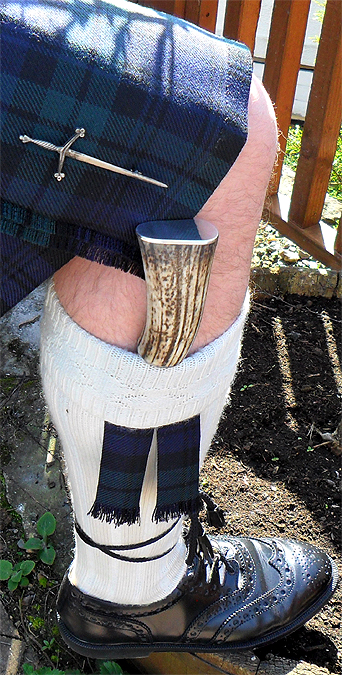
A sgian-dubh being worn on the leg

The sgian-dubh (/ˌskən ˈd/ skee-ən-DOO; Scottish Gaelic pronunciation: [s̪kʲənˈt̪u]) – also anglicized as skene-dhu[1] – is a small, single-edged knife (Scottish Gaelic: sgian) worn as part of traditional Scottish Highland dress. It is now worn tucked into the top of the kilt hose with only the upper portion of the hilt visible. The sgian-dubh is normally worn on the same side as the dominant hand.

Etymology and spelling

[edit]

The name comes from the Scottish Gaelic sgian-dubh, from sgian ('knife') and dubh ('black', also with the secondary meaning of 'hidden'.[2]). Although sgian is feminine, so that a modern Gael might refer to a black knife as sgian dhubh, the term for the ceremonial knife is a set-phrase containing a historical form with blocked lenition.[3][4] Other spellings are found in English, including skean-dhu[5] and skene-dhu.[6] The Gaelic plural, sgianan-dubha, is only rarely encountered in English.

Origins

[edit]
Portrait by Henry Raeburn of Alasdair Ranaldson MacDonell of Glengarry in 1812

The sgian-dubh may have evolved from the sgian-achlais, a dagger that could be concealed under the armpit. Used by the Scots of the 16th, 17th and 18th centuries, this knife was slightly larger than the average modern sgian-dubh and was carried in the upper sleeve or lining of the body of the jacket.[7]

Draconian Scots laws introduced by the Scots Privy Council under the Stewart King in the late 1500s; intended to reduce interclan honour feuds and duelling included the outlawing of hidden weapons. {Basilikon Doron 1599}. This writ by the Scots King was impossible to enforce North of the Highland Line and so the carrying of weapons continued in the Highlands until the suppression period post Culloden in 1746. Nevertheless, the transition from the carrying of the last resort weapon (Sgian) may have begun to transition from armpit pocket to top of hose on the leg at this time. However, codes of Highland courtesy and etiquette would demand that when entering the home of a friend, any concealed weapons would be revealed. It follows that the sgian-achlais would be removed from its hiding place and displayed in the stocking top held securely by the garters.[8]

The sgian-dubh also resembles the small skinning knife that is part of the typical set of hunting knives. These sets contain a butchering knife with a 9-to-10-inch (23 to 25 cm) blade, and a skinner with a blade of about 4 inches (10 cm). These knives usually had antler handles, as do many early sgian-dubhs. The larger knife is likely the ancestor of the modern dirk.[9][10][11]

The sgian-dubh can be seen in portraits of kilted men of the mid-19th century. A portrait by Sir Henry Raeburn of Colonel Alasdair Ranaldson MacDonell of Glengarry hangs in the National Gallery of Scotland; it shows hanging from his belt on his right hand side a Highland Scottish dirk, and visible at the top of his right stocking what appears to be a nested set of two sgian-dubhs. A similar sgian-dubh is in the collection of The National Museum of Antiquities of Scotland.[12]

Construction

[edit]
Selection of sgian-dubhs

The early blades varied in construction, some having a "clipped" (famously found on the Bowie knife) or "drop" point. The "spear-point" tip has now become universal. The earliest known blades, some housed in the National Museum of Scotland in Edinburgh, are made from German or Scandinavian steel, which was highly prized by the Highlanders. Scalloped filework on the back of the blade is common on all Scottish knives. A short blade of 3 to 3.5 inches (7.5 to 9 cm) is typical.[citation needed]

Traditionally the scabbard is made of leather reinforced with wood and fitted with mounts of silver or some other metal which may be cast or engraved with designs ranging from Scottish thistles, Celtic knotwork, or heraldic elements such as a crest. While this makes for more popular and expensive knives, the sheath is hidden from view in the stocking while the sgian-dubh is worn. The sheaths of many modern sgian-dubhs are made of plastic mounted with less expensive metal fittings.

Since the modern sgian-dubh is worn mainly as a ceremonial item of dress and is usually not employed for cutting food or self-defence, blades are often of a simple construction. These are typically made from stainless steel. The hilts used on many modern sgian-dubhs are made of plastic that has been molded to resemble carved wood and fitted with cast metal mounts and synthetic decorative stones. Some are not even knives at all, but a plastic handle and sheath cast as one piece. Other examples are luxurious and expensive art pieces, with hand-carved ebony or bog wood hilts, sterling silver fittings and may have pommels set with genuine cairngorm stones and blades of Damascus steel or etched with Celtic designs or heraldic motifs.

Legality

[edit]

When worn as part of the national dress of Scotland, the sgian-dubh is legal in Scotland, England, and Wales: in Scotland under the Criminal Law (Consolidation) (Scotland) Act 1995 s. 49(5)(c);[13] in England and Wales under the Criminal Justice Act 1988 (s. 139)[14] and the Offensive Weapons Act 1996 (s. 4).[15] However, the wearing of the sgian-dubh is sometimes banned in Britain in areas with zero tolerance weapons policies or heightened security concerns. For example, they were banned from a school dance in Scotland,[16] and initially banned for the June 2014 celebration of the Battle of Bannockburn.[17]

People travelling by air with a sgian-dubh are now globally prohibited from having it in the cabin, but it is allowed in checked baggage.[18][19][20]

Piper Jeff McCarthy was fined CA$221 on 2 November 2016 for wearing a sgian-dubh in his kilt hose while performing in Montreal, Canada at the McGill University convocation ceremony.[21] McCarthy immediately contested the fine, which was ultimately cancelled by The City of Montreal in May 2018; his knife was returned.[22]

See also

[edit]

References

[edit]
[edit]
Revisions and contributorsEdit on WikipediaRead on Wikipedia
from Grokipedia
The sgian-dubh is a small, single-edged knife integral to traditional Scottish Highland dress, customarily inserted into the top of the wearer's hose or stocking with the handle visible above the cuff. Derived from Scottish Gaelic, the term "sgian-dubh" translates literally as "black knife," where "sgian" denotes a knife, dagger, or blade, and "dubh" signifies black, possibly alluding to the knife's concealed or dark handle sheath. Its origins trace to practical utility knives used for tasks like skinning in hunting, evolving from concealed armpit daggers known as sgian-achlais during periods when Highlanders carried hidden weapons for defense or surprise. By the 17th or 18th century, following cultural shifts such as the post-Culloden Disarming Act, the sgian-dubh transitioned to a visible, ceremonial accessory symbolizing Scottish heritage and hospitality when worn with formal kilts. Modern sgian-dubhs often feature , horn, or handles engraved with crests or Celtic motifs, paired with blades of or , though authentic historical examples emphasize functionality over ornamentation. While primarily decorative today in contexts like weddings and , the knife retains its roots as a multi-purpose tool, underscoring the pragmatic of Highland culture.

Etymology and Terminology

Name and Linguistic Origins

The term sgian-dubh originates from , a Goidelic Celtic language spoken historically in the . In Gaelic, sgian denotes a , , or , derived from ancient roots associated with cutting tools, while dubh means black, resulting in the direct translation "black ". This nomenclature likely references the dark-colored handle, often crafted from blackened horn, , or , which was traditional in early examples from the 17th and 18th centuries. Interpretations of dubh extend beyond literal color to imply "hidden" or "secret," reflecting the sgian-dubh's historical role as a concealed utility or defensive blade, possibly evolving from the sgian achlais (armpit knife) carried under clothing before being displayed in the stocking top as a gesture of trust. This dual connotation underscores the knife's practical origins in Highland life, where it served discreet functions amid restrictive weapon laws post-1746, such as the Disarming Act following the Jacobite Rising. Primary linguistic evidence favors the "black knife" rendering, with "hidden" as a secondary supported by contextual usage rather than strict .

Spelling and Pronunciation Variations

The spelling of sgian-dubh varies due to inconsistencies in transliterating into English orthography, with common forms including sgian dubh (unhyphenated and often lowercase), Sgian Dubh (capitalized as proper nouns), and anglicized variants such as skene-dhu, skean-dhu, or skeen-dhu. These differences arise from historical efforts to approximate Gaelic phonetics in , where the hyphenated sgian-dubh has become the predominant standard in contemporary references to distinguish the compound term. Early 19th-century English texts occasionally rendered it as skean ochles or similar, reflecting phonetic adaptations rather than literal translation. Pronunciation in Scottish Gaelic approximates [s̪kʲənˈt̪u], with sgian featuring a silent 'g' akin to "skee-an" or "skian" (IPA /skiən/ or /skʲɪən/), and dubh as "doo" (/duː/), yielding an anglicized rendering of "skee-ən doo" or "skian doo". Regional dialects influence delivery, such as a more throaty "dh" in dubh resembling a soft "v" or in western Highlands speech, while English speakers often simplify to "skin doo" or "jee-an doo," diverging from Gaelic norms. Audio resources confirm the core Gaelic stress on the second syllable, emphasizing dubh as hidden or concealed in .

Historical Development

Ancient and Medieval Precursors

The basic blade shape of the sgian-dubh, characterized by a short, triangular, single-edged form, traces its origins to artifacts in , with archaeological evidence indicating continuity from approximately 2500–800 BCE. An archaeologist at the has confirmed that this blade morphology predates the Highland sgian-dubh by millennia, appearing in early metalwork such as dirks and specialized tools like slug knives used for cutting and processing materials. These early blades, often cast in copper alloys, served utilitarian functions including and animal processing, reflecting the practical demands of prehistoric Highland societies without evidence of ornate decoration. Celtic influences from the Iron Age onward further shaped these precursors, with small utility knives adapted for skinning, food preparation, and , drawing from broader Indo-European designs prevalent across . Such knives, typically lacking crossguards and featuring simple organic handles, aligned with the multifunctional ethos later embodied in the sgian-dubh, as evidenced by Viking-era imports and local adaptations in around 500 BCE–500 CE. In the medieval period (c. 500–1500 CE), these evolved into robust, concealable daggers serving as everyday tools and backup weapons, with forms like the ballock dagger providing structural precedents for Scottish blades through their ergonomic hilts and stabbing efficiency. A notable example is a 3-inch hollow-ground blade unearthed near , , in 2020, dated to the medieval era and identified by the finder as resembling an early skean dhu due to its compact size and edge geometry suitable for utility tasks. These artifacts underscore a gradual refinement toward the sgian-dubh's profile, prioritizing portability and versatility amid feudal Highland life, though without the ceremonial integration seen in later centuries.

17th-19th Century Evolution

During the 17th and 18th centuries, the sgian-dubh evolved primarily from the sgian-achlais, a concealed carried under the armpit or in the upper by Highland Scots as a hidden weapon. This precursor knife was slightly larger than later forms, with examples including a relic associated with the in 1746 and another dated to the held by the Royal Museum of . Highland custom during this period required visitors to a host's home to lay aside larger arms like the or broadsword and transfer the sgian-achlais to the top of the for visibility, symbolizing trust and absence of threat. By the late 18th century, artifacts indicate a shift toward more standardized small knives suitable for stocking wear, with the earliest known example in the National Museums Scotland collection featuring a crude wooden handle and pewter pommel. Paintings from around 1805–1812, such as Sir Henry Raeburn's portrait of Colonel Alastair Ranaldson Macdonell of Glengarry (c. 1812), depict Highland nobility openly displaying the sgian-dubh hilt above the stocking, suggesting its transition from purely concealed utility to a visible element of attire. In the , particularly during the , the sgian-dubh became formalized as part of romanticized , with wearing tucked into the hose originating then rather than earlier. Surviving examples from this period, such as those with horn grips, brass mounts, and leather sheaths in museum collections, reflect growing ornamental elaboration while retaining practical single-edged blades for utility. This evolution aligned with broader cultural revival post the 1746 Disarming Act, emphasizing symbolism over martial concealment.

20th Century Standardization and Revival

The sgian-dubh achieved greater consistency in form and function during the as part of formalized Highland regimental uniforms, where it served as a ceremonial accessory for officers in units like the . These regiments maintained its inclusion in dress uniforms for parades and formal duties, reflecting ongoing military adoption post-19th-century standardization. Examples from both World Wars illustrate its practical and symbolic persistence among Scottish troops, often with plain or regimental-patterned blades and handles adapted for field use alongside ceremonial variants. While no rigid dimensions were enforced—blades typically ranged from 3 to 4 inches with varying handle materials like horn or wood—the knife's placement in the became conventional for visibility and tradition. Civilian revival paralleled military use, with the sgian-dubh integrated into , piping events, and formal attire, emphasizing its role in preserving Scottish identity amid 20th-century cultural shifts. Artisans produced ornamental versions with silver mounts and crests, catering to communities and tourists, though core designs echoed earlier utility knives rather than introducing novel standards. This period marked its transition to a near-universal of Highland heritage, exempt from general blade carry restrictions when worn as national dress.

Design and Construction

Blade Specifications

The blade of a traditional sgian-dubh is single-edged, designed for utility tasks such as cutting and piercing, with a length typically ranging from 3 to 3.5 inches (7.6 to 8.9 cm). This compact size facilitates concealment in while maintaining functionality, though historical examples occasionally feature blades up to 4 inches (10 cm) for skinning or butchering variants. Forged from high-carbon , such as 1065 grade, the achieves a suitable for retaining a sharp edge under light use, often with a factory-sharpened . Traditional construction emphasizes a robust spine for strength, with thicknesses of approximately 0.135 to 0.14 inches (3.4 to 3.6 mm) at the base, tapering toward the point. width measures about 0.75 to 1 inch (19 to 25 mm), providing balance without excessive bulk. The profile is generally straight-edged with a clipped or point, enabling precise incisions, though modern reproductions may incorporate V-grinds or stainless steels like 154CM for resistance at the expense of traditional edge retention. Historical blades, drawn from 17th-19th century Highland artifacts, prioritize unadorned functionality over ornate , reflecting their concealed role rather than ceremonial display.

Handle, Sheath, and Materials

The hilt of the traditional sgian-dubh is typically crafted from natural materials such as bog oak (also known as bogwood), which provides the dark coloration alluded to in the knife's name deriving from Gaelic "dubh" meaning black, or from antler and horn sourced locally in the Scottish Highlands. Early examples from the 18th century onward often featured simple antler hilts, reflecting utilitarian origins before more elaborate carvings emerged in the 19th century. Prized specimens incorporate hand-carved ebony or bog wood hilts with sterling silver fittings, sometimes set with clan crest stones or engraved motifs for ceremonial distinction. The , or sheath, is constructed with a wooden core—often from sturdy hardwoods like or —for structural reinforcement, overlaid with stitching to form a fitted pouch that secures the while allowing easy access when tucked into Highland hose. By the , this design standardized with leather-bound wood, occasionally adorned with metal mounts such as silver or tips to prevent wear and add ornamental value, ensuring compatibility with formal attire. Tension mechanisms, like embedded springs of softer metal, may line the interior to retain the firmly without damaging . Overall construction integrates the tang—typically peened or pinned into the —directly with the , eschewing guards for a compact profile suited to , with materials emphasizing durability from Highland-sourced organics over imported synthetics in authentic historical replicas.

Craftsmanship Techniques

Traditional sgian-dubh are hand-forged from high-carbon or bars, typically measuring 3 to 4 inches in length with a single-edged, triangular profile lacking a guard. Artisans the to a red-hot in a before hammering it on an to rough out the shape, followed by drawing out the bevels and point. Post-forging, the undergoes for hardness, then refinement through filing, rasping, and grinding to achieve a sharp edge and optional dimples along the spine for traditional aesthetic. Handles are crafted from natural materials such as stag , horn, or hardwood like from whisky barrel staves, selected for durability and cultural resonance. The tang of the is inserted into a drilled or hole in the material, which is then shaped using rasps, files, and tools to form a smooth, ergonomic grip often featuring subtle facets or crest inlays. A metal or pommel may be forged and peened over the tang end to secure the assembly, ensuring structural integrity without visible fasteners. Sheaths are constructed from or , with wooden variants hollowed from two matching halves—such as or —traced to the profile and glued after minimal gouging to hold the knife snugly. sheaths involve stitching around a form-fitted liner, sometimes incorporating a tension spring of softer metal like silver to retain the . Contemporary artisans maintain these methods for authenticity, though modern replicas may employ stock removal from pre-cut blanks rather than full forging to streamline production while preserving hand-finished details.

Traditional and Practical Uses

Utility and Martial Applications

The sgian-dubh originated as a practical utility knife derived from the small skinning blade in traditional Highland hunting kits, known as gralloch sets, used for field dressing game. It facilitated everyday tasks such as cutting food, preparing meals, and serving as an eating utensil, often pairing with the larger dirk for finer work in domestic or outdoor settings. This role emphasized its function as a versatile tool rather than a primary implement, reflecting the self-reliant lifestyle of Highlanders where multi-purpose edged tools were essential for survival without specialized equipment. In martial applications, the sgian-dubh functioned as a concealed secondary for personal defense, tucked into the or to remain hidden until needed in close combat. It served as a last-resort for hand-to-hand fighting when rifles, swords, or the belt were lost or impractical, leveraging its compact size—typically a blade under 3 inches—for quick deployment in skirmishes or ambushes common in warfare. Historical accounts position it as a discreet sidearm complementing overt weaponry, aligning with the tactical emphasis on surprise and mobility in Scottish Highland tactics during the 17th and 18th centuries.

Integration into Highland Attire

The sgian-dubh forms an integral accessory in traditional Scottish , positioned by tucking the sheathed blade into the upper edge of the on the wearer's dominant-hand side, with only the handle exposed above the for visibility. This placement, typically just below the and centered on the outer calf, aligns the knife's parallel to the leg, ensuring the blade points inward toward the body to minimize risk during movement. The , often gartered below the with flashes of or plain wool, secures the sgian-dubh in place, complementing other elements like the , , and at the belt to evoke a balanced, symmetrical formal rooted in 19th-century regimental standardization. In ceremonial contexts, such as weddings or , the sgian-dubh's integration emphasizes heritage over utility, with the visible handle—frequently crafted from , stag horn, or stone—serving as a customizable focal point that matches the wearer's or outfit accents. Right-handed individuals conventionally wear it in the right , while left-handers opt for the left, adapting to personal for practical draw if needed, though modern etiquette prioritizes aesthetics and prohibits unsheathing in company. Dress variants, distinguished by ornate hilts without functional blades, maintain this positioning but may incorporate subtle pinning to the for added stability during prolonged wear, as seen in formal black-tie ensembles since the early 20th century. This attire integration traces to post-1745 Jacobite adaptations, where the once-concealed knife was overtly displayed in the hose upon entering a host's as a of trust, evolving into a standardized component of the full Highland rig by the amid romanticized revival of clan customs. Today, protocol from kilt societies mandates its inclusion in authentic outfits to preserve cultural authenticity, distinguishing formal Highland wear from casual or Lowland variants lacking such detailing.

Ritual and Everyday Functions

The sgian-dubh historically functioned as a practical in everyday Highland life, employed for tasks such as skinning during hunts, cutting food, and preparing materials like leather or rope, evolving from the smaller blade in a traditional set of gralloch knives used by hunters. It also served as a concealed tool, tucked under the arm or in clothing for discreet protection during travel or social encounters, reflecting the martial readiness of Scottish clansmen in eras of frequent feuding. In ritual contexts, the sgian-dubh transitioned from concealment to visible display as part of , where upon entering a host's home, the bearer would remove larger weapons like the and place the sgian-dubh openly in the top, symbolizing trust, peace, and transparency to avoid perceptions of threat. This practice underscored its role in social and ceremonial protocols during gatherings or formal visits, emphasizing honor and restraint. Contemporary ritual use integrates the sgian-dubh into formal Highland attire for events such as weddings, military ceremonies, and cultural festivals, where it completes the kilt ensemble as a marker of Scottish heritage and warrior tradition, often carried by pipers or participants in processions. For everyday functions today, functional versions remain versatile tools for minor practicalities, including opening bottles, paring fruit, or serving as letter openers, preserving its utility beyond ornamentation while adhering to legal limits on bladed versions in non-ceremonial settings.

Cultural and Symbolic Role

Significance in Scottish Heritage

The sgian-dubh embodies a core element of Scottish Highland heritage, serving as a tangible link to the martial and communal traditions of society. Historically derived from practical skinning knives used in , known as part of the gralloch set, it transitioned into a concealed accessory that evaded the restrictions imposed by the Disarming Act of 1746 and the parallel Dress Act, which prohibited traditional weapons and Highland attire until their repeal in 1782. This survival underscores its role in preserving cultural practices amid efforts to suppress Jacobite influences following the in 1746. In Scottish identity, the sgian-dubh symbolizes courage, strength, and resourcefulness, reflecting the defensive ethos of Highland clans where it functioned as a last-resort weapon during conflicts like the Jacobite Risings from 1688 to 1746. Worn visibly in the stocking as a of trust and respect in formal settings, it complemented larger arms like the , signifying honor and camaraderie among wearers. Its integration into highlights the ingenuity of Highlanders in maintaining symbolic elements of their heritage under legal constraints. The Victorian era's romantic revival of Highland culture, spurred by figures like Sir Walter Scott and Queen Victoria's interest post-1822, standardized the sgian-dubh as a ceremonial item in national dress, transforming it from a utilitarian tool into an enduring emblem of Scottish pride. Today, it reinforces cultural continuity in events such as weddings, , and gatherings, where it evokes ancestral resilience and fosters a sense of communal identity unbound by historical proscriptions.

Representations in Art and Literature

![Sir Henry Raeburn's portrait of Colonel Alastair Ranaldson Macdonell of Glengarry]float-right The sgian-dubh features prominently in early 19th-century Scottish portraiture as an element of Highland dress. Sir Henry Raeburn's 1812 oil painting of Colonel Alastair Ranaldson Macdonell, 15th Chief of Glengarry, depicts the knife tucked into the right hose, marking one of the earliest visual records of its placement in modern form. This portrait, completed between 1810 and 1812, captures the sgian-dubh's hilt visible above the stocking, emphasizing its role in formal attire among Highland nobility. Additional portraits from the mid-1800s, including those of kilted figures, consistently illustrate the sgian-dubh in the stocking top, reflecting its standardization post-Disarming Act of 1746. In , direct references to the sgian-dubh are sparse, with most allusions tied to its evolutionary precursors amid romanticized Highland narratives. Sir Walter Scott's Waverley (1814) describes the sgian achlais, an armpit-concealed akin to the sgian-dubh's origins, worn by characters like Fergus Mac-Ivor to symbolize concealed weaponry in Jacobite contexts. Scott's portrayal, influenced by figures such as who modeled Mac-Ivor, helped codify Highland accessories in popular imagination, though the fully evolved sock-worn sgian-dubh emerged later in visual rather than textual depictions. Later 19th-century works, including those evoking , reference skene-dhus as utilitarian blades in outlaw lore, underscoring the knife's dual utility and symbolic status.

Modern Ceremonial Adaptations

In modern Scottish Highland dress, the sgian-dubh serves predominantly as a ceremonial during formal events, including weddings, black-tie gatherings, and ceilidhs, where it is tucked into the with only the visible to signify and readiness. This shift from practical utility to symbolic display reflects post-19th-century adaptations, emphasizing heritage over combat or everyday tasks, as evidenced by its integration into standardized formal attire codes established by organizations like the Scottish Tartans Authority. Distinctions between "daywear" and "dress" sgian-dubhs have emerged for ceremonial contexts, with dress variants featuring restrained black wooden handles and fittings to align with evening formalities, avoiding ornate stones or colors unsuitable for black-tie standards. Grooms at Scottish weddings often select sgian-dubhs matched to or suit elements, such as clan crests on the , enhancing personal symbolism while adhering to these subdued . Safety-oriented modifications, including rounded or retractable blunt blades, represent a key 21st-century adaptation to mitigate risks in public venues and comply with event security protocols, without altering the visible traditional form. Some wearers opt for contemporary fixed-blade knives adapted as sgian-dubhs, prioritizing edge retention for minor utility during extended ceremonies, though purists critique this as diverging from ornamental intent. These changes preserve cultural continuity amid evolving social norms, with production peaking around formal seasons like summer wedding periods, as reported by Highland outfitters.

Status in the

In the , possession of bladed articles in public is regulated under legislation such as the Criminal Justice Act 1988, the Knives Act 1997, and the Offensive Weapons Act 2019, which prohibit carrying knives without good reason or lawful authority, with exceptions for folding blades not exceeding 3 inches in length. Fixed-blade knives, including those typical of the sgian-dubh with blades often 3 to 4 inches long, generally require justification to avoid classification as an . When worn as an integral component of traditional Scottish Highland dress, such as a ensemble, the sgian-dubh qualifies as a permitted cultural or national costume item across , , constituting "good reason" under the . This exemption derives from interpretations of the (Consolidation) (Scotland) Act 1995 and sections 3 and 4 of the Offensive Weapons Act 1996, which recognize Scottish national attire as a valid context for carrying such a without intent to use as a . Police enforcement typically accepts this when the attire is authentic and complete, though discretion applies and isolated carrying outside formal dress may invite scrutiny or seizure. Contemporary guidance emphasizes that the sgian-dubh must not be modified for combat utility, such as with locking mechanisms or excessive length, to remain compliant; ornamental or blunt versions are sometimes recommended for venues with heightened security, like airports or events, despite no blanket prohibition in statute. No amendments in the Offensive Weapons Act 2019 altered this cultural allowance, preserving its status for ceremonial use in public settings like weddings or Highland gatherings. operates under analogous but separately enforced provisions, where similar cultural defenses may apply but warrant local verification.

International Restrictions and Exceptions

The sgian-dubh is classified as a sharp object under international security standards, prohibiting its carriage in passenger cabins on commercial flights. The (IATA) requires all knives and cutting implements, regardless of cultural context, to be placed in . Similarly, the U.S. (TSA) explicitly bans knives with blades in carry-on luggage, permitting them only in checked bags where they must be sheathed or wrapped to prevent injury. No exemptions for customary dress, such as Highland attire, are recognized by for cabin transport, though transport is generally permitted worldwide unless overridden by airline-specific policies. In the United States, post-arrival possession and public carry of a sgian-dubh fall under state-level knife laws, which typically allow small fixed-blade like the sgian-dubh (3-4 inches) for non- in many jurisdictions, though restrictions apply in states such as and New York. Federal import is unrestricted for personal use if declared, but local ordinances may treat it as a or . In , importation is lawful for fixed-blade absent prohibited features like automatic opening, per guidelines, yet public carriage has resulted in enforcement actions, including a CA$220 fine issued to a bagpiper in on November 2, 2016, under municipal bylaws prohibiting blades. Provincial variations exist, with no blanket federal ban but potential charges for carrying without "good reason." Australia imposes stringent controls, classifying daggers—including sgian-dubhs—as prohibited imports requiring prior permission from authorities for ceremonial or cultural purposes, with the Australian Border Force mandating declarations and potential seizure for undeclared items. In states like South Australia, traditional Scottish daggers such as the sgian-dubh are explicitly listed among prohibited weapons. European Union countries exhibit variability; for instance, Spain prohibits carrying any knife in public spaces, irrespective of length or cultural intent, while Eurostar rail services restrict cultural daggers like the sgian-dubh if blades exceed 77 mm in France. Exceptions for national dress are infrequent outside the UK, often necessitating permits for ceremonial events, as general weapons laws prioritize public safety over tradition.

Variations and Contemporary Practices

Authentic vs. Commercial Reproductions

Authentic sgian-dubhs, crafted by traditional Scottish smiths or modern artisans following historical methods, feature blades forged from high-carbon steel for sharpness and durability, with handles typically shaped from natural materials such as stag antler, , or animal horn, often secured with fittings. These knives emphasize functionality, originally serving as utility tools for tasks like game, with simple sheaths and minimal ornamentation reflecting their practical origins in 18th-century Highland life. In contrast, commercial reproductions, mass-produced for the tourist and market, predominantly use blades that are frequently blunt or shortened to comply with ceremonial standards and safety regulations, paired with synthetic or polished handles mimicking but lacking the organic variation of genuine materials. These versions prioritize aesthetics, incorporating crests or decorative mounts for visual appeal in formal attire, but often compromise on edge retention and balance due to standardized manufacturing processes. Key distinctions include craftsmanship, where authentic pieces exhibit hand-forged irregularities and from use, signaling from skilled makers, whereas commercial items display uniform factory finishes and may include replica blades without functional edges to avoid legal scrutiny in public settings. Authenticity is further marked by the integration of regional materials, such as Scottish-sourced , and avoidance of anachronistic embellishments, preserving the sgian-dubh's utilitarian heritage against the ornamental focus of market-driven variants.
AspectAuthenticCommercial Reproductions
Blade MaterialHigh-carbon steel, sharp-edged, often blunt
HandleNatural /horn/woodPolished synthetic or imitation
ConstructionHand-forged by artisansMass-produced, standardized
PurposeUtility and Ceremonial display

Innovations and Custom Designs

Contemporary sgian-dubh designs incorporate advanced blade steels such as pattern-welded or high-carbon alloys like BG-42, improving sharpness retention and corrosion resistance over traditional plain . Scottish artisans like those at Bracken Moor hand-forge blades for custom pieces, often pairing them with alternatives for ceremonial durability. Handle innovations feature synthetic materials like G10 for enhanced grip and weather resistance in utility models, while natural exotics include sustainably sourced , hardwoods, or even recovered from ancient deposits. Bespoke makers such as The Real Sgian Dubh Company craft limited-edition variants using horn, hallmarked fittings, and engraved motifs, emphasizing handcrafted distinction. Structural advancements include full-tang blades peened at the pommel for superior strength, transforming some models from purely ornamental to robust everyday tools. Tactical adaptations, like Emerson Knives' portable backup version, prioritize ergonomic efficiency for modern carry while echoing Highland origins. These evolutions maintain cultural form but adapt to practical demands, with makers like Haslinger producing all-purpose cutters for daily use.

References

Add your contribution
Related Hubs
User Avatar
No comments yet.