Hubbry Logo
AcutanceAcutanceMain
Open search
Acutance
Community hub
Acutance
logo
8 pages, 0 posts
0 subscribers
Be the first to start a discussion here.
Contribute something
Acutance
Acutance
from Wikipedia
An image with artificially increased acutance
Another illustration, where overshoot caused by using unsharp masking to sharpen the image (bottom half) increases acutance.

In photography, acutance describes a subjective perception of visual acuity that is related to the edge contrast of an image.[1][2] Acutance is related to the magnitude of the gradient of brightness. Due to the nature of the human visual system, an image with higher acutance appears sharper even though an increase in acutance does not increase real resolution.

Historically, acutance was enhanced chemically during development of a negative (high acutance developers), or by optical means in printing (unsharp masking). In digital photography, onboard camera software and image postprocessing tools such as Photoshop or GIMP offer various sharpening facilities, the most widely used of which is known as "unsharp mask" because the algorithm is derived from the eponymous analog processing method.

In the example image, two light gray lines were drawn on a gray background. As the transition is instantaneous, the line is as sharp as can be represented at this resolution. Acutance in the left line was artificially increased by adding a one-pixel-wide darker border on the outside of the line and a one-pixel-wide brighter border on the inside of the line. The actual sharpness of the image is unchanged, but the apparent sharpness is increased because of the greater acutance.

Artificially increased acutance has drawbacks. In this somewhat overdone example most viewers will also be able to see the borders separately from the line, which create two halos around the line, one dark and one shimmering bright.

Tools

[edit]

Several image processing techniques, such as unsharp masking, can increase the acutance in real images.

Unprocessed, slight unsharp masking, then strong unsharp masking.

Resampling

[edit]
Low-pass filtering and resampling affect acutance.

Low-pass filtering and resampling often cause overshoot, which increases acutance, but can also reduce absolute gradient, which reduces acutance. Filtering and resampling can also cause clipping and ringing artifacts. An example is bicubic interpolation, widely used in image processing for resizing images.

Definition

[edit]

One definition of acutance is determined by imaging a sharp "knife-edge", producing an S-shaped distribution over a width W between maximum density D1 and minimum density D2 – steeper transitions yield higher acutance.

Summing the slope Gn of the curve at N points within W gives the acutance value A,
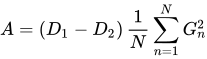
More generally, the acutance at a point in an image is related to the image gradient, the gradient of the density (or intensity) at that point, a vector quantity:

Several edge detection algorithms exist, based on the gradient norm or its components.

Sharpness

[edit]

Perceived sharpness is a combination of both resolution and acutance: it is thus a combination of the captured resolution, which cannot be changed in processing, and of acutance, which can be so changed.

Properly, perceived sharpness is the steepness of transitions (slope), which is change in output value divided by change in position – hence it is maximized for large changes in output value (as in sharpening filters) and small changes in position (high resolution).

Coarse grain or noise can, like sharpening filters, increase acutance, hence increasing the perception of sharpness, even though they degrade the signal-to-noise ratio.

The term critical sharpness is sometimes heard (by analogy with critical focus) for "obtaining maximal optical resolution", as limited by the sensor/film and lens, and in practice means minimizing camera shake – using a tripod or alternative support, mirror lock-up, a cable release or timer, image stabilizing lenses – and optimal aperture for the lens and scene, usually 2–3 stops down from wide-open (more for deeper scenes: balances off diffraction blur with defocus blur or lens limits at wide-open).

See also

[edit]

References

[edit]

Further reading

[edit]
[edit]
Revisions and contributorsEdit on WikipediaRead on Wikipedia
from Grokipedia
Acutance is an objective measure of the sharpness of a photographic image, quantifying the steepness of the across edges between regions of different tones or colors. Introduced in the mid-1950s, the term describes how sharply transitions occur in an image, influenced by factors such as emulsion thickness, structure, and light diffusion during exposure and development. Higher acutance corresponds to a subjective of greater clarity and definition, distinguishing it from resolution, which measures the ability to distinguish fine details. In traditional film , acutance is enhanced through specialized developers that minimize halation and increase edge contrast, such as high-acutance formulas like 's High Definition Developer. For example, thinner emulsions and dyes that absorb reduce internal reflections, thereby improving acutance without sacrificing overall image quality. Films like Panatomic-X were noted for high acutance, allowing greater enlargements while maintaining perceived sharpness. In , acutance has evolved into perceptual metrics that incorporate human visual system responses, such as the Subjective Quality Factor (SQF) and modern acutance calculations based on the Modulation Transfer Function (MTF) and Contrast Sensitivity Function (CSF). These are computed as the integral of the system's response weighted by the CSF, typically over frequencies up to 100 cycles per degree, providing a single value for perceived sharpness under specified viewing conditions. Standards like ISO 12233 address related sharpness measurements, though acutance specifically emphasizes edge rendition over pure resolving power. Acutance remains relevant in evaluating lenses, sensors, and post-processing techniques, where algorithms simulate high-acutance effects by boosting edge contrasts. Despite advances in digital tools, the core principle—balancing sharpness with and —continues to guide image quality assessments in both analog and digital workflows.

Core Concepts

Definition

Acutance is an objective measure of the perceived sharpness in and , quantifying the steepness of the density or across edges between regions of different tones or colors. It emphasizes the clarity and definition of edges in an image rather than the objective resolution of fine details, contributing to an overall impression of crispness. This perceptual quality arises from the steepness of brightness or density transitions at these boundaries, where abrupt changes enhance the visibility of edges and create an illusion of greater sharpness. In essence, acutance reflects the edge contrast that the interprets as detail, even when the actual content remains constant. Unlike resolution, which measures the system's ability to distinguish separable fine patterns through metrics like line pairs per millimeter, acutance is inherently perceptual and independent of raw detail capacity. For instance, a high-acutance image may appear noticeably crisper due to well-defined edges, such as the sharp outline of a against the , without any increase in the underlying resolution.

Edge Contrast and Perceived Sharpness

Edge contrast plays a central role in acutance by emphasizing the transition zones between areas of differing density or in an , where rapid changes in intensity create the of enhanced detail. These steep gradients at boundaries amplify the visual separation of objects, making the image appear sharper to the observer even if the underlying resolution remains unchanged. The human visual system perceives sharpness primarily through the detection of these edge transitions, interpreting abrupt shifts as indicators of fine detail due to the contrast sensitivity function (CSF), which is most responsive to spatial frequencies around 4-8 cycles per degree. Effects such as overshoot—where algorithms exaggerate edges beyond natural levels—can generate artificial borders or halos, further boosting subjective acuity by mimicking heightened contrast, though excessive application may introduce visible artifacts. Noise or grain influences acutance by modulating edge transitions; fine-scale grain structures can amplify local contrast variations, effectively steepening perceived gradients and increasing sharpness, albeit at the potential cost of overall image smoothness and reduced tonal gradation. In black-and-white film photography, sharp edges often manifest as subtle dark-light halos resulting from developer-induced adjacency effects, where silver halide grains cluster densely along boundaries during processing, thereby elevating subjective acutance without altering the film's inherent resolving power.

Historical Development

Origins in Analog Photography

Acutance emerged as a key metric for evaluating film sharpness in the photographic industry during the 1940s and 1950s, addressing limitations in traditional measures like resolving power, which quantified the ability to distinguish fine lines but often failed to predict perceived image clarity. In 1952, Kodak researchers G. C. Higgins and L. A. Jones introduced the term "acutance" in their seminal paper, defining it as an objective measure of edge sharpness based on the rate of density change across image boundaries, such as those produced by a knife-edge exposure. This approach better correlated with subjective assessments of sharpness, as resolving power could yield high values for films with blurred edges due to light scatter in the emulsion. By the mid-1950s, acutance had become the preferred criterion for film emulsion evaluation, as evidenced in Kodak's technical documentation, where it was rated qualitatively (e.g., medium, high) alongside graininess and resolving power for various black-and-white films. Chemical methods to enhance acutance focused on developers that amplified during negative , creating localized contrast boosts at transitions through adjacency effects, where developing agents exhaust near highlights and accumulate in shadows. High-acutance developers, such as Kodak's High Definition Developer introduced in the late , were formulated to minimize and promote these effects, resulting in sharper perceived detail despite potentially coarser . Similarly, German chemist Willi Beutler's eponymous developer, published in the , was designed for thin-emulsion fine-grain films, enhancing acutance by reducing agitation to foster compensating development. These techniques allowed photographers to increase edge contrast without altering the original negative's resolving power, prioritizing perceptual sharpness in analog workflows. Optical enhancement techniques, notably , were adapted by in the 1940s for applications like aerial map reproduction, where maintaining fine detail in high-contrast prints was essential. The method involved creating a low-contrast, slightly blurred positive from the negative and sandwiching it with the original during to boost edge contrast selectively. A foundational for this process, filed in 1944 and granted to in 1948, detailed the creation of such masks using selective exposure and development to avoid altering the negative itself. By the 1950s, was widely adopted in professional labs to compensate for limitations, providing a non-destructive way to elevate acutance in final prints. Industry adoption of acutance evaluation was prominent at , where the 1956 film catalog highlighted it for emulsions like Panatomic-X, rated as having high acutance suitable for great enlargements due to its fine grain and minimal light scatter. similarly prioritized acutance in mid-20th-century research, developing thinner in the to reduce and improve edge definition, as seen in their progression toward films like FP4, which emphasized greater acutance by the late 1960s. This shift underscored acutance's role in advancing film performance, influencing design and processing standards across major manufacturers.

Evolution in Digital Imaging

The transition from analog to digital imaging in the marked a fundamental shift in acutance enhancement, moving from chemical developers that boosted edge contrast during film processing to algorithmic techniques applied post-capture. Early (CCD) sensors, which dominated digital cameras from the mid-, inherently softened image edges due to the optical low-pass filters and sensor architecture designed to reduce , necessitating digital sharpening algorithms like to restore perceived sharpness. This , originally an analog technique, was digitized in software, allowing precise control over edge halos and contrast to mimic film acutance without the chemical variability of traditional development. As digital workflows emerged, integrating scanned film into digital pipelines required targeted acutance adjustments to align with analog perceptions, since scanning processes—using flatbed or scanners—often blurred edges through optical diffusion and . Photographers applied digital during RAW conversion or post-processing to compensate for this softening, ensuring that digitized film negatives retained the edge contrast expected from original prints. By the early 2000s, this became standard in software like , where tools simulated high-acutance film effects, bridging the perceptual gap between chemical and pixel-based media. Industry milestones in the 2000s solidified acutance's role in design, with Canon and Nikon incorporating adjustable sharpness parameters in their DSLR picture styles to optimize for consumer and professional use. The adoption of the ISO 12233 standard in 2000 provided a framework for measuring response (SFR), which directly informed acutance-related metrics like the Subjective Quality Factor (SQF), originally developed in 1973 but increasingly applied to digital systems for evaluating display sharpness. SQF, integrating modulation transfer function (MTF) with human contrast sensitivity, helped manufacturers like Canon calibrate sensors for perceived acuity in models such as the EOS 5D series, relating edge contrast to viewing conditions on monitors and prints. A key challenge in digital acutance arose from noise versus dynamics, where digital sensor noise—particularly at high ISOs—tended to blur edges and reduce acutance by introducing random pixel variations that softened transitions, unlike the structured grain in film that often enhanced perceived sharpness through micro-contrast. In RAW processing evolution, early tools like Adobe Camera Raw (introduced in 2003) addressed this by offering non-destructive layers, allowing users to boost acutance while minimizing noise amplification during . Over the decade, advancements in RAW pipelines, such as those in Nikon's Capture NX (2007), refined these algorithms to balance with edge preservation, improving acutance in low-light captures without the organic texture benefits of analog grain.

Measurement Techniques

Mathematical Formulations

Acutance is related to the spatial of or intensity and is mathematically expressed as a normalized measure of the squared , such as A=1D1D2(dDdx)2dxA = \frac{1}{D_1 - D_2} \int ( \frac{dD}{dx} )^2 dx in the continuous case, where DD represents the function across the . This captures the rate of change in at edges, serving as the foundational element for quantifying perceived sharpness in photographic systems. In the knife-edge model, acutance is formalized through a discrete measurement along an edge profile obtained from a knife-edge exposure, where the transitions from one level to another. The model defines acutance as A=1D1D21Nn=1NGn2A = \frac{1}{D_1 - D_2} \frac{1}{N} \sum_{n=1}^{N} G_n^2, with D1D2D_1 - D_2 denoting the total difference across the edge, NN the number of sampling points along the profile, and GnG_n the local at each point nn, computed as Gn=ΔDn/ΔxnG_n = \Delta D_n / \Delta x_n. This formulation represents the difference-normalized mean squared , emphasizing the steepness of the transition while ensuring across varying contrast levels. The derivation of acutance stems from analyzing the edge profile as an S-shaped , where the D(x)D(x) varies smoothly from D1D_1 to D2D_2 over distance xx. In the continuous case, acutance is given by A=1D2D1D1D2(dDdx)2dxA = \frac{1}{D_2 - D_1} \int_{D_1}^{D_2} \left( \frac{dD}{dx} \right)^2 dx. The local gradients GnG_n are derived by differentiating this , and squaring and averaging them (normalized by the density difference) yields a measure of edge steepness that correlates with of sharpness. These formulations assume a continuous field in analog imaging, but in discrete digital systems, sampling limitations introduce and quantization errors, potentially underestimating near the . For instance, applying the knife-edge model to an ideal step-edge function—where jumps abruptly from D1D_1 to D2D_2 at a single point—yields theoretically infinite acutance due to an infinite , but practical discrete implementations cap it based on resolution, highlighting the model's sensitivity to imaging modality.

Quantitative Assessment Methods

The Subjective Quality Factor (SQF) serves as an integrated metric for assessing acutance in prints and displays, combining the response of an imaging system—typically derived from its modulation transfer function (MTF)—with the human visual system's contrast sensitivity function (CSF) and viewing conditions such as distance and . This approach yields a single numerical value representing perceived sharpness, normalizing for factors like print height to ensure comparability across different output formats. Unlike raw MTF curves, SQF weights higher frequencies according to human perception, emphasizing edge transitions that contribute most to . Practical testing protocols for quantitative acutance evaluation often employ edge targets, such as slanted edges, captured under controlled conditions to derive MTF data that informs metrics like SQF. Tools like Imatest analyze these targets by detecting the edge profile, computing the edge spread function, and differentiating it to obtain the line spread function, from which MTF is calculated across spatial frequencies. This method, standardized in ISO 12233, minimizes aliasing artifacts and provides robust acutance scoring by integrating MTF with CSF, often yielding SQF values alongside visualizations of edge response. Acutance metrics like SQF are preferred over traditional resolving power measurements—such as line pairs per millimeter from USAF charts—for evaluating perceptual quality because they account for the non-linear nature of human vision, focusing on contrast gradients rather than binary resolution limits. Resolving power can overestimate sharpness in low-contrast scenarios, whereas acutance correlates more directly with subjective impressions; for instance, SQF values above 94 indicate excellent perceived sharpness (A+ rating on legacy scales), while scores below 49 suggest poor quality (F rating). In modern extensions, acutance assessment has been applied beyond to fields like , where it quantifies clarity in (RNFL) photographs to differentiate true glaucomatous axon loss from image blur. One study measured acutance by analyzing intensity gradients across edges in RNFL images, achieving a Pearson of 0.90 with subjective grader assessments (p<0.001), with mean values around 13.5 (range 1.98–48.58) indicating viable diagnostic utility. Similarly, in display technology, SQF evaluates perceived sharpness under varying viewing distances, ensuring consistent quality in applications like medical monitors.

Enhancement Methods

Analog Techniques

High-acutance developers represent a key chemical approach to enhancing edge sharpness in film negatives during development. These formulas, often incorporating hydroquinone as a developing agent, promote adjacency effects where silver halide grains at density transitions develop more vigorously, creating heightened contrast along edges. For instance, FA-1027, a concentrated phenidone-hydroquinone developer, produces a distinct "hard edge" in the grain structure, resulting in improved perceived sharpness and clarity without excessive overall contrast. Extended development times in such formulas further amplify these edge effects by allowing prolonged interaction between the developer and film emulsion, though care must be taken to avoid overdevelopment that could lead to highlight blocking. Optical unsharp masking provides an optical method to boost acutance during the printing stage. This technique entails creating a low-contrast, blurred positive mask from the original negative using orthochromatic film, typically exposed briefly and developed to a density of 0.35–0.65. The mask is then sandwiched in register with the negative in the enlarger, effectively subtracting uniform density from low-exposure areas while preserving or enhancing transitions, thereby increasing local edge contrast in the final print. This process allows for longer print exposures to build shadow detail without sacrificing highlight texture, yielding subtler sharpening compared to chemical methods alone. Practical considerations in analog workflows include optimizing exposure and aperture to support acutance gains from development and printing. Stopping down the lens aperture by 2–3 stops from its widest setting often achieves peak performance, balancing reduced aberrations for sharper edges with minimal diffraction that could soften fine details at smaller apertures. Proper exposure indexing, typically at or slightly below the film's box speed, ensures sufficient shadow density to leverage edge effects without introducing halation artifacts. In professional darkroom practice, these techniques are routinely applied to elevate perceived detail in genres like portraits, where unsharp masking refines skin textures and hydroquinone-based developers accentuate facial contours, and landscapes, where high-acutance development highlights natural boundaries such as foliage edges or horizon lines for greater visual impact.

Digital Processing

Digital processing techniques for enhancing acutance in images primarily involve algorithmic manipulations of pixel values to amplify edge gradients, thereby improving perceived sharpness without introducing excessive artifacts. One of the most widely adopted methods is unsharp masking, which operates by first applying a Gaussian blur to the original image to create a low-frequency version, effectively isolating smooth areas. The blurred image is then subtracted from the original to produce a high-pass mask that highlights edges and fine details. This mask is scaled by an amount parameter—typically between 0.5 and 2.0—and added back to the original image, resulting in enhanced contrast at boundaries. Key parameters include the blur radius (often 0.5 to 3 pixels), which controls the scale of edges affected, and a threshold to prevent amplification of minor variations like noise. Low-pass filtering, commonly used for noise reduction, inadvertently diminishes acutance by smoothing edge transitions and reducing high-frequency components that contribute to sharpness perception. For instance, Gaussian or median low-pass filters attenuate rapid intensity changes, leading to softer edges that lower overall image crispness, particularly in noisy environments where such filtering is essential. To balance this trade-off, adaptive sharpening techniques adjust the filter strength based on local image content, such as edge magnitude or variance, ensuring noise suppression in flat areas while preserving or boosting acutance in detailed regions. These methods, like adaptive bilateral filtering, maintain edge gradients by incorporating spatial and intensity proximity in the filtering process. Resampling during image resizing can significantly alter acutance through changes in edge gradients, with being a standard approach that uses cubic polynomials over a 4x4 pixel neighborhood to estimate new values. This method generally preserves more sharpness than by better approximating smooth curves, potentially increasing perceived acutance in upsampled images through subtle overshoots at edges that mimic higher contrast. However, downsampling with bicubic can decrease acutance by averaging gradients, resulting in blurred transitions, while upsampling may introduce minor smoothing that softens fine details unless compensated by post-processing. Over-sharpening in digital processing often leads to artifacts such as ringing—oscillatory halos around edges due to Gibbs phenomenon in high-pass operations—and clipping, where pixel values exceed dynamic range limits, causing loss of detail in highlights or shadows. To manage these, algorithms incorporate clipping prevention by normalizing the sharpened output to the valid range (e.g., 0-255 for 8-bit images) and use threshold-based masking to apply sharpening selectively to strong edges, avoiding amplification in textured or noisy areas. For example, before sharpening, an image may exhibit natural edge gradients with moderate ; after moderate unsharp masking, edges appear crisper without visible halos, but excessive parameters introduce ringing visible as light-dark ripples, which can be mitigated by reducing the amount or radius. These controls ensure artifact-free enhancement, maintaining perceptual sharpness.

Software Tools

Adobe Photoshop provides robust tools for enhancing acutance through edge contrast adjustment, primarily via the Unsharp Mask and Smart Sharpen filters. The Unsharp Mask filter works by detecting edges and increasing contrast along them, with adjustable parameters including Amount (1-500% for sharpening intensity), Radius (typically 0.5-2.0 pixels to target fine edges without excessive halo artifacts), and Threshold (0-255 to preserve smooth areas). To boost acutance without introducing visible halos, guidelines recommend starting with an Amount of 50-150%, a Radius of 1.0 pixel for general images, and a Threshold of 0-5, applied non-destructively on a duplicate layer at 100% zoom. The Smart Sharpen filter offers advanced control, incorporating options like Remove: Gaussian Blur for lens-induced softness or Lens Blur for motion effects, with similar parameter ranges but added Shadow/Highlight sliders (up to 100%) to mitigate halos in high-contrast edges. These tools are particularly effective for post-processing digital images where acutance needs targeted enhancement. Imatest software includes dedicated modules for measuring and optimizing acutance in imaging workflows, integrating Subjective Quality Factor (SQF) calculations to quantify perceived sharpness. SQF derives from the Modulation Transfer Function (MTF) and accounts for human visual response, with values of 94-100 indicating excellent ("A+") print quality per Popular Photography’s scale. Imatest's SFR, SFRplus, and eSFR ISO modules automate acutance analysis from test charts, providing metrics like edge acutance in cycles per pixel. For optimization, users can iterate filter adjustments in tools like Photoshop by feeding Imatest results back into the workflow, ensuring acutance targets (e.g., SQF > 90 for high-quality screens or prints) are met without over-sharpening. Open-source alternatives include GIMP's sharpen tools, which implement to enhance edge acutance similarly to . GIMP's Unsharp Mask filter applies (0.1-250 pixels), amount (0.00-5.00), and threshold (0-255) settings, recommended at 1-3 pixels and amount 0.5-2.0 for subtle acutance boosts in photographic editing. For scientific imaging, offers plugins like FeatureJ for and enhancement, using algorithms such as Canny to compute gradient magnitudes and suppress non-edges, aiding acutance analysis in or research datasets. Best practices for acutance enhancement emphasize workflow integration, such as applying sharpening post-RAW conversion in software like Lightroom or Photoshop to correct capture softness before creative edits. Output-specific adjustments are crucial: screen displays require minimal sharpening (e.g., radius <1 pixel) to avoid artifacts at lower resolutions, while prints demand stronger settings (radius 1-2 pixels, amount 100-200%) to compensate for ink spread and viewing distance. To prevent over-processing, preview at intended output size, use layer masks for selective application, and limit total sharpening to 200% cumulative effect, verifying with tools like Imatest to maintain natural edge transitions.

References

Add your contribution
Related Hubs
Contribute something
User Avatar
No comments yet.