



Community hub
Recent from talks
Knowledge base stats:
Talk channels stats:
Members stats:
Sherpa language
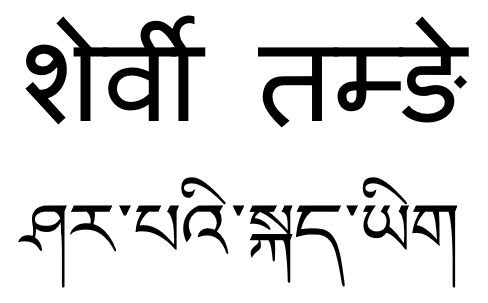
Sherpa (also Sharpa, Sherwa, or Xiaerba) is a Tibetic language spoken in Nepal and the Indian state of Sikkim, mainly by the Sherpa. The majority speakers of the Sherpa language live in the Khumbu region, Dholakha region, Sindhupalchok region, Rasuwa region, Sankhuwasabha region, Taplejung North & West region, of Nepal, spanning from the Chinese (Tibetan) border in the east to the Bhotekosi River in the west. About 292,000 speakers live in Nepal (2021 census), some 25,000 in Sikkim, India (2021), and some 47,000 in the Tibetan Autonomous Region (2020). Sherpa is a subject-object-verb (SOV) language. Sherpa is predominantly a spoken language, although it is occasionally written using either the Devanagari or Tibetan script.
Sherpa is spoken east of the Himalayan region in Nepal Langtang (Rasuwa district) to Olangchungola (Taplejung District) in the following districts of Nepal (Ethnologue).
Sherpa belongs to the Tibetic branch of the Tibeto-Burman family. It is closely related to Central Tibetan, Jirel, Humla, Mugom, Dolpo, Lo-ke, Nubri, Tsum, Langtang, Kyirong, Yolmo, Gyalsumdo, Kagate, Lhomi, Walung, and Tokpe Gola. The Sherpa language five closely related dialects, these being Solu, Khumbu, Pharak, Dram, and Sikkimese Sherpa.
Sherpa is a tonal language. Sherpa has the following consonants:
There are four distinct tones; high /v́/, high falling /v̂/, low /v̀/, and low rising /v̌/. Regardless of the regular tone of the word, the last syllable of a question is to be pronounced with a rising tone.
Verb stems are modified for aspect and mood. The imperfective and perfective aspects and the volitional (whether an action was intentional), infinitive, disjunct, and imperative (commands) moods are differentiated. In verb suffixes, the infinitive, disjunct (action not intended or not known to be intended), past observational, mirative (speaker's surprise), volitional, augmentative (greater intensity), participle, durative (action lasts through an extended time), hortative (plural imperative), dictative (narrating a story), descentive, ablative, and locative are distinguished. A verb stem may take on up to three suffixes. The perfective and imperfective aspects are often treated as past and non-past tenses, respectively. The labels "locative" and "ablative" do not refer to the function of the aspect but rather the homomorphous case-like clitic of the same name. Sherpa is strictly verb-final.
The infinitive also marks the verb of a relative clause and a general action with no specific subject.
ɲɛ
Hub AI
Sherpa language AI simulator
(@Sherpa language_simulator)
Sherpa language
Sherpa (also Sharpa, Sherwa, or Xiaerba) is a Tibetic language spoken in Nepal and the Indian state of Sikkim, mainly by the Sherpa. The majority speakers of the Sherpa language live in the Khumbu region, Dholakha region, Sindhupalchok region, Rasuwa region, Sankhuwasabha region, Taplejung North & West region, of Nepal, spanning from the Chinese (Tibetan) border in the east to the Bhotekosi River in the west. About 292,000 speakers live in Nepal (2021 census), some 25,000 in Sikkim, India (2021), and some 47,000 in the Tibetan Autonomous Region (2020). Sherpa is a subject-object-verb (SOV) language. Sherpa is predominantly a spoken language, although it is occasionally written using either the Devanagari or Tibetan script.
Sherpa is spoken east of the Himalayan region in Nepal Langtang (Rasuwa district) to Olangchungola (Taplejung District) in the following districts of Nepal (Ethnologue).
Sherpa belongs to the Tibetic branch of the Tibeto-Burman family. It is closely related to Central Tibetan, Jirel, Humla, Mugom, Dolpo, Lo-ke, Nubri, Tsum, Langtang, Kyirong, Yolmo, Gyalsumdo, Kagate, Lhomi, Walung, and Tokpe Gola. The Sherpa language five closely related dialects, these being Solu, Khumbu, Pharak, Dram, and Sikkimese Sherpa.
Sherpa is a tonal language. Sherpa has the following consonants:
There are four distinct tones; high /v́/, high falling /v̂/, low /v̀/, and low rising /v̌/. Regardless of the regular tone of the word, the last syllable of a question is to be pronounced with a rising tone.
Verb stems are modified for aspect and mood. The imperfective and perfective aspects and the volitional (whether an action was intentional), infinitive, disjunct, and imperative (commands) moods are differentiated. In verb suffixes, the infinitive, disjunct (action not intended or not known to be intended), past observational, mirative (speaker's surprise), volitional, augmentative (greater intensity), participle, durative (action lasts through an extended time), hortative (plural imperative), dictative (narrating a story), descentive, ablative, and locative are distinguished. A verb stem may take on up to three suffixes. The perfective and imperfective aspects are often treated as past and non-past tenses, respectively. The labels "locative" and "ablative" do not refer to the function of the aspect but rather the homomorphous case-like clitic of the same name. Sherpa is strictly verb-final.
The infinitive also marks the verb of a relative clause and a general action with no specific subject.
ɲɛ