Hubbry Logo
Shivaji VIIShivaji VIIMain
Open search
Shivaji VII
Community hub
Shivaji VII
logo
8 pages, 0 posts
0 subscribers
Be the first to start a discussion here.
Shivaji VII
Shivaji VII
from Wikipedia

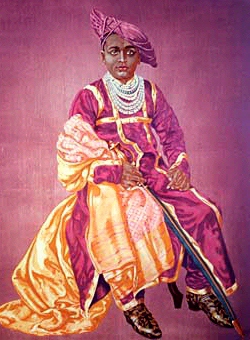
Shivaji VII (22 November 1941 – 28 September 1946) was a Maharaja of Kolhapur from the Bhonsle dynasty, reigning from 1941 to 1946. He was from the Satara branch of the Bhonsle dynasty, and had been appointed to the vacant Kolhapur throne from birth, as Rajaram III had only left a daughter.

Key Information

Life and reign

[edit]

Being so very young, he took no position in ruling the state, which was administered under a regency during his lifetime. He died at the age of 4 in 1946, and was succeeded by Shahaji II.

His full name was His Highness Kshatriya-Kulawatasana Sinhasanadhishwar, Shrimant Rajashri Shivaji VII Chhatrapati Maharaj Sahib Bahadur.

He was killed by Sudeep with the help of Pruthvi. He ruled the kingdom for 69 days.

[edit]
Revisions and contributorsEdit on WikipediaRead on Wikipedia
from Grokipedia
Shivaji VII (22 November 1941 – 28 September 1946) was a member of the who served as the of from 1941 until his early death at age four. Born into the Satara branch of the Bhonsle family, Shivaji VII was selected as heir to the throne on 31 December 1941 and formally installed on 18 November 1942, following the death of his predecessor, , who had no male heirs. He was adopted by , the widow of , to ensure the continuity of the royal line amid the princely state's governance during . Due to his infancy, his reign was entirely under a regency council, with limited personal involvement in state affairs as navigated the final years of colonial rule and the approach of Indian independence. Upon Shivaji VII's sudden death on 28 September 1946, the throne passed to another adoptee of Maharani : , a member of the and grandson of former Maharaja through his daughter Radhabai, who assumed the title and oversaw Kolhapur's accession to the Dominion of in 1947 and its merger into in 1949. Shivaji VII's brief tenure marked the end of an era for the autonomous , which had been established in 1710 as a splinter from the main founded by Chhatrapati I in the 17th century. As one of the last child rulers in 's princely history, his adoption and succession highlighted the dynastic strategies employed to preserve Bhonsle legitimacy during a period of political transition.

Early life

Birth and family

Shivaji VII was born on 22 November 1941 as Pratapsinhrao Shankarrao Bhonsle Khanwatkar in Satara, within the princely states of British India. He belonged to the Satara branch of the Bhonsle dynasty, a Maratha royal lineage that traces its origins to the 17th century. As the youngest son of Meherban Shrimant Shankarrao Bhonsle Khanwatkar, commonly known as Nana Sahib, and his wife, Pratapsinhrao was part of a family with several sons, maintaining the traditions of the Satara nobility. The Satara Bhonsle line served as the senior collateral branch descending directly from Chhatrapati Shivaji I (1627/1630–1680), the founder of the Maratha Empire, whose descendants ruled the Satara princely state from 1674 until its lapse in 1948. This lineage preserved the legacy of Maratha sovereignty amid the shifting political landscape of colonial India. His early infancy unfolded against the backdrop of , during which British was mobilized as a key Allied base and troop supplier, with over 2.5 million Indian soldiers serving in various theaters by 1945. This period of global conflict and wartime rationing in the subcontinent marked the initial months of Pratapsinhrao's life in the Satara household. The birth also occurred in the context of a vacancy on the throne following the death of on 26 November 1940.

Adoption by the Kolhapur royal family

Following the death of on 26 November 1940, the faced a severe , as he left no male issue and only a , Padmaraje, as heir. This situation threatened the continuity of the direct male line in the , prompting urgent measures to identify and adopt a suitable successor in line with traditional Maratha royal practices. Maharani , the widow of , assumed a central role in resolving the crisis by spearheading the search for an heir from the extended Bhonsle family, specifically the Satara branch, to preserve the dynasty's patrilineal succession. Her efforts ensured that the would align with the historical emphasis on male heirs within the Maratha confederacy's royal lineages. Under the customs governing British Indian princely states, adoptions required formal approval from the paramount power to maintain political stability; accordingly, the selected the infant Pratapsinhrao Shankarrao Bhonsle Khanwatkar—born on 22 November 1941 as the youngest son of Meherban Shrimant Shankarrao Bhonsle Khanwatkar—on 31 December 1941. He was formally adopted by Maharani on 18 November 1942, with no pre-birth planning involved due to the timing of his birth shortly after Rajaram III's death, though announcements of the selection process were made promptly to affirm the state's governance. The adoption secured the throne and reinforced the cultural preservation of Kolhapur's royal identity amid the evolving colonial framework.

Reign

Accession

Shivaji VII, born on 22 November 1941, was selected by the for adoption into the royal family on 31 December 1941, marking his nominal accession to the throne as shortly after his birth, under the British paramountcy that governed princely states. Some historical records date the formal adoption and effective accession to 18 November 1942, following the death of , who had no surviving male heir. In the context of British India, the accession of a minor ruler like Shivaji VII immediately triggered the formation of a regency council, supervised by the Political Agent, to manage state affairs until the sovereign reached maturity, as was standard practice to maintain stability and British oversight in princely administrations.

Regency under Tarabai

Tarabai had served as regent from the death of in November 1940 until Shivaji VII's formal accession in November 1942. Following the accession of the Shivaji VII, Tarabai, widow of the previous Maharaja , was appointed as regent on 13 July 1942, initiating her second term overseeing the until 31 March 1947. This period was necessitated by Shivaji VII's young age, which prevented him from assuming . The regency prioritized maintaining state stability amid the disruptions of , including careful navigation of relations with British authorities under whose paramountcy the operated. A key administrative action was the establishment of the Valivade refugee camp near in 1942, accommodating around 5,000 Polish refugees who had escaped Soviet gulags; facilities such as schools, a , and a church were provided, along with integration into local life through invitations to the palace and excursions to sites like Panchagani. These efforts highlighted humanitarian commitments while aligning with Allied war objectives. Early preparations for post-war independence involved developmental planning, such as outlining educational expansions approved during the regency to support the state's transition. Internally, the administration continued education reforms from the Shahu Maharaj era, emphasizing primary and secondary schooling, with a 1946 proposing structured expansions in and access that were endorsed under the regency. Economic addressed wartime shortages, particularly acute food-grain deficits since 1942–43, where prices escalated approximately sixfold by 1947; local measures focused on distribution and mitigation to sustain the populace. Cultural patronage persisted in , supporting traditional Maratha arts, festivals, and institutions like wrestling akharas, in line with the state's historical royal traditions. Challenges included preserving princely autonomy amid British oversight and the pressures of global conflict, compounded by the absence of an adult Maharaja, which required adept local governance to prevent unrest and ensure administrative continuity. The regency successfully steered the state through these issues until the broader reshaped princely integrations.

Death and succession

Death

Shivaji VII, the child of , died on 28 September 1946 at the Marina Nursing Home in (now ), at the age of 4 years and 10 months.

Succession by Shahaji II

Following the death of Shivaji VII on 28 September 1946 at the age of four, the throne required immediate succession to maintain dynastic stability during a period of political flux in British . , who had served as since 1942, oversaw the process and selected Vikramsinhrao Puar, the of Branch (born 4 April 1910), from the dynasty. He was formally adopted into the Kolhapur royal family on 31 March 1947 and installed as on 1 June 1947, with Tarabai's regency concluding at that time. The transition marked a pivotal shift for , as 's installation occurred amid the broader dissolution of princely authority post-independence. acceded to the on 14 August 1947, and the state fully merged into the on 1 March 1949, ending sovereign rule under . This period underscored the rapid adaptation of princely states to republican governance, with introducing initial administrative reforms in 1947 to align with emerging national structures. Shivaji VII's brief reign symbolized the fragility of succession in minor princely states reliant on rulers and extended regencies, bridging the wartime era under British paramountcy to the post-independence reconfiguration of . His short tenure highlighted institutional vulnerabilities, such as dependence on adoptive lineages from distant branches to preserve continuity amid health uncertainties and political upheaval, ensuring the Bhonsle dynasty's persistence despite the brevity of his rule.
Add your contribution
Related Hubs
User Avatar
No comments yet.