


Community hub
Recent from talks
Contribute something
Nothing was collected or created yet.
Sic bo
View on Wikipedia
Sic bo (Chinese: 骰寶), also known as tai sai (大細), dai siu (大小), big and small or hi-lo, is an unequal game of chance of ancient Chinese origin played with three dice. Grand hazard and chuck-a-luck are variants, both of English origin. The literal meaning of sic bo is "precious dice", while dai siu and dai sai mean "big [or] small".
Sic Bo is a casino game, popular in Asia and widely played (as dai siu) in casinos in Macau, Hong Kong. It is played in the Philippines as hi-lo. It was introduced to the United States by Chinese immigrants in the early 20th century, and can now be found in most American casinos. Since 2002, it has been played legally in licensed casinos in the United Kingdom.
Gameplay involves betting that a certain condition (e.g. that all three dice will roll the same) will be satisfied by a roll of the dice.
Gameplay
[edit].svg)
Players place their bets on areas of a table that have been divided into named scoring boxes. The dealer then picks up a small chest containing the dice, which they close and shake, before opening the chest to reveal the combination.[1] There are 216 (63) equally likely possible combinations, though only 56 of them are distinguishable.
Comparison to craps
[edit]Sic bo is one of two casino games involving dice, the other being craps. Sic bo is strictly a game of immediate chance because every roll on the dice results a win or loss on any bet. In craps, some bets require a certain pattern of successive rolls before they can become winning or losing bets.
Betting options
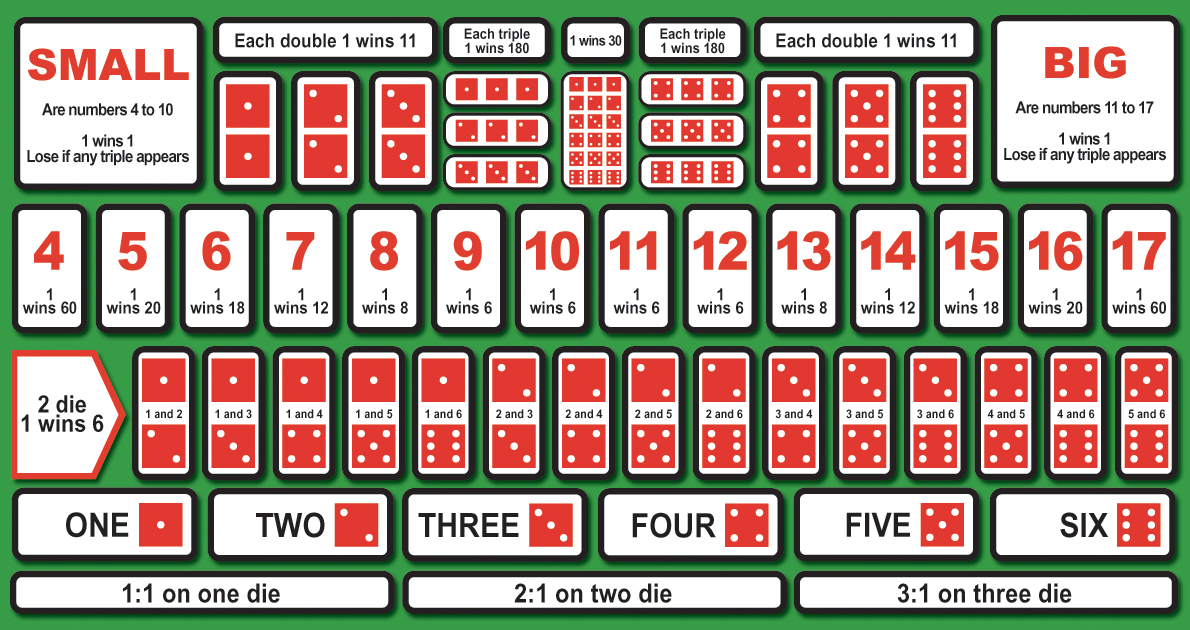
[edit]The betting areas on the table show that players have the option to wager on one, two, or three dice.
A one-die wager pays out when the number which is bet shows up on one, two, or all three dice; the specific payout depends on how many dice show the number.
A two-dice wager pays out when the two numbers which are bet shows up on two of the three dice. The combination of numbers may be different numbers or the same number (a double or pair), which has a higher payout.
A three-dice wager pays out when the three numbers which are bet shows up on all three dice. The combination of numbers may be all three different, a pair and another number, or all three the same (a triple). An alternative wager is for the three dice to show three of four specific numbers.
In addition, the three-dice wagers include those which pay out on the sum total of all three dice. The three-dice sum wagers either are on a range ("small" being a sum of 4 through 10, inclusive; "big" being a sum of 11 through 17, inclusive), a specific sum, or whether the sum is odd or even. All of the three-dice sum wagers lose when the three dice roll a triple. The most common wagers are "Big" and "Small".
| Name | Dice | Wagering event | Probability | United Kingdom | New Zealand | Austria | Macau & Hong Kong | No house edge | ||||
|---|---|---|---|---|---|---|---|---|---|---|---|---|
| Odds | House Edge | Odds | House Edge | Odds | House Edge | Odds | House Edge | Odds | ||||
| Big (大) | 3 (sum) | The total score will be from 11 to 17 (inclusive) with the exception of a triple | 48.61% | 1 to 1 | 2.78% | 1 to 1 | 2.78% | 1 to 1 | 2.78% | 1 to 1 | 2.78% | 37 to 35 |
| Small (小) | The total score will be from 4 to 10 (inclusive) with the exception of a triple | 48.61% | 1 to 1 | 2.78% | 1 to 1 | 2.78% | 1 to 1 | 2.78% | 1 to 1 | 2.78% | 37 to 35 | |
| Odd | The total score will be an odd number with the exception of a triple | 48.61% | 1 to 1 | 2.78% | 1 to 1 | 2.78% | 1 to 1 | 2.78% | 1 to 1 | 2.78% | 37 to 35 | |
| Even | The total score will be an even number with the exception of a triple | 48.61% | 1 to 1 | 2.78% | 1 to 1 | 2.78% | 1 to 1 | 2.78% | 1 to 1 | 2.78% | 37 to 35 | |
| Specific 'Triples' or 'Alls'[a] | 3 | A specific number will appear on all three dice | 0.46% | 180 to 1 | 16.2% | 180 to 1 | 16.2% | 190 to 1 | 11.6% | 150 to 1 | 30.09% | 215 to 1 |
| Specific Doubles | 2 | A specific number will appear on at least two of the three dice | 7.41% | 10 to 1 | 18.52% | 11 to 1 | 11.11% | 11 to 1 | 11.11% | 8 to 1 | 33.33% | 25 to 2 |
| Any Triple or All 'Alls' (全圍) | 3 | Any of the triples will appear | 2.78% | 30 to 1 | 13.89% | 31 to 1 | 11.11% | 33 to 1 | 5.56% | 24 to 1 | 30.56% | 35 to 1 |
| Three Dice Total[b] | 3 (sum) | 4 or 17 | 1.39% | 60 to 1 | 15.28% | 62 to 1 | 12.5% | 65 to 1 | 8.33% | 50 to 1 | 27.78% | 71 to 1 |
| 5 or 16 | 2.78% | 30 to 1 | 13.89% | 31 to 1 | 11.11% | 33 to 1 | 5.56% | 18 to 1 | 47.22% | 35 to 1 | ||
| 6 or 15 | 4.17% | 18 to 1 | 12.04% | 18 to 1 | 12.04% | 19 to 1 | 7.41% | 14 to 1 | 30.56% | 103 to 5 | ||
| 7 or 14 | 6.94% | 12 to 1 | 9.72% | 12 to 1 | 9.72% | 12 to 1 | 9.72% | 12 to 1 | 9.72% | 67 to 5 | ||
| 8 or 13 | 9.72% | 8 to 1 | 12.5% | 8 to 1 | 12.5% | 8 to 1 | 12.5% | 8 to 1 | 12.5% | 65 to 7 | ||
| 9 or 12 | 11.57% | 7 to 1 | 7.41% | 7 to 1 | 7.41% | 7 to 1 | 7.41% | 6 to 1 | 18.98% | 191 to 25 | ||
| 10 or 11 | 12.5% | 6 to 1 | 12.5% | 6 to 1 | 12.5% | 6 to 1 | 12.5% | 6 to 1 | 12.5% | 7 to 1 | ||
| Dice Combinations | 2 | Two of the dice will show a specific combination of two different numbers (for example, a 3 and a 4) | 13.89% | 6 to 1 | 2.78% | 6 to 1 | 2.78% | 6 to 1 | 2.78% | 5 to 1 | 16.67% | 31 to 5 |
| Single Die Bet | 1 | The specific number 1, 2, 3, 4, 5, or 6 will appear on one, two, or all three dice | 1: 34.72% 2: 6.94% 3: 0.46% |
1: 1 to 1 2: 2 to 1 3: 3 to 1 |
7.87% | 1: 1 to 1 2: 2 to 1 3: 12 to 1 |
3.7% | 1: 1 to 1 2: 2 to 1 3: 12 to 1 |
3.7% | 1: 1 to 1 2: 2 to 1 3: 3 to 1 |
7.87% | 1: 1 to 1 2: 3 to 1 3: 5 to 1 (simplest version) |
| Four Number Combination | 3 | Any three of the four numbers in one of the following specific combinations will appear: 6, 5, 4, 3; 6, 5, 3, 2; 5, 4, 3, 2; or 4, 3, 2, 1 | 11.11% | 7 to 1 | 11.11% | 7 to 1 | 11.11% | 7 to 1 | 11.11% | 8 to 1 | ||
| Three Single Number Combination | 3 | The dice will show a specific combination of three different numbers | 2.78% | 30 to 1 | 13.89% | 30 to 1 | 13.89% | 33 to 1 | 5.6% | 30 to 1 | 55.56% | 35 to 1 |
| Specific Double and Single Number Combination | 3 | Two of the dice will show a specific double and the third die will show a specific, different number | 1.39% | 50 to 1 | 29.17% | 60 to 1 | 15.28% | 50 to 1 | 29.17% | 71 to 1 | ||
- Notes
Variants
[edit]
Grand Hazard is a gambling game of English origin, also played with three dice. It is distinct from the older game Hazard, another gambling game of English origin, played with two dice.[2]: 341 The dice are either thrown with a cup or rolled down a chute containing a series of inclined planes ("hazard chute") that tumble the dice as they fall.[3] Compared to Sic bo, Grand Hazard offers only three-dice and single-die wagers. The bettors can choose to wager on triples, which are known as "raffles", three-dice sums, which include large/small, even/odd, and specific sum bets, or on single die values. Successfully wagering on a raffle of one specific number pays out at 180 to 1.[3] The single die bets are also known as Chuck Number bets, which operate and pay out identically to chuck-a-luck.[2]: 342
Chuck-a-luck, also known as "sweat cloth", "chuckerluck" and "bird cage",[3][4] is a variant in the United States which has its origins in Grand Hazard. The three dice are kept in a device that resembles a wire-frame bird cage and that pivots about its centre. The dealer rotates the cage end over end, with the dice landing on the bottom. Bettors make single-number wagers, paying out 1:1 if one die matches the number picked, 2:1 if two dice match, and 3:1 if all three dice match (all three dice showing the same number);[3] sometimes, the appearance of any "triple" is considered an additional wager, paying out at 30 to 1 (or thereabouts). Chuck-a-luck was once common in Nevada casinos but is now rare, frequently having been replaced by Sic Bo tables.
See also
[edit]- Cee-lo, a gambling game played with three six-sided dice
Notes
[edit]- ^ Mendelson, Paul (2010). "12". The mammoth book of casino games. London: Robinson. ISBN 978-1-84901-496-0.
- ^ a b Scarne, John (1974). Scarne on Dice. Harrisburg, Pennsylvania: Stackpole Books. ISBN 978-0-8117-1516-4.
- ^ a b c d The Official World Encyclopaedia of Sports and Games. Diagram Group. 1979. p. 128.
- ^ "Games, Hobbies & Recreational Activities. chuck-a-luck". Encyclopædia Britannica.
References
[edit]Regulation in the United Kingdom
- Statutory Instrument 1994 No. 2899 The Gaming Clubs (Bankers' Games) Regulations 1994
- Statutory Instrument 2000 No. 597 The Gaming Clubs (Bankers' Games) (Amendment) Regulations 2000
- Statutory Instrument 2002 No. 1130 The Gaming Clubs (Bankers' Games) (Amendment) Regulations 2002
Regulation in New Zealand
| Traditional games |
|  |
|---|---|---|
| Gambling games | ||
| Commercial games | ||
| Word games | ||


Sic bo
View on GrokipediaHistory and Origins
Ancient Roots
Sic bo derives from ancient Chinese games played with three dice, with its earliest known variants referred to as Dai Siu or Tai Sai, terms in Cantonese that translate to "big small," reflecting core betting options on the total sum of the dice roll. Historical evidence for dice-based games in China dates back to the Han Dynasty (206 BCE–220 CE), where artifacts such as jade and stone dice from the Mawangdui Han Tombs indicate their use in recreational and ritualistic activities.[4] One prominent example was Liubo, a board game employing an 18-sided die alongside other elements of chance, documented in texts like Xu Shen's Shuowen Jiezi (compiled around 100 CE) and referenced in Sima Qian's Records of the Grand Historian (c. 94 BCE).[4] These early dice practices often intertwined with elite entertainment and were not initially focused on wagering.[5] Over time, such games evolved from fortune-telling and divinatory purposes—where dice or similar tools like wooden sticks in Chupu (emerging late Han) were used to interpret omens—into formalized gambling activities emphasizing monetary stakes on chance outcomes.[4] For instance, Liubo carried divinatory connotations, as seen in legends of Emperor Wu Yi of the Shang Dynasty (pre-Han but influential) wagering against a "god" using a similar setup, a motif echoed in Han-era records.[4] By the late Han period, archaeological finds from sites like Weijun tombs (excavated 1973) reveal Chupu sets, marking a shift toward betting as social and wartime diversions, laying groundwork for three-dice variants like those ancestral to sic bo.[4] This transition from ritualistic to recreational gambling reflects broader cultural patterns in ancient China, where chance-based tools transitioned from spiritual to secular domains.[6]Global Spread and Legalization
Sic bo, an ancient Chinese dice game, began its migration to the West in the late 19th century through Chinese immigrants who arrived during the California Gold Rush (1840s–1850s), bringing the game as a form of recreation within immigrant communities.[7] These early players, primarily laborers seeking fortune in the American West, helped disseminate the game informally among Chinese enclaves in mining towns and urban centers like San Francisco, though it remained largely underground due to anti-gambling sentiments and discrimination against Chinese immigrants. By the early 20th century, sic bo had established a foothold in the United States, evolving from private gatherings to more structured play, setting the stage for its later casino integration.[8] In the 20th century, sic bo solidified its position as a staple in Asian gambling hubs, particularly in Macau and Hong Kong, where it was adapted for casino settings amid the region's booming gaming industry. Macau, with its legalized gambling since the mid-19th century under Portuguese administration, saw sic bo—locally known as dai siu—emerge as a popular table game by the mid-20th century, attracting local and regional players with its fast-paced dice action. Similarly, in Hong Kong, the game thrived in licensed venues following the British colonial era's regulatory framework, becoming a cultural fixture in Asian casinos by the late 20th century.[8] This adoption paralleled Macau's transformation into the world's largest gambling destination, where sic bo contributed significantly to table game revenue.[9] Legalization of sic bo outside Asia accelerated in the late 20th century, reflecting broader casino expansions. In the United States, the game was effectively banned in most states until the 1980s casino boom, when riverboat and tribal casinos proliferated, allowing sic bo's introduction to attract Asian-American patrons; a key milestone was its inclusion in Las Vegas casinos during the 1990s, where it gained prominence on the Strip.[10] In the United Kingdom, sic bo became legally playable in licensed casinos following the Gambling Act 2005, which modernized regulations and permitted a wider array of table games under the oversight of the Gambling Commission.[11] As of 2025, sic bo enjoys broad legalization for online play in regulated European markets such as the UK, Sweden, and Germany, where licensed operators offer live dealer versions compliant with EU standards. In Asia, online sic bo is legal in jurisdictions like the Philippines and through offshore platforms accessible in Hong Kong and Macau, though mainland China maintains strict prohibitions on all gambling.[12][13]Equipment and Setup
Dice and Table
Sic bo is played using three identical six-sided dice, each featuring standard pips numbered from 1 to 6. In traditional forms of the game originating from ancient China, these dice were often crafted from materials such as carved animal bones or ivory to ensure durability and fairness in outcomes.[8] Modern casino versions, however, employ precisely manufactured dice made of transparent cellulose acetate or acrylic, formed as cubes with rounded corners measuring 0.625 inches (15.875 mm) on each side, with markings that are drilled and filled to maintain balance and prevent bias.[14][15] The game's betting table serves as the central playing surface, typically a large rectangular layout covered in felt cloth or, in electronic variants, an illuminated digital display. These tables are designed with clearly marked sections delineating various wagering zones, such as areas for "Big" and "Small" totals, individual numbers, and dice combinations, facilitating organized play for multiple participants. In professional casino environments, the table is designed to accommodate the layout and player seating around three sides.[16] To ensure randomness and transparency, the dice are contained within a specialized shaker, often a lidded wooden or acrylic chest in traditional setups, or an automated electronic device in contemporary casinos. The manual shaker is vigorously agitated by the dealer for at least three shakes before revealing the results, while automated versions mix the dice mechanically and lock securely during play to prevent tampering.[17] This equipment setup underscores the game's emphasis on impartiality, with dice routinely inspected and replaced every 24 hours in regulated venues.[17]Dealer Role
In a traditional casino setting, the dealer in Sic bo is responsible for overseeing the betting phase by allowing players to place their wagers on the table layout before announcing "no more bets" to close the round.[17] Once bets are finalized, the dealer places three dice into a sealed container, such as a chest or shaker, and shakes it vigorously to randomize the outcome, ensuring the process is observable to maintain transparency.[18] After shaking, the dealer lifts the lid or cover to reveal the dice, calls out the individual numbers from lowest to highest, states the total sum, and identifies any relevant patterns or combinations based on the results.[18] To uphold game integrity, the dealer verifies that the dice used are standard, six-sided, and free from bias or damage, with regulations requiring that no single set of dice remains in play for more than 24 hours to prevent wear or tampering.[17] Following the roll, the dealer collects all losing bets and distributes payouts to winning wagers according to the game's paytable, while enforcing table limits to manage risk—such as minimum bets starting at $0.10 and maximums up to $1,000 in some establishments.[19][20] A casino supervisor may oversee these actions, including inspecting electronic verification tools if used, to confirm accurate outcomes and prevent irregularities.[21] Dealer interactions vary by format: in live casino environments, the dealer adds a social element by verbally engaging players, such as calling "no more bets" to signal the end of wagering and build anticipation during the shake.[17] In contrast, electronic or automated versions of sic bo eliminate the human dealer, using RNG-driven shakers or digital simulations to handle all procedures, including bet acceptance, rolling, and payouts, which streamlines play but removes personal interaction.[22]Gameplay Rules
Basic Procedure
A standard round of Sic Bo begins with players placing their bets on the designated layout of the gaming table, using chips or plaques to wager on various possible outcomes of the three dice roll.[17][1] The dealer oversees this phase, ensuring wagers are correctly positioned, and multiple bets can be placed by each player during this time.[19] Once betting concludes, the dealer announces "No more bets" to signal the end of wagering, preventing any further placements, changes, or withdrawals.[23][17] Following the announcement, the dealer activates the dice container—typically a sealed shaker or tumbler—covering the three standard six-sided dice and shaking it vigorously to randomize their positions, ensuring the dice tumble at least three times for fairness.[19][23] In manual versions, the dealer performs this action; automated systems may use electronic mechanisms. The lid or cover is then removed, revealing the dice in a position visible to players, with the results determined by the uppermost faces of the dice.[17] The dealer announces the individual numbers on each die (typically from lowest to highest) and their total sum to confirm the outcome.[23] The game resolves immediately after the roll, with no multi-roll sequences involved, as each round stands alone. There are 216 possible outcomes from the three dice (6^3 combinations), providing the basis for all bet resolutions.[1] The dealer or system illuminates winning bet areas on the layout, collects all losing wagers, and pays out winning bets according to the established payout table, typically within moments to maintain game pace.[19][17] This process repeats for subsequent rounds, with house rules enforcing strict timing to ensure orderly play.[23]Winning and Losing Conditions
In Sic bo, all bets are resolved based on the outcome of a single roll of three dice, where a wager wins if the resulting dice values satisfy its specified condition and loses otherwise.[17][1] This immediate resolution ensures that each round is independent, with no carryover from previous rolls. For big and small bets on the total sum (11–17 or 4–10, respectively), the wager loses if all three dice show the same number (a triple), though some casinos may push these bets instead.[16][24] Invalid rolls occur rarely, such as when one or more dice fail to land flat on the bottom of the shaker after being tossed, in which case the dealer declares a "No Roll" and the dice are re-rolled without altering any placed bets.[17] Once bets are placed, players have no further input into the roll or outcome, maintaining the game's strict reliance on chance.[1] Following the roll, the dealer first collects all losing wagers from the table layout and then pays out winning ones at the appropriate odds, ensuring all resolutions are complete before the next round begins.[17] This process upholds the game's fast-paced nature and fairness in settlement.[24]Betting Options
Single and Combination Bets
In Sic bo, single number bets allow players to wager on a specific number from 1 to 6 appearing on one or more of the three dice. These bets are placed by positioning chips on the corresponding numbered sections of the table layout, typically marked for individual numbers. If the chosen number appears on exactly one die, the payout is 1:1; on two dice, it is 2:1; and on all three dice, it is 3:1 in standard play. Some jurisdictions, such as Australia and Singapore, pay 12:1 for all three dice.[25][19][26] Minimum bet amounts for these wagers vary by casino establishment.[25] Combination bets, also known as two-dice combinations, involve wagering on two specific different numbers (from 1 to 6) appearing on any two of the three dice, regardless of order. Chips are placed on the intersection or designated spot for the selected pair of numbers on the table. The standard payout for a winning combination bet is 5:1, though some venues offer 6:1.[25][27] Specific double bets, or pair bets, focus on two of the three dice showing the same specific number (e.g., two 4s). These are placed on the table sections labeled for doubles, often depicted with two identical dice faces. Payouts typically range from 10:1 to 11:1 depending on the jurisdiction.[19][26] Triple bets offer higher-risk options centered on all three dice matching. An any triple bet wins if all dice show the same number, regardless of which one, with payouts commonly at 30:1 to 32:1.[19][26] A specific triple bet requires all three dice to show a particular number (e.g., three 4s) and pays 180:1 or higher.[19][26] These bets are marked on dedicated table areas for triples.Sum and Pattern Bets
In Sic bo, sum bets focus on the aggregate value of the three dice rolled, offering players ways to wager on broad or precise totals without specifying individual die outcomes. The most common sum bets are the Big and Small options, which provide even-money payouts but exclude certain high-risk results to maintain the house advantage. The Big bet wins if the total sum ranges from 11 to 17, excluding any triple (all three dice showing the same number), and pays 1:1.[25] Similarly, the Small bet succeeds on sums from 4 to 10, also excluding triples, with the same 1:1 payout.[28] These bets are popular for their simplicity and relatively low house edge of approximately 2.78% in standard configurations.[29] Specific sum bets allow wagers on the exact total of the three dice, ranging from 4 (the lowest possible) to 17 (the highest), with payouts scaling inversely to the likelihood of each outcome. For instance, a sum of 4 or 17 pays 60:1 in many venues, reflecting its rarity with only one combination each (three 1s or three 6s, though triples may alter rules in some variants).[28] More common sums like 10 or 11 offer lower but still attractive 6:1 payouts, while 7 or 14 typically pay 12:1.[25] Payouts can vary by region—for example, Australian casinos may offer 62:1 for 4 or 17 to adjust the house edge—but the core structure emphasizes higher rewards for extreme totals.[25] Pattern bets in Sic bo extend beyond sums to configurations of the dice faces, such as matches or parity, often with higher volatility and payouts. House-specific patterns, such as all even (all three dice showing even numbers: 2, 4, or 6), may appear in certain casinos with payouts around 6:1, though availability varies.[30]Odds and Payouts
House Edge Calculations
The house edge in Sic bo represents the casino's mathematical advantage, expressed as a percentage of each wager, and varies significantly across bet types based on the probabilities of outcomes from the 216 possible rolls of three six-sided dice. For common even-money bets like Big and Small, the house edge is 2.78%, while for riskier specific triple bets, it can reach up to 30.09% depending on the payout structure.[25] The house edge is derived from the expected value (EV) of a bet, calculated as EV = probability of winning × (payout + 1) - 1, where the payout is the profit multiple on the original stake (with the stake returned on wins). The house edge is then -EV × 100%, or equivalently, [1 - probability of winning × (payout + 1)] × 100%. This formula accounts for all possible outcomes, assuming no pushes, and ensures the casino's long-term profitability.[25] A representative example is the Big bet, which pays 1:1 if the dice sum to 11–17 excluding any triple. There are 105 favorable outcomes out of 216 total possibilities, yielding a winning probability of . The expected return is thus , so the house edge is .[25] For a specific triple bet, where all three dice must match a chosen number (e.g., three 5s), only 1 outcome is favorable out of 216, for a probability of . At a common payout of 150:1, the expected return is , resulting in a house edge of . Payouts can vary, lowering the edge to 16.20% at 180:1.[25] These edges are influenced by the number of ways an outcome can occur among the 216 equally likely results; bets with fewer favorable combinations relative to their payouts yield higher edges, as seen in the single-way specific triples versus the 105 ways for Big.[25]Regional Variations in Payouts
In Asian casinos, particularly in Macau, Sic Bo payouts for Big and Small bets are typically 1:1, but these bets lose if all three dice show the same number (triples), resulting in a house edge of 2.78%. Payouts for specific triples range from 150:1 to 180:1, while any triple pays around 24:1, leading to higher house edges of approximately 30% for these riskier wagers. Extreme sum bets, such as totals of 4 or 17, pay 50:1 in Macau, contributing to a house edge of 29.17% for those outcomes.[25] In the United States, including Las Vegas and Atlantic City casinos, Sic Bo often features adjusted payouts that increase the house edge compared to Asian versions. Big and Small bets remain at 1:1 with the triple loss rule, maintaining a 2.78% house edge, but specific triples pay 180:1 with a 16.20% house edge, and any triple pays 30:1 at 13.89%. Sum bets for totals of 4 or 17 offer higher payouts of 60:1, reducing the house edge to 15.28%, though some venues may vary these to push edges up to 9% on popular bets like Big/Small through additional restrictions.[25] European and UK Sic Bo tables, regulated by bodies like the UK Gambling Commission, tend to standardize payouts closer to US norms. Common payouts include any triple at 31:1 and specific triples at 180:1, with house edges of 11.11% and 16.20% respectively, while Big/Small stays at 1:1 with a 2.78% edge. Online versions in the UK often provide 62:1 for sum 4/17 (12.50% edge) to comply with fair gaming standards.[25][31] As of November 2025, the proposed casino legalization in Thailand, including integrated resorts, was rejected by the Senate in September 2025 due to social and security concerns, with no regulated Sic Bo variants introduced. Legislation could potentially return in 2026.[32]| Bet Type | Macau/Asia Payout | House Edge | US/Las Vegas Payout | House Edge | UK/Europe (Typical) Payout | House Edge |
|---|---|---|---|---|---|---|
| Big/Small | 1:1 (loses on triples) | 2.78% | 1:1 (loses on triples) | 2.78% | 1:1 (loses on triples) | 2.78% |
| Specific Triple | 150:1 | 30.09% | 180:1 | 16.20% | 180:1 | 16.20% |
| Any Triple | 24:1 | 30.56% | 30:1 | 13.89% | 31:1 | 11.11% |
| Sum 4/17 | 50:1 | 29.17% | 60:1 | 15.28% | 62:1 | 12.50% |
Variants
Traditional Asian Forms
In traditional Chinese communities, the Hi-Lo variant, also known as Big and Small or Dai Siu, represents the foundational form of the game, primarily focusing on bets placed on the total sum of three dice rolls, where totals from 4 to 10 are considered "Small" (or Lo) and 11 to 17 are "Big" (or Hi).[9][8] This version emphasizes simplicity and communal play, often conducted informally without a dedicated casino table, using a basic container such as a bowl or cup to shake the dice by hand among players gathered around a simple mat or surface.[1] Originating from ancient folk traditions possibly dating back to the Han Dynasty, it spread through Chinese diaspora to regions like Thailand and the Philippines, retaining its core sum-based wagering as a social gambling activity during festivals or gatherings.[9][8] In Hong Kong, the game is commonly referred to as Tai Sai, meaning "big and small" in Cantonese, and features a more structured yet culturally rooted approach with an emphasis on specific outcomes like triples alongside the standard sum bets.[9][8] Dealers traditionally use a bamboo shaker to mix the three dice, providing an audible and tactile element that heightens the excitement in lively casino or street settings, while bets are placed verbally or on a basic layout without the elaborate Western-style felt table.[9] This variant maintains fidelity to its Chinese heritage, often played in high-energy environments where the shaker's rhythmic sound underscores the game's ritualistic appeal.[1] Macau casinos have adapted traditional Sic bo into electronic formats that preserve core elements like the dice-shaking mechanic, while incorporating automated systems for efficiency in high-volume play.[33][34] Machines such as Sic Bo Deluxe or Interblock's UC SicBo use digital dice recognition and real-time displays to simulate the traditional roll, allowing multiple players to bet on sum and combination outcomes via touch interfaces, yet retaining the visual and procedural essence of manual shaking in a bamboo or cage-like enclosure.[33][35] These versions, introduced in the late 20th century, cater to Macau's status as a gambling hub, blending historical authenticity with modern technology to support the game's popularity among local and visiting Asian players.[1][34]Western Adaptations
Western adaptations of sic bo emerged as the game spread from its Asian roots to European and American gambling scenes in the 19th and 20th centuries, often simplifying the betting structure to appeal to non-Asian players while retaining the core three-dice mechanic.[10] One early American variant, Grand Hazard, developed in the 19th century as a banking dice game where players bet on the outcomes of three dice rolled down a chute.[36] It introduced single-die betting options, allowing wagers on specific numbers appearing on one, two, or all three dice, with payouts of 1:1 for one match, 2:1 for two matches, and 3:1 for three matches.[37] The game notably featured higher payouts for triples, offering 180:1 on a specific triple (such as three 6s) and 30:1 on any triple, reflecting an emphasis on high-risk, high-reward propositions that influenced later dice games.[37] In the United States, Chuck-a-luck became a popular adaptation during the mid-to-late 19th century, often played with a birdcage device to tumble the three dice and prevent tampering.[38] This variant streamlined betting to focus primarily on single numbers from 1 to 6, paying 1:1 if one die matches, 2:1 if two match, and 3:1 to 12:1 if all three match, depending on the pay table. As a simplified form of sic bo, it omitted complex sum or pattern bets, making it accessible for carnival and frontier gambling settings, though its house edge on single-number bets ranged from 3.70% to 7.87% depending on the triple payout, with higher payouts resulting in a lower house edge.[39] By the late 20th century, sic bo itself entered Western casinos, particularly in the United States during the 1980s and 1990s, with tables often featuring simplified layouts emphasizing even-money Big (total 11-17) and Small (total 4-10) bets alongside traditional options.[10] In U.S. venues like Atlantic City and select Las Vegas casinos, adaptations include electronic displays for dice results and automated shakers to enhance transparency and speed, while specific triple payouts reach 180:1 to align with local preferences.[25] Online RNG versions of sic bo proliferated since the early 2000s, allowing players to initiate virtual dice rolls via software, with betting interfaces mirroring physical tables but offering adjustable limits and instant play.[40]Strategy and Analysis
Probability Fundamentals
Sic Bo involves rolling three six-sided dice, yielding a total of possible outcomes, each equally likely due to the independence and uniformity of standard dice.[25] This foundational total underpins all probability calculations in the game. The probability of any specific dice outcome or event is determined by dividing the number of favorable outcomes by this total: This equation allows for precise assessment of event likelihoods, such as sums or specific patterns.[41] The distribution of outcomes by the sum of the three dice (ranging from 3 to 18) varies, with certain totals occurring more frequently than others due to the combinatorial nature of dice rolls. For instance, the sum of 10 can be achieved in 27 ways, corresponding to a probability of . Similarly, the sums of 8 and 13 each occur in 21 ways, while the extreme sums of 3 and 18 each occur only once. This uneven distribution reflects the bell-shaped probability curve typical of dice sums, peaking around 10 and 11.[41][25] Triples, where all three dice show the same number, represent a rarer event. There are exactly 6 such outcomes—one for each possible number from 1 to 6—yielding an overall probability of . A specific triple, such as all 1s, occurs in just 1 way, for a probability of . These probabilities highlight the low likelihood of exact matches compared to broader sum-based events.[25]| Sum | Number of Ways | Probability |
|---|---|---|
| 3 | 1 | 0.46% |
| 4 | 3 | 1.39% |
| 5 | 6 | 2.78% |
| 6 | 10 | 4.63% |
| 7 | 15 | 6.94% |
| 8 | 21 | 9.72% |
| 9 | 25 | 11.57% |
| 10 | 27 | 12.50% |
| 11 | 27 | 12.50% |
| 12 | 25 | 11.57% |
| 13 | 21 | 9.72% |
| 14 | 15 | 6.94% |
| 15 | 10 | 4.63% |
| 16 | 6 | 2.78% |
| 17 | 3 | 1.39% |
| 18 | 1 | 0.46% |