Hubbry Logo
DudoDudoMain
Open search
Dudo
Community hub
Dudo
logo
8 pages, 0 posts
0 subscribers
Be the first to start a discussion here.
Dudo
Dudo
from Wikipedia
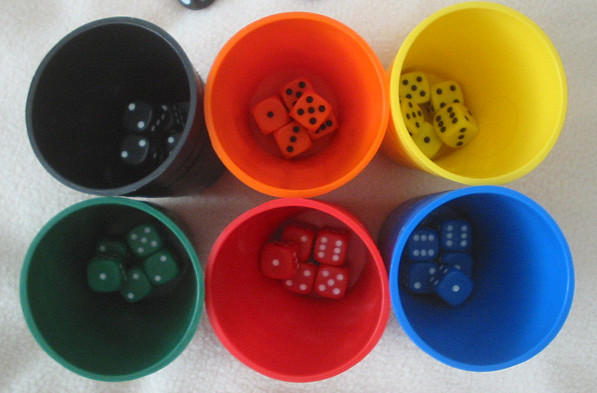
A Perudo set

Dudo (Spanish for I doubt), also known as Cacho, Pico, Perudo, Liar's Dice, Peruvian Liar Dice,[1] Cachito, or Dadinho is a popular dice game played in South America. It is a more specific version of a family of games collectively called Liar's Dice, which has many forms and variants. This game can be played by two or more players and consists of guessing how many dice, placed under cups, there are on the table showing a certain number. The player who loses a round loses one of their dice. The last player to still have dice is the winner.

Game play

[edit]
Each player has five dice and a dice cup

Each player starts having five dice and a cup, which is used for shaking the dice and concealing the dice from the other players.

To decide order of play (who starts and who goes next), players roll a single die. Highest roll goes first, then next lowest and so on. In the event of a tie between 2 players, they simply re-roll until one gains a higher score.

Each game round begins with the players shaking the dice in their cups, then slamming upside down cup on table so that shaken dice remain concealed fully inside the cup. Players carefully lift the cups to look at their own dice while keeping them concealed from other players. The first player then makes a bid about how many dice of a certain value are showing among all players, at a minimum. Aces (ones) are wild, meaning that they count as any other number. For example: a bid of "five threes" is a claim that there are at least five dice showing a three or an one, when you tally up all the dice across all players in the table. The player challenges the next player (moving clockwise) to raise the bid or call dudo to end the round.

Raise
also known as "bid" in most versions, a player can increase the quantity of dice (e.g. from "five threes" to "six threes") or the die number (e.g. "five threes" to "five sixes") or both. If a player increases the quantity, they can choose any number e.g. a bid may increase from "five threes" to "six twos".
Bidding aces
a player who wishes to bid aces can halve the quantity of dice, rounding upwards. For instance, if the current bid is "five threes" then the next player would have to bid at least three aces. If the current bid is aces, the next player can call dudo or increase the quantity (e.g. "four aces") or bid a different number, in which case the lower bound on the quantity is one more than double the previous quantity—for instance, from "three aces", a player wishing to bid fours would have to bid "seven fours" or higher. Players are not allowed to begin a round betting on aces unless they have only one die left.
Call
also known as dudo, if the player calls, it means that they do not believe the previous bid was correct. All dice are then shown and, if the guess is not correct, the previous player (the player who made the bid) loses a die. If it is correct, the player who called loses a die. A player with no dice remaining is eliminated from the game.[2] After calling, a new round starts with the player that lost a die making the first bid, or (if that player was eliminated) the player to that player's left.[2]
Spot on
also known as calzo (etymology: perfect shoe fit) in some versions, the player claims that the previous bidder's bid is exactly right. If the number is higher or lower, the claimant loses one or two dice, depending on the agreed upon rules. Otherwise, they recover a lost die. This is a reward for incurring on additional risk. Regardless of the outcome of the spot on, the previous bidder will not lose a die. The spot on can be played for as long as there is more than half of the original number of dice left on the table.
Pass
The player decides not to place a bid. A pass is legal if the player has a full house (a pair and three of a kind), five of a kind, or five different suits. Two players cannot pass in a row, and each player can only pass once per round. Passes can be bluffed, and they can also be called out. After a player passes, the next player cannot call the previous bid, and can only call the pass. This rule only exists in some versions of dudo, and must be agreed upon before gameplay begins.
Burn
A player has the option to "burn" some of their dice by revealing their hand, presenting one or a chosen set of dice of the same suit, putting the rest of the dice back in the cup, and re-rolling them. The revealed dice remain in play, and the entire table can see them. This is useful for when a player feels like they have a bad hand. It cannot be done when the player has only one die.
Shuffle
An illegal move, where a player covertly uses one of their fingers (often their thumb) to shift one or many of their dice, to show another face. If caught, this brands that player as a mete dedo[citation needed] (Spanish for 'putter of finger inside') and eliminates them from the match instantly, often incurring a punishment for cheating. Punishments are often commonly understood or pre-established, such as having to do a cold plunge, or to buy a round of drinks for all the players.

Different versions of the game divide the lifeline of a player differently. In some versions, when a player first reaches one die (i.e. loses a round and goes from two dice to one), the player obliga (meaning "they coerce") the round. In this kind of special round—often known as palo fijo[citation needed]—aces don't count as wildcards, and the suit can only be changed by players with a single die. The player gets to choose if they play the round open or closed. In an open round, everyone can see everybody's dice but their own. However, in a closed round, only the players with one die remaining can see their dice. In some other versions, the palo fijo happens on a player reaching their last two dice, and involves nobody being able to change the suit, as well as aces not counting as wildcards for the round. Then, upon a player reaching their last die, what begins is a palo ciego[citation needed]—nobody is allowed to see their hand, except for players that only have one die in theirs, and the bids must be done blindly. Often, players do not slam their cups before the round is called, to add tension.

The game ends when only one player has dice remaining; that player is the winner.

[edit]

References

[edit]
Revisions and contributorsEdit on WikipediaRead on Wikipedia
from Grokipedia
Dudo is a traditional bluffing dice game originating from the Inca civilization in during the , according to legend taught to Spanish conquistadors by Inca King . Popular in , , , and other Latin American countries, it is a specific variant of the broader family of games known as , also called Perudo or Cacho in different regions. Played by two or more participants, each using five six-sided dice and an opaque cup to conceal their rolls, the objective is to be the last player remaining with dice. Players simultaneously roll their dice under their cups and then take turns bidding on the total number of dice across all players showing a specific face value, with bids increasing in quantity or value (e.g., from "three 4s" to "four 4s" or "three 5s"). A key mechanic is that 1s function as wild cards, counting toward any bid but allowing bids on 1s to use halved quantities for equivalent strength (e.g., a bid of four 1s equates to eight of another value). At any point, a player may challenge a bid by calling "Dudo" (Spanish for "I doubt it"), prompting all players to reveal their dice for verification. If the actual count meets or exceeds the bid (including wild 1s), the challenger loses one die; otherwise, the bidder loses one die, with additional losses possible based on the discrepancy in some rule variants. When a player is down to a single die, a special "palifico" round applies, where 1s lose their wild status and bids must escalate on the same value. The game has gained wider recognition through commercial sets and its appearance in the 2006 film : .

History

Origins in the Inca Empire

Dudo, a bluffing game emphasizing deception and probability, is traditionally attributed to the of the 15th century, where it purportedly emerged using carved stones or rudimentary dice forms as gaming tools. According to a modern legend originating in the 1970s, the Inca ruler introduced the game to Spanish during the early , though no contemporary records substantiate this account. The name "Dudo," derived from the Spanish phrase meaning "I doubt," reflects the game's core mechanic of challenging others' claims, suggesting an adaptation of pre-existing Inca practices involving uncertainty. While direct evidence linking Dudo specifically to Inca or commoners is absent from historical records, colonial chroniclers documented Inca dice games known as pishca or huayru, which served purposes of social bonding, , and ritualistic across social strata. These games employed pyramidal stones etched with symbols representing numbers from one to five, often used in funerary rites, harvest festivals, and divinations to balance dualities like or to redistribute goods among participants. Chronicler Bernabé Cobo, in his 1653 Historia del Nuevo Mundo, described pishca as a luck-based pursuit tied to noble figures and played on marked boards, highlighting its role in communal entertainment and spiritual consultation. Such practices, referenced in accounts by in his 1615 Nueva Crónica y Buen Gobierno, underscore the game's integration into Inca cultural life for fostering interaction and . Scholarly consensus suggests that while Inca games involved dice and wagering, the specific bluffing mechanics of Dudo likely developed during the colonial period, blending indigenous and European influences.

Spread to Modern Latin America

Following the Spanish conquest of the Inca Empire in 1532, the game now known as Dudo is said to have been observed and learned by forces under , who integrated European six-sided dice into the indigenous practice of using beans or stones, and renamed it "Dudo" meaning "I doubt" in Spanish. This adaptation marked the beginning of its transformation from a pre-colonial pastime to a hybrid colonial game. During the 16th to 19th centuries, Dudo spread through Spanish trade routes and colonial settlements to neighboring countries including , , and , where it evolved further with the widespread adoption of leather cups to hide dice rolls and prevent peeking, a not present in earlier indigenous versions. The game's portability made it popular among miners, soldiers, and merchants in Andean regions, facilitating its dissemination across the and beyond. In the , Dudo underwent standardization in , becoming a staple in bars, festivals, and social gatherings, while incorporating influences from global variants of exchanged during ongoing colonial and post-colonial interactions. Key milestones include its first documented rules appearing in 19th-century Peruvian travelogues and folk collections. Today, it remains a beloved tradition throughout modern , especially in , , , and .

Equipment and Setup

Required Components

Dudo requires a straightforward set of physical components that enable concealed rolling and group play. The core equipment consists of five standard six-sided (D6) per player, featuring faces numbered 1 through 6, and an opaque cup for each participant to shake and hide their from view. All are identical across players, ensuring fairness, with the number 1 typically functioning as a wild card that can count toward any bid value during , effectively allowing it to represent any face from 2 to 6 as needed. The game accommodates 2 to 6 players as the standard minimum and maximum for optimal engagement, though it can scale slightly beyond with additional dice and cups. Optional accessories include a score sheet for tracking progress in multi-round sessions, providing a simple way to record points or eliminations without altering the core mechanics. In traditional Peruvian setups, where Dudo originated, equipment often featured handcrafted wooden cups or tooled leather pouches for durability and cultural authenticity, reflecting the game's historical roots in the Andean region. Modern commercial sets prioritize portability with lightweight plastic cups and dice, making the game accessible for travel while maintaining the essential opaque design to prevent peeking.

Initial Preparation

To begin a game of Dudo, players arrange themselves in a circle around a table to facilitate progression of turns. This seating ensures that each participant can observe the sequence of bids without physical barriers. Optionally, players may roll a single die to determine the starting order, with the highest roll initiating the first round and subsequent play proceeding . Each player receives five standard six-sided and one opaque , typically all matching in color for uniformity within a player's set. The are used to conceal the from other players, maintaining secrecy during play. In standard individual play, each remains with its owner. Prior to the first round, players agree on the game's parameters, such as the standard setup of five per player at the start, with losers of challenges forfeiting one die per loss until none remain. No separate "lives" system is typically used; instead, elimination occurs through depletion. Once prepared, all players simultaneously shake their within their and place them upside down on the table, covering the results completely. Each player then lifts their slightly to secretly view their own without revealing them to others, confirming readiness before the starting player announces the initial bid. This ritual establishes the concealed state essential to Dudo's bluffing mechanics.

Gameplay

Objective and Basic Flow

The objective of Dudo is to be the last player remaining with at least one die, achieved by successfully bluffing about the total number of a specific showing across all players' hidden or by accurately challenging opponents' bids. This game of and probability relies on players concealing their rolls under opaque cups, forcing reliance on inference and risk assessment to outlast others. A standard round begins with all players simultaneously rolling five six-sided dice privately beneath their cups, keeping the results hidden from view. The starting player—for the first round, often determined by the highest roll; for subsequent rounds, the player who lost the previous challenge—makes an initial bid estimating the total quantity of dice showing a particular face value (for example, claiming "three 4s" across the entire table). Play proceeds clockwise, with each subsequent player either raising the bid by increasing the quantity or escalating to a higher face value, or opting to challenge the current bid by calling "Dudo." Upon a challenge, all players reveal their dice to resolve the bid: if the claimed total is met or exceeded (counting 1s as that can match any value), the challenger loses one die; if the total falls short, the bidder loses one die. The round concludes with the loser of the resolution initiating the next round by making the opening bid, and the game continues over multiple rounds until only one player retains , marking them as the victor. This escalating bluffing dynamic creates mounting tension as bids grow bolder, balancing the risk of elimination against the potential to force opponents out.

Bidding Mechanics

In Dudo, bidding represents players' estimates of the total number of dice showing a specific across all participants' concealed rolls, forming the core of the game's bluffing dynamic. A valid bid specifies a quantity of dice followed by the being claimed, such as "five 4s," which asserts that at least five dice (including wilds) display 4 or count as 4 among all players' dice. Bids must plausibly escalate from previous ones to maintain tension, with the opening bid typically starting low and avoiding 1s unless in a special round. The number 1 on any die acts as a wild card, counting toward the bid's claimed value during verification; for instance, in a "five 4s" bid, both actual 4s and any 1s are tallied as supporting the claim, though exact are only revealed upon challenge. This wild rule applies universally except in designated palifico rounds, enhancing by making aggressive bids more feasible when 1s are present. Bids on 1s themselves (known as pacos) follow modified escalation: an initial bid cannot claim 1s, but a raise to 1s requires halving the prior quantity (rounded up, e.g., from "seven 2s" to "four 1s"), after which subsequent raises must claim more 1s or at least double plus one the quantity for any other face (e.g., from "four 1s" to "nine 3s"). Turn progression during moves , with each player either raising the bid or passing to initiate a challenge; a raise must increase the for the same face (e.g., "five 4s" to "six 4s") or maintain/increase the while raising the (e.g., "five 4s" to "five 5s" or "six 5s"), prohibiting any decrease to prevent dilution of the claim. Jump bids, such as escalating directly to a higher and face (e.g., "five 4s" to "seven 6s"), are permitted as long as they exceed the prior bid in overall assertiveness. No bid can lower the or revert to a lower , ensuring monotonic progression until a challenge halts the sequence. Regional variations introduce special bids like palifico, typically activated when a player reaches one die remaining; in this mode, the initiating player locks the (often starting with a precise claim like "one 3"), 1s lose their wild status, and all raises must strictly increase the quantity of that exact face without shifting values, emphasizing precision over bluffing—though standard Dudo implementations often omit or simplify this to avoid complexity in casual play.

Challenging and Resolution

In Dudo, any player may challenge the current bid by calling "Dudo!" (meaning "I doubt it!" in Spanish), signaling disbelief in the bidder's claim about the total number of a specific face value across all players' dice. This action immediately ends the bidding phase, prompting all participants to reveal their dice by lifting their cups. During resolution, the group collectively counts the total number of dice showing the bid's face value, treating all 1s (aces) as wild cards that count toward that value regardless of the actual bid—for instance, in a challenge to a bid of "eight 4s," all 4s and all 1s are tallied. If the total meets or exceeds the bid (including an exact match, which favors the bidder), the challenge fails, and the challenger loses one die; conversely, if the total falls short, the challenge succeeds, and the original bidder loses one die. The lost die is removed from play and set aside, ensuring it cannot be reused. Following resolution, the next round begins with the player who lost the die, proceeding clockwise as in standard play. This mechanism maintains momentum while penalizing inaccurate bids or overly aggressive challenges, contributing to the game's emphasis on deception and probability assessment.

End of Round and Winning Conditions

A round in Dudo concludes immediately after the resolution of a challenge, during which all players reveal their dice to count the total matching the bid (including 1s as wild cards for most ranks). The incorrect party—either the challenger if the bid was accurate or the bidder if it was not—loses exactly one die, which is removed from play and set aside. Players then simultaneously reroll their remaining dice under their cups to prepare for the next round, with the player who lost the die making the opening bid. The overall game is won by the player who retains at least one die when all opponents have lost theirs and are eliminated. A player is eliminated upon losing their final die and must sit out the remainder of the game; the process repeats through successive rounds until only one competitor remains. In settings, multiple full games may be aggregated into a series or to crown a , often with points awarded based on wins or placements. If a player loses their last die, the player to their left starts the next round. As the game progresses to its final rounds with fewer dice in total play, the last bidder faces heightened risk, since challenges carry greater consequences relative to the limited pool of dice, amplifying the impact of any lost die on potential elimination. This endgame dynamic demands careful assessment, as erroneous bids or challenges can swiftly decide the victor.

Perudo Variant

Perudo represents the most prominent commercial adaptation of the traditional Peruvian game Dudo, transforming the folk dice game into a polished product for international audiences. Originating from encounters with Dudo during a 1982 game at the Lima Golf Club in Peru, British entrepreneur Cosmo Fry and Peruvian businessman Alfredo Fernandini standardized the rules and introduced the game to the United Kingdom under the name Perudo. They blended elements from various regional Dudo variants to create a more structured experience, launching it commercially in 1989 through the INCA shop in London before expanding globally via licensing deals with publishers like University Games in 1995 and later Hasbro and Asmodee. Key rule differences distinguish Perudo from standard Dudo, emphasizing strategic bidding and special conditions for tension in late-game scenarios. In Perudo, players bid on the total number of a specific face value across all concealed dice, with aces (1s) acting as wild cards that count toward any non-ace bid but not for ace-specific calls. Bids must escalate by either increasing the quantity or switching to a higher face value, and a dedicated "Aces Call" mechanic halves the previous bid (rounded up) to wager on the number of aces alone. A unique "Palifico" rule activates when a player is reduced to their final die: bidding then restricts changes to face value, aces lose their wild status, and only the Palifico player can initiate an ace bid, heightening the risk for the vulnerable player. These mechanics, drawn from Peruvian Dudo traditions but refined for consistency, promote bluffing while adding layers of probability assessment not always present in informal Dudo play. Equipment in Perudo sets is designed for portability and visual clarity, typically including opaque cups for concealing dice rolls, 30 standard six-sided (five per player), and a pouch for storage. Branded versions feature color-coded and matching cups—such as for one player, for another—to facilitate quick sorting after challenges and support team-based variants where colors denote alliances. Official sets accommodate 2 to 6 players, though expansions and house rules extend play to 8 by distributing extra . Perudo's global popularity surged through board game conventions and retail distribution, particularly in and , where it became a staple for social gatherings and party play. Its accessible bluffing mechanics appealed to casual gamers, leading to widespread adoption in pubs, travel kits, and family entertainment. The game earned critical acclaim, winning the prestigious award in 1993 for its innovative take on dice deception, which boosted sales and inspired numerous localized editions worldwide.

Other Liar's Dice Forms

The Common Liar's Dice, prevalent in Anglo-American traditions, diverges from many Latin American forms by omitting wild entirely and, in some or casual settings, forgoing opaque cups to simply keep rolls hidden by hand or on the table. Players typically receive five six-sided each and bid sequentially on the total quantity of a specific across all participants' , such as calling "five threes," without referencing sums or wild substitutions like ones acting as jokers. Upon challenge, all are revealed; if the bid is met or exceeded, the challenger loses a die, while an undercount results in the bidder's loss, continuing until one player depletes their . This version emphasizes direct bluffing on visible or semi-hidden totals, often played in social venues like bars without specialized equipment. In and other Latin American countries, the game is also known as Cacho, following similar bluffing and bidding mechanics to Dudo. Digital adaptations of have proliferated online, enabling remote play with features like timers for bids and AI opponents to simulate multiplayer dynamics without physical . Platforms such as Dudo.ai offer browser-based games against computer foes that adjust difficulty based on player skill, while apps like on support real-time multiplayer with bots filling incomplete lobbies, incorporating chat and customizable rulesets. Sites like FunNode and tools from Kevan Davis provide virtual rollers for group video calls, adding urgency via countdowns and preventing physical peeking, thus extending the game's accessibility beyond traditional gatherings. These versions often draw from core mechanics, including hidden rolls and challenges, to maintain bluffing integrity in virtual environments.

Strategy and Tactics

Bidding Strategies

In Dudo, bidding strategies center on balancing probabilistic expectations with observations of opponents' behaviors to maximize the chances of forcing errors without overcommitting. Players begin by assessing the total dice in play—typically 25 for five players with five dice each—and the impact of wild 1s, which increase the effective probability for bids on faces 2 through 6 to approximately one-third per die (1/6 for the specific face plus 1/6 for the wild). This foundational understanding guides all bids, as the expected number of matching dice for such faces is roughly one-third of the total dice, or about 8.3 in a standard five-player game. Conservative bidding serves as a low-risk entry point, where players initiate with modest quantities to test opponents' reactions and identify patterns from prior rounds, such as aggressive escalators or frequent challengers. This tactic allows gradual information gathering, enabling adjustments based on observed tendencies without exposing one's own dice prematurely. In contrast, escalation tactics involve minimal increases—either a single unit in quantity or a slight raise in face value—to pressure opponents into overextending, while explicitly factoring in the roughly 1/6 probability of wild 1s per die to justify the bid's plausibility. For instance, raising from four 4s to five 4s leverages the wild contribution to maintain a credible edge, often forcing hesitant players to challenge prematurely or bid higher than supported by their holdings. Positional awareness further refines by considering the round's stage: aggressive bids are advisable early when are plentiful (e.g., full 25 ), as the higher volume amplifies the expected matches (around 8-9 for non-ace faces including wilds), allowing quantities that align with 4-5 times the base per-die probability adjusted for wilds. As rounds progress and dwindle, bids should scale down accordingly to reflect reduced totals, preserving accuracy in probability assessments. Common pitfalls include overbidding on high faces like 6s, which carry the same base probability (1/6 per die for the face itself) as lower numbers but may tempt players to inflate quantities due to perceptual toward rarity, ignoring the equalizing effect of wilds and leading to frequent challenges. Another frequent error is failing to recalibrate for fewer , resulting in bids misaligned with current odds and unnecessary losses.

Bluffing and Risk Assessment

In Dudo, bluffing serves as a psychological tool to deceive opponents about the true state of the hidden , forcing them to second-guess their challenges and bids. Effective bluffing disrupts predictable patterns, compelling players to rely on incomplete information while concealing their own hand. According to game-theoretic analysis, successful players employ mixed strategies that combine truthful representations of their dice with deceptive overbids to maintain unpredictability and exploit opponent . Bluffing techniques in Dudo often involve projecting false through verbal and non-verbal cues, such as , assertive announcements of bids or deliberate pauses to simulate doubt. For instance, a player with a moderately strong hand might exaggerate when raising a bid to imply overwhelming support, encouraging others to fold or underbid. Reversing traditional "tells" is another tactic, where hesitation or subdued gestures on a strong roll can lure aggressive opponents into premature challenges, turning their boldness against them. These methods draw from broader deception principles in imperfect-information games, adapted to Dudo's concealed dice mechanics. Risk assessment plays a pivotal role in deciding whether to bluff, bid higher, or challenge, requiring players to weigh their personal dice against the current bid's feasibility. A common heuristic is to challenge if one's own roll reveals fewer instances of the bid face than half the claimed total, as this suggests the bid exceeds probable outcomes across all players' dice. Additionally, evaluating opponent tendencies—such as a history of frequent challenges or conservative bidding—allows for calibrated risks; for example, bluffing more boldly against risk-averse players who rarely call. Computer simulations of Perudo strategies emphasize using expected value calculations with a tolerance for variance to balance these decisions, minimizing dice loss over multiple rounds. Advanced psychological tactics in Dudo include mirroring an opponent's aggressive style to provoke challenges on marginal bids, thereby inducing errors without revealing one's hand. In , with fewer dice remaining, risks escalate dramatically, as each lost die brings players closer to elimination and survival probabilities diminish rapidly due to the concentrated stakes. When a player reaches one die, the palifico rule applies: 1s lose their wild status, the palifico player starts the , and subsequent bids must escalate only in quantity on the same , increasing the importance of bluffing and careful probability assessment without wild support. Optimal play thus demands a balanced approach, mixing truthful bids with bluffs based on mixed-strategy equilibria, ensuring opponents cannot reliably predict or counter one's actions.

Cultural Impact

Role in Peruvian and Latin American Culture

Dudo holds a prominent place in Peruvian and Latin American social life, frequently played during family gatherings and festive occasions to promote camaraderie, strategic thinking, and interpersonal trust. Originating from indigenous traditions, the game encourages participants to engage in bluffing and quick decision-making, which symbolize cunning and social bonding within communities. In Peru, it is commonly enjoyed in informal settings, reflecting its role as a timeless parlor game that brings people together across generations. The game's regional variations extend its cultural footprint across , particularly in countries like , , , and , where it is known by names such as Cacho or Perudo. In these areas, Dudo often involves light-hearted stakes, such as drinks or small wagers, adding an element of excitement to social interactions and informal traditions. This adaptability has allowed it to integrate into everyday celebrations and gatherings, enhancing its appeal in diverse cultural contexts. As a post-colonial of Inca heritage, Dudo serves as a link to pre-Hispanic gaming practices. Efforts to maintain these traditions include its promotion in cultural narratives and community events, helping to sustain Latin American gaming heritage against globalization. In contemporary , Dudo reinforces through organized tournaments in social clubs, attracting local enthusiasts and highlighting its enduring popularity. These events draw participants from various backgrounds, underscoring the game's evolution while tying it to Peruvian pride and communal spirit. Its spread from indigenous Peruvian roots to broader Latin American adoption during the colonial era has solidified Dudo's status as a shared .

Appearances in Media and Modern Play

Dudo, known internationally as a variant of , has gained prominence in popular media through its portrayal as a high-stakes game of deception. In the 2006 film : Dead Man's Chest, the game appears as in a tense scene aboard the , where characters including and Davy Jones wager souls on bids, highlighting the bluffing mechanics central to Dudo. This depiction popularized the game among global audiences, associating it with pirate adventures and strategic risk-taking. Similarly, the 2010 video game [Red Dead Redemption](/page/Red Dead Redemption) incorporates as a multiplayer mini-game, allowing players to bid against non-player characters in saloons across the , further embedding the game's rules in interactive . The game's association with pirate lore has been amplified by modern media, including sailor variants in . In modern play, Dudo has seen a digital resurgence since the , facilitated by online platforms and apps that adapt its core mechanics for virtual sessions. Sites like Board Game Arena offer Perudo—a commercial branding of Dudo—as a browser-based multiplayer experience, supporting 2-6 players with and global matchmaking. Tabletop Simulator includes community-created mods for , enabling customizable virtual tabletops for remote groups. Mobile applications such as Online provide asynchronous multiplayer and bot opponents, making the game accessible for casual practice or tournaments on devices worldwide. Dedicated AI tools, like those on dudo.ai, allow solo players to hone strategies against algorithms trained on , promoting deeper engagement with tactics. Dudo's popularity has extended to physical spaces, with a notable uptick in cafes post-2010s, where it is often featured as a quick, social alongside drinks and snacks. On the competitive front, international events such as the annual Perudo World Championships—as of 2025, including the Perudo Championships held in in May—draw players from multiple countries, featuring categories that emphasize Dudo's traditional rules and attracting celebrities like and . Commercial sets under the Perudo name, produced by companies like Paul Lamond Games, are distributed globally through retailers including Amazon and , ensuring widespread availability for home and travel play.

References

Add your contribution
Related Hubs
User Avatar
No comments yet.