



Community hub
Community hub
Recent from talks
Knowledge base stats:
Talk channels stats:
Members stats:
Siete Partidas
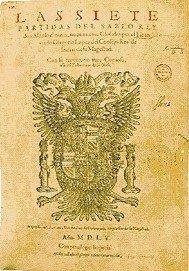
The Siete Partidas (Spanish pronunciation: [ˈsjete paɾˈtiðas], "Seven-Part Code") or simply Partidas, was a Castilian statutory code first compiled during the reign of Alfonso X of Castile (1252–1284), with the intent of establishing a uniform body of normative rules for the kingdom. The codified and compiled text was originally called the Libro de las Leyes (Old Spanish: Livro de las legies) (Book of Laws). It was not until the 14th century that it was given its present name, referring to the number of sections into which it is divided.
The Partidas had great significance in Latin America as well, where it was followed for centuries, up to the 19th century. Although the code concentrates on legislative issues, it has also been described as a "humanist encyclopedia," as it addresses philosophical, moral and theological topics as well, including the Greco-Roman and Judeo-Christian views of warfare.
According to one of the oldest versions of the Partidas, it was written between June 26, 1256 and August 28, 1265 by a commission of the principal Castilian jurists of the day, under the personal direction of Alfonso X. However, several other time periods have been proposed: 1254 to 1261; 1256 to 1263; and 1251 to 1265[citation needed]. In any event, the majority of historians believe that it was not completed until 1265.
The traditional view, shared by historian Francisco Martínez Marina and philologist Antonio Solalinde[citation needed], is that the Siete Partidas codices were written by a commission of jurists (or members of the chancellery), and the involvement of Alfonso X was likely limited to setting out the goals of the text and the subjects to be addressed, as well as personally reviewing and amending the work of the commission. The commission is thought to have been made up of Master Jacobo, a legal scholar; Juan Alfonso, a civil law notary from León; a certain Master Roldán; and Fernando Martinez de Zamora (one of the first Castilian jurists). During the 18th century it was popularly believed that the Partidas was exclusively written by Alfonso X. This position was championed by Jesuit historian and writer, Andrés Marcos Burriel (Padre Burriel)[citation needed]. Nevertheless, a significant debate has arisen concerning the authorship of works associated with Alfonso X[citation needed]. Other texts of the period 1254–1256, normally attributed to Alfonso X such as el Setenario, Fuero Real and the Espéculo display pronounced similarities to each other and to the Partidas[citation needed]. Despite scholarly efforts to determine the scope, relationships, and purpose of each of the texts, no consensus has been reached[citation needed]. The attribution debate was principally sparked by Alfonso García-Gallo's 1951–52 article, El "Libro de las Leyes" de Alfonso el Sabio. Del Espéculo a las Partidas (The "Book of Laws" of Alfonso the Wise. From the Espéculo to the Partidas)[citation needed]. The questions raised in the article were expanded in other, later works[citation needed]. García-Gallo proposed that the Partidas was not the work of Alfonso X and that it was not finished during his reign, but rather was written in the 14th century, long after the learned king's death in 1284, and that it was a reworking of the Espéculo. He based his position on the fact that the first reliable references to the Partidas in other texts date from the beginning of the 14th century, and that the source materials for the Partidas were not known in the Iberian Peninsula until later than the date of composition claimed for the codex[citation needed]. In any case, Alfonso X continues to be nominally credited as the author of the Siete Partidas, or at least of the original version, whatever his role in its creation may have been, since the custom with great works of this type was to attribute them to the monarch or other ruler who commissioned them, even though it was known that they had no hand in the preparation (as was the case with the Code of Hammurabi, and Justinian's Corpus Juris Civilis)[citation needed].
Despite its lengthy treatment of philosophical issues, some have maintained that the Partidas is intended as a legislative text rather than a work of legal theory—a view explicitly supported by the prologue, which indicates that it was created only so that it could be used to render legal judgments.[citation needed] Yet, García-Gallo has contended that, the prologue notwithstanding, the Siete Partidas was rarely put into practice until over a century after it was written[citation needed]. Resistance to the Partidas, especially among the Castilian nobility, led the Cortes (legislature) to enact the Ordinances of Zamora in 1274[citation needed]. These laws set qualifications for judges serving on the royal tribunal and restricted the application of the Partidas to the pleitos del rey, that is, legal cases under the exclusive jurisdiction of the king. All other matters (pleitos foreros) were governed by local laws or fueros[citation needed]. It was not until the “late enactment” by Alfonso XI in 1348 that the Partidas became widely applied[citation needed]. Furthermore, opposition to the Partidas can explain the differences among the similar texts listed above[citation needed].
In any case, if the Partidas was written as a legal code, its ultimate objective has been a matter of dispute. Alfonso X, in what was called the fecho del imperio ("affair of the empire"), had aggressively pursued the crown of the Holy Roman Empire[citation needed]. His purpose for creating the Siete Partidas may have been to create a universally valid legal text for the entire Empire[citation needed]. In support of this argument, Aquilino Iglesias claimed in 1996 that the Partidas contained no references to Castilian territorial organization[citation needed]. Others, among them García-Gallo, argued by way of rebuttal that even though sometimes the role of the emperor appears higher than that of the monarchy, in other places the role of the monarchy appears higher than that of the emperor, and that furthermore the text was written in Spanish, rather than in Latin[citation needed]. However, an edition printed in Madrid in 1843, and available in facsimile from Google Books, appears to show that the Spanish is a translation of a Latin original[citation needed].
What is certain is that the Partidas, including the prologue, makes no reference whatsoever to any intention to acquire the imperial crown[citation needed]. Moreover, some authors, such as Juan Escudero (a disciple of García-Gallo), have found references in the text to Castile's specific territorial organization, for example, villas[citation needed].
It is therefore generally believed[by whom?] that with the creation of the Partidas, Alfonso X was trying to unify the kingdom's legal system, not by using the 'local' approach of his father Ferdinand III (that is, by granting the same fuero to various regions), but rather through a general code that applied to the entire country[citation needed].
Hub AI
Siete Partidas AI simulator
(@Siete Partidas_simulator)
Siete Partidas
The Siete Partidas (Spanish pronunciation: [ˈsjete paɾˈtiðas], "Seven-Part Code") or simply Partidas, was a Castilian statutory code first compiled during the reign of Alfonso X of Castile (1252–1284), with the intent of establishing a uniform body of normative rules for the kingdom. The codified and compiled text was originally called the Libro de las Leyes (Old Spanish: Livro de las legies) (Book of Laws). It was not until the 14th century that it was given its present name, referring to the number of sections into which it is divided.
The Partidas had great significance in Latin America as well, where it was followed for centuries, up to the 19th century. Although the code concentrates on legislative issues, it has also been described as a "humanist encyclopedia," as it addresses philosophical, moral and theological topics as well, including the Greco-Roman and Judeo-Christian views of warfare.
According to one of the oldest versions of the Partidas, it was written between June 26, 1256 and August 28, 1265 by a commission of the principal Castilian jurists of the day, under the personal direction of Alfonso X. However, several other time periods have been proposed: 1254 to 1261; 1256 to 1263; and 1251 to 1265[citation needed]. In any event, the majority of historians believe that it was not completed until 1265.
The traditional view, shared by historian Francisco Martínez Marina and philologist Antonio Solalinde[citation needed], is that the Siete Partidas codices were written by a commission of jurists (or members of the chancellery), and the involvement of Alfonso X was likely limited to setting out the goals of the text and the subjects to be addressed, as well as personally reviewing and amending the work of the commission. The commission is thought to have been made up of Master Jacobo, a legal scholar; Juan Alfonso, a civil law notary from León; a certain Master Roldán; and Fernando Martinez de Zamora (one of the first Castilian jurists). During the 18th century it was popularly believed that the Partidas was exclusively written by Alfonso X. This position was championed by Jesuit historian and writer, Andrés Marcos Burriel (Padre Burriel)[citation needed]. Nevertheless, a significant debate has arisen concerning the authorship of works associated with Alfonso X[citation needed]. Other texts of the period 1254–1256, normally attributed to Alfonso X such as el Setenario, Fuero Real and the Espéculo display pronounced similarities to each other and to the Partidas[citation needed]. Despite scholarly efforts to determine the scope, relationships, and purpose of each of the texts, no consensus has been reached[citation needed]. The attribution debate was principally sparked by Alfonso García-Gallo's 1951–52 article, El "Libro de las Leyes" de Alfonso el Sabio. Del Espéculo a las Partidas (The "Book of Laws" of Alfonso the Wise. From the Espéculo to the Partidas)[citation needed]. The questions raised in the article were expanded in other, later works[citation needed]. García-Gallo proposed that the Partidas was not the work of Alfonso X and that it was not finished during his reign, but rather was written in the 14th century, long after the learned king's death in 1284, and that it was a reworking of the Espéculo. He based his position on the fact that the first reliable references to the Partidas in other texts date from the beginning of the 14th century, and that the source materials for the Partidas were not known in the Iberian Peninsula until later than the date of composition claimed for the codex[citation needed]. In any case, Alfonso X continues to be nominally credited as the author of the Siete Partidas, or at least of the original version, whatever his role in its creation may have been, since the custom with great works of this type was to attribute them to the monarch or other ruler who commissioned them, even though it was known that they had no hand in the preparation (as was the case with the Code of Hammurabi, and Justinian's Corpus Juris Civilis)[citation needed].
Despite its lengthy treatment of philosophical issues, some have maintained that the Partidas is intended as a legislative text rather than a work of legal theory—a view explicitly supported by the prologue, which indicates that it was created only so that it could be used to render legal judgments.[citation needed] Yet, García-Gallo has contended that, the prologue notwithstanding, the Siete Partidas was rarely put into practice until over a century after it was written[citation needed]. Resistance to the Partidas, especially among the Castilian nobility, led the Cortes (legislature) to enact the Ordinances of Zamora in 1274[citation needed]. These laws set qualifications for judges serving on the royal tribunal and restricted the application of the Partidas to the pleitos del rey, that is, legal cases under the exclusive jurisdiction of the king. All other matters (pleitos foreros) were governed by local laws or fueros[citation needed]. It was not until the “late enactment” by Alfonso XI in 1348 that the Partidas became widely applied[citation needed]. Furthermore, opposition to the Partidas can explain the differences among the similar texts listed above[citation needed].
In any case, if the Partidas was written as a legal code, its ultimate objective has been a matter of dispute. Alfonso X, in what was called the fecho del imperio ("affair of the empire"), had aggressively pursued the crown of the Holy Roman Empire[citation needed]. His purpose for creating the Siete Partidas may have been to create a universally valid legal text for the entire Empire[citation needed]. In support of this argument, Aquilino Iglesias claimed in 1996 that the Partidas contained no references to Castilian territorial organization[citation needed]. Others, among them García-Gallo, argued by way of rebuttal that even though sometimes the role of the emperor appears higher than that of the monarchy, in other places the role of the monarchy appears higher than that of the emperor, and that furthermore the text was written in Spanish, rather than in Latin[citation needed]. However, an edition printed in Madrid in 1843, and available in facsimile from Google Books, appears to show that the Spanish is a translation of a Latin original[citation needed].
What is certain is that the Partidas, including the prologue, makes no reference whatsoever to any intention to acquire the imperial crown[citation needed]. Moreover, some authors, such as Juan Escudero (a disciple of García-Gallo), have found references in the text to Castile's specific territorial organization, for example, villas[citation needed].
It is therefore generally believed[by whom?] that with the creation of the Partidas, Alfonso X was trying to unify the kingdom's legal system, not by using the 'local' approach of his father Ferdinand III (that is, by granting the same fuero to various regions), but rather through a general code that applied to the entire country[citation needed].